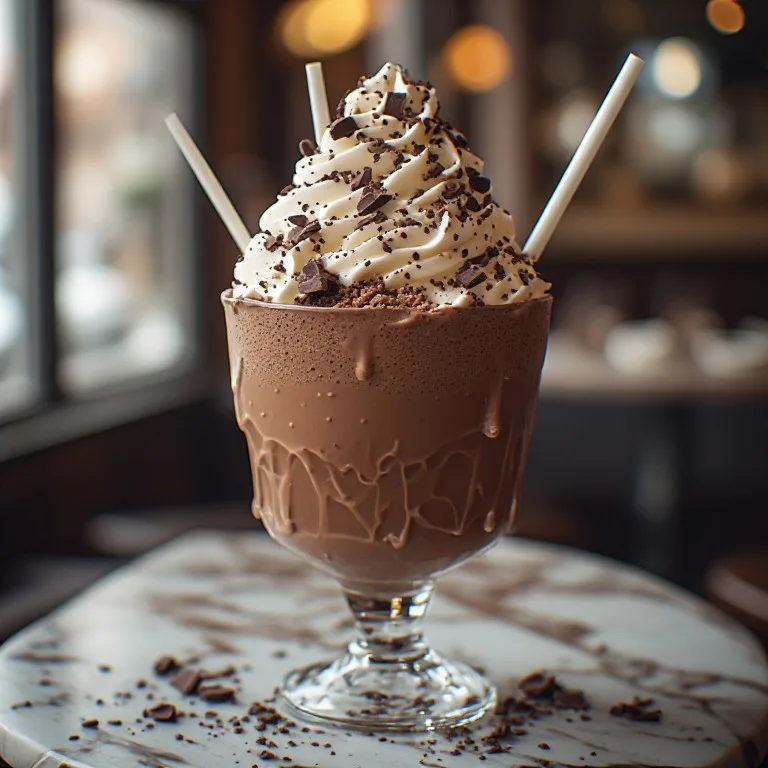


Serendipity 3 opened in 1954 in a basement on East 60th Street on the Upper East Side and has been serving the Frrrozen Hot Chocolate — their spelling, with three R’s, which they trademarked — for over 70 years. Andy Warhol was a regular. The 2001 film Serendipity filmed key scenes there and sent a generation of tourists through the door. A single serving in a tall goblet now costs around $22, with a wait of 30 to 60 minutes on busy weekends.
Making it at home takes five minutes and costs about $1.25 per serving. The key difference from every recipe that produces something thin and icy: use two different cocoa powders and nonfat dry milk powder as the thickener.
Why Two Cocoa Powders
Single-cocoa versions taste flat. Natural unsweetened cocoa (like Ghirardelli) is bright and fruity but slightly sharp. Dutch-process cocoa (like Hershey’s Special Dark) is mellow, dark, and slightly alkaline. Together they produce a layered chocolate flavor that is more complex than either alone — the same approach that makes good ganache and high-end hot chocolate powders taste deeper than standard store-bought cocoa.
The restaurant uses its own proprietary hot chocolate mix, which almost certainly combines multiple cocoa types. Published reverse-engineered recipes from major food sites converge on this same principle regardless of the exact brands.
Why Nonfat Dry Milk Powder
Without dry milk powder, this drink blends into something closer to a chocolate slushie — icy, thin, and flat. Nonfat dry milk powder adds dairy protein and lactose that thicken the blended drink significantly, giving it the body that makes it feel like a dessert rather than a snow cone. It also adds a cooked-milk sweetness that rounds out the cocoa bitterness. One-third cup is enough to transform the texture. King Arthur, Carnation, and Bob’s Red Mill all make it; find it in the baking aisle.
The Texture Target
The right consistency pours slowly — like a very thick milkshake, not like a slushy or a thin smoothie. When you tip the blender, the drink should ease out rather than pour freely. If it pours too fast, add more ice and blend again. If it is too thick to move at all, add a tablespoon of milk and blend briefly. The texture degrades quickly once blended — the ice begins to separate from the liquid within about 10 minutes without commercial stabilizers. Make it, pour it, and drink it immediately.
What the Restaurant Charges vs. What This Costs
The Frrrozen Hot Chocolate at Serendipity 3 runs approximately $22 to $24 per serving as of 2026, served in a signature goblet topped with whipped cream and chocolate shavings. The restaurant sells a proprietary mix for home use — 6 hot cocoa packets for about $18 — which is a reasonable purchase if you want the convenience. This recipe uses pantry staples that cost about $2.50 total for two servings: $0.30 for cocoa, $0.40 for sugar, $0.30 for dry milk powder, $0.40 for a cup of whole milk, and $1.10 for the whipped cream.