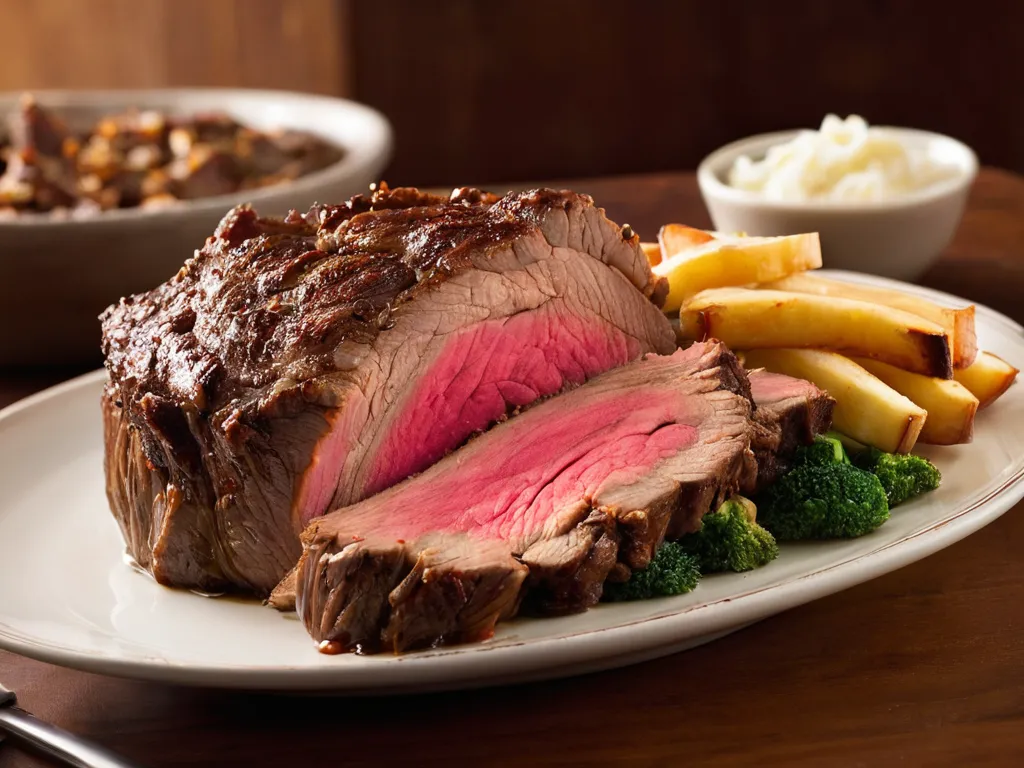
Copycat Texas Roadhouse Prime Rib
Prep: 20 minutes (plus overnight marinade) Cook: ~3 hours active oven time Rest: 1 hour (required) Servings: 8
Texas Roadhouse built its reputation on hand-cut steaks, but the prime rib is the dish regulars plan their weekend around. It’s a weekend special — typically Friday through Sunday — produced in limited quantities, slow-roasted, carved to order, and served with au jus; most locations sell out before close. At $25.99 for the 12 oz cut, a full dinner for two pushes $80 with sides and drinks. A 7-pound bone-in roast at home feeds eight for around $45–55 total — roughly $6–7 a plate — and the hands-off oven time is mostly waiting.
The two things that make this recipe work: the overnight marinade and the rest.
Why It Works: The Marinade
Texas Roadhouse marinated their prime rib before a corporate demonstration, and the ingredient list has circulated widely since: kosher salt, black pepper, brown sugar, liquid smoke, soy sauce, and garlic oil. The logic behind each component:
Kosher salt: The primary tenderizer and flavor driver. Salt draws out surface moisture initially, then — given 8–24 hours — that brine is reabsorbed back into the meat, seasoning the interior instead of sitting only on the surface. This is dry-brining, and it’s the reason Texas Roadhouse has you marinate overnight. Use kosher salt specifically: the larger crystals absorb more slowly and more evenly than table salt.
Brown sugar: A small amount caramelizes during the 450°F blast, contributing to the bark’s color and a subtle sweetness that balances the salt. It also accelerates the Maillard reaction at lower temperatures than sugar-free preparations.
Liquid smoke: Provides the faint smokiness that makes the crust taste like it came off a pit. A quarter cup may seem like a lot, but most of it drips off during roasting. You want it in the crust, not the interior.
Soy sauce: Adds a deep umami backbone and a second layer of salt with a slightly different character than kosher salt alone. It also darkens the exterior, contributing to the bark’s color.
Garlic: A quarter cup of minced garlic forms the aromatic foundation of the bark. Some of it burns to a deep, savory char during the high-heat blast — intentionally. That’s the flavor.
The High-Heat Sear, Then Low-and-Slow
The two-stage oven method is the technique that Texas Roadhouse actually describes in their public materials: a 450°F blast to build crust, then 250°F to cook slowly and evenly to temperature.
Why not just cook low-and-slow the whole time? The crust requires surface temperatures well above 300°F for Maillard browning and caramelization. The interior requires gentle, even heat to stay pink from edge to edge. These two goals are incompatible at a single temperature. The two-stage method solves this by sequencing them.
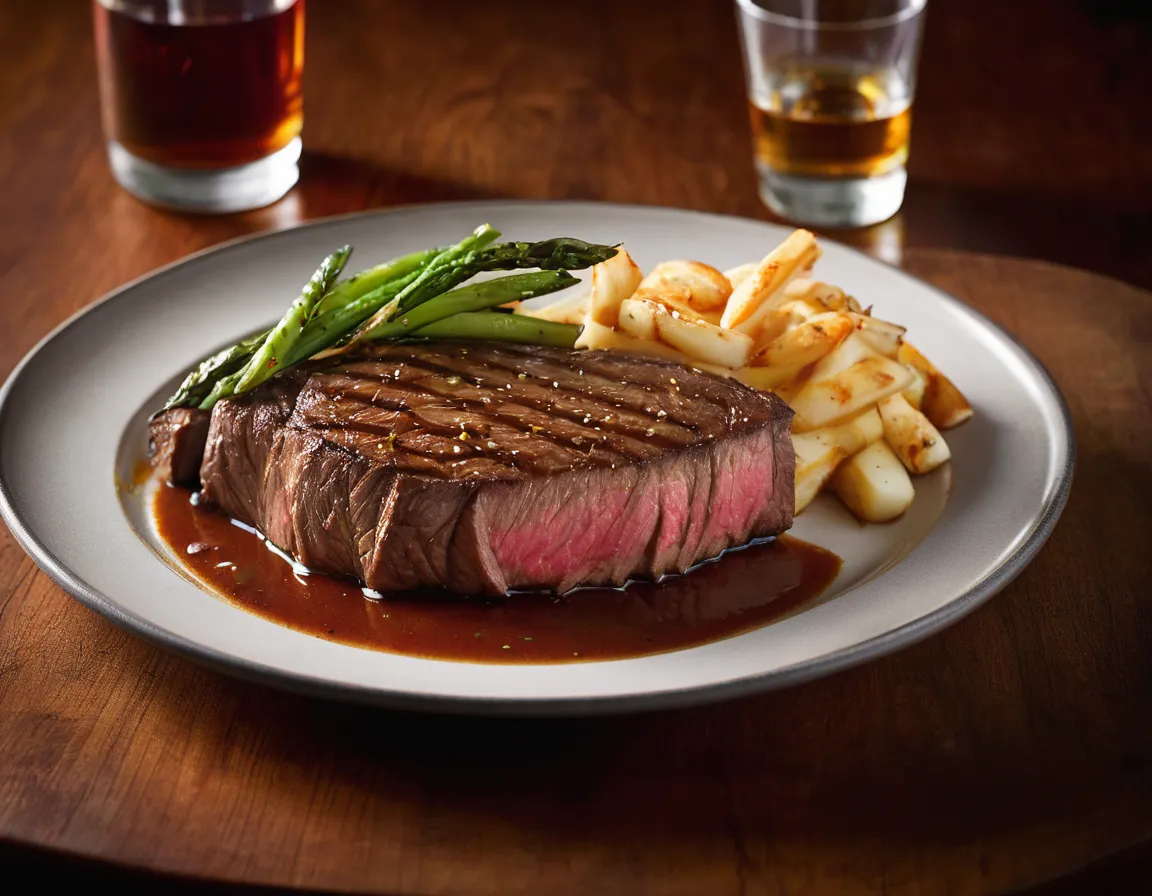
At 250°F, a bone-in rib roast is essentially a slow-cooker. The bone conducts heat inward slowly, the marbling bastes the meat as fat gently renders, and the collagen in the connective tissue softens without seizing. The result is uniform pink all the way to within a half-inch of the exterior — the “wall-to-wall medium-rare” that’s the visual signature of a proper prime rib.
The End Cut Secret
Ask any regular Texas Roadhouse patron and they’ll tell you: if you want the best cut, ask for the end piece. Former employees have confirmed this publicly — you can request the end cut without an upcharge.
Here’s what “end cut” means on a roast: the outermost slices have significantly more bark coverage relative to their interior than the center slices. The bark is where the concentrated seasoning, caramelization, and texture contrast live. A center slice has bark on top only; an end cut has bark on three sides.
At the restaurant, ask when you sit down — not when the server takes your order. The end cuts go fast and the kitchen carves to order, so requesting early gives them the heads-up to hold one for you.
At home, you have full control: carve the roast from the outside in and the end pieces are yours.
Temperature Guide
Pull the roast from the oven when the probe reads these internal temperatures — the roast will continue rising during the rest:
| Pull Temp | Resting Temp | Doneness |
|---|---|---|
| 115°F | 120–125°F | Rare (bright red, very soft) |
| 120–125°F | 125–130°F | Medium-rare (pink center, juicy) |
| 130–135°F | 135–140°F | Medium (pink fading to gray) |
| 140°F | 145–150°F | Medium-well (mostly gray) |
Texas Roadhouse’s default is medium-rare. If you’re cooking for a group with varied preferences, carve the end cuts first (they run slightly more done), then work toward the center for rarer slices.
The Full-Hour Rest
This is the step most home prime rib recipes understate. The rest is not a suggestion.
When a large roast comes out of the oven, the muscle fibers are contracted and the juices are driven toward the center by heat. If you cut into it immediately, those juices run out onto the board — not into your mouth. A full 60-minute rest at room temperature allows the fibers to relax and reabsorb the juice. A properly rested roast is noticeably more tender and juicy than one cut at 20 minutes.
The other benefit: a 1-hour rest gives you time to make the au jus, plate the sides, and let everything arrive at the table together. A 7-pound roast stays warm under foil for well over an hour.
Making the Au Jus
The au jus is not gravy. It’s a thin, flavorful liquid — just enough to dip or spoon — made from the pan drippings stretched with beef broth. Don’t thicken it with flour or cornstarch.
The drippings from a marinated prime rib are intensely flavored. Skim most of the fat but keep a thin slick — pure defatted drippings are watery and less satisfying. Simmer the drippings with broth for 15 minutes to concentrate and integrate, strain, and taste before salting. The marinade’s soy sauce means the drippings are already salty; additional salt is rarely needed.
Serve the au jus in a small bowl or ramekin alongside each plate. Some diners dip each bite; some spoon it over the slice. Both are correct.
Horseradish Cream
Traditional with prime rib: mix 2 tablespoons prepared horseradish (drained) with ½ cup full-fat sour cream, a pinch of kosher salt, and a squeeze of lemon. Refrigerate for at least 30 minutes before serving. The heat from prepared horseradish blooms and then mellows in the cream — it should be pungent enough to notice but not so sharp it overpowers the beef.
Cost vs. the Restaurant
| Texas Roadhouse | Homemade | |
|---|---|---|
| 12 oz serving | ~$25.99 | — |
| 8 servings (~14 oz each) | ~$208 | ~$45–55 total |
| Cost per serving | ~$26 | ~$6–7 |
| Au jus | Included | $1–2 extra |
Note: restaurant price covers the cut of prime rib only; sides, drinks, and tip add substantially more. The home version includes au jus and serves 8 for under $60 total with mid-quality USDA Choice beef.
Storage and Reheating
Same-day: Prime rib is best served immediately after the rest. Leftovers are excellent but the eating window is the night of.
Refrigerator: Wrap uncut slices in butcher paper or foil, refrigerate for up to 4 days. Sliced leftovers keep for 3 days in an airtight container.
Reheating without overcooking: The classic method is the au jus bath. Bring the reserved au jus to a gentle simmer, submerge slices for 60–90 seconds until just warmed through. This avoids the gray overcooked edges you get from microwave or oven reheating. Alternatively, a 250°F oven for 10–15 minutes with the slices covered in foil works for larger portions.
Freezing: Freeze in individual slices, wrapped in plastic then foil, for up to 2 months. Thaw overnight in the refrigerator and reheat in the au jus bath as above.
More Texas Roadhouse Recipes
Round out the table:
- Texas Roadhouse Rolls — the soft, honey-glazed rolls that arrive before any menu item. Made with a milk-and-egg enriched dough and glazed while hot.
- Texas Roadhouse Cinnamon Honey Butter — whipped butter with powdered sugar, honey, and cinnamon. The reason the rolls disappear before your entree arrives.
- Texas Roadhouse Steak Seasoning — the signature dry rub (salt, pepper, garlic, onion, paprika, brown sugar) used on their hand-cut steaks. Works on the prime rib as a bark alternative to the marinade method.
- Texas Roadhouse Loaded Baked Potato — the classic side pairing with prime rib: butter, sour cream, cheddar, bacon.