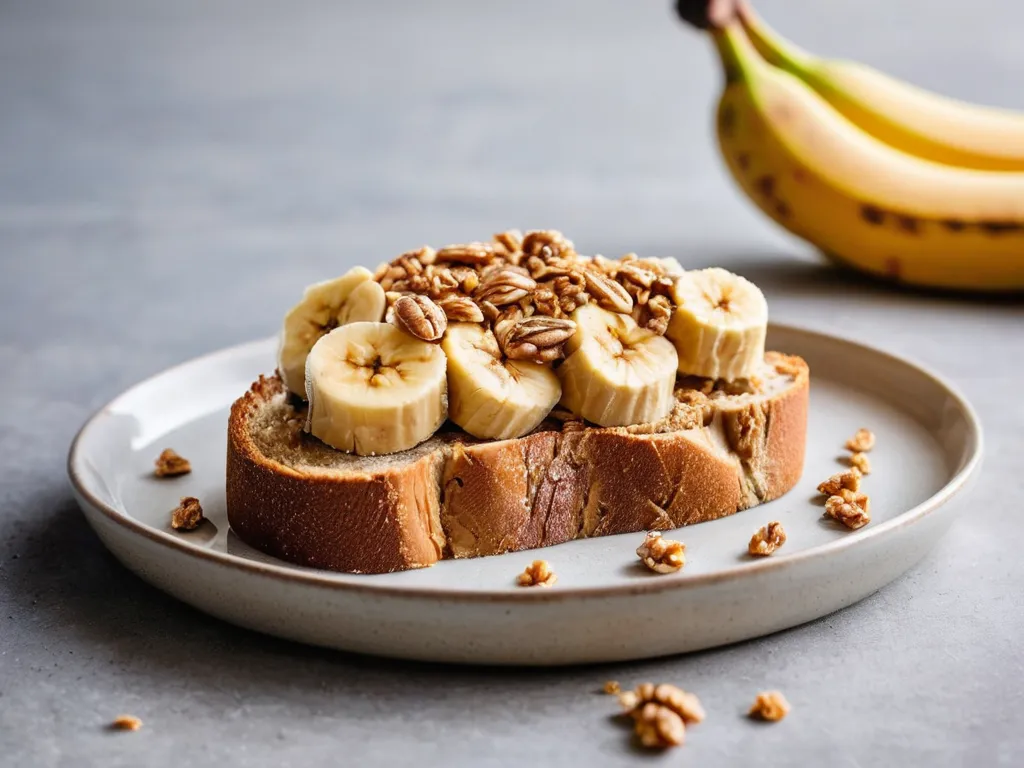
Peanut butter banana toast has existed as a breakfast staple for decades — Elvis Grilled Peanut Butter and Banana Sandwiches notwithstanding — but TikTok codified it into a specific format: thick sourdough, generous natural peanut butter, perfectly ripe banana sliced into coins, honey drizzle, granola for crunch, a hit of cinnamon, and — the step most home versions skip — a finishing pinch of flaky sea salt. That salt is the difference between a good breakfast and one you think about.
The overhead shots of layered banana coins on golden bread accumulated hundreds of millions of views under hashtags like #breakfasttoast and #peanutbuttertoast, making this one of the most replicated “aesthetic breakfast” formats on the platform. The appeal is obvious: it takes under 5 minutes, the visual is genuinely beautiful, and every flavor and texture base is covered — sweet, salty, creamy, crunchy, chewy, soft.
TL;DR
Ripe-but-firm banana (yellow, a few spots). Thick sourdough, deeply toasted. Natural peanut butter, room-temperature so it spreads without tearing. Warm honey drizzle. Granola clusters (not loose oats — clusters stay crunchy). Cinnamon. Flaky sea salt — not optional. Eat immediately. The nutrition is denser than it looks: approximately 565 calories and 87g carbs per serving, mostly from the banana, bread, and honey.
The Bread Choice
Sourdough isn’t arbitrary. It’s the right structural choice for a loaded toast for two reasons.
First, density: sourdough’s naturally leavened crumb (wild yeast + lactobacillus bacteria) produces a tighter, chewier crumb structure than commercially leavened breads. It resists moisture longer than sandwich bread or brioche when peanut butter oils and banana begin seeping in.
Second, crust integrity: a thick sourdough slice toasted to deep golden has a rigid crust that supports the toppings. Brioche — an enriched dough with roughly 20–30% fat from eggs and butter — produces a tender crumb with almost no crust structure. It goes soft within 2–3 minutes of peanut butter contact. Sandwich bread has the same problem.
Thick-cut matters. A thin slice (1/4 inch) flexes under the weight of banana slices and granola and provides less textural contrast. Aim for slices close to 1 inch — the kind you get from an artisan loaf or by cutting a store sourdough round yourself. If your toaster won’t accommodate a thick slice, use the broiler (425°F, 3–4 minutes per side, watching closely).
Toast to deep golden, not pale gold. The crust needs to be rigid and dry. Pale toast is still somewhat pliable and will accelerate moisture absorption.
Peanut Butter: Natural vs. Conventional
The recipe specifically calls for natural peanut butter, and the difference is real.
Natural peanut butter (Jif Natural, Adams, Santa Cruz, Smucker’s Natural, or any brand where the only ingredients are peanuts and salt) has a creamier, more liquid texture when at room temperature and a cleaner, more peanut-forward flavor. No added sugar, no stabilizers.
Conventional peanut butter (Jif Creamy, Skippy Creamy, Peter Pan) contains added ingredients: sugar (about 3g per 2-tablespoon serving), and a stabilizer oil to prevent natural oil separation. Jif uses fully hydrogenated rapeseed oil; Skippy uses a blend of hydrogenated cottonseed, soybean, and rapeseed oils. These stabilizers give conventional peanut butter a denser, slightly waxier texture that can feel stiff on warm toast.
The flavor difference: conventional peanut butter is noticeably sweeter (due to added sugar), which flattens the contrast with the honey drizzle. When honey is already doing the sweetening, the added sugar in Jif or Skippy competes instead of complementing.
If natural peanut butter is what you have, one prep note: stir it first. Natural peanut butter separates in the jar, with the oil pooling on top. Stir until homogeneous, then microwave for 10–15 seconds to reach spreading consistency. Cold-from-the-fridge natural peanut butter tears the toast.
Banana Ripeness: The Science
The right banana for this toast is ripe but firm: yellow with a few small brown spots on the skin.
Here’s why ripeness matters chemically: as a banana ripens, enzymes (primarily amylase) convert stored starches into simple sugars — glucose, fructose, and sucrose. A green banana is about 25% starch and under 1% sugar per 100 grams. By the time it reaches the yellow-with-spots stage, the starch content has dropped to under 5% and sugar has climbed to roughly 12–14 grams per 100 grams. That ripening makes the banana sweeter, more flavorful, and more aromatic.
But ripe-but-firm is the key qualifier. An overripe banana — one that’s heavily brown and soft to the squeeze — has had its cell walls degrade. It won’t slice cleanly into coins; it will compress into mush when you layer it and then collapse under the weight of the granola. You want the banana at peak flavor and structure simultaneously, which is the yellow-with-spots window.
If you only have green bananas: leave them on the counter at room temperature for 24–48 hours. Don’t refrigerate green bananas — cold temperatures halt the ripening enzymes. A banana that was refrigerated before ripening may darken on the outside (cold breaks down the skin) but remain starchy on the inside.
For a deeper dive into what heat does to bananas, see the caramelized brown sugar banana guide, which covers the same starch-to-sugar conversion in the context of pan caramelization.
The Flaky Salt Step
This step separates the TikTok version from the basic peanut butter banana toast your parents made.
Flaky sea salt is structurally different from fine table salt. Maldon — the most recognizable brand, produced in Essex, England since 1882 — forms large, thin pyramid-shaped crystals through a shallow-pan evaporation process. Those crystals have low density relative to their surface area, which means they crunch briefly before dissolving, delivering concentrated pockets of saltiness rather than uniform background saltiness throughout the dish.
On peanut butter specifically, salt performs three jobs:
- Suppresses bitterness: peanuts develop mild bitter compounds during roasting; sodium suppresses bitterness perception on the tongue
- Enhances sweetness contrast: a small amount of salt makes the honey and banana taste sweeter by contrast (a well-documented sensory phenomenon — why salted caramel tastes more intensely sweet than unsalted)
- Amplifies aromatics: fat carries aromatic compounds, and salt enhances how those aromatics register on the palate
Fine table salt technically does the same things but dissolves immediately into the peanut butter surface, creating uniform saltiness rather than the crunch-and-burst effect. The experience is measurably different. A bag of Maldon (about $6 at any grocery store) lasts months and is worth having for any application where you want finishing salt crunch.
Six Variations Worth Making
1. Almond butter version Swap peanut butter for almond butter (Justin’s Classic Almond Butter is a good commercial option; Kirkland organic almond butter is reliably good). Almond butter is slightly lower in fat than peanut butter (about 9g fat per 2 tablespoons vs. 16g for peanut butter) and has a more delicate, slightly sweet flavor that pairs especially well with maple syrup instead of honey. The texture is similar; the flavor is lighter.
2. Cottage cheese and banana (high-protein) Replace peanut butter with 3–4 tablespoons of full-fat cottage cheese. Top with banana slices, honey, granola, and cinnamon. Per serving: roughly 20g protein (versus 15g for peanut butter), lower fat, and a tangy creaminess that contrasts the banana differently than peanut butter does. This variation gained traction during the cottage cheese TikTok wave of 2023 and deserves to stay.
3. Tahini and Medjool date Spread 2 tablespoons of tahini (ground sesame paste) instead of peanut butter. Layer banana slices and 2–3 chopped Medjool dates. Finish with sesame seeds and flaky salt; skip the honey — the dates provide enough sweetness. The sesame-banana-date combination is a Middle Eastern flavor pairing that works better than it sounds.
4. Chocolate hazelnut and banana The original viral combination: Nutella spread instead of peanut butter, banana slices, crushed toasted hazelnuts, flaky sea salt. This one predates TikTok by a decade but found a new generation on the platform. It’s dessert-adjacent for breakfast but makes no apologies for it. If using Nutella, keep the portion to 1.5 tablespoons — it’s denser and sweeter than peanut butter, and more tends to overwhelm the banana.
5. Sunflower seed butter (nut-free) SunButter sunflower seed butter has a texture and fat content close to peanut butter but with an earthier, slightly more assertive flavor. The nut-free option for school lunches, nut allergies, or anyone who wants a different base. Use the same quantities as the peanut butter version; the assembly is identical.
6. Ricotta and pistachio Spread 3 tablespoons of full-fat ricotta, layer banana coins, drizzle honey, scatter roughly chopped toasted pistachios, finish with flaky salt. This version is lighter in peanut butter flavor terms but richer in dairy; it’s the most restaurant-feeling of the variations. Pairs especially well with a cup of starbucks-style cold brew.
Nutrition Breakdown (Full Recipe)
One serving as written — 1 thick sourdough slice (~60g), 2 tbsp natural peanut butter, 1 medium banana, 1 tbsp honey, 2 tbsp granola:
The full nutritional picture is denser than the simple ingredient list suggests. The banana contributes 27g carbs on its own; the honey adds 17g; a thick sourdough slice adds roughly 27g more. Total carbs land around 87g, which is substantial for a single-serving breakfast. It’s also about 565 calories.
Where this compares favorably to a typical breakfast: 15g of protein (primarily from peanut butter), 6g of fiber (banana 3g, sourdough 1g, peanut butter 1.6g), and no refined sugar beyond the honey and granola. The fat (22g) is almost entirely from the peanut butter, which is predominantly monounsaturated — the same fat profile as olive oil.
If you want to reduce calories or carbs significantly, see the healthier tips in the recipe card above. The most effective lever is the peanut butter (reduces fat and calories) or the bread portion (reduces carbs).
The Pairing
This toast is a complete breakfast that doesn’t need a side, but it pairs naturally with something cold and slightly bitter to cut the sweetness. An iced matcha latte is the TikTok pairing — see the iced matcha latte guide if you’re making it at home. A glass of cold brew or an iced Americano also works. The bitterness of coffee or green tea balances the honey-banana sweetness in a way that orange juice or a smoothie wouldn’t.
For more in the viral TikTok breakfast canon, the avocado egg toast guide covers the everything bagel version, the baked oats guide is the alternative for when you want something warm without a toaster, and the banana nice cream guide is what to do with overripe bananas that are too soft to slice.