


Pin It

Viral TikTok Beef Broth Bowl (Coconut Curry Ground Beef Over Rice)

Viral TikTok Beef Broth Bowl (Coconut Curry Ground Beef Over Rice)
Jump to Recipe
Prep 10 min Cook 15 min Serves 4
Quick answer: Brown 1 lb ground beef (85/15) in a large skillet over high heat, breaking it into small pieces; when nearly cooked through, add 3 tbsp Thai red curry paste and cook, stirring, for 2 full minutes until the paste darkens and the kitchen smells deeply aromatic. Add 5 cloves minced garlic and 1 tbsp grated ginger, stir 30 seconds. Pour in 1 can (13.5 oz) full-fat coconut milk and 1 cup low-sodium beef broth. Add 2 tbsp fish sauce, 1 tbsp soy sauce, 1 tbsp brown sugar. Simmer 5 minutes. Squeeze in the juice of half a lime and taste for salt. Divide cooked jasmine rice across 4 bowls; ladle the beef and broth generously over the rice. Top with sliced cucumber, fresh cilantro, green onion, sesame seeds, and chili crunch. Serve with lime wedges.

Viral TikTok Beef Broth Bowl (Coconut Curry Ground Beef Over Rice)

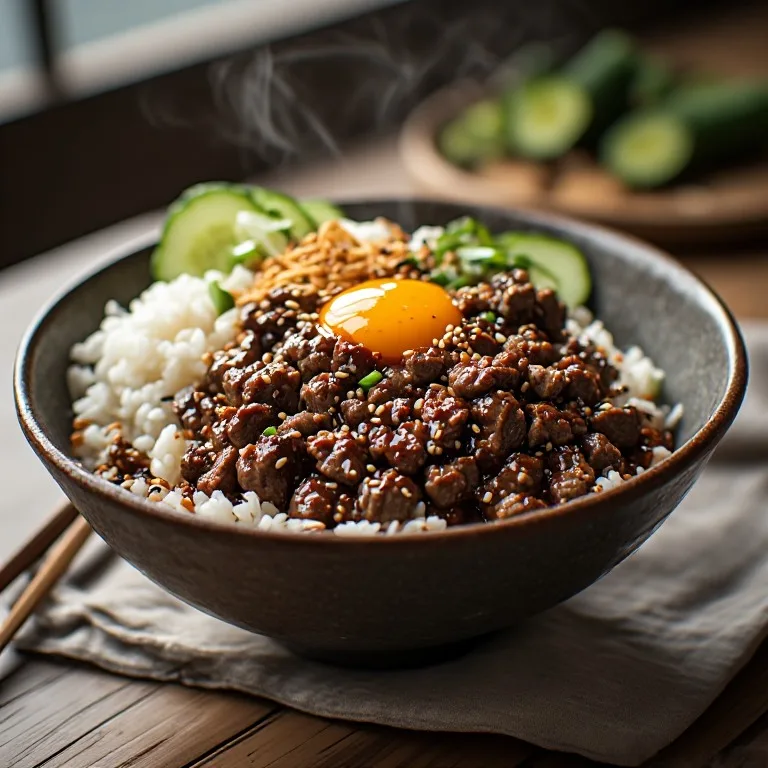
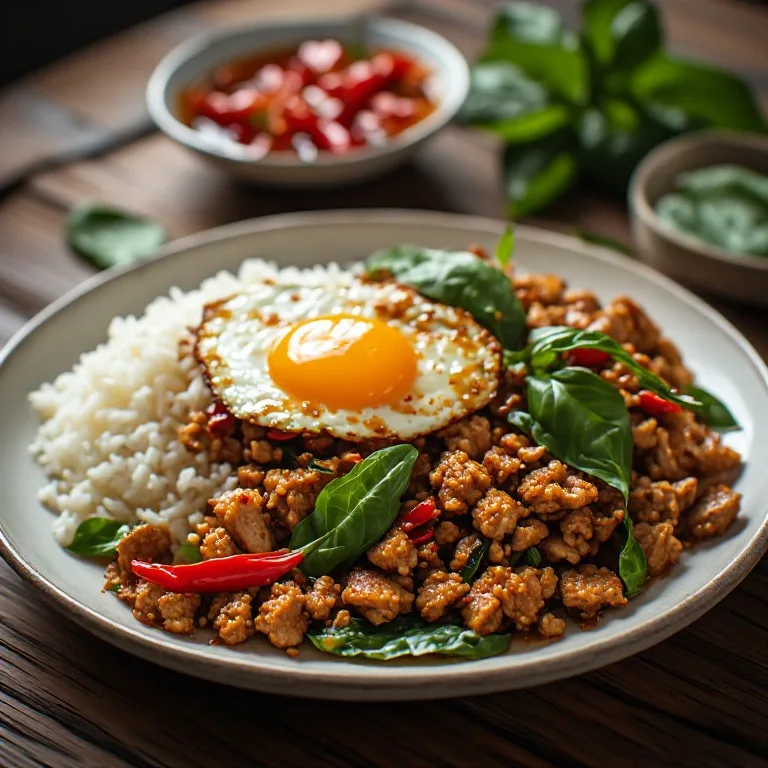
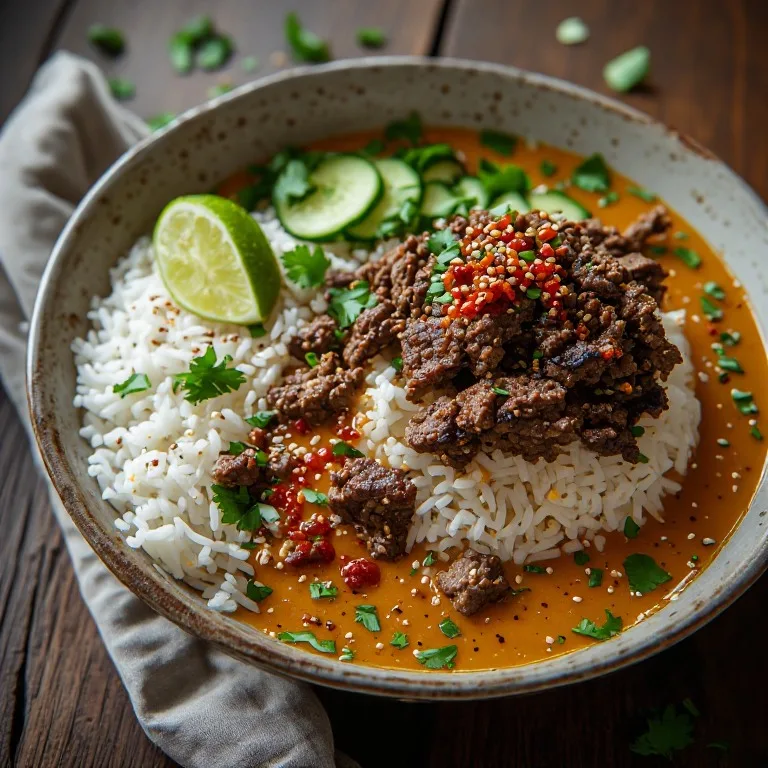
The viral TikTok beef broth bowl: caramelized ground beef bloomed with Thai red curry paste and simmered in coconut milk and beef broth, poured over jasmine rice and piled high with fresh cucumber, cilantro, and chili crunch. 25 minutes, 4 bowls, restaurant-level flavor.

Easy Prep: 10 min Cook: 15 min Total: 25 min4 servings ~$4.50/serving
Prep10 min
Cook15 min
Total25 min
Servings
4
At home~$4.50/serving
vs
Restaurant~$20.25/serving
You save ~78%

The Story Behind the Recipe

The broth bowl format took off on TikTok in 2025–2026 when food creators discovered that pouring hot, richly seasoned broth over rice transforms a weeknight bowl into something that tastes like it came from a restaurant. The coconut-curry beef version spread fast: deep-caramelized ground beef in a fragrant red curry coconut broth, poured steaming over jasmine rice, finished with a pile of fresh herbs and chili crunch. The visual hook is obvious — the golden broth soaking into white rice, the green of the cilantro — but what keeps people making it again is the flavor balance: spicy, savory, slightly sweet, creamy, and bright all at once, done in under 25 minutes from a single pan.

At a Thai or Southeast Asian restaurant, a comparable curry beef rice bowl would run $16–22. At home, 1 lb of ground beef ($5–7), one can of coconut milk ($2.50), and a tube of Thai red curry paste ($2–4 at any grocery store) comes to roughly $3.50 per serving. The technique that separates a flat, slightly harsh curry bowl from a deeply aromatic one is a single step: blooming the curry paste directly in the beef fat while the meat is still hot and mostly dry. Adding curry paste to liquid (broth or coconut milk first) means it never fully caramelizes. Cooked paste-to-fat for 2 full minutes is what produces the layered base that makes the finished broth taste like it simmered for an hour.

Nutrition Facts

Per serving (4 servings)
Calories810
Total Fat42g
Total Carbs72g
Dietary Fiber3g
Sugars5g
Protein26g
Sodium870mg

* Estimated values based on standard recipe preparation. Actual values may vary.

Ingredients

  • For the coconut curry beef broth
  • For the bowls (4 servings)

Instructions

💡
Pro tip: This recipe tastes even better the next day. The flavors need time to meld together in the fridge.
❄️
Storage: Keeps in an airtight container in the fridge for up to 2 weeks. Freezer-friendly for up to 3 months.
🎃 Free Halloween cookbook — download now The Copycat Halloween Cookbook A ready-made, photo-illustrated PDF of our best halloween copycat recipes — free to download, no building required. Pay what you want to support if you love it.

Free PDF — instant download. We'll also send new seasonal copycat recipes now and then; unsubscribe anytime. Or just download it →

The broth bowl format is the rice bowl’s better version. You make a deeply spiced beef in a fragrant coconut-curry broth, pour it over jasmine rice — not just ladled on top, but generously enough that the rice begins to soak it up — and pile on fresh herbs and chili crunch. Each bite starts dry (the toppings), moves to creamy and spiced (the beef), and ends brothy (the liquid the rice absorbed). It’s done in 25 minutes from a single skillet.

The key difference from a standard ground beef bowl: this one is liquid-forward. The Korean ground beef bowl is a glaze situation — minimal sauce, sticky coating, dry bowl. This is a soup-bowl hybrid. There’s enough broth that it visibly pools, the rice softens slightly as you eat, and you can drink the last of it from the bowl if you want.

  • Brown 1 lb ground beef (85/15) until caramelized
  • Bloom 3 tbsp Thai red curry paste in the beef fat for 2 full minutes — this step is non-negotiable
  • Add coconut milk + beef broth + fish sauce + soy sauce + brown sugar
  • Simmer 5 minutes, finish with lime juice
  • Pour over jasmine rice, top with cucumber, cilantro, chili crunch, lime
  • 25 minutes total, about $3.50/serving, roughly 810 calories per bowl
The Blooming Step: Why It Matters

Most recipes treat curry paste as something you add to liquid. That’s wrong. Curry paste is a collection of fat-soluble aromatics — lemongrass, galangal, dried chilies, shrimp paste — that only fully release their flavor in fat, not water. Professional Thai cooks always fry their curry paste in oil or coconut cream first. For this recipe, you have a pan full of hot rendered beef fat after browning the meat — that’s your frying medium.

Add the curry paste, press it against the pan, stir it into the fat, and cook it for 2 full minutes. You’ll see it darken from bright orange-red to a deeper, slightly brown-edged color. The kitchen will smell like a Thai restaurant. That transformation is the paste caramelizing and blooming — it’s the difference between a broth that tastes jarred and one that tastes like it simmered all afternoon.

Do not rush this step. Two minutes at medium-high heat is the minimum.

The Beef: 85/15, Not Leaner

The fat in ground beef does two things here that matter:

  1. It’s the cooking medium for the curry paste. When you add the paste to the meat after browning, you’re adding it to the rendered fat that’s still in the pan. That fat blooms the paste. If you drain the beef completely before adding the paste, you lose the blooming medium and have to add oil separately — it works, but you lose the beef-fat flavor.

  2. It carries the broth flavor back into the meat. The fat in the beef absorbs the coconut curry broth as it simmers. Leaner beef (93/7) gives you dry, separate meat floating in broth. 85/15 gives you beef that tastes like it belongs in the broth because it does.

Building the Broth Right
ComponentRoleAmount
Full-fat coconut milkCreamy body, fat-soluble flavor carrier1 can (13.5 oz)
Low-sodium beef brothUmami base, thins the coconut to broth-consistency1 cup
Fish sauceDeep savory backbone (the MSG of Southeast Asia)2 tbsp
Soy sauceSecondary savory layer + color1 tbsp
Brown sugarBalances chili heat, rounds the broth1 tbsp
Lime juiceAcidity that wakes up all the flavors1 tbsp (added off heat)

The lime juice goes in off heat only — acid added to simmering coconut milk can cause the emulsion to break slightly. Off heat, it brightens without destabilizing the broth.

Curry Paste Brands: What to Buy
BrandStrengthNotes
Mae Ploy (tub)★★★★★Most concentrated; used by Thai restaurants; 2 tbsp = plenty for this recipe
Maesri (small can)★★★★Very close to Mae Ploy; small cans = fresh paste per use
Thai Kitchen (most U.S. grocery stores)★★Much milder; use 4 tbsp for this recipe; widely available
Trader Joe’s Red Curry SauceNot the sameThis is a pre-made sauce, not a paste — not suitable as a substitute

Any red curry paste brand works. Adjust the amount based on strength. Taste the broth before serving and add more paste (diluted in a small amount of broth first) if it lacks depth.

What to Serve and What to Skip

Add to the bowl:

  • Sliced cucumber — the coolness is the critical counterpoint to the spiced hot broth; do not skip this
  • Fresh cilantro — a heavy hand; this isn’t a garnish, it’s a component
  • Thai basil if you can get it — sweeter and more anise-forward than Italian basil; adds a restaurant note
  • Chili crunch — textural contrast and oil-fried heat on top
  • Soft-boiled egg (7-minute jammy) — optional but excellent, the yolk acts as a secondary sauce
  • Lime wedge — squeeze at the table to brighten each individual bite

Skip:

  • Heavy starchy additions (extra noodles alongside rice, breadcrumbs, thick sauce) — the broth bowl is a balanced dish and adding starch on starch dulls the fresh quality
  • Shredded cheese — the coconut milk + fish sauce profile doesn’t accept dairy cheese naturally
Cost at Home vs. Restaurant
Home (4 servings)Per serving
Ground beef, 1 lb$5–7—
Coconut milk (1 can)$2.50—
Red curry paste (~3 tbsp)$1 (from a $4 tub)—
Fish sauce, soy sauce, lime~$1—
Jasmine rice (3 cups dry)$2—
Cucumber, cilantro, garnishes~$3—
Total~$14.50–16.50~$3.50–4
Thai restaurant curry bowl—$16–22
🥗

Make It Healthier

Love Viral TikTok Beef Broth Bowl (Coconut Curry Ground Beef Over Rice) but want a lighter version? Try these simple swaps:

  • ✓Swap ground beef for 93/7 ground turkey — saves about 90 calories and 12g fat per serving while the curry paste and coconut broth carry the full flavor; turkey browns more quickly so watch for dryness
  • ✓Use light coconut milk instead of full-fat — the broth will be slightly less creamy but still richly flavored from the curry paste and beef, saving about 60 calories and 6g fat per serving
  • ✓Reduce rice to ¾ cup cooked per serving and add a large handful of baby spinach directly into the hot broth — the heat wilts it in 30 seconds, adding fiber and volume without changing the flavor
  • ✓Use half the brown sugar (½ tablespoon) and replace it with a teaspoon of honey — lower glycemic index and you use less overall sweetener while still balancing the heat from the curry paste

Frequently Asked Questions

What is the viral TikTok beef broth bowl?

The viral TikTok beef broth bowl is a rice bowl where caramelized ground beef is cooked with Thai red curry paste, garlic, and ginger, then simmered in a broth made from full-fat coconut milk and beef stock. The beef broth is poured generously over jasmine rice so the bowl is part soup, part grain bowl — the rice soaks up the spiced coconut broth while the beef, fresh cucumber, cilantro, and chili crunch provide contrast. It blew up on TikTok FoodTok in 2025–2026 for being fast (under 30 minutes), deeply flavorful, and visually striking — the golden broth against white rice and green herbs is why it photographs well and keeps circulating.

How is this different from a regular ground beef rice bowl?

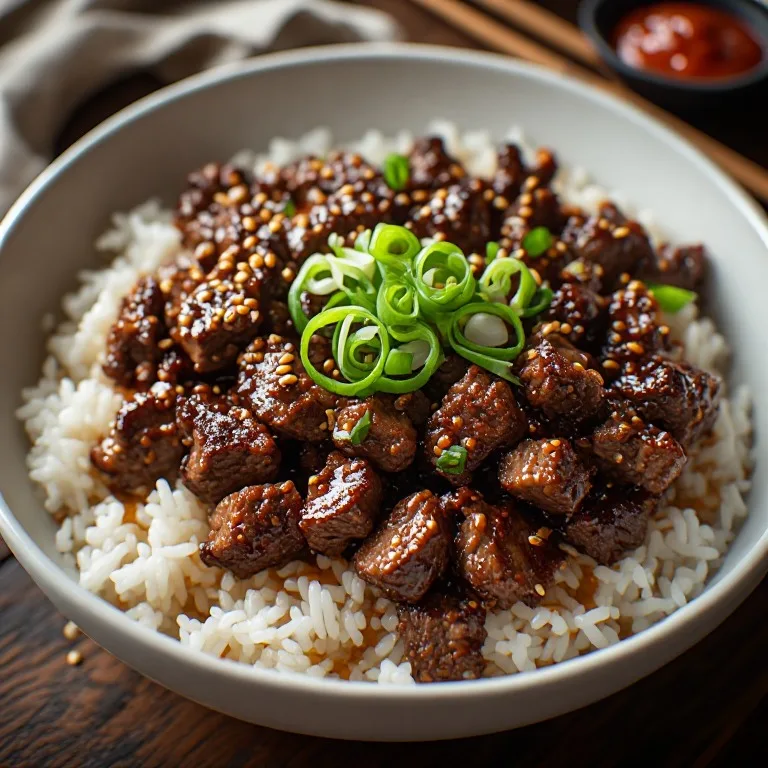
The regular TikTok ground beef bowl (the Korean-style version) is a dry-glazed recipe: ground beef coated in a sticky soy-sesame-ginger sauce with very little liquid, served over rice like a bibimbap. The beef broth bowl is liquid-forward by design — you're making a genuine broth that pools around the rice and soaks in as you eat it, more like a deconstructed curry soup than a glazed bowl. The Thai red curry paste and coconut milk create a completely different flavor profile (spicy, fragrant, creamy) versus the soy-sesame-sweet of the Korean bowl. Both start with 1 lb of ground beef, but the finished dishes taste nothing alike.

What Thai red curry paste should I buy?

Mae Ploy (in the tub) and Maesri (in small cans) are both significantly more concentrated and flavorful than U.S. supermarket brands like Thai Kitchen. With Mae Ploy or Maesri, 2–3 tablespoons is the right amount for 1 lb of beef and 2 cups of liquid. With Thai Kitchen Red Curry Paste (the most common U.S. grocery option), use 3–4 tablespoons to get the same depth. All three are available on Amazon if not at your local grocery. If you can only find green curry paste, use it — the broth will have a brighter, more herb-forward flavor (galangal, lemongrass, kaffir lime) versus the deeper, slightly earthy red paste. Both work well.

Why do you bloom the curry paste in the beef fat before adding liquid?

Curry paste is made of aromatics — lemongrass, galangal, chilies, garlic, shrimp paste, kaffir lime — that are fat-soluble, not water-soluble. When you add curry paste to fat over heat, the oil draws out the fat-soluble flavor compounds from the paste and distributes them throughout the dish. When you add curry paste directly to liquid (broth or coconut milk), the compounds never fully bloom and you get a one-dimensional, slightly harsh flavor. Cooking the paste in the beef fat for 2 minutes — until it darkens and you can smell the aromatics — is exactly what every Thai restaurant cook does with their curry pastes. It's the difference between a broth that tastes like it simmered all day versus one that tastes jarred.

Can I make this with a different protein?

Ground chicken or turkey works well — the blooming step is the same, and the lighter meat works with the coconut curry broth. Ground pork adds a slightly sweeter, fattier richness that's excellent. Shrimp works as a faster option: bloom the curry paste in a tablespoon of butter, then add shrimp and cook just until pink (3–4 minutes), add the coconut broth, and simmer 2 minutes. Tofu (extra-firm, pressed) can replace the beef for a vegetarian version — press and cube it, pan-fry until golden, set aside, make the broth in the same pan, and add the tofu back in for the last 2 minutes. Use soy sauce or tamari instead of fish sauce.

Can I meal prep the beef broth bowl?

Yes — the coconut curry beef base holds well in the refrigerator for up to 4 days, covered. Store the broth and beef together; do not mix with the rice until serving. Reheat gently on the stovetop over medium-low heat with a splash of broth or water if it thickens too much. Cook the rice fresh each day (or reheat rice with a small splash of water in a covered pan). The fresh toppings — cucumber, cilantro, Thai basil, green onion — should be added at serving time, not stored in the meal-prep container. The flavors actually deepen slightly by day two as the curry paste and coconut milk continue to meld.

My broth tastes flat — how do I fix it?

Four adjustments, in order of likelihood: (1) Add more fish sauce a teaspoon at a time — it provides the deep umami backbone the broth needs and you often need more than expected. (2) Add lime juice — acid sharpens everything and exposes flavors that were masked by the fat. (3) Add more curry paste — if the broth tastes creamy and flat, it needs more heat and aromatics. (4) Cook the broth longer — 5 more minutes of simmering concentrates the flavors. If the broth tastes harsh and curry-forward rather than flat, it needs more brown sugar (add ½ tablespoon at a time) and a squeeze of lime to balance the chili heat.

What can I add to make the bowl more substantial?

Sliced bok choy or baby bok choy wilts into the simmering broth in the last 2 minutes and adds texture and a slight bitterness that cuts the coconut fat. A handful of bean sprouts added at serving time gives crunch. Thin rice noodles cooked separately and added to the bowl instead of (or alongside) jasmine rice turn it into more of a noodle soup. A spoonful of sambal oelek or extra Thai bird's eye chilies for more heat. A drizzle of coconut cream (the thick layer from the top of an unshaken can) at serving adds richness and visual appeal.

Love this recipe? Share it!

Free PDF: our 12 most-wanted copycat recipes — instant download.

Made it? Buy us a coffee

Every recipe here is free, with no paywalls. If this one was a hit at your table, a small tip keeps new copycats coming.

$

Ratings & Reviews

—
No ratings yet

Rate this recipe

Click a star to rate

Leave a Review

0/500

CS

Copycat Spices Editorial

Researched + fact-checked. Every recipe on Copycat Spices is built from published sources — official ingredient lists, brand-published recipes, interviews and food-science references — and fact-checked before it goes live, then written as clear, step-by-step instructions for home cooks of all skill levels.

Learn more about our mission →