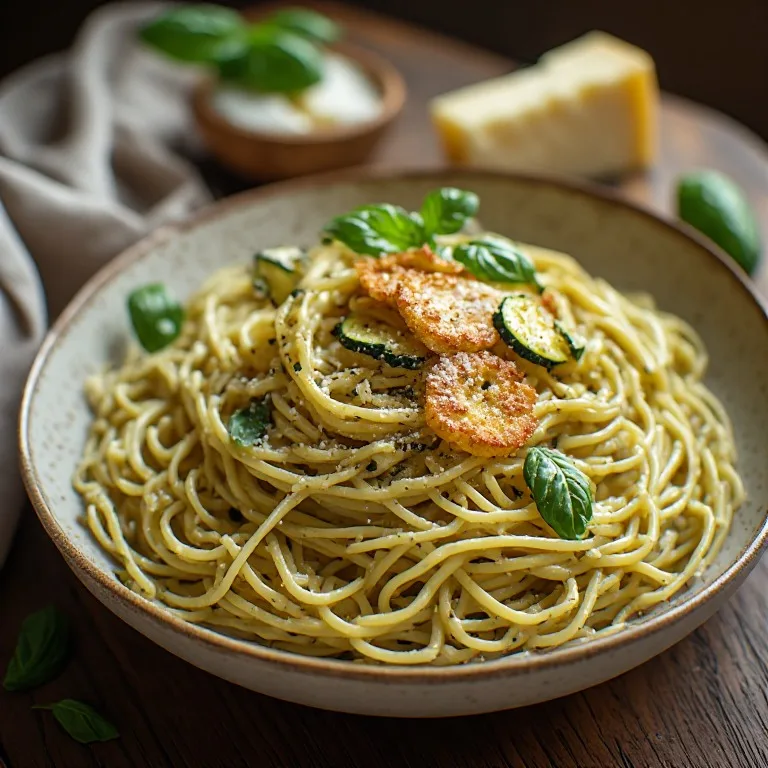


Viral TikTok Spaghetti alla Nerano — Stanley Tucci’s Fried Zucchini Pasta
Prep: 15 min | Zucchini rest: 1 hr–overnight | Cook: 30 min | Serves: 4
In Season 2 of Searching for Italy, Stanley Tucci sits down at a table on the Sorrento Peninsula, takes a fork of spaghetti, and says — in a voice that sounds genuinely startled — that it might be one of the most delicious things he’s ever eaten. The dish was spaghetti alla nerano. The reaction was immediate and global: chefs recreated it, food journalists flew to Nerano to taste the original, and TikTok spent the better part of a year trying to make it at home.
The funny thing is, the dish has no exotic ingredients. There’s no truffle, no expensive protein, no obscure technique requiring professional equipment. There’s zucchini. Fried zucchini. Cheese, basil, pasta water. That’s the whole recipe. The reason it’s hard to believe something so simple can taste that good is exactly why people keep searching for it: you have to make it to understand.
Where the Dish Comes From
Nerano is a small village — really just a cluster of houses and restaurants — at the tip of the Sorrento Peninsula, where the peninsula bends toward Positano and the Amalfi Coast. It sits at the edge of a sheltered bay called Marina del Cantone. No train station, barely a main road, the kind of place where the restaurant menus are written by hand.
The dish has been there for at least 70 years, attributed to the cooks of the local restaurants who had zucchini from the hillside gardens and nothing particularly fancy in the kitchen. Lo Scoglio — run by the De Simone family, now in its third generation — is the restaurant most associated with making the dish famous before Tucci ever arrived. They’ve been serving it the same way for decades.
The cheese is the other Campanian element: Provolone del Monaco, a DOP stretched-curd cheese produced only in the Monti Lattari mountains overlooking the peninsula. It’s semi-aged, slightly tangy, with a richness and complexity that standard Provolone doesn’t have. Outside of specialty Italian shops, it’s difficult to find in the US — but a Parmigiano Reggiano and Pecorino Romano blend gets you very close.
The Zucchini Is the Sauce
This is the single most important thing to understand before you cook this dish. The zucchini are not a vegetable side that gets stirred in. They ARE the sauce. You fry them, let them rest, and then partially mash them into the pasta water and cheese emulsion so they dissolve into every bite.
Three things have to be true for this to work:
The zucchini must be fried, not sautéed. Sautéing keeps them mild and slightly watery. Frying in abundant olive oil at proper frying temperature draws out moisture rapidly, caramelizes their natural sugars, and concentrates their flavor to something nutty and almost sweet. The difference is not subtle.
They must rest after frying. Right out of the oil, they’re still hot and releasing steam. As they cool, the moisture evaporates and they go from slippery to silky. Overnight in the fridge (uncovered) is the traditional approach, and you’ll notice the difference — they become stickier, denser, and more flavorful. One hour at room temperature is the minimum; overnight is better.
About a third should be mashed into the sauce. Not all of them — you want intact pieces in every bite — but enough to create a rough paste that clings to the pasta. The mashed zucchini act as a thickener and flavor base; the whole pieces provide texture.
On the Cheese
Provolone del Monaco is the authentic choice. If you can find it at a specialty Italian deli or cheese shop, use it — the flavor is noticeably more complex than any substitute. It melts into the sauce in a way that’s hard to replicate.
If you can’t find it (which is most of the time, outside of Campania): 70g Parmigiano Reggiano and 30g Pecorino Romano is the best approximation. The Parmigiano provides nuttiness and depth; the Pecorino adds the slight sharpness and salinity that Provolone del Monaco has. This is what most Italian home cooks outside of Campania use.
Whatever you use: grate it very fine. A Microplane rasp grater produces a light, powdery texture that melts into the sauce instantly. Large shreds don’t emulsify — they clump and create a stringy sauce instead of a smooth one. Do not use pre-grated cheese from a bag.
The Emulsion Finish
The final step — adding cheese and pasta water off heat, tossing vigorously — is the same technique as cacio e pepe and pasta alla gricia. It takes about 90 seconds of active tossing to work. The starchy pasta water acts as an emulsifier, binding the fat from the cheese and the olive oil with the water into a stable, glossy sauce.
Two things to know: add the cheese in two stages rather than all at once (each addition emulsifies more easily than one large dump), and add pasta water slowly — a few tablespoons at a time — rather than pouring in a cupful. The sauce should coat a spoon without dripping off it. If it looks dry, add water. If it looks soupy, toss more off heat.
What About Garlic?
This is genuinely contested. Lo Scoglio’s version reportedly does not use garlic. Other Campanian cooks add one smashed clove to the frying oil for the first 30 seconds, then remove it before adding the zucchini. Both are legitimate.
The no-garlic version is cleaner — the zucchini flavor is entirely unobstructed, which is the point when the vegetable is the sauce. The garlic version is more aromatic and slightly more complex at the base. If you’re making it for the first time, try it without garlic: you can always add it next time if you want more depth.
What to Serve With It
This is a first-course pasta in the Italian tradition — a light, elegant dish that doesn’t need much alongside it:
- A simple green salad with lemon and olive oil — the acidity cleanses the palate between bites
- Grilled white fish (branzino, sea bass, or snapper) — very coastal Italian, the right pairing if you’re making a full meal
- A cold, dry white wine — the wines of Campania work perfectly: Falanghina, Greco di Tufo, or Fiano di Avellino. A Vermentino or Pinot Grigio from elsewhere in Italy is also fine.
- Nothing complicated — this is a dish that doesn’t need to be surrounded by other strong flavors. Let it be the center of the meal.