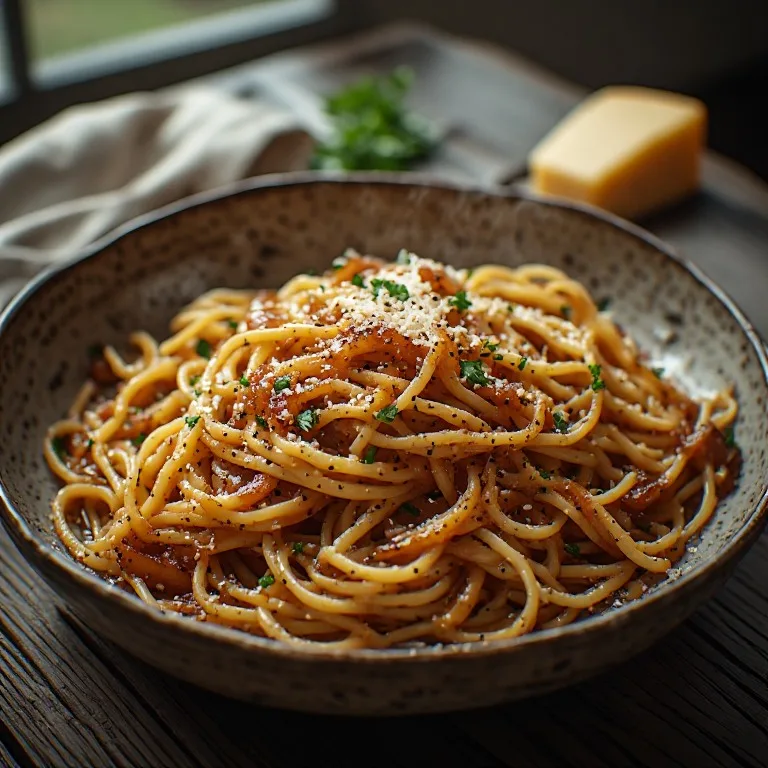



Caramelized onion pasta is the recipe that proves cream is not what makes pasta taste rich.
The sauce in this version has no heavy cream, no Gruyère, no beef broth. It is built from three things: deeply caramelized onions, the starchy water from the pasta pot, and freshly grated Parmesan. The result is richer-tasting than most cream pasta sauces, because caramelized onion sugars and glutamates do something cream cannot: they add actual flavor, not just fat.
The TikTok reveal moment — the reason this dish has millions of views — is what happens when you add hot pasta water to a pan of jammy onions. The dark, sticky mass loosens into a glossy, pourable sauce in seconds. There is no roux, no cream, no thickener. The starch in the pasta water does the emulsifying work on its own.
The TL;DR: caramelize onions low and slow for 45 to 55 minutes, deglaze with wine as needed, add garlic and soy sauce at the end, toss with pasta and pasta water, finish off heat with freshly grated Parmesan. The patience required is in the onion caramelization — once that’s done, the pasta comes together in under 10 minutes.
The No-Cream Sauce, Explained
Why does this taste richer than pasta with heavy cream? Two mechanisms:
The caramelized onions. When onions cook low and slow for 45 to 55 minutes, their water evaporates and their natural sugars concentrate and undergo the Maillard reaction — the same process that browns meat and bakes bread. This produces flavor compounds that taste both sweet and savory, and releases glutamates (the molecules responsible for the “savory depth” quality in aged cheese, soy sauce, and fish sauce). Caramelized onions have significantly more glutamate content than raw onions. The deep, complex flavor in this sauce comes from those compounds, not from cream.
The pasta water starch. Pasta cooking water is not just water — it contains dissolved starch from the pasta itself, typically around 2 to 3 percent starch concentration after 10 minutes of boiling. When hot starchy pasta water is added to the fat in the onion pan and agitated, the starch molecules coat the fat droplets and suspend them in the water, creating an emulsified liquid that clings to pasta strands as a glossy sauce. This is the same science that makes cacio e pepe and carbonara possible without cream. The sauce coats your palate the way cream does, because it carries fat in suspension — but the flavor comes from the onions, not from dairy.
The Parmesan adds another layer of glutamates and fat. The soy sauce adds more. The result is a dish that hits all the richness receptors cream-based pasta hits, plus a depth of flavor cream cannot provide.
The One Number That Matters: 45 to 55 Minutes
The most common mistake with caramelized onion pasta is under-caramelized onions — cooked long enough to turn golden and soft, but not long enough to turn jammy, dark, and intensely sweet.
Here is the honest timeline: for 2 pounds of sliced yellow onions in a 12-inch pan over medium heat, real caramelization takes 45 to 55 minutes. Not 10 minutes. Not 20 minutes.
The reason recipes understate the time: onions spend the first 20 to 25 minutes releasing moisture. They are essentially simmering in their own water, and the pan temperature cannot rise high enough for browning to occur until most of that water is gone. What looks like “golden, fragrant” onions at the 20-minute mark is actually onions that have lost most of their water and are now golden-tan — they have not yet entered real caramelization. The deep color, the jammy texture, and the intense sweetness come in the next 25 to 30 minutes of low, slow heat.
For the baking soda shortcut: add 1/4 teaspoon per pound of onions (1/2 teaspoon total) in the first few minutes of cooking. Baking soda raises the pH of the onion surface, which accelerates Maillard browning — time cuts to 20 to 25 minutes. The onions are slightly softer and a touch more one-note than the slow version, but the shortcut works for weeknights. See How to Caramelize Onions for every shortcut that actually helps and every one that does not.
The Deglaze Is Flavor, Not Cleanup
During the second half of caramelization (medium-low heat, after the moisture phase), dark, sticky fond builds on the pan bottom between stirs. This looks like a potential burning problem. It is actually concentrated caramelized onion sugars — the most flavorful thing in the pan.
When you add 2 tablespoons of water or white wine and scrape up the fond, it dissolves back into the onions and deepens the sauce flavor significantly. Each deglaze step is a flavor addition, not a rescue. This is why stainless steel and carbon steel pans produce better caramelized onions than nonstick — they develop more and darker fond.
White wine deglazes produce a slightly more complex flavor (the wine’s acidity sharpens the sweetness) but any liquid works. Water is perfectly fine.
The Garlic Goes in Late — by Design
The garlic (2 sliced cloves) is added in the last 5 minutes of caramelization, not at the start. This is intentional. Garlic added to a hot pan with raw onions browns first and produces a harsh, bitter quality that does not mellow as the onions caramelize. Added to an already-caramelized onion pan in the last 5 minutes, the garlic softens and picks up the dark, sweet color of the onions without burning, because the surrounding sugar mass acts as a heat buffer. The garlic in the finished dish is mellow, sweet, and integrated — not sharp or raw-tasting.
Soy Sauce in Italian-Style Pasta — Why It Works
One tablespoon of soy sauce in a dish with no other Asian ingredients reads as counterintuitive. The science is straightforward: soy sauce is glutamate-dense (roughly 1,000mg of glutamate per 100g), and glutamates produce the “savory depth” sensation on the palate. Adding soy sauce to caramelized onions — which are already developing glutamates through the Maillard reaction — amplifies the existing depth without adding any soy or Asian flavor. The soy sauce cooks into the onions for a full minute and becomes undetectable as a distinct ingredient in the finished dish.
Fish sauce (1 teaspoon) works on the same principle in smaller volume. Anchovy fillets dissolved into the butter at the very start work as a solid-form version — melt 2 fillets completely before the onions go in, and they disappear entirely, leaving only depth. These are the umami upgrades that make the no-cream version taste like there is something more to it.
Pasta Shape and Tossing Technique
Long strands (spaghetti, linguine, bucatini) are the best choice. The jammy caramelized onions wrap around each strand and cling in thin, even layers — every forkful gets onion rather than a large clump on some bites and none on others. The sauce is a glaze, not a heavy coat, and long pasta handles glazes well.
The tossing matters. Add the pasta water to the onions first, stir to loosen the sauce, then add the pasta and toss aggressively over medium heat. Add reserved pasta water in 2-tablespoon splashes — not all at once. Adding too much water at once dilutes the sauce before it has a chance to thicken around the pasta. Add a splash, toss, check the consistency, add more if needed. The target: every strand coated in a glossy, slightly sticky sauce, no pooling liquid at the bottom of the pan.
Fresh Parmesan Off Heat — Not Optional
Pull the pan off the burner before the Parmesan goes in. The Parmesan melts into the hot starchy sauce from residual heat — the pan, the pasta, and the liquid are all still very hot. On direct burner heat, the Parmesan proteins seize before they emulsify, and you get grainy or stringy clumps instead of a smooth coating.
Pre-shredded Parmesan from a bag contains anti-caking agents (cellulose powder or potato starch) that also prevent smooth melting. A block of Parmigiano-Reggiano or Grana Padano grated fresh on the fine side of a box grater melts in seconds and disperses evenly. Grate it just before using — pre-grated and left to sit will dry out slightly and melt unevenly.
The Four Failure Modes
1. Onions are golden and soft but the sauce is bland. Under-caramelized. Golden onions have lost their water; dark mahogany onions have developed their flavor. Cook further, lower and slower, with deglazes as needed.
2. Sauce is dry and sticky around the strands. Too little pasta water, or pasta water was cold when added. Add hot pasta water in 2-tablespoon splashes and toss vigorously. If all the pasta water has cooled, heat a splash of plain water in the microwave before adding — hot liquid emulsifies; cold liquid does not.
3. Parmesan is grainy and clumped, not silky. Pan was still over direct heat when cheese was added, or pre-shredded Parmesan was used. Both cause the proteins to seize. For the current batch: add a small splash of hot pasta water and stir hard — it will partially salvage the texture. Use fresh-grated next time and pull fully off the burner first.
4. Sauce tastes flat despite long caramelization. Not enough salt in the pasta water, or the final salt adjustment was skipped. The pasta carries most of the dish’s starch and texture but none of the flavor of the sauce — it needs to be adequately seasoned. Also check if the soy sauce went in — this is the single most common “something is missing” culprit.
How This Compares to Similar Dishes
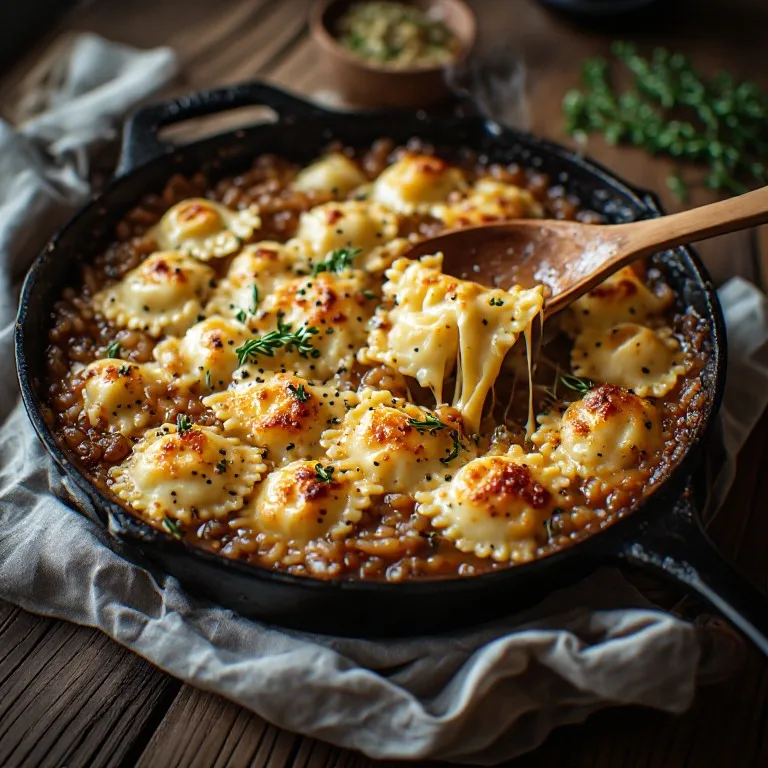
This is not French Onion Soup Pasta — that version is a baked pasta with beef broth, Gruyère, and a broiled cheese crust, closer to a deconstructed French onion soup in a baking dish. This is a stovetop pasta where the onions are the sauce.
It is also a different category from Caramelized Cabbage Noodles, which caramelizes cabbage in miso butter and tossed with egg noodles — a similar technique applied to a different allium-adjacent vegetable with a noodle format rather than pasta.
For a no-technique, shorter-cook alternative, Creamy Lemon Pasta uses Parmesan and pasta water on the same emulsification principle with a 20-minute cook time. Boursin Pasta uses cheese as the base in a similar dump-and-toss method — faster but with a simpler flavor profile.
Ahead-of-Time Options
Caramelized onions: The onions can be made up to 5 days ahead. They keep refrigerated in a sealed container and improve in flavor over time. Weeknight execution: reheat the onions in the skillet for 3 to 4 minutes, cook the pasta, and the dish comes together in under 15 minutes.
Freezing the onions: Caramelized onions freeze well for up to 3 months in 1/4-cup portions. Freeze flat in a zip-lock bag, break off what you need, and thaw in the pan directly from frozen. Having frozen caramelized onions in stock means this dish is always 15 minutes away.
The finished pasta: Does not hold well. The pasta continues absorbing the sauce as it cools and tightens into a dry clump. Leftover pasta can be revived: reheat in a skillet over medium-low with 3 to 4 tablespoons of water or broth per serving, tossing until it loosens and warms through. But it does not reopen to the original glossy finish. This is a make-and-eat dish.