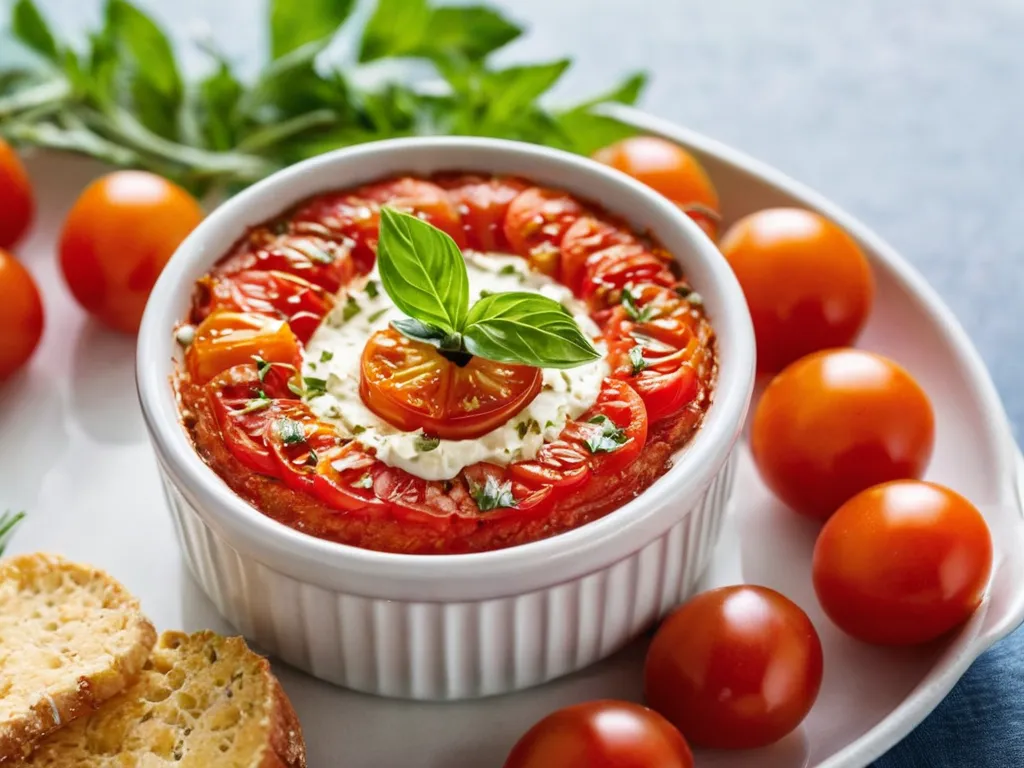
The baked tomato feta dip is the party-appetizer version of the most viral food recipe in TikTok’s history. Same technique as the baked feta pasta — one block of feta, surrounded by burst cherry tomatoes, baked at 400°F until golden — but the mashed result goes directly to the table as a warm, creamy dip rather than being tossed with pasta.
The dish traces to bouyiourdi, a traditional Greek meze from Thessaloniki, in Greek Macedonia, that has been served at tavernas in northern Greece for generations. TikTok simplified it, renamed it, and made it the dish that caused a documented feta shortage worldwide in early 2021. The dip version is what you make when you want that same dramatic table moment — the smoosh, the sizzle, the bubbling tomatoes — without cooking pasta.
TL;DR
One block of block feta (not crumbled), one pint of cherry tomatoes, a few garlic cloves, 3 tablespoons of olive oil, red pepper flakes, and dried oregano. Bake at 400°F in a small dish for 35–40 minutes. Mash immediately. Serve with bread. The key technique is vessel size: the dish should be small enough that the tomatoes press close to the feta, so their juices steam and concentrate around it rather than evaporating off separately.
The Greek Origin: Bouyiourdi
Long before TikTok, tavernas in Thessaloniki — northern Greece’s largest city — were serving a dish called bouyiourdi (μπουγιουρντί): a baked earthenware pot of feta with sliced peppers, tomatoes, olive oil, and bukovo (Greek crushed dried chili), brought to the table sizzling hot with bread. It’s a standard meze in northern Greek cuisine, widely traced to Greeks from Asia Minor and the Black Sea who resettled around Thessaloniki after the 1922 population exchange — which is why the dish is so strongly identified with that city.
The name comes from the Ottoman Turkish “buyurdi” (also rendered buyuruldu), which meant an official written order or decree. In later Greek slang the word came to mean an unwelcome notice or “bill” — a play on the dish’s fiery, spicy bite. The traditional version uses sliced Florina peppers or banana peppers baked alongside the feta, plus sometimes a layer of shredded kasseri cheese on top. The core technique — feta block, olive oil, heat, bread for dipping — is the same dish TikTok made famous.
The viral TikTok version (the baked feta pasta that went globally viral in 2021) adapted the concept by using cherry tomatoes instead of sliced peppers, and then adding pasta to turn it into a sauce. The dip version here is closer to the original Greek meze: the baked feta and tomatoes are served directly as an appetizer, without pasta.
The baked feta pasta that went viral in January 2021 (created in 2019 by Finnish blogger Jenni Häyrinen, which caused a documented feta shortage worldwide) is covered in detail in the baked feta pasta article. This dip is a distinct use case: no pasta, served as a standalone appetizer, thicker and more concentrated.
Why Block Feta, Not Pre-Crumbled
This is the one rule that cannot be bent.
Block feta packed in brine retains significant moisture — you can see it in how the cheese feels firm but not dry when you cut into it. When heated to 400°F, that moisture moves outward, the protein network softens, and the fat becomes liquid. The result is a block that has gone from crumbly-firm to soft and yielding — ready to be mashed into the burst tomatoes. The brine that the block sits in during packaging also keeps the flavor complex and bright.
Pre-crumbled feta starts life drier — it’s been broken apart and lost some of its brine, then packed without it. At 400°F, it dries further, browns in small pieces, and doesn’t have the structural integrity to transform into a creamy dip. You’ll get hot crumbles of cheese in a pool of tomato juice rather than a unified, mash-able dip.
Greek PDO (Protected Designation of Origin) feta is the best choice when you can find it. EU PDO regulations (granted under Regulation (EC) No 1829/2002) require Greek PDO feta to be made from at least 70% sheep’s milk plus up to 30% goat’s milk — no cow’s milk is permitted. It must be produced in specific mainland Greek regions plus Lesbos. The US does not legally enforce the EU PDO designation, so most “feta” sold in American supermarkets is made from cow’s milk in Denmark, Bulgaria, or the US itself; it tastes milder and less tangy. Look for “PDO” or the Greek “ΠΟΠ” on the label and “Product of Greece” to confirm authenticity. Brands like Dodoni, Epiros, or Kolios are widely available at Whole Foods, Trader Joe’s, and Greek or Middle Eastern grocery stores. Generic supermarket feta works fine but tastes noticeably different.
Vessel Size: The One Thing Most Recipes Get Wrong
A baking dish that’s too large is the most common reason this recipe underperforms.
The cherry tomatoes need to sit in close contact with the feta block, essentially nestled around it. As they burst at 400°F, they release juice that needs to pool around the base of the feta — steaming it from the sides and creating the liquid that becomes part of the dip. In a large baking dish, the tomatoes spread out, burst away from the feta, and their juices evaporate across a large surface area rather than concentrating at the feta.
Right size: Aim for roughly a 2-quart baking dish — something where the feta block fits in the center and the tomatoes are mounded close against its sides. An 8×6-inch or small oval ceramic gratin dish is ideal; the traditional Greek vessel for bouyiourdi is earthenware (clay), which holds heat well and keeps the dip warm at the table. A 9×13-inch dish is too large unless you double the recipe.
Cast iron works but runs hotter than ceramic, which means the garlic cloves at the edges can over-char before the tomatoes are fully burst. If you use cast iron, watch the garlic more carefully and move it slightly away from the direct edge if you see it darkening too fast. Ceramic or earthenware is lower-risk and produces more even cooking throughout.
The Bake: What You’re Looking For
35–40 minutes at 400°F. You’re targeting two things simultaneously:
-
Tomatoes fully burst. They should be shriveled, blistered, and some should have completely collapsed. Partially burst tomatoes still have structural integrity that prevents them from fully integrating into the mash. At 35 minutes, essentially all of them should be done.
-
Golden top on the feta. The top surface of the feta block should have developed color — golden to light brown, not just white. This is where a significant amount of flavor develops (Maillard reaction between the feta’s proteins and its trace sugars). If you’re only getting white feta at 35 minutes, turn on the broiler for 2–3 minutes while watching closely.
Feta doesn’t melt — and this is actually a structural feature, not a bug. Feta has unusually high acidity (from the brine curing process), which prevents its proteins from bonding in the way that produces a liquid melt. The mechanism is similar to why paneer and queso blanco hold their shape at high heat rather than flowing. What you get instead: a block that softens from firm-and-crumbly to soft-and-yielding. The mash step (below) is what unifies it into a dip.
The Mash: Work Fast
Pull the dish from the oven and mash immediately. The feta is at its most workable when hot — as it cools, it stiffens back toward crumbly. Use a fork and press firmly, working the feta into the burst tomatoes while smashing the garlic cloves against the sides. Stir until you have a chunky, creamy dip with visible tomato pieces and pools of orange-red olive oil.
Don’t over-process — you’re aiming for a cohesive dip, not a smooth puree. If you want it smoother, use a potato masher and put in another 30 seconds of work. Leave it chunky for more texture.
The Honey Drizzle: Optional but Excellent
A drizzle of honey over the mashed dip before serving sounds strange but does two things:
- Rounds the salt. Feta is inherently salty; a touch of sweetness doesn’t make the dish sweet, it makes it taste more balanced.
- Adds visual appeal. The honey pools in the ridges of the mashed feta, catching the light.
Use about 1–2 teaspoons total. Wildflower honey, thyme honey, or any mild variety works. Spicy chile honey (like Mike’s Hot Honey) is a strong variation.
Variations
Bouyiourdi-style (most authentic): Add 1 sliced Florina (roasted red) pepper or banana pepper around the feta before baking. The pepper provides more heat and a slightly sweet roasted character. This is closer to the Greek original.
Spicy version: Double the red pepper flakes (½ teaspoon), and add 1–2 teaspoons of harissa or a few slices of fresh jalapeño. The feta’s saltiness and the tomato’s acidity can handle significant heat without losing balance.
Herb-forward: Replace the dried oregano with a combination of fresh thyme sprigs and a rosemary sprig laid on top of the feta before baking. Remove before mashing. The herbs perfume the olive oil and tomatoes during the bake.
Spinach addition: Add 2 cups of baby spinach to the tomatoes before baking. It will fully wilt during the 40-minute bake and add color and nutrition to the finished dip. This also makes the dip go further.
Olive addition: Scatter 15–20 pitted Kalamata olives around the tomatoes before baking. They don’t change dramatically during baking but add concentrated brininess and visual contrast.
What to Serve With It
The dip works with six types of accompaniments:
- Crusty bread: The most popular choice. Slice a baguette or sourdough into ½-inch pieces. The crust’s texture contrasts with the creamy dip; the bread absorbs the olive oil-tomato liquid at the bottom of the dish.
- Warm pita: Better for scooping large amounts. Tear into pieces and serve alongside.
- Crostini: Thin toasted baguette slices brushed with olive oil — more structural than soft bread, good for party presentations where people are standing.
- Cucumber rounds: Mild and low-carb; the cucumber’s coolness against the hot dip is pleasant.
- Endive leaves: Cup-shaped for scooping, slightly bitter (which cuts the richness of the feta), sturdy enough to not collapse under a spoonful of dip.
- Sliced bell peppers: Echoes the traditional bouyiourdi technique of incorporating peppers into the dish itself.
For a party table, put out two or three options and let people mix. The dip itself is the centerpiece.
Storage
Leftovers keep in the fridge for 3 days in an airtight container. The dip separates as it cools — the olive oil rises to the top and the feta stiffens. To reheat: 300°F oven for 10–12 minutes, or microwave in 30-second bursts at 70% power, stirring between each. Stir vigorously before serving to re-emulsify. The texture won’t be as creamy as when it just came out of the oven, but the flavor holds.
Cost
A restaurant-quality warm cheese dip at a restaurant: $12–16. This entire dish:
| Ingredient | Cost |
|---|---|
| Block feta (8 oz) | $4–6 |
| Cherry tomatoes (1 pint) | $2–3 |
| Garlic, olive oil, herbs | <$1 |
| Total (serves 6) | ~$7–10 |
Per serving (before bread), under $2. Add a $3 baguette and you have an appetizer for 6 people for about $13 total — roughly the price of a single serving at a restaurant.
For more ways to use feta, the CAVA Crazy Feta copycat covers whipped feta with roasted jalapeño — a different preparation that’s served cold. If you want to turn this same baked feta base into a main course, baked feta pasta is the direct extension: toss the mashed feta-tomato mixture with hot pasta and a splash of pasta water. For another viral TikTok appetizer with similar visual appeal, caprese garlic bread uses tomatoes and fresh mozzarella in a related combination. And if you’ve got a Greek theme going, the viral TikTok Greek wrap is the logical next dish after this one.