You’ve shaken a jar of olive oil and vinegar vigorously, poured it over a salad, and watched it separate back into two distinct layers by the time it hit the bowl. You’ve seen hollandaise curdle at a critical moment. You’ve added butter to a pan sauce and ended up with grease floating on top instead of a glossy, cohesive coating. All three are the same problem: a failed emulsion.
Understanding emulsification doesn’t just fix these specific failures — it gives you a framework that explains every sauce in the world.
What emulsification is
Oil and water don’t mix. The molecules are fundamentally incompatible: water molecules are polar (one end is positively charged, one is negative) while fat molecules are nonpolar, so they simply don’t attract each other. When you shake them together, you can force them into temporary contact, but they separate again almost immediately.
Emulsification is the process of getting fat and water to coexist stably by using an emulsifier — a molecule with one water-loving end (hydrophilic) and one fat-loving end (hydrophobic). The emulsifier molecule wraps around tiny fat droplets, with its fat-loving end inside and its water-loving end facing outward. This coating of emulsifier makes each fat droplet compatible with the surrounding water, preventing the fat from coalescing and separating.
The result is a smooth, creamy, unified liquid where neither phase is dominant — a vinaigrette, a mayonnaise, a hollandaise, a pan sauce mounted with butter.
The emulsifiers you already have
Egg yolk is the gold standard. It’s rich in lecithin, one of the most powerful natural emulsifiers, which is why mayonnaise, hollandaise, aioli, and Caesar dressing all rely on it. A single egg yolk can emulsify up to a cup of oil. The key is adding the oil very slowly at first — drop by drop — until the emulsion is established, then gradually increasing to a thin stream.
Mustard — specifically Dijon — contains mucilage, a compound from the mustard seed coat that acts as a mild emulsifier. A teaspoon of Dijon in a vinaigrette will keep it together for an hour or more, versus seconds for plain oil and vinegar. It also contributes flavor, which is a bonus.
Garlic contains small amounts of lecithin, which is part of why a well-pounded garlic aioli (where the garlic itself is the base) can emulsify without egg. The technique takes patience and a mortar and pestle, but the result is extraordinary.
Reduction and starch don’t emulsify in the chemical sense, but concentrating a sauce enough — reducing it until its natural proteins and starches thicken — creates physical stability. This is how a well-reduced stock-based sauce maintains its consistency without butter or egg.
Vinaigrettes: the daily practice
The ratio for a classic French vinaigrette is 3:1 oil to acid (vinegar or citrus juice), though you can go as low as 2:1 for something sharper. The emulsifier and technique determine how long it holds.
Temporary vinaigrette (no emulsifier): Combine in a jar and shake. Lasts 30 seconds.
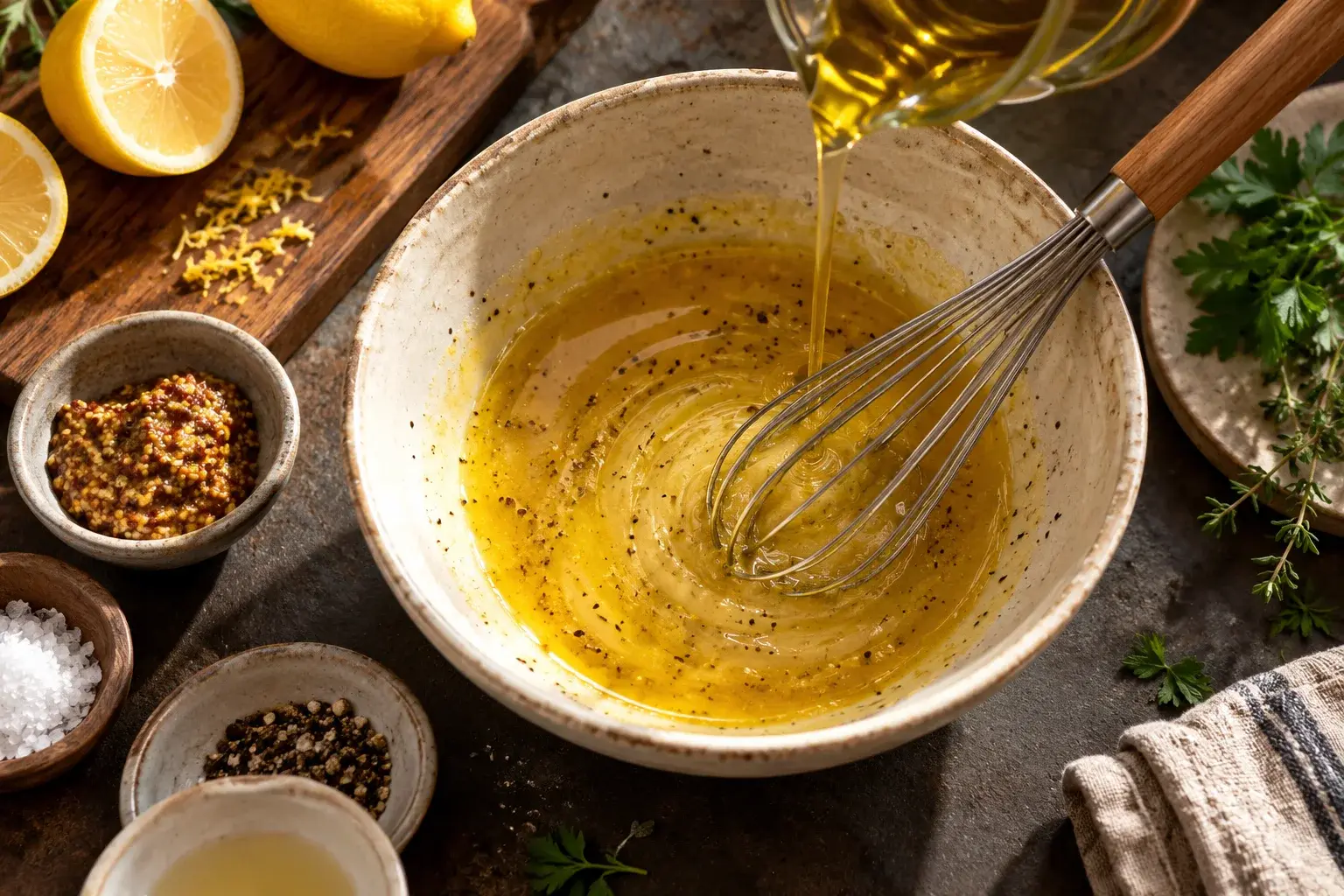
Semi-stable vinaigrette: Whisk together the acid, salt, and a teaspoon of Dijon mustard until dissolved. Then add the oil in a slow, steady stream while whisking constantly — not all at once. The mustard provides emulsification, and the gradual addition gives each drop of oil time to be coated before more is added. This holds for hours in the fridge. A minced shallot adds another layer of mild emulsification and flavor.
For a honey-mustard style dressing or something like a copycat Chipotle vinaigrette, the honey adds body and mild stabilization in addition to sweetness.
Mayonnaise and aioli: permanent emulsions
Mayo is a permanent emulsion of oil in egg yolk, where the fat-to-liquid ratio is extreme — sometimes 20:1 or higher. The lecithin in the yolk handles it, but only if you add the oil slowly enough.
Start with the yolk (and a teaspoon of Dijon, if you like) in a bowl. Whisk in the oil starting at a literal drip — one drop at a time for the first tablespoon — while whisking constantly. Once the emulsion is established and the mayo starts to look thick and pale, you can increase to a thin stream. Add a teaspoon of water or lemon juice halfway through to loosen it. Season at the end.
Once you’ve made mayo from scratch, the jarred version never tastes quite the same. The same base technique — with more garlic — is aioli.
Pan sauces and mounted butter
Mounting a pan sauce with butter (monter au beurre) creates an emulsion of water-based stock and fat from butter. The milk solids and water in butter act as a mild emulsifier, but the technique is critical:
- The sauce must be off the heat or on very low heat — above 160°F the emulsion breaks
- Butter must be cold — room temperature butter adds fat too fast and overwhelms the liquid
- Add it piece by piece, swirling or whisking constantly
The result is a glossy, velvety, unified sauce. If the pan gets too hot after mounting, you’ll see the fat split out and pool on the surface. That’s a broken emulsion — see below for how to fix it.
When sauces break: diagnosis and repair
Vinaigrette separated: Just re-whisk or shake. Add a tiny pinch more mustard if it won’t hold.
Mayonnaise broke (looks curdled, greasy, stringy): Start a new yolk in a clean bowl. Very slowly whisk the broken mayo into it as if starting fresh — the new lecithin rescues the old.
Pan sauce broke (fat floating on top): Remove from heat, let cool to warm (not hot), add a tablespoon of cold water, and whisk vigorously. The lower temperature and added water sometimes pull the emulsion back together.
Hollandaise curdled (egg scrambled): If it just looks grainy, whisk in an ice cube immediately and take it completely off the heat. If the egg has actually curdled into visible bits, strain them out and try whisking in a little cold water — the sauce will be thinner but may be salvageable.
Temperature is everything
Most emulsions have a preferred temperature range. Cold (refrigerator-temperature) emulsions like mayo and vinaigrette are stable. Warm emulsions like hollandaise and mounted butter pan sauces exist in a narrow window: warm enough to melt the fat but cool enough not to break the suspension. This is why controlling heat is the central skill of sauce-making.
Understanding emulsification also unlocks flavor balance: fat is one of the eight flavor axes specifically because it carries aroma across the palate and creates mouthfeel. An emulsified sauce delivers fat in a way that coats the tongue uniformly, which is why a properly emulsified dressing tastes richer and more cohesive than oily and sharp separately.
Put the technique into practice on one of the dressings or sauces below — then taste the difference.