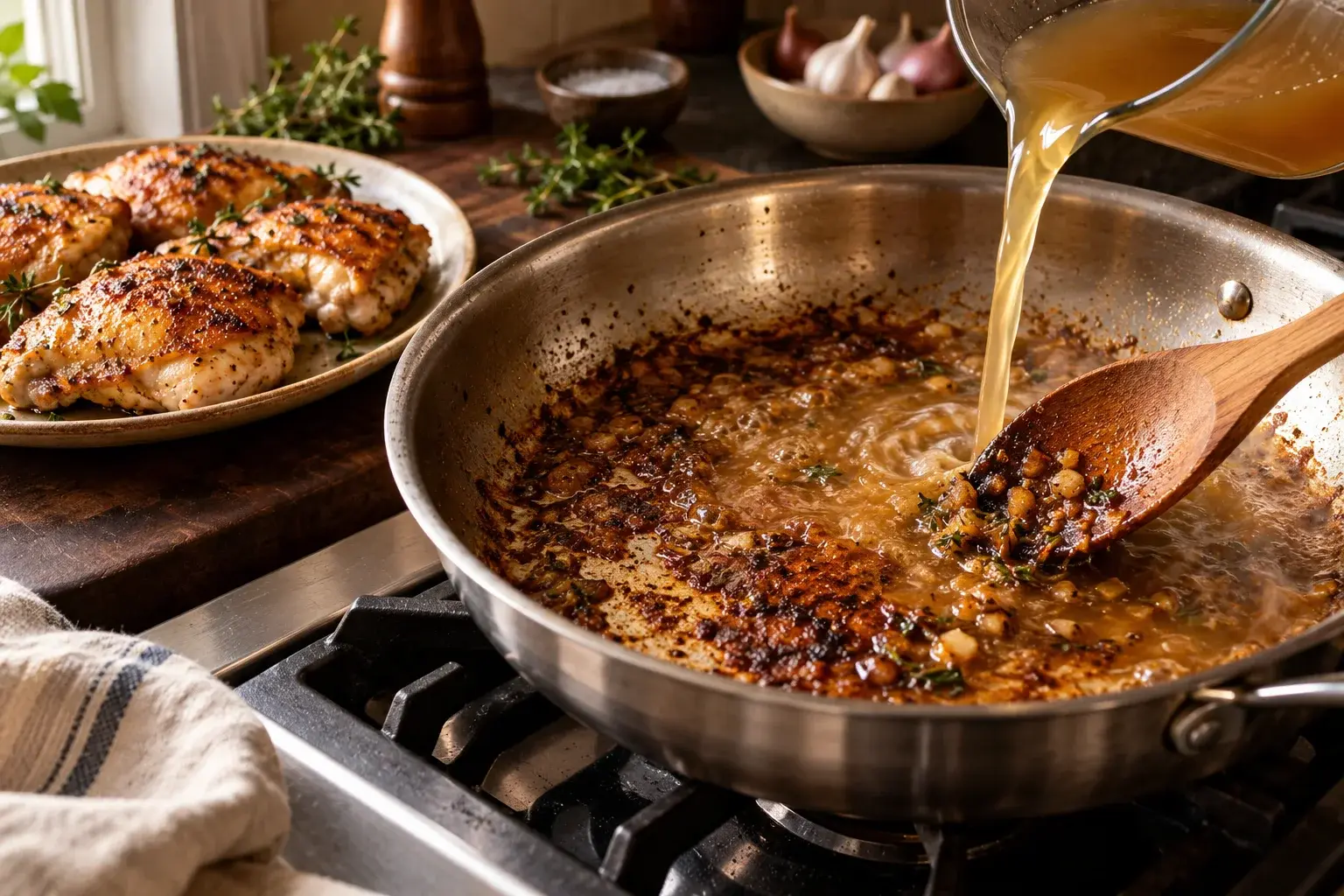
You’ve just seared a perfect steak or a beautiful chicken breast, and your pan looks like an unholy mess — brown, stuck-on residue covering the bottom, smoke curling faintly from the sides. Most home cooks reach for the scrubber. Restaurant cooks reach for the wine bottle.
That sticky brown layer is fond, and it’s the foundation of some of the finest sauces in Western cooking. Learning to deglaze is learning to finish a dish the way the pros do — and it takes less than 10 minutes.
Understanding the fond
Fond is the French word for “base” or “bottom,” and it’s exactly that: the concentrated residue left in the pan after searing meat, sautéing aromatics, or roasting. It’s made up of Maillard reaction compounds — denatured proteins, caramelized sugars, and rendered fat — and it contains an enormous amount of flavor in a very small volume.
When you dissolve that fond into a liquid, you’re essentially reconstituting a sauce that the cooking process has already started building for you. The pan did most of the work. You’re just collecting what it made.
The basic method
Step 1: Remove the meat. After searing, transfer your protein to a rack to rest. The pan should still be hot — ideally over medium-high heat.
Step 2: Drain excess fat if needed. If there’s more than about a tablespoon of fat in the pan, pour off the excess. You want enough to sauté aromatics, not enough to fry them.
Step 3: Add aromatics (optional but recommended). A minced shallot or two, dropped into the hot pan, cooks in 60–90 seconds and adds a savory, slightly sweet base. A smashed garlic clove works too. Stir constantly — they can go from golden to burned quickly in the residual heat.
Step 4: Deglaze. Add ½ cup of liquid — dry white wine, red wine, cognac, stock, sherry, or a combination — to the hot pan. It will sizzle violently. Immediately use a wooden spoon or spatula to scrape the entire bottom of the pan, getting into the corners. Every bit of fond you dislodge is flavor going into your sauce.
Step 5: Reduce. Let the liquid boil and reduce by about half. If you used wine, you’ll notice the alcohol smell burn off after a minute or two, leaving behind the wine’s fruit and acidity. Taste the liquid — it should taste intensely savory and well-seasoned. If it tastes sharp or raw, let it reduce a bit more.
Step 6: Add stock (optional). Pour in another ¼ to ½ cup of stock — chicken, veal, or beef depending on your protein — and let it reduce again until the sauce coats the back of a spoon. This step deepens the flavor and gives you more volume to work with.
Step 7: Mount with butter. Remove the pan from the heat entirely, or drop it to the lowest flame. Add 2–3 tablespoons of cold butter, cut into small cubes, one piece at a time, swirling the pan constantly. The cold butter melts into the sauce slowly, creating an emulsion that turns a thin liquid into something glossy, rich, and velvety. This technique — monter au beurre — is the difference between a jus and a pan sauce.
Do not let the pan get hot again after the butter goes in, or the emulsion will break and you’ll have a greasy puddle.
Seasoning and finishing
Taste the sauce and adjust:
- Salt: Season carefully — the fond and any reduced stock already carry significant salt.
- Acid: A squeeze of lemon or a teaspoon of good wine vinegar brightens the whole sauce and lifts the richness of the butter. This is the step that separates a flat pan sauce from a vibrant one. (See the role of acid in cooking for why this matters so much.)
- Fresh herbs: Thyme, tarragon, chives, or flat-leaf parsley — added at the very end, off the heat — add brightness and a professional finish.
Strain through a fine-mesh sieve if you want a smooth, elegant presentation. Leave it unstrained for a more rustic, bistro-style sauce.
Matching the liquid to the protein
- Chicken: White wine or dry sherry + chicken stock + tarragon or thyme
- Beef or lamb: Red wine or port + beef or veal stock + rosemary or a touch of Dijon
- Pork: Apple cider or calvados + chicken stock + sage or mustard
- Fish: Dry white vermouth + clam juice or fish stock + lemon and dill
- Shellfish: White wine or cognac + stock + cream + tarragon (a classic bistro combination)
The caramelized onion shortcut
Want to make a pan sauce with even more depth and barely any extra work? A tablespoon of caramelized onions stirred in after deglazing adds an enormous amount of savory sweetness. The onions have already done the hard work of developing complex flavor over low heat — they’re essentially a sauce base that’s been waiting in your fridge.
A note on emulsification
The butter-mounting step works because you’re creating an emulsion — fat droplets suspended in the water-based liquid. If you want to understand exactly why sauces become silky or break, how to emulsify sauces covers the science in detail. Pan sauces follow the same principles as vinaigrettes and hollandaise: temperature control, gradual addition, and the right ratio of fat to liquid.
Once you make a pan sauce the first time, you’ll wonder how you ever served a seared piece of protein without one. Now pick a recipe below and put the technique into practice.