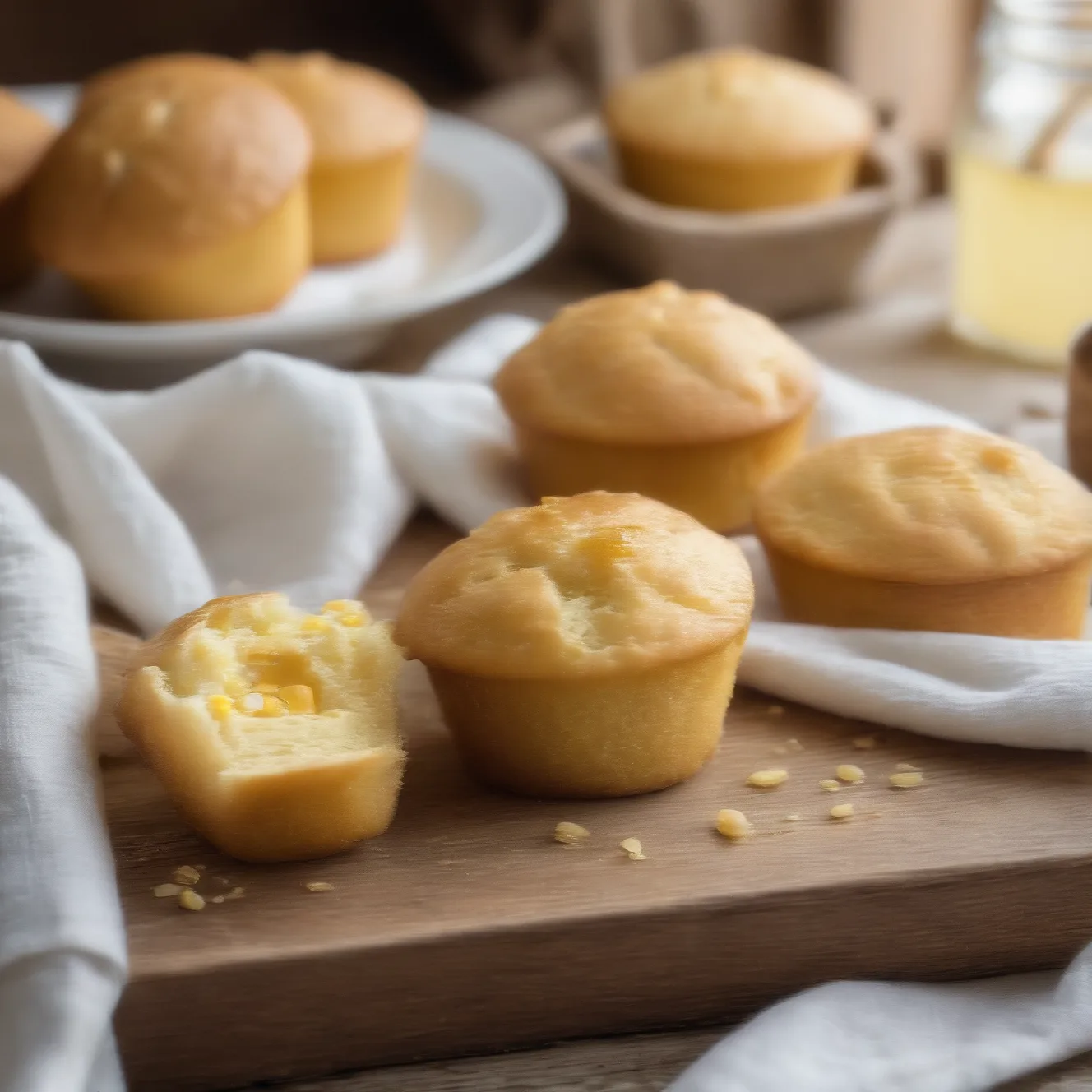
TL;DR: Equal parts yellow cornmeal and all-purpose flour, 1/4 cup sugar plus 2 tablespoons honey, buttermilk, eggs, and a full stick of butter. Butter the muffin wells (not spray). 12 strokes max, fill 2/3 full, 375°F for 15–18 minutes. Tender, sweet, slightly corny — the muffins CB puts on the table for free.
Cracker Barrel puts corn muffins on every table before you order anything. They arrive hot, two or three per basket alongside the biscuits, with butter on the side. It’s one of the small gestures that defines eating at CB: before you’ve spent a dollar, you’re already eating well. People remember those muffins specifically — sweet, soft, with a slightly crispy bottom edge from the buttered pan — and that’s why copycat versions are perennially searched.
The most common mistake in copycat recipes is making them too Southern. True Southern cornbread is savory, crumbly, and dominated by coarse cornmeal. CB’s corn muffins are the opposite: sweet, tender, and light, with a crumb that pulls apart cleanly rather than breaking into grit. Understanding that distinction is the entire recipe.
Northern vs. Southern Cornbread — Where CB Falls
American cornbread splits into two distinct traditions:
Southern cornbread uses coarse stone-ground cornmeal at a 2:1 or higher cornmeal-to-flour ratio (or sometimes no flour at all), little or no sugar, buttermilk, and fat — originally bacon grease, now usually shortening or oil. It’s savory, crumbly, and dense, designed to be eaten with savory meals — beans, chili, greens. Cast-iron baked. The cornmeal dominates and you taste the grain.
Northern cornbread is closer to a quick bread or muffin: equal parts flour and cornmeal (or more flour than cornmeal), significant sugar, eggs, and butter. It’s cakey, slightly sweet, and tender. The corn is background flavor rather than the point. Northern cornbread is what most of the country thinks of when they think of a “corn muffin.”
| Southern cornbread | Northern (Cracker Barrel) | |
|---|---|---|
| Cornmeal-to-flour | 2:1 or higher (sometimes all cornmeal) | 1:1 (equal parts) |
| Sugar | Little to none | Sugar + honey |
| Fat | Bacon grease, shortening, or oil | Butter |
| Texture | Crumbly, gritty, dense | Tender, cakey, holds together |
| Baked in | Cast-iron skillet | Muffin tin |
| Eaten with | Beans, greens, chili | Butter and honey |
Cracker Barrel corn muffins are Northern-style, full stop. They’re sweet, they use equal parts flour and cornmeal, and they’re baked in a muffin tin rather than a skillet. If you’ve been using a Southern cornbread recipe and wondering why the result doesn’t match — that’s why. You need the Northern ratio and the sweeteners.
The Cornmeal-to-Flour Ratio
The 1:1 ratio (1 cup cornmeal, 1 cup flour) is the structural decision that determines texture. Here’s what shifts when you change it:
- More cornmeal than flour → grittier crumb, more pronounced corn flavor, crumblier interior, denser weight per muffin. This is the Southern direction.
- Equal parts → balanced crumb — enough cornmeal for corn flavor and slight graininess, enough flour for structure and tenderness. This is where CB sits.
- More flour than cornmeal → lighter, cakey interior, milder corn flavor, less distinctly cornbread. This is the direction of a standard yellow muffin.
The 1:1 ratio is the sweet spot for a muffin that reads as cornbread (corn flavor, golden color, slight graininess) while eating like a muffin (tender, not crumbly, holds together when buttered).
Cornmeal grind matters too. Medium-grind yellow cornmeal is the right choice — it provides visible texture and corn character. Fine cornmeal produces a more uniform, cake-like crumb (less interesting). Coarse-grind cornmeal makes the muffins gritty in a way that’s unpleasant in a baked muffin (it’s meant for polenta). When the bag says “medium grind” or just “yellow cornmeal” without specifying, that’s usually what you want. Bob’s Red Mill medium-grind and Quaker yellow cornmeal are both correct.
The Dual Sweetener (Sugar + Honey)
Most cornbread recipes use sugar alone. CB’s corn muffins use both sugar and honey, and they do different things.
Granulated sugar provides the sweetness structure. Sugar crystals are incorporated into the crumb, providing body and the clean, straightforward sweetness you taste first.
Honey adds two things sugar can’t: a faint floral depth that makes the muffin taste slightly more complex than “just sweet,” and hygroscopic behavior. Hygroscopic means honey actively attracts water molecules from the surrounding air. Sugar-only muffins begin drying out within hours of baking. Muffins with honey stay noticeably moister at room temperature for 24–48 hours after baking. If you’ve ever noticed that CB’s corn muffins have a soft, slightly sticky interior even after sitting in the basket for a while — that’s the honey.
Stir the honey into the melted butter while the butter is still warm. Honey dissolves readily in warm fat but not in cold fat or cold milk — if you add it to the buttermilk, it tends to clump and doesn’t distribute evenly.
Why Buttermilk
Buttermilk in this recipe does two things: it provides acid that reacts with the baking soda (producing CO2 bubbles for lift) and it adds tang that balances the sweetness. The 1/4 teaspoon of baking soda in this recipe is specifically for the buttermilk — baking soda needs acid to activate, and without acid, it doesn’t do anything. The baking powder provides additional leavening that’s heat-activated (a second rise when the muffins hit the oven), independent of the acid.
This is the same buttermilk-baking-soda mechanism that makes Cracker Barrel biscuits rise tall. In muffins, it produces the dome. The difference from biscuits is that you don’t want the dome on muffins — fill the wells only 2/3 full, and 375°F is the right baking temperature (not the high 450°F used for biscuits). Lower heat lets the muffins rise gently and evenly before the top sets, rather than billowing into an aggressive dome.
The Overmixing Problem
Cornmeal doesn’t contain gluten — only the flour does. But there’s plenty of flour in these muffins, and gluten develops fast when flour meets liquid. At 12 strokes, gluten development is minimal — you get a tender crumb and a rounded top. At 40 strokes (which is what “mix until smooth” produces), the gluten network tightens and creates a dense, tunneled interior with a peaked, cracked top. Bakers call these “muffin tunnels” — long vertical air channels that form when batter is beaten past the smooth-batter stage.
The lumps in under-mixed muffin batter almost always hydrate and soften during the 5-minute wait before baking or in the oven itself. They are not a problem. Smooth batter, in a muffin, is.
Variations
Jalapeño cheddar corn muffins: Fold in 2 tablespoons of finely diced fresh jalapeño (seeds removed for mild heat, seeds in for spicy) and 1/2 cup of shredded sharp cheddar after the wet-meets-dry step. Reduce the sugar to 2 tablespoons — the cheddar’s salt and the jalapeño’s vegetal bite reduce the need for sweetness contrast.
Blueberry corn muffins: Toss 3/4 cup of fresh or frozen blueberries with 1 teaspoon of flour (prevents sinking) and fold in at the end of mixing. The combination of sweet cornmeal and tart blueberry is a classic Northern quick-bread pairing.
Bacon corn muffins: Cook 4 strips of bacon until crispy, then crumble and fold into the batter. Swap 1 tablespoon of the melted butter for 1 tablespoon of the reserved bacon fat — that carries the smoke through the whole crumb rather than leaving it only in the bacon bits. Reduce the sugar to 2 tablespoons; this version leans toward the savory Southern tradition, where rendered fat and cornmeal do the heavy lifting instead of sweetness.
Mini muffins: Fill a 24-cup mini muffin tin with the same batter (about 1 tablespoon per well, not 2/3 full — minis are shallower) and bake at 375°F for 10–12 minutes. Makes roughly 24 mini muffins; good for serving in a basket the way CB presents them.
Pairings and Serving
These go directly on the table warm, with butter softened enough to spread without tearing. The classic CB move is to add a drizzle of honey across the top of the split muffin before the butter — not instead of it. Cinnamon honey butter (1/2 cup softened butter, 2 tablespoons honey, 1/4 teaspoon ground cinnamon, pinch of salt, beaten together) is a popular serve alongside.
For savory pairings, the sweetness of these muffins benefits from a salty, rich, well-seasoned dish:
- Cracker Barrel chicken and dumplings — the slightly sweet muffin against the rich, savory broth
- Cracker Barrel meatloaf — the same pairing CB serves in the restaurant
- Cracker Barrel hashbrown casserole — classic breakfast spread, where these replace or complement the biscuits
- Chili or hearty vegetable soup — the Northern cornbread tradition, where sweet cornbread dunked in chili is a regional staple
Cost
A single Cracker Barrel corn muffin, as part of a meal, is effectively free (the restaurant includes them with every entrée). Made at home, this batch of 12 costs roughly $3–4 in ingredients — about $0.25–0.33 per muffin. A bag of cornmeal covers 4–5 batches. The only expense that isn’t always on hand is buttermilk, which is worth keeping for biscuit and pancake recipes as well.