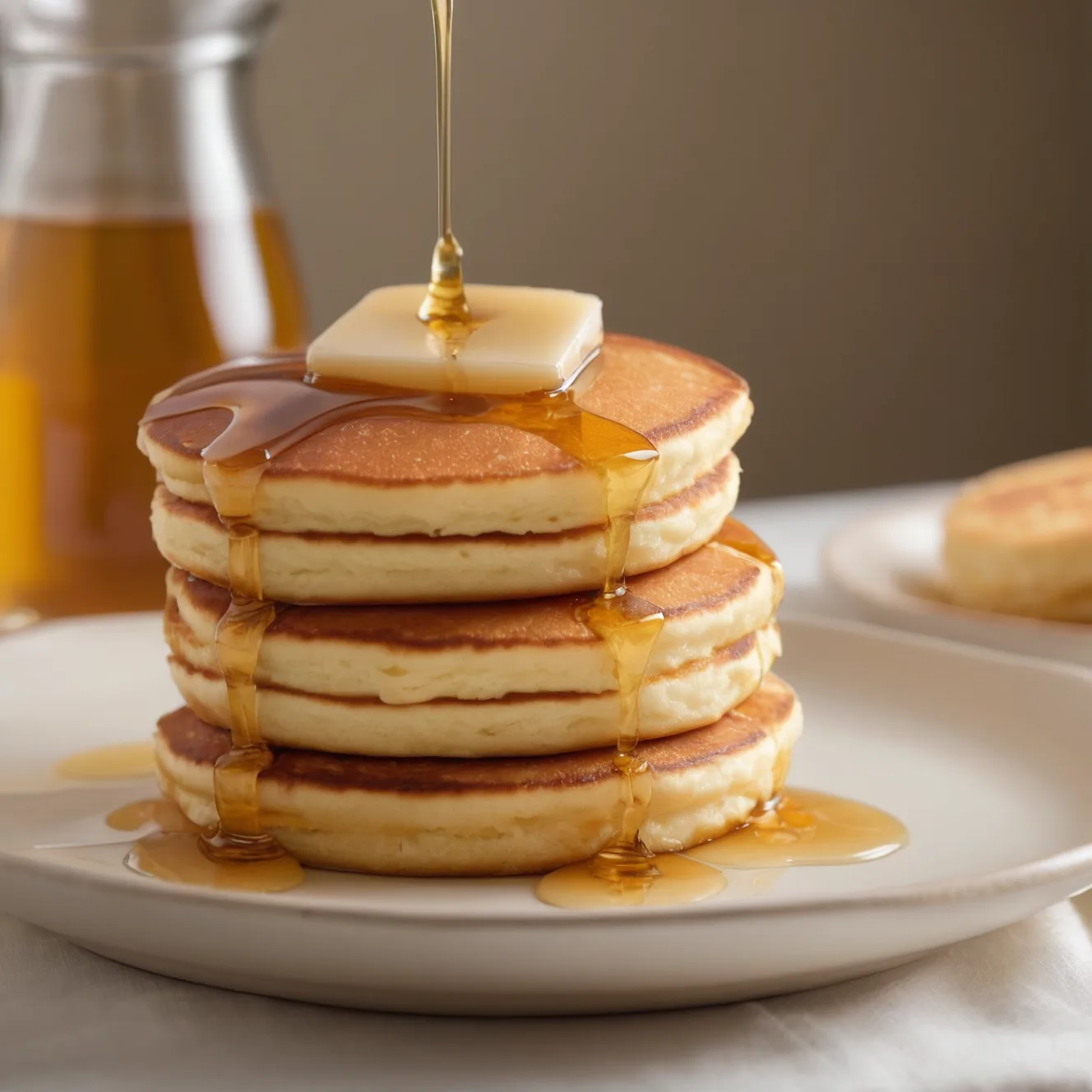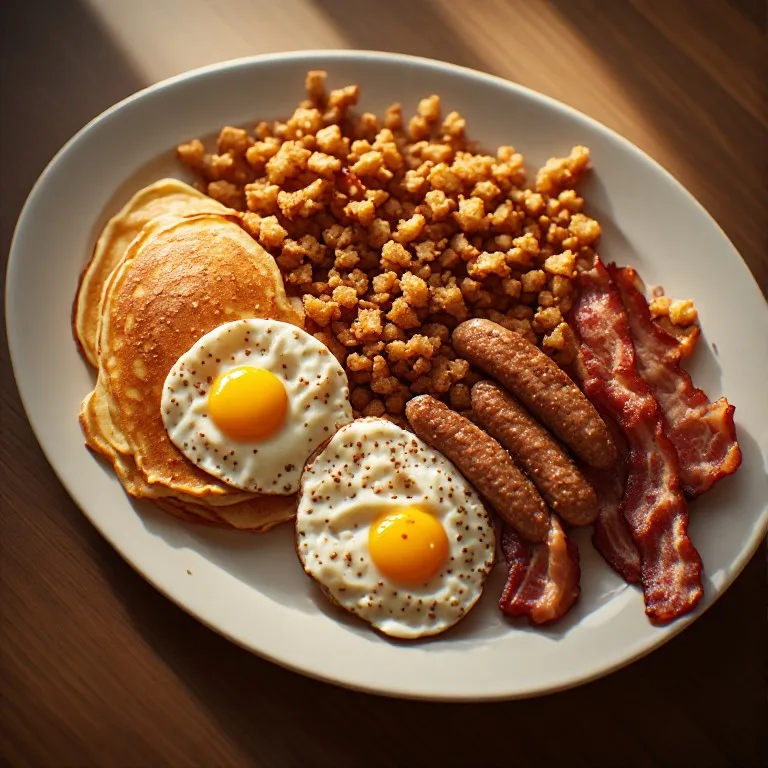



Denny’s Lumberjack Slam is the chain’s version of the full diner breakfast: every major protein on one plate, plus two starches. Where the Grand Slam is four items (pancakes, eggs, bacon, sausage), the Lumberjack Slam is seven — add a ham steak, hash browns, and white toast, and you have a plate that’s been feeding shift workers, travelers, and post-bar crowds for decades.
The techniques that separate a good Lumberjack Slam from a mediocre one are not complicated, but most copycat attempts get at least two of them wrong. This recipe addresses all three.
What Makes the Lumberjack Slam Different from the Grand Slam
The Grand Slam is the menu’s backbone — four items, baseball theme, 1977. The Lumberjack Slam adds the three components the Grand Slam omits: a ham steak, hash browns, and toast. That’s not just more food; it’s a fundamentally different coordination problem. Four items can be managed by one cook in two pans. Seven items require a sequencing plan or things come to the table cold.
The ham steak is the defining addition. Without it, you have an upgraded Grand Slam. The ham’s caramelized sear — the sweet, slightly charred crust from a flat-top at high heat — is what makes the Lumberjack Slam feel like a distinct plate rather than a padded order.
The Ham: The Component That Makes or Breaks This Plate
Most copycat attempts use thin deli ham and fail. The restaurant version uses a thick boneless ham steak — a slab roughly half an inch thick — cooked on a flat-top griddle at high heat until it develops caramelization and char marks on both cut faces.
Ham is already cooked (cured and fully pre-cooked), which means you are not cooking it through — you are building color and the Maillard reaction products that produce the sweet, slightly smoky crust that distinguishes a diner ham from a microwaved deli slice. This requires high heat, dry surface contact, and at minimum 2–3 minutes per side without moving the steak.
What to buy: Look in the refrigerated meat case for packages labeled “ham steaks” or “center-cut ham slices” — typically sold near pork chops. Smithfield, Hormel, and store-brand options are all fine. Avoid the deli counter (slices are too thin and too processed) and avoid Canadian bacon (different cure, different texture). Bone-in-style ham steaks are acceptable; they tend to be moister.
Why cast iron or heavy stainless: Nonstick pans are rated to around 450°F. Getting real char marks on ham requires a surface temperature well above that. A cast iron skillet preheated over high heat for 2 minutes, with a thin film of oil, will produce the color you’re after. A nonstick skillet over medium-high will produce a pallid, steamed-looking piece of ham.
Hash Browns: The Moisture Problem
The only reason hash browns fail is retained moisture. A medium russet potato is approximately 80% water by weight. If you grate it and go straight to the pan, you’re steaming potato in its own liquid. The exterior can’t brown because liquid evaporates at 212°F and browning happens well above that.
The fix is wringing. Grate the potatoes, spread the shreds on a clean kitchen towel, fold the towel tightly, and wring over the sink as hard as you can — then wring again. The shreds will look almost dry. They still contain plenty of moisture to steam slightly in the pan, but the surface is dry enough to start browning immediately on contact with hot fat.
The second mistake is moving hash browns too early. A crust needs to form before the patty can be flipped without falling apart. Four full minutes without touching is the rule — check by lifting one edge with a spatula. If it’s deep golden brown and the patty holds together, flip. If it’s pale or sticking, it needs more time.
Clarified butter vs. vegetable oil: Clarified butter has a higher smoke point than whole butter (because the milk solids that burn have been removed) and produces better browning and flavor than vegetable oil. If you have it, use it. If you don’t, vegetable oil works fine — do not use whole butter, which burns before the hash browns are done.
Eggs: All Styles
The Lumberjack Slam comes with two eggs any style, cooked to order. Scrambled is the default and goes last — eggs are the most time-sensitive item on the plate and the only one that cannot be held in the oven without degrading. For all other styles, the technique is identical to what Denny’s serves with the Grand Slam:
Over-easy: Butter, medium heat, egg cracked in gently. Cook until white is fully set with no translucent spots (~2 minutes). Flip with a thin spatula, cook 20–30 seconds. Yolk runs when broken.
Over-medium: Same process but 45–60 seconds after the flip. Yolk is jammy but not fully set.
Over-hard: Same process, 1.5–2 minutes after the flip. Yolk fully set.
Sunny-side up: Medium-low heat, cover the skillet with a lid for 1–2 minutes to steam the top white without flipping. Yolk stays intact and runny.
Poached: 3 inches of water at a bare simmer with a splash of white vinegar. Gentle swirl, egg cracked into a small cup first, slipped in from the surface. 3 minutes for runny, 4 minutes for set.
The Seven-Component Timing Sequence
This is where most home attempts fall apart. You cannot cook seven components simultaneously. The sequence below staggers starts so everything finishes within 5 minutes of each other:
- Bacon (10 min, cold-start method) → oven
- Sausage (8 min, in bacon fat) → oven
- Grate and wring potatoes (5 min passive — do this while sausage cooks)
- Mix and rest pancake batter (5 min passive — runs parallel to potato prep)
- Hash browns (8 min, two rounds of two portions) → oven in single layer
- Ham steaks (5–6 min total on high heat) → oven
- Pancakes (5–6 min per round) → oven, uncovered
- Toast (2–3 min, buttered flat-top method) → plate immediately
- Eggs (2 min) → plate immediately
Total active cooking time is 35–40 minutes. The 200°F oven is what makes this achievable — it holds items warm without continuing to cook them. At 200°F, bacon, sausage, ham, and pancakes hold 20–30 minutes without quality loss.
The Sodium
The restaurant Lumberjack Slam with hash browns and white toast contains 4,110mg sodium per FatSecret — nearly three times the American Heart Association’s 1,500mg daily recommendation in one plate. This is worth knowing if sodium is a concern, and it explains why the plate feels filling well after the physical volume alone would justify it. Salt is a satiety signal.
At home, using unsalted butter throughout, measuring salt on the hash browns rather than free-pouring, and toasting in a pop-up toaster rather than the buttered flat-top method knocks a meaningful amount off — exact figures depend on which ham you buy (sodium varies widely by brand).
How It Compares to Other Denny’s Breakfasts
| Item | Calories | Sodium | Price |
|---|---|---|---|
| Original Grand Slam | 740 | 2,300mg | ~$11.99 |
| Lumberjack Slam | 1,260 | 4,110mg | ~$16 |
| Moons Over My Hammy | 870 | 2,510mg | ~$14.49 |
| Country Fried Steak & Eggs | 1,020 | 2,940mg | ~$15.49 |
Prices are approximate and swing widely by location and franchise — the Lumberjack Slam alone has been spotted anywhere from about $11 to over $18. The Lumberjack Slam is the highest-calorie and highest-sodium item of the four. It’s also the only one that includes every major breakfast component in a single order.
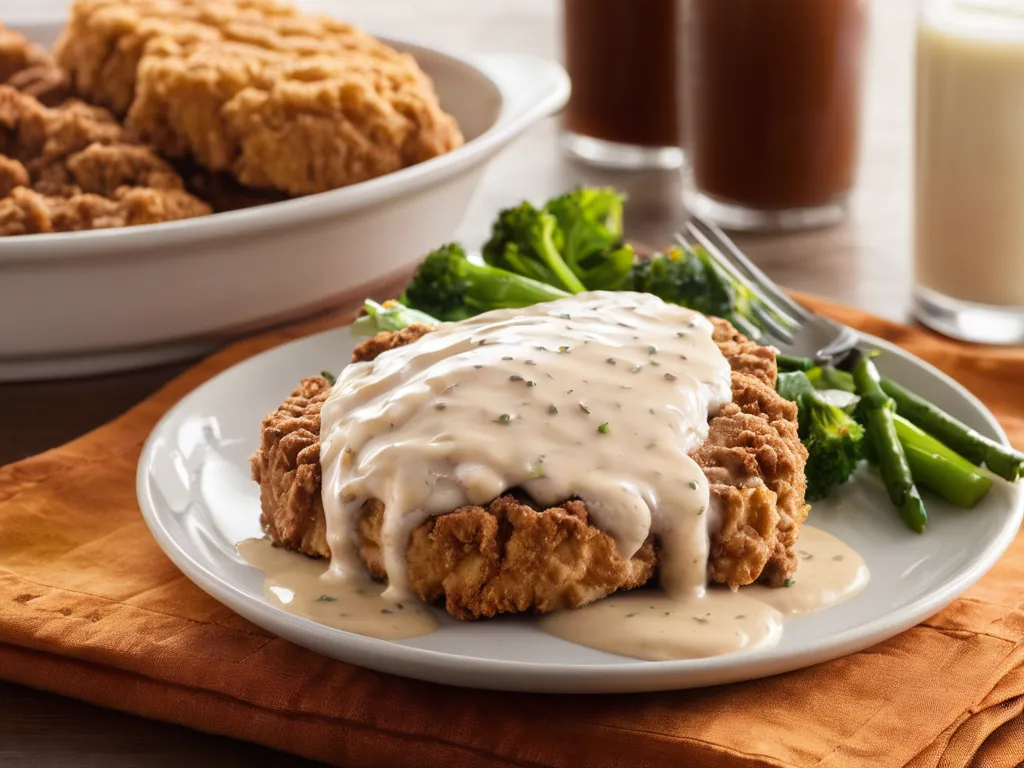
For the Grand Slam recipe with the full buttermilk pancake formula, egg technique breakdown, and bacon-from-cold method, see Denny’s Grand Slam copycat. For the Denny’s Moons Over My Hammy — the sourdough egg-and-ham melt — or the Denny’s Country Fried Steak, both are in the catalog.