Copycat Frank Pepe’s White Clam Pizza (The New Haven Original, Made at Home)
Prep time: 30 min (plus 24-48 hr cold ferment) Cook time: 8 min Servings: 4 Difficulty: Medium
Three Mistakes Most Copycat Recipes Make
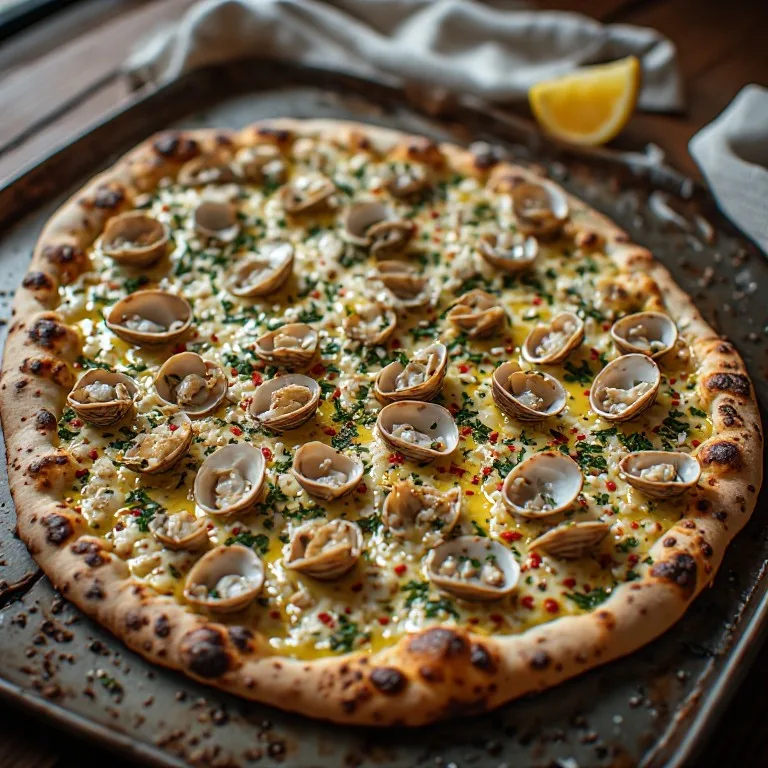
Mistake 1: Adding mozzarella. Every clam white pizza at a regular pizza shop has mozzarella. The Frank Pepe original does not. The cheese creates a steam barrier that dilutes the clam brine and softens the crust — it turns a lean, intense pizza into a familiar cheesy one. Not bad, just different. The no-cheese version is more surprising and more distinctive.
Mistake 2: Using canned clams. Canned clams are pre-cooked and waterlogged. Their liquid is weak and salty rather than bright and oceanic. More practically, their excess moisture makes the crust soggy. Fresh littlenecks placed raw on the pizza cook in the oven’s heat while simultaneously releasing juice that soaks into the dough — that brine-soaked crust is the signature of the dish.
Mistake 3: Oven temperature too low (or not preheating the steel long enough). At 400°F on a cold sheet pan, the pizza bakes for 15 to 20 minutes, the clams overcook, the garlic burns unevenly, and the crust never chars. At 550°F on a baking steel preheated for 60 minutes, the pizza is done in 6 to 8 minutes — the crust sets on the bottom before the toppings have time to overcook. The full-hour preheat is not optional; the steel needs to absorb heat throughout its mass, not just on the surface.
The Dough: Why Cold Fermentation Matters
A 1-hour warm rise produces serviceable pizza dough. A 24 to 48-hour cold ferment produces a dough with a distinctly more complex flavor: the yeast works slowly at refrigerator temperature, generating flavor compounds rather than just carbon dioxide. The gluten also relaxes during the cold rest, making the dough easier to stretch without tearing and producing the chewy, slightly blistered texture associated with New Haven-style pizza. If you want the opposite of this lean, savory crust — soft, sweet, and golden — the same slow-rise principle drives our Papa John’s pizza dough recipe.
The recipe below makes enough dough for one 14-inch pizza. If you are cooking for more than four people, double the batch and divide into two dough balls — bake them back-to-back, returning the steel to temperature for 10 minutes between pies.
Building the Pizza: The Right Order
The order of toppings matters here. Olive oil goes directly on the dough first — it creates a barrier that keeps the dough from absorbing too much clam juice and sogging out. Garlic goes on the oil, not on top of the clams, so it caramelizes against the crust rather than steaming under the clam pile. The clams go on last (before the cheese), so they are exposed to the oven’s radiant heat and cook through cleanly.
Work quickly once the pizza is on the peel. Every minute the dressed pizza sits on the semolina, the clam juice softens the dough from below. From toppings-on to oven should be under 3 minutes.
The Coal-Fired Oven vs. a Home Oven
Frank Pepe’s ovens burn anthracite coal and reach 800 to 900°F. A home oven maxes at 500 to 550°F. The gap is real and you cannot fully close it — but the right equipment and technique get you 85 to 90 percent of the way there.
The baking steel is the key variable. Its thermal mass means it holds far more heat than a stone or sheet pan and delivers that heat instantly to the dough’s underside. The full 60-minute preheat saturates the steel with heat. When the pizza lands on it, you hear a distinct sizzle — that is the crust setting immediately rather than sitting on a gradually warming surface.
If you have an outdoor pizza oven (Ooni, Roccbox, or similar) that reaches 700°F or more, use it: you will get a closer result than any home oven can produce.
At the Restaurant
Frank Pepe’s original New Haven location at 157 Wooster Street — the Spot, as longtime regulars call it — is a no-reservation institution with lines that start before opening on weekends. The white clam pizza runs roughly $30 to $35 for a large (about $25 to $30 for a medium); a small original clam pie is the more common single-person order. From that one shop, Frank Pepe’s has grown to roughly 16 to 17 locations across seven states — including Connecticut (Hamden, Manchester, Fairfield, and others), Massachusetts, Rhode Island, and New York. The New Haven original is the benchmark. Budget the drive — or build the steel.