



Pin It

Momofuku Noodle Bar Ramen (David Chang's Shoyu Broth at Home)

Momofuku Noodle Bar Ramen (David Chang's Shoyu Broth at Home)
Jump to Recipe
Prep 45 min (plus 6 hr simmer) Cook 6 hr 30 min Serves 4
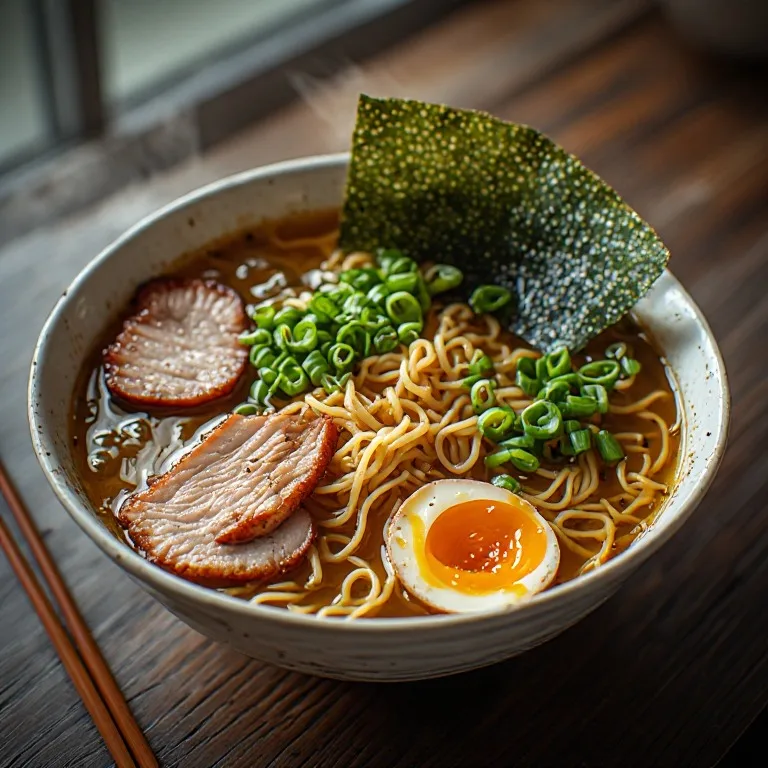
Quick answer: Rinse 3 pieces of kombu under cold water, combine with 5 quarts cold water in a large stockpot, heat over medium until just below a simmer (180°F), turn off heat, and steep 10 minutes — do not boil, or the kombu turns bitter. Remove kombu. Add 1 cup dried shiitakes, bring to a gentle boil, simmer 30 minutes until mushrooms have given their color to the broth. While the kombu steeps, roast 2½ lb pork neck bones on a sheet pan at 425°F for 25 minutes until deeply browned. Add the roasted pork bones to the broth, along with 2 chicken leg quarters and 4 slices thick-cut bacon. Return to a gentle simmer. After exactly 45 minutes, remove the bacon — any longer and it overpowers everything. Continue simmering the broth with 3 scallions, 1 charred halved onion, and 1 carrot for 5 to 6 more hours. Strain and discard solids. Make the tare: in a small saucepan, combine 1 cup Japanese soy sauce (Kikkoman or Yamasa), ½ cup sake, ½ cup mirin, and 2 tablespoons chicken fat or neutral oil. Simmer 5 minutes until slightly reduced. To serve, heat broth to a full rolling boil. Cook 3 to 4 oz fresh or dried alkaline ramen noodles per package directions; drain. Ladle 1½ cups very hot broth into a prewarmed bowl, stir in 2 to 3 tablespoons tare, and adjust to taste — the seasoned broth should be just at the edge of too salty. Add noodles. Top with 2 to 3 slices of dry-cured roasted pork belly (seared until caramelized), one halved soy-marinated egg, a small mound of bamboo shoots (menma), 2 sheets of nori, and thinly sliced scallions. A few drops of sesame oil over the top. Serve immediately — ramen waits for no one. At Momofuku Noodle Bar, the ramen runs about $24 to $28 per bowl; the full broth batch below makes 8 to 10 portions for roughly $35 in ingredients.

Momofuku Noodle Bar Ramen (David Chang's Shoyu Broth at Home)

The famous Momofuku Noodle Bar ramen made at home: a golden shoyu broth built on kombu, dried shiitakes, roasted bones, and the secret American ingredient — bacon. The dish that launched David Chang's empire, decoded from the Momofuku cookbook.

Hard Prep: 45 min (plus 6 hr simmer) Cook: 6 hr 30 min Total: 13h 15m4 servings ~$4.50/serving
Prep45 min (plus 6 hr simmer)
Cook6 hr 30 min
Total13h 15m
Servings
4
At home~$4.50/serving
vs
Restaurant~$20.25/serving
You save ~78%

The Story Behind the Recipe

The famous Momofuku Noodle Bar ramen made at home: a golden shoyu broth built on kombu, dried shiitakes, roasted bones, and the secret American ingredient — bacon. The dish that launched David Chang's empire, decoded from the Momofuku cookbook.

Nutrition Facts

Per serving (4 servings)
Calories680
Total Fat28g
Total Carbs58g
Dietary Fiber3g
Sugars6g
Protein42g
Sodium1420mg

* Estimated values based on standard recipe preparation. Actual values may vary.

Ingredients

  • Broth (makes 3 to 4 quarts)
  • Shoyu tare (makes enough for 8 to 10 bowls)
  • Per bowl (4 servings)

Instructions

💡
Pro tip: This recipe tastes even better the next day. The flavors need time to meld together in the fridge.
❄️
Storage: Keeps in an airtight container in the fridge for up to 2 weeks. Freezer-friendly for up to 3 months.
🎃 Free Halloween cookbook — download now The Copycat Halloween Cookbook A ready-made, photo-illustrated PDF of our best halloween copycat recipes — free to download, no building required. Pay what you want to support if you love it.

Free PDF — instant download. We'll also send new seasonal copycat recipes now and then; unsubscribe anytime. Or just download it →

Copycat Momofuku Noodle Bar Ramen (David Chang’s Shoyu Broth at Home)

Prep time: 45 min (plus 6 hr simmer) Cook time: 6 hr 30 min Servings: 4

David Chang opened Momofuku Noodle Bar in August 2004 at 163 First Avenue in New York’s East Village. The menu was built around ramen. Not the polished, reservation-required food that would come later — just ramen, served at a counter in a 600-square-foot room. Chang had trained in Japanese ramen shops and wanted to make ramen in New York with the ingredients he had: American chicken, American pork bones, and American bacon.

The pork buns came later, almost by accident. The ramen was the original vision.

Two decades on, the Momofuku empire spans multiple concepts and James Beard Awards, and David Chang is considered one of the most influential chefs in American food. The shoyu ramen that started it all is no longer the main focus at the Noodle Bar, which has evolved considerably. But the recipe — documented in the 2009 Momofuku cookbook with Peter Meehan — remains the foundational statement of what the restaurant was built on. A broth that takes the Japanese dashi technique seriously and then does one distinctly American thing to it.

That thing is bacon.

What the Cookbook Actually Says

The Momofuku cookbook ramen broth is a four-stage build. Stage one: kombu steeped in water just below a boil, then removed. Stage two: dried shiitakes simmered 30 minutes. Stage three: roasted pork neck bones, chicken leg quarters, and bacon added, simmered together — bacon pulled out at exactly 45 minutes. Stage four: everything simmers another five to six hours with scallions, a charred onion, and carrot.

The tare — the seasoning sauce — is made separately from the broth. It is not a secret ingredient inside the broth; it is added per bowl at service. Soy sauce, sake, mirin, and chicken fat, simmered briefly. Two to three tablespoons per bowl, stirred into the hot broth just before noodles go in.

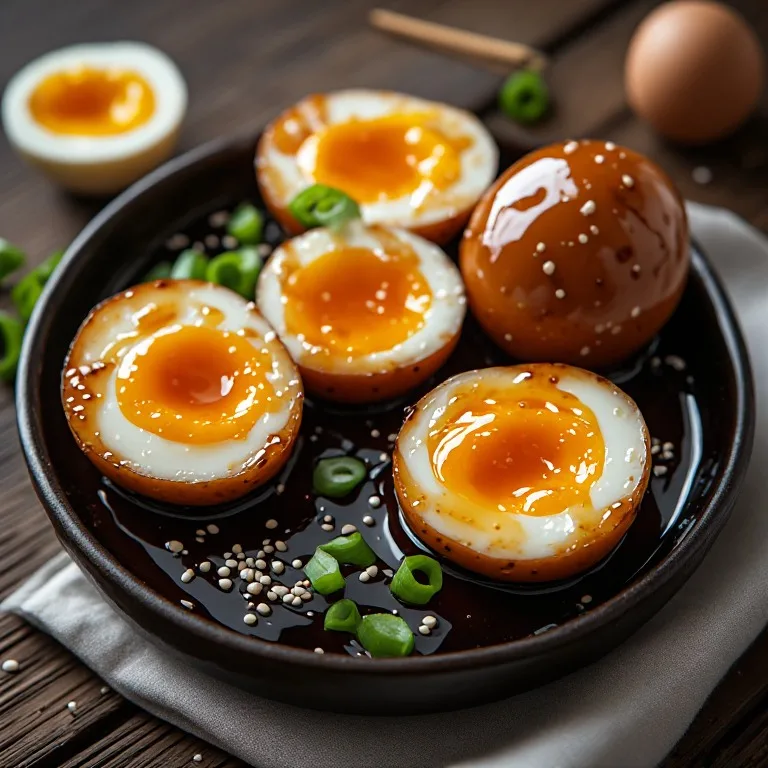
The toppings are the salt-and-sugar-cured pork belly from the pork buns (same recipe, same technique), Momofuku soy-marinated eggs, bamboo shoots, nori, scallions, sesame oil.

That is the recipe. The technique behind each step is where most home attempts go wrong.

The Bacon Rule

Bacon is not a background flavor — it is a forward one, and it will take over the broth if left in too long. Chang’s 45-minute rule is not approximate. At 45 minutes, the bacon has donated smoke, pork fat, and saltiness to the broth without converting it into something that tastes primarily of cured pork. Past 90 minutes, the broth tastes of bacon specifically — that round, sweet, smoky note that is good in sandwiches and wrong in a bowl of ramen. At 3 hours, it tastes like condensed bacon soup.

Set a timer. Remove the bacon at 45 minutes. You will likely taste the broth and think it needs more — it doesn’t. The tare will season the broth at service, and the pork belly topping brings additional meatiness. The bacon has done its work.

In traditional Japanese shoyu ramen, the smoked note comes from katsuobushi, dried bonito shaved thin and steeped briefly in hot water. The flavor is lighter and more oceanic than bacon, with similar umami compounds but less sweetness and almost no pork fat. Chang’s substitution produces a bolder, richer, more American-tasting broth — more assertive but less delicate. This is the right trade given the rest of the dish’s character.

Tare: Why It’s Made Separately

Real ramen — at every serious ramen shop — is built in two parts: the soup (unseasoned broth) and the tare (seasoning concentrate). They are combined at service, per bowl, in the proportions that taste right that day. This separation exists for a practical reason: you can make a large batch of neutral broth and season each bowl to taste, adjusting the tare based on the specific bowl and the preference of the person eating it.

What it means at home: the broth you pull off the heat after six hours should taste clean and savory but underseasoned. That is correct. Season it when it goes in the bowl, not in the pot.

The Momofuku tare is soy sauce, sake, and mirin simmered with chicken fat. The fat is important — it coats the broth and gives it a slight richness that plain soy sauce doesn’t provide. The easiest way to get it: after the broth chills overnight, the chicken fat solidifies on the surface — skim a spoonful of that (schmaltz) and melt it into the tare. Store-bought schmaltz or plain neutral oil works as a substitute. Either works; the chicken fat version is better.

Use 2 tablespoons of tare per bowl as a starting point, stir it into the hot broth before adding noodles, and taste. Add more tare in small increments. Chang’s standard in the cookbook: the broth should be “at but just under too salty.” Season up to that point and stop.

The Kombu Extraction

Kombu is dried kelp, and it contains glutamates — the compounds responsible for umami — in high concentrations. It releases those glutamates at temperatures between 140°F and 180°F. At boiling temperature (212°F), it releases alginic acid and other compounds that taste bitter and produce a slimy texture.

The technique: start the kombu in cold water, heat to just below a simmer (you want small bubbles starting to form, not a rolling boil), let it steep 10 minutes, remove before raising heat. This is cold-start dashi, the foundational technique in Japanese cooking. Most home cooks skip it because it adds a step and requires watching the temperature — but it takes 15 minutes total and produces a clean, ocean-scented broth layer that carries through the whole six-hour simmer.

The Noodles

Sun Noodle, based in Pennsauken, New Jersey, is the noodle of record at Momofuku Noodle Bar and most serious ramen shops in North America. Sun Noodle makes alkaline noodles — the kansui (potassium carbonate and sodium carbonate solution) that goes into the dough is what gives ramen noodles their yellow color, springy-firm bite, and slightly mineral flavor. Sun Noodle sells direct and through select retailers; their dried varieties are widely available at Asian grocery stores.

What you’re looking for at the grocery store: refrigerated or frozen fresh ramen noodle packets, or dried ramen noodles specifically marketed for ramen (not instant ramen with flavor packets). The label may say “alkaline noodles,” “sun noodle,” or just “ramen noodles” — the indication is a yellow-golden color from kansui rather than eggs. Fresh noodles cook in 1 to 2 minutes and have a springier texture; dried noodles take 3 to 4 minutes and are slightly more uniform in texture.

Egg noodles look similar but cook softer and lack the alkaline chew. Regular pasta produces a wrong-textured bowl even in correct broth. The noodle is the structural backbone of ramen — it matters.

Building the Bowl

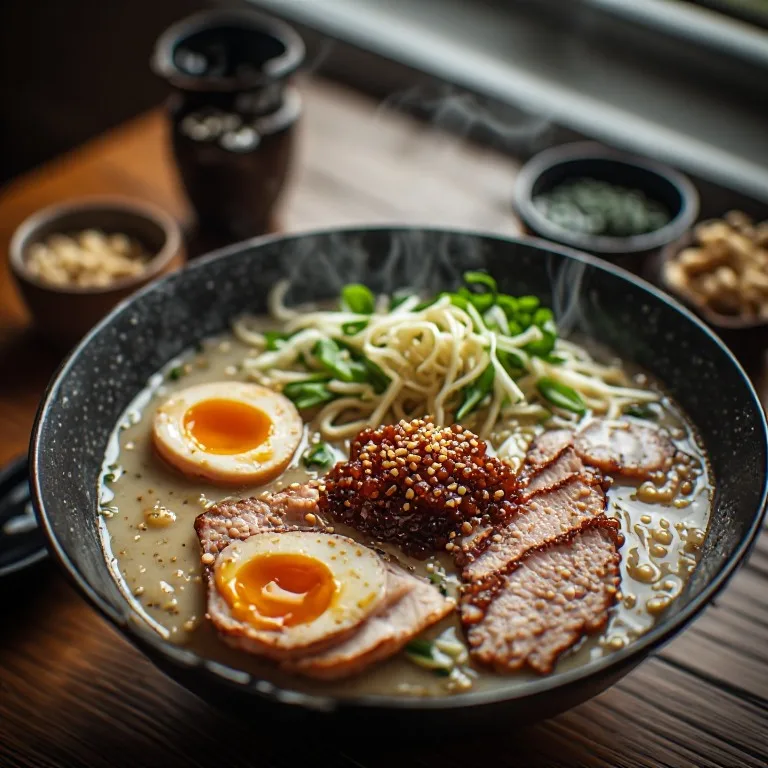
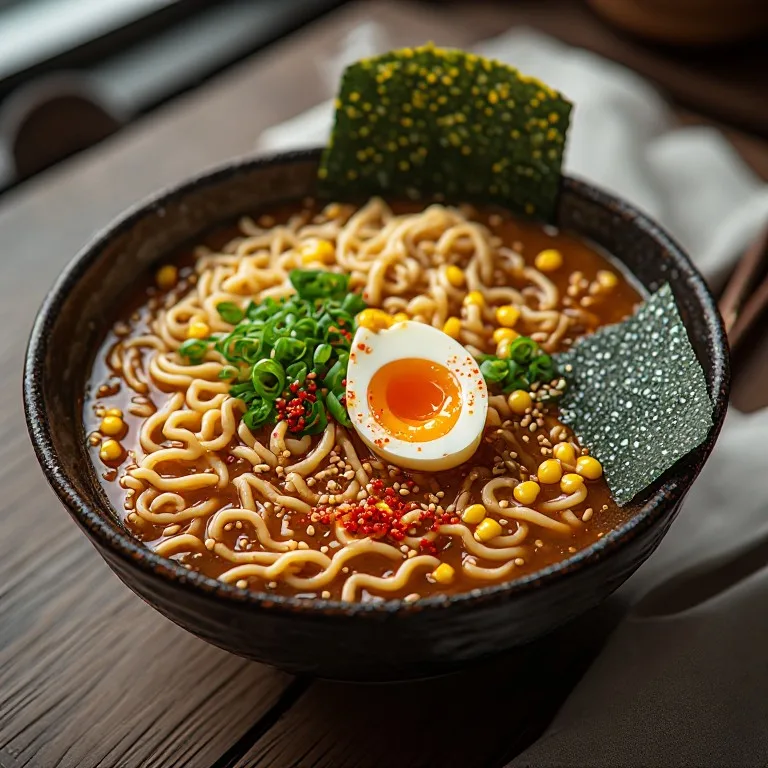
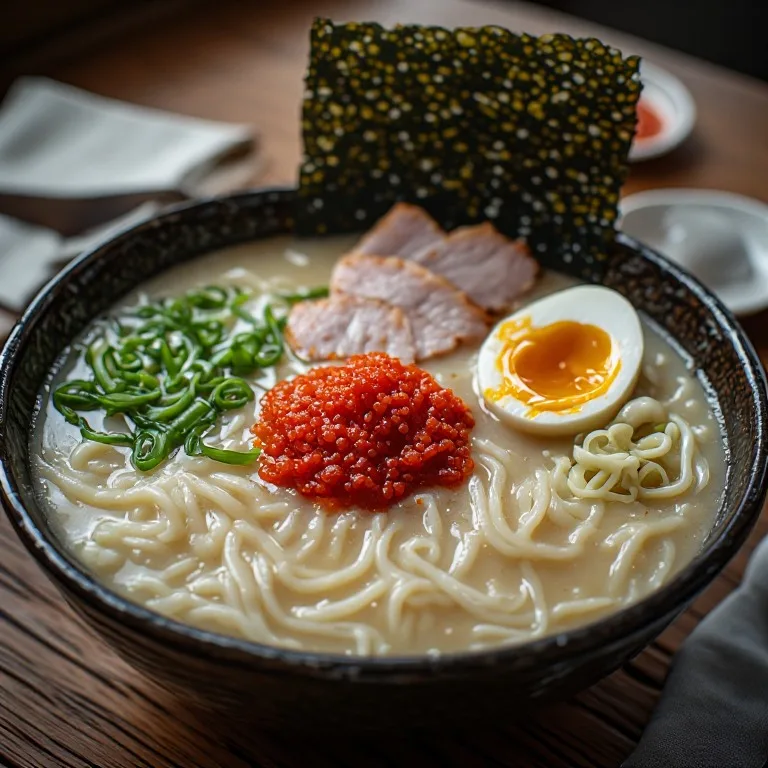
Assembly is fast when components are ready. Bring broth to a full boil before service — not a warm simmer, a boil. Preheat bowls (fill with boiling water, let sit 2 minutes, drain right before plating). Cook noodles per package directions; drain but do not rinse with cold water. Working quickly: tare in the prewarmed bowl first, then boiling broth poured over, then noodles. Taste and adjust. Then toppings — pork belly slices seared to caramelized, soy egg halved to show the jammy yolk, bamboo shoots, nori stood upright at the edge of the bowl, scallions, sesame oil.

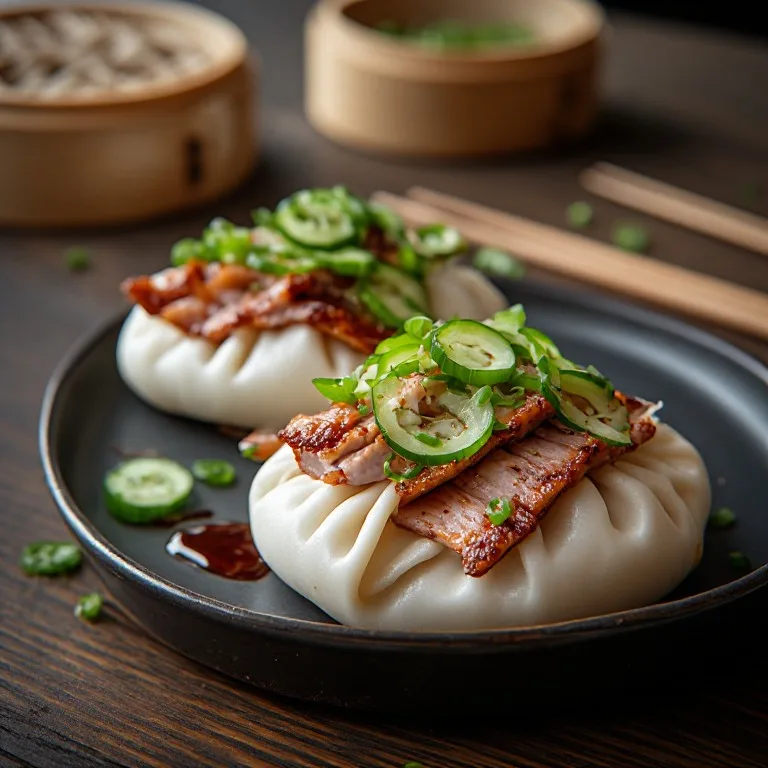
The pork belly for the ramen is the same dry-cured belly from the Momofuku pork buns recipe — salt, sugar, roast, chill, slice, sear. That belly was already on the menu when ramen launched. Chang saw no reason to change it for the topping format.

Serve immediately. In a ramen shop, the gap between bowl hitting the pass and reaching the table is 90 seconds. At home, the gap between assembling and sitting down should be similarly brief. The noodles are absorbing broth from the moment the bowl is assembled. Ramen is a meal that rewards urgency.
🥗

Make It Healthier

Love Momofuku Noodle Bar Ramen (David Chang's Shoyu Broth at Home) but want a lighter version? Try these simple swaps:

  • ✓Swap the pork belly topping for thinly sliced chicken breast poached directly in the broth for the last 10 minutes of service — the sodium and fat drop significantly and the broth gains extra depth.
  • ✓Reduce the tare per bowl from 3 tablespoons to 1½ tablespoons — the sodium per serving drops by roughly 400mg. The broth will taste thinner, but adding a squeeze of fresh ginger juice compensates with brightness.
  • ✓Add a large handful of baby spinach or bok choy to the bowl with the noodles — the residual heat of the broth wilts them in 60 seconds. Adds fiber and volume at almost no caloric cost.

Frequently Asked Questions

Why does the Momofuku broth use bacon? That's not a traditional Japanese ingredient.

David Chang opened Momofuku Noodle Bar in 2004 after cooking in Japanese ramen shops and wanted to make ramen with American pantry staples. In traditional Japanese ramen, umami and smokiness come in part from katsuobushi (dried bonito flakes), which build a dashi base. Chang substituted thick-cut bacon. The reasoning is culinary, not symbolic: bacon is smoked and cured pork, and when simmered in broth it contributes a similar quality of smoke-touched meatiness that katsuobushi does — a low-grade saltiness and a savory background note that doesn't read distinctly as 'bacon flavor' but makes the broth rounder. The critical rule is 45 minutes. Left in longer, the bacon crosses from background note into dominant flavor. Most home recipes ignore this timing and end up with a broth that tastes overwhelmingly smoked. Chang's cookbook specifies 45 minutes explicitly. Remove the bacon, keep the broth. That exchange is the single most important timing detail in the whole recipe.

What is tare, and why can't I just season the broth with soy sauce directly?

Tare is the seasoning sauce that makes each bowl of ramen taste right. In professional ramen shops, the broth (called 'soup') and the seasoning (tare) are made separately and combined per bowl at service. This matters for two reasons. First, control: you can adjust seasoning per bowl without reheating and reducing the entire broth. Second, flavor depth: the Momofuku tare is not simply soy sauce — it is soy sauce simmered with sake, mirin, and chicken fat, which rounds the salt, adds sweetness, and builds a savory fat coating that adheres to the noodles rather than pooling at the bottom of the bowl. If you add raw soy sauce directly to the broth, you get a sharp, flat, edgy saltiness. The tare produces a rounder, layered seasoning that integrates into the broth rather than sitting on top of it. Use 2 to 3 tablespoons per 1½ cups broth as a starting point. Taste and add more. Chang writes that 'underseasoned broth is a crime' and means it — the broth should be aggressively seasoned, just at the edge of where more salt would be too much.

What kind of noodles does Momofuku use?

Momofuku Noodle Bar uses Sun Noodle, a New Jersey–based noodle manufacturer that supplies most serious ramen shops in North America. Sun Noodle makes alkaline noodles — wheat noodles made with kansui (a solution of sodium carbonate and potassium carbonate) that gives ramen noodles their characteristic yellow color, springy-firm bite, and slightly mineral wheat flavor. At home, fresh alkaline ramen noodles from an Asian grocery are the closest substitute — look for refrigerated or frozen ramen noodle packets at Korean or Japanese grocery stores. Dried ramen noodles (not the instant variety with flavor packets) also work; Sun Noodle makes a widely available dried version. What doesn't work: regular pasta, soba, udon, rice noodles, or instant ramen noodles divorced from their packets. Egg noodles are visually similar (also yellow) but produce a different texture — they soften faster and lack the alkaline chew. The noodle is load-bearing in a bowl of ramen; using the wrong one produces a dish that tastes off even when the broth is right.

Why do you start the kombu in cold water and not boil it?

Kombu releases glutamates — the compounds responsible for its umami — at temperatures between 140°F and 180°F. At a full boil (212°F), kombu releases alginic acid compounds that taste bitter, slimy, and unpleasant, muddying the broth. Cold-start extraction: submerge the kombu in cold water, heat slowly to just below a simmer, hold there for 10 minutes, then remove the kombu before raising the heat further. This is the standard dashi technique in Japanese cooking. The same logic applies to bonito-based dashi — bonito also turns bitter when boiled. Steep the kombu separately before adding the bones, because the bones require a long hard simmer at temperatures that would destroy the kombu's contribution. Layer the extractions in order: kombu first at low heat, shiitake at a gentle boil, then bones and bacon for the long simmer. Each layer adds to the broth without damaging the previous one.

Why roast the pork bones before adding them to the broth?

Raw pork bones contribute gelatin and collagen (which gives the broth body) but not much Maillard-reaction flavor — the deep, roasted, meaty notes that make a broth taste like it has been worked for hours. Roasting the bones at 425°F for 25 minutes until they're deeply browned creates hundreds of flavor compounds on the bone surface through the Maillard reaction. When those browned bones go into the broth, those compounds dissolve into the liquid over the long simmer. The result is a broth with a significantly deeper, more complex flavor profile than a broth made with raw bones. You can skip the roasting step and still produce a palatable broth — but it will taste thinner and less developed. The roasting takes 25 minutes and produces noticeably better results. Also important: blanch or rinse raw bones first to remove blood and impurities, which cause scum and off-flavors in the broth.

Why preheat the bowls before serving?

Ramen broth must be served at a full rolling boil — around 212°F. A room-temperature ceramic bowl immediately drops the broth temperature by 8 to 12°F on contact. Over the 2 to 3 minutes it takes to assemble and transport the bowl, the broth drops further. By the time a bowl reaches the table in a cold bowl, it may be below 185°F, which is the point at which ramen begins to read as 'lukewarm' rather than 'piping hot.' Ramen noodles also continue to absorb broth as the bowl sits; a bowl that starts at the right temperature stays in the right window longer. Preheat bowls by filling them with boiling water for 1 to 2 minutes before service, then dumping and drying quickly. Restaurant ramen shops keep their bowls warmed continuously for this reason. At home, even 30 seconds of hot water in the bowl makes a meaningful difference in how the finished bowl holds up from counter to table.

How is this different from tonkotsu ramen?

Tonkotsu broth is made by boiling pork trotters and femur bones at a hard boil for 8 to 18 hours, emulsifying bone marrow fat and collagen into a thick, opaque, milky white broth with a strong pork flavor. The opacity is caused by fat and collagen particles kept in suspension by the aggressive boil. Momofuku's ramen is a shoyu ramen — a golden, semi-clear broth built on chicken bones, pork neck bones, and bacon, seasoned with a soy-based tare. It is not boiled aggressively; it is simmered gently, which keeps the fat mostly unbroken and the broth relatively clear. The result is a lighter-bodied broth with more distinct individual flavor contributions (umami from kombu and shiitake, smoke from bacon, richness from bones and chicken) compared to the thick, fatty, all-in-one quality of tonkotsu. Tonkotsu eaters sometimes find shoyu ramen thin; shoyu ramen advocates find tonkotsu heavy. Momofuku's version is firmly in the shoyu camp, and its accessibility — it doesn't require cracking femur bones or a 12-hour boil — makes it more practical for home cooks.

Can I make the broth ahead and what's the best way to store it?

Yes — the broth actually improves overnight in the fridge as flavors continue to develop and any remaining fat solidifies and can be skimmed cleanly from the surface. The strained broth keeps refrigerated for up to 5 days or frozen for up to 3 months. Freeze in quart containers (1½ cups per serving portion) for easy individual servings. The tare keeps in the fridge for 2 weeks in a sealed jar. The pork belly (same dry-cure recipe as the pork buns) keeps refrigerated unsliced for up to 5 days and frozen for up to 1 month. The soy eggs keep refrigerated in their marinade for up to 5 days but are best between 6 and 48 hours of marinating. The bamboo shoots are canned and keep indefinitely once opened in water in the fridge. With all components made ahead, each bowl assembles in 5 minutes: boil noodles, heat broth, combine and top. This is worth knowing because the 6-hour broth seems daunting at first glance, but 90% of it is passive simmering — start it on a weekend morning and you have ramen components for the week.

Love this recipe? Share it!

Free PDF: our 12 most-wanted copycat recipes — instant download.

Made it? Buy us a coffee

Every recipe here is free, with no paywalls. If this one was a hit at your table, a small tip keeps new copycats coming.

$

Ratings & Reviews

—
No ratings yet

Rate this recipe

Click a star to rate

Leave a Review

0/500

CS

Copycat Spices Editorial

Researched + fact-checked. Every recipe on Copycat Spices is built from published sources — official ingredient lists, brand-published recipes, interviews and food-science references — and fact-checked before it goes live, then written as clear, step-by-step instructions for home cooks of all skill levels.

Learn more about our mission →