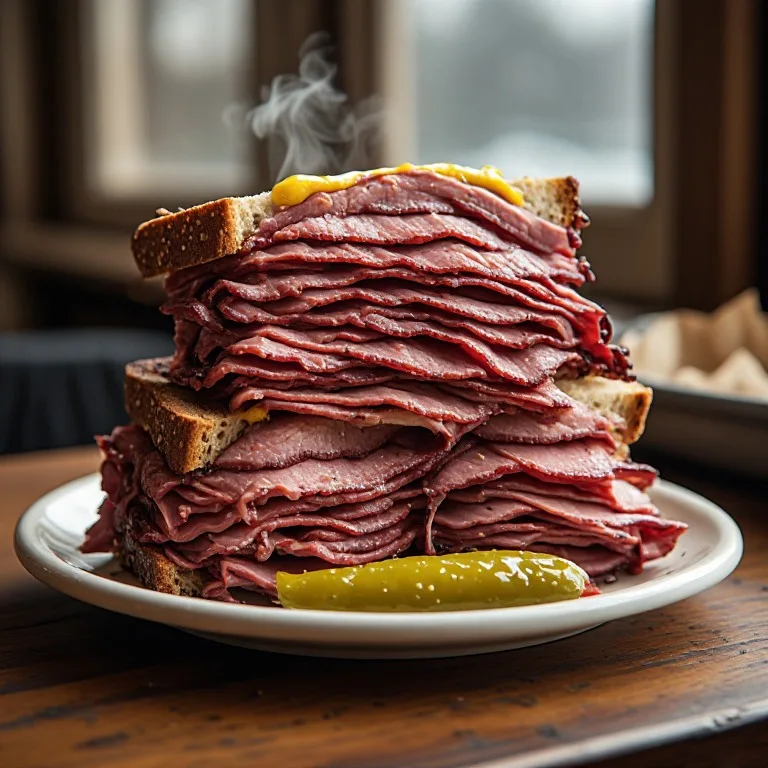


Copycat Franklin Barbecue Brisket (Aaron Franklin’s Famous Central Texas Method)
Prep time: 30 min Cook time: 12–14 hours (plus 2-hour rest) Servings: 12–16
Franklin Barbecue in Austin, Texas serves one thing: Central Texas barbecue. The menu is beef brisket, pork ribs, pulled pork, sausage, and turkey. The brisket is the reason people drive from other states and line up at 7:00 AM for a restaurant that does not open until 11:00. Aaron Franklin, who built his first smoker in a trailer in 2009 and moved to a brick building on East 11th Street a year later, won the James Beard Award for Best Chef: Southwest in 2015 — the first pitmaster ever to receive that recognition. His brisket is considered by many food writers to be the best in the country.
The brisket at Franklin runs about $42 per pound. It regularly sells out before 2:00 PM. The restaurant now accepts online reservations, but historically a 3-to-5-hour wait in line was the price of admission.
The method is simple. The execution requires patience.
What Makes This Brisket Different
Three principles define Franklin’s approach, and all three separate his brisket from most of what is sold as smoked brisket:
The whole packer brisket, cooked as one. A whole packer brisket is the flat and the point together, typically 12 to 14 pounds. The point is the fattier, more marbled muscle that sits on top of the flat; the flat is the lean, uniform lower muscle that most people picture as “brisket.” They are separated by a thick fat seam. Cooked together, the point’s intramuscular fat renders slowly throughout the cook, effectively basting the flat from above. Separating them — buying a “flat only” — removes this self-basting mechanism and makes a dry result almost inevitable in a 12-hour cook. Franklin cooks whole. So should you.
Post Oak wood, nothing else. Post Oak (Quercus stellata) is the traditional smoking wood of the Texas Hill Country, where Franklin Barbecue’s tradition originates. It produces a mild, clean smoke with almost no tannins or bitterness. After 12 or more hours of continuous smoke exposure, Post Oak never turns the meat harsh. Hickory is fine for a 3-hour rib cook; it can produce an acrid note on an all-day brisket. Mesquite burns hot and fast and overwhelms beef. Franklin uses Post Oak exclusively. The wood choice is not incidental.
The rest. Most brisket sold at restaurants and competition cooks is served within 30 to 60 minutes of leaving the smoker. Franklin holds his briskets for several hours — wrapped in butcher paper, sitting in a warming box — before slicing. The rest is not passive waiting. It is where the carryover heat finishes the final collagen-to-gelatin conversion in the flat, where the juices the cook forced to the center redistribute back through the muscle, and where the bark — that dark, pepper-crusted exterior — settles from a fragile surface layer into a cohesive part of the slice. The difference between a brisket rested 30 minutes and one rested 3 hours is significant, and it is what makes the slice come off the knife as a single, integrated piece rather than meat that separates from its exterior crust.
The Rub
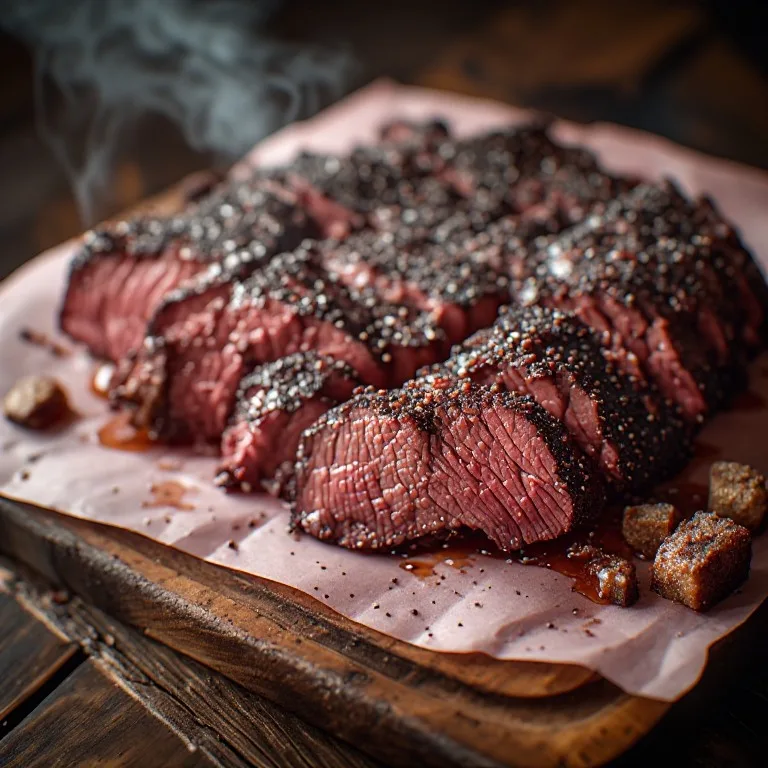
The Dalmatian rub — named for the spotted pattern it creates on raw meat — is 50 percent kosher salt and 50 percent coarse black pepper, applied liberally to every surface. That is the complete recipe.
This is not minimal because of laziness. It is minimal because any additional flavoring — garlic powder, paprika, onion, cumin, brown sugar, chili powder — competes with the two things a perfectly cooked Franklin brisket tastes like: beef and Post Oak smoke. The rub’s job is enhancement, not transformation.
The pepper must be coarse. 16-mesh black pepper (sometimes sold as “restaurant grind” or “BBQ grind”) is specified because fine ground pepper burns and turns bitter during a 12-hour smoke. Coarse pepper maintains its structure throughout the cook and creates a true pepper crust — a crunchy, spiced surface layer that is part of what people mean when they talk about the bark at Franklin Barbecue.
For a 12-pound brisket: 1/2 cup kosher salt, 1/2 cup coarse black pepper. Coat every surface until you can see the rub on every inch of meat.
The Bark
The bark — the darkened, firm exterior of a properly smoked brisket — is not just aesthetic. It is the product of the Maillard reaction and the ongoing polymerization of the pepper, salt, rendered fat, and smoke deposits on the meat’s surface over 12 hours of heat exposure. A good bark is deeply mahogany, dry and firm to the touch, and genuinely crusty. It should hold together when you slice through it rather than flaking off the meat.
Three things destroy bark: too much moisture (from wrapping in foil too early, from excess fat left on the surface, or from opening the smoker so often that temperature drops and steam accumulates), too low a temperature (bark requires sustained heat; 225°F for 12 hours builds it; lower temperatures produce pale, tacky surfaces), and overcrowding the smoker.
Franklin checks his bark before wrapping. Only when it is set, dark, and dry does the butcher paper go on. This is the single most important judgment call in the entire cook.
The Stall
Every beginning brisket cook encounters the stall with confusion: the temperature climbs steadily to around 165°F, then stops, sometimes for 3 or 4 hours, sometimes longer, while the smoker temperature holds steady at 225°F.
The stall is evaporative cooling. Moisture from within the brisket migrates to the surface and evaporates, absorbing heat energy at exactly the rate your fire is delivering it. The physics are identical to why sweating keeps you cool. It resolves on its own when enough surface moisture has evaporated that the equilibrium breaks. It requires nothing from the cook except patience.
The butcher paper wrap, applied after the bark is set, reduces the open evaporative surface area, which shortens the stall — sometimes significantly. It does not eliminate it. It also does not steam the bark the way foil wrapping does, because butcher paper breathes. This is why Franklin uses pink butcher paper and not the Texas Crutch (foil).
Slicing
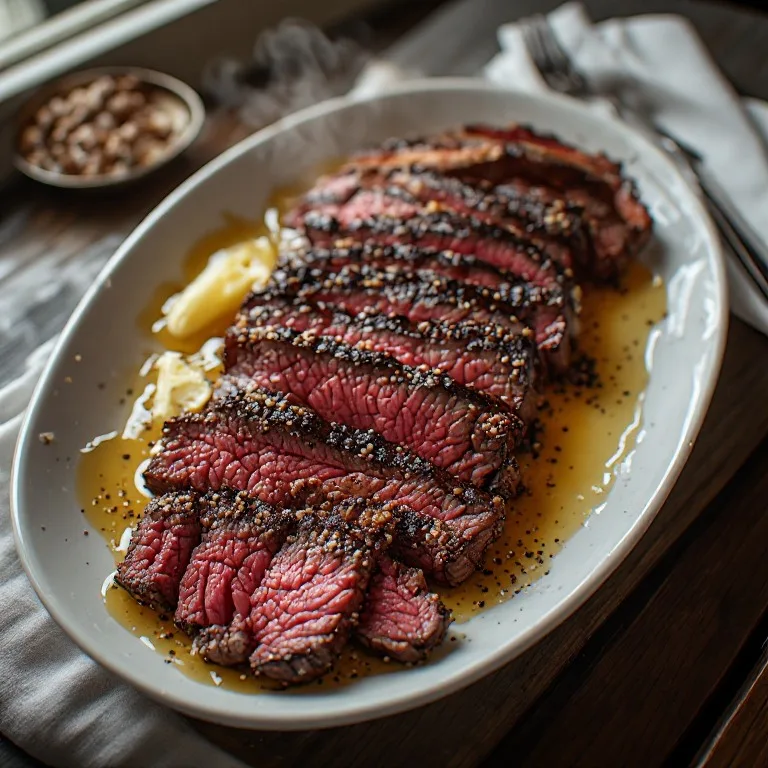
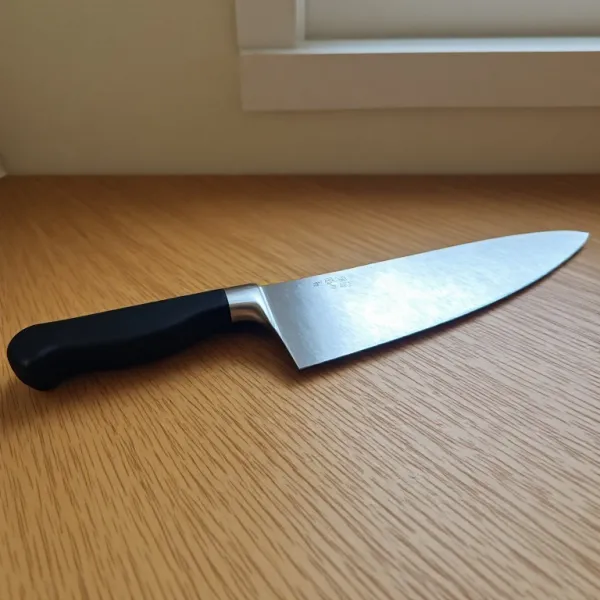
A brisket sliced with the grain is chewy regardless of how well it was cooked. The muscle fibers in the flat run lengthwise; the cut must go perpendicular to them. Hold the flat by one end, look at the surface, identify which direction the fibers run, and slice at 90 degrees to that direction. 1/4-inch slices for the flat; thicker, 1/2-inch slices hold together better for the fattier point.
At Franklin, a mixed order comes with slices of both flat and point together. The point is richer and fattier; the flat is leaner and holds the smoke ring — the pink band just below the bark that is the visual signature of a long, low smoke. When a Franklin slice is photographed for a food magazine, it is usually a flat slice showing the smoke ring.
The leftover fat on the cutting board and the juices that ran out of the butcher paper wrap during the rest: pour these over the sliced meat before serving. Nothing at Franklin Barbecue is wasted.