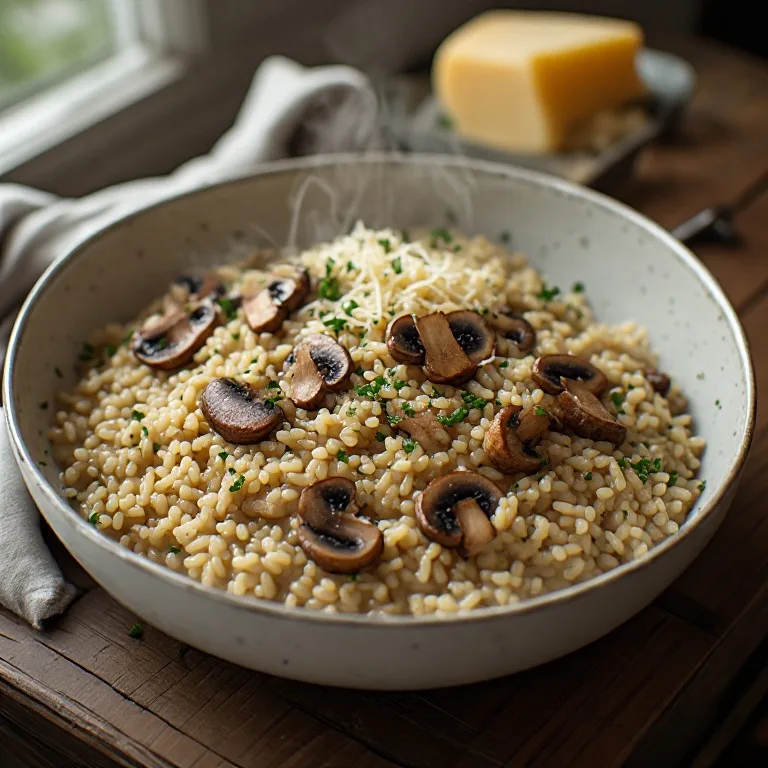



Gordon Ramsay’s Mushroom Risotto
Prep time: 20 min | Cook time: 40 min | Serves: 4 | Difficulty: Intermediate
Gordon Ramsay has demonstrated mushroom risotto more times than almost any other recipe. It appears in his online videos, his MasterClass, his cookbooks, and — perhaps most visibly — on Hell’s Kitchen, where it functions as a recurring benchmark. Contestants who cannot make risotto properly do not last long. The failure mode is almost always the same: they rush the finish, the emulsification never happens, and the plate arrives with rice in a puddle instead of a unified, glossy mass.
The dish appears on the menu at his Bread Street Kitchen restaurants in London, Dubai, and Hong Kong at around £22 ($28) a portion. The home version, using a good block of Parmesan and quality dried porcini, costs roughly $10 for four people.
The Two-Mushroom System
Ramsay’s recipe uses dried porcini and fresh mushrooms together, and the two perform completely different functions.
Dried porcini are intensely concentrated — they’ve lost 90% of their water weight in drying, which means the umami compounds (glutamic acid, guanosine monophosphate) that make mushrooms taste savory are packed into a small mass. When you soak them, both the mushroom and the liquid become flavor carriers. Straining that soaking liquid and adding it to your stock means that every ladle you add to the risotto carries porcini depth. You can taste the difference in the finished dish even when you cannot identify the porcini specifically — the background is richer, with more length.
Fresh mushrooms do the opposite. They have texture, a brighter and more immediately savory flavor, and a surface that can brown. Sautéing fresh cremini or chestnut mushrooms at high heat drives off their considerable moisture (they are 90% water by weight) and creates Maillard browning — that nutty, roasted character that is completely absent from rehydrated dried mushrooms. The two mushrooms together cover the full range: depth and concentration from the dried, freshness and texture from the sautéed.
Sauté the fresh mushrooms first, before you start the risotto, in a very hot dry-ish pan. Ramsay insists on not crowding them — crowded mushrooms steam rather than sear, and steamed mushrooms are pale and soft rather than caramelized. A single layer in a hot pan, left mostly undisturbed for 2 to 3 minutes before tossing, is the method.
The Stock and Heat Management
Two things must be true simultaneously for the stock-addition phase to go correctly: the stock must be hot, and the heat under the risotto pan must be controlled.
Hot stock matters because adding cold liquid to hot rice shocks the starch and interrupts the slow, even hydration that produces creaminess. Keep the stock at a gentle simmer on a back burner throughout the 18 to 22 minutes of cooking. Each ladle should go in warm enough that the pan continues simmering when the stock hits the rice.
The risotto pan heat should be medium to medium-high — a steady simmer, not an aggressive boil. A boil drives moisture out of the rice too fast, causing the outside to overcook while the center stays hard, and causes the pan to dry between ladles faster than you can stir. If you see the pan bubbling hard, reduce the heat.
The timing cue for each ladle: add the next one when a wooden spoon dragged across the center of the pan leaves a trail that fills in slowly — not when the pan is completely dry. Waiting until the pan is dry lets the rice touch the hot metal with no moisture between them, which causes sticking and uneven cooking.
The Mantecatura: Cold Butter, Not Warm
This is the step. Everything else — the porcini soaking, the mushroom sauté, the ladle-by-ladle stock addition — matters, but the mantecatura is what makes the finished risotto feel like something you paid $28 for rather than something you made at home.
The technique is counterintuitive: you remove the pan from heat, then add cold fat. Not room-temperature butter, not warmed mascarpone — cold, from the refrigerator. Cold fat emulsifies more readily than warm fat, for the same reason cold butter makes a better beurre blanc: the temperature differential between the cold fat and the hot rice creates the physical conditions for emulsification rather than the fat simply melting into the liquid and separating.
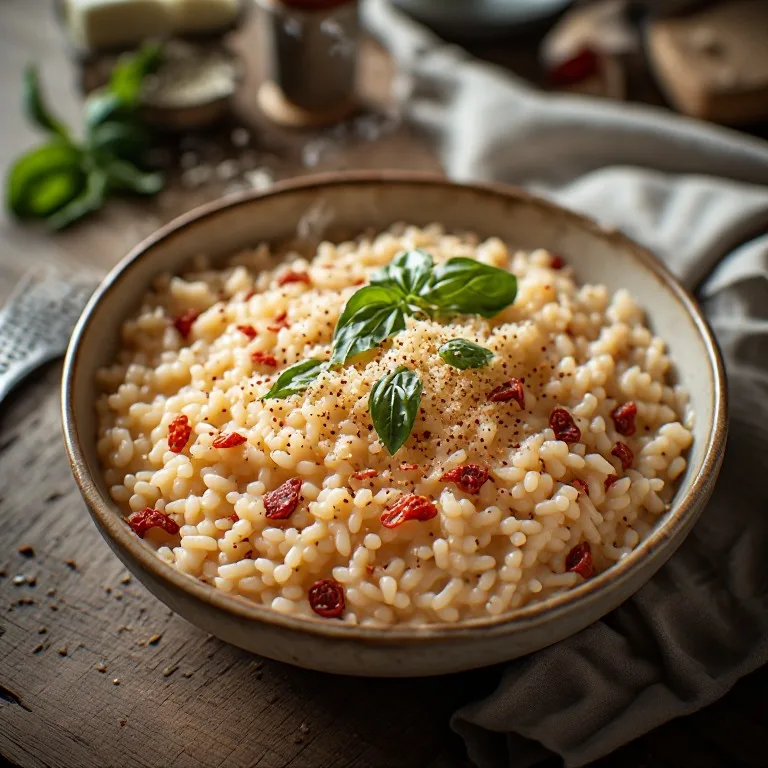
Add the cold butter cubes, mascarpone, and Parmesan all at once. Then stir hard — much harder than feels necessary. Ramsay tilts the pan at an angle and beats with a wooden spoon for 45 to 60 seconds. The goal is to force the fat into tiny droplets and distribute them throughout the starchy liquid. When the emulsion forms correctly, the risotto changes in appearance: it becomes glossy, cohesive, and fluid in a specific way.
The test: tilt the pan 45 degrees. A properly emulsified risotto flows as a single mass, slowly. If liquid separates from the rice and runs toward the lower edge, the emulsification is incomplete — put the pan back on very low heat for 30 seconds while stirring, which may rescue it. If the risotto sits stiff without flowing, it was cooked past the correct point and absorbed too much liquid.
Serving and Timing
Risotto does not hold. The same emulsion that makes it restaurant-quality at the moment of plating breaks down within 10 to 15 minutes as the residual heat in the rice continues cooking the starch and the fats separate. This is not a dish you can make and let sit.
Plate immediately into warm shallow bowls. Finish with truffle oil — Ramsay uses it, and it transforms the dish for about 40 extra calories per serving. A drizzle over the surface, a grating of Parmesan, and a few fresh thyme leaves. Serve within 2 minutes of plating.
If you are cooking for guests and do not want to stand at the stove during dinner, use the restaurant technique: cook the risotto to 80% done, spread it thin on a baking sheet, and refrigerate. At service, reheat with 1 to 2 ladles of hot stock, finish the final 4 to 5 minutes of cooking, then execute the mantecatura. This holds the prep work to earlier in the day and keeps the service window to under 10 minutes.