


Copycat Gordon Ramsay Beef Wellington (With the Crepe Layer That Keeps the Pastry Crisp)
Prep time: 45 min | Cook time: 30 min | Serves: 6 | Difficulty: Advanced
Gordon Ramsay has cooked hundreds of dishes on television across more than 20 years, but no single recipe is more associated with his name than Beef Wellington. It appears on Hell’s Kitchen as the ultimate test — the dish contestants must execute under pressure, whose failure marks an inflection point in each episode’s narrative. It appears in his cookbooks, his online recipes, his MasterClass. It is what people mean when they say they are cooking a “Gordon Ramsay recipe.”
The version most people are trying to replicate comes directly from his published recipes on gordonramsay.com and gordonramsayrestaurants.com: center-cut beef tenderloin seared in a very hot pan, coated in Dijon mustard, wrapped in mushroom duxelles and Parma ham, and baked inside puff pastry to a mahogany crust. His flagship restaurant — Restaurant Gordon Ramsay at 68 Royal Hospital Road in Chelsea, London — earned three Michelin stars in 2001, making it the first London restaurant to hold three stars, and has held them since. The restaurant itself serves modern French cuisine (Kim Ratcharoen was appointed chef de cuisine in 2025, and the menu leans toward lobster ravioli and roasted veal sweetbread). But the Beef Wellington that lives in the popular imagination is something Ramsay has refined over decades as his most taught, most broadcast, and most home-cooked recipe.
The good news: it is harder-looking than it is hard. The puff pastry conceals most imperfections. The techniques — searing, making duxelles, rolling a tight cylinder in plastic wrap — are each straightforward when taken separately. And the forgiving temperature window of a rested tenderloin means there is more margin than you think.
The Problem Most Beef Wellingtons Have (And What Ramsay Fixes)
A Wellington that arrives at the table with a soggy bottom layer of pastry — the layer that sat against the baking sheet — is the defining failure mode. It happens for one reason: moisture from the duxelles migrates into the pastry during the bake and softens the bottom before it has time to set and crisp.
The traditional fix is to dry the duxelles completely before assembly and to bake the Wellington on a hot surface (a preheated baking sheet). Those two things are still essential. But the distinguishing element in Ramsay’s recipe is the addition of a thin savory crepe — a chive crepe, specifically — wrapped as the outermost layer, between the Parma ham and the puff pastry. The crepe absorbs moisture coming from the mushroom-and-ham side while keeping the pastry dry on the other side. Because crepes are cooked egg-and-flour, they behave like a gentle blotter: absorbent but not transmissive.
The result is a Wellington where the puff pastry rises and browns correctly on all surfaces, not just the top and sides.
The Three Things That Determine Success
First: the duxelles must be completely dry. Cremini mushrooms are 90% water by weight. When you pulse them in a food processor and cook them in a dry pan, the goal is to drive off that water completely — the mixture should go from wet and pale to dark, paste-like, and almost sticking to the pan before you stop. This takes 10 to 12 minutes of active stirring over medium-high heat, not 4 or 5. When you press a bit of finished duxelles between your fingers, there should be no moisture. Undershooting here by even a few minutes is the most common source of a soggy Wellington.
Second: the wrapped log must be cold when it goes into the pastry. After rolling the beef in the duxelles-Parma ham-crepe wrap and sealing it in plastic wrap, the log goes into the refrigerator for a minimum of 30 minutes. This does two things: it firms the log so it holds a clean cylinder shape during pastry wrapping, and it ensures the beef is cold when it enters the hot oven, which gives you the temperature differential needed to get a pink center and a crisp brown exterior simultaneously. A log that goes into the pastry warm will lose that differential and the beef will overcook from the outside in.
Third: the thermometer rules, not the clock. Oven temperatures vary by 25°F to 50°F, tenderloin thickness varies, and refrigerator chill depth varies. A 25-minute bake time is a guideline; 125°F internal at the center is the target. Insert the thermometer through an end (not through the pastry sides) and pull the Wellington when it reads 125°F — carryover will bring it to 130°F during the 10-minute rest.
The Crepe Method, Explained
The chive crepes are the technique most home cooks skip when they first read the recipe — they look like an extra step for something that seems unnecessary. They are not unnecessary.
The crepe batter (egg, flour, milk, chives) is made thin and rested briefly before cooking. The crepes need to be very thin — you are coating the pan barely enough for the batter to set, not building a thick layer. They are cooked on both sides until just set, with no browning on either side; browned crepes become firmer and slightly rubbery, which would create a noticeable textural layer in the finished Wellington. You want the crepe to be flexible enough to wrap and invisible in the finished slice.
The assembly order matters, and it is the part people most often get backwards. On the plastic wrap, working bottom to top: crepes first, laid flat in a single sheet. Parma ham laid over the crepes in an overlapping layer. Duxelles spread across the Parma ham. Beef placed at the near edge, then the whole thing rolled toward the far edge using the plastic wrap as a lever. The beef ends up at the center of the log, and from inside out the layers run: beef → duxelles → Parma ham → crepe → puff pastry. That means the crepe sits directly against the inside of the pastry — exactly where it needs to be to intercept moisture before it reaches the dough. Put the crepe against the beef instead (a common mistake) and it does nothing for the pastry, because the wet duxelles is still on the pastry side of it.
What Makes a Good Wellington Slice
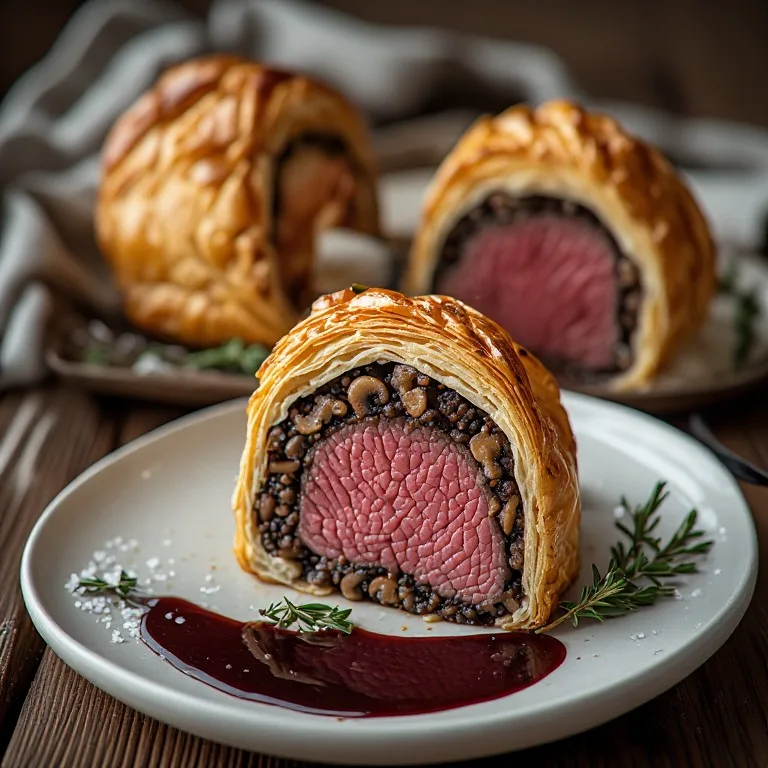
When you cut through a correctly made Wellington, each slice should show a distinct cross-section: the deep golden-brown pastry layers on the outside; the thin, nearly invisible crepe just inside the pastry; the Parma ham; the dark, savory ring of duxelles; and then the beef, pink throughout with a thin grey-brown outer band from the initial sear. Each component should be distinct but integrated — the layers should not slide apart when you lift a slice. The pastry on the bottom should be as crisp as the pastry on the top.
If the pastry is soft on the bottom, the duxelles was underdried or the baking surface was cold. If the grey band around the beef is very wide, the oven was too hot or the Wellington was warm when it went in. If the layers slide apart when sliced, the log was not wrapped tightly enough before refrigeration.
The Red Wine Sauce
Beef Wellington served without a sauce is unusual at a restaurant level. The dish itself is rich — butter in the pastry, fat in the Parma ham, earthiness from the duxelles — and it benefits from something sharp and clean alongside it. The simplest version: reduce shallots and red wine by two-thirds, add good beef stock, reduce again by half, and finish with cold butter for gloss. Make it while the Wellington bakes; strain it; serve it warm. It is not a complex sauce and it should not be. The Wellington is the centerpiece.