
Pin It

Jean-Georges Black Truffle Pizza (The $50 Mark Hotel Pizza, Made at Home)

Jean-Georges Black Truffle Pizza (The $50 Mark Hotel Pizza, Made at Home)
Jump to Recipe
Prep 25 min (plus dough rise if homemade) Cook 10 min Serves 2 personal pizzas
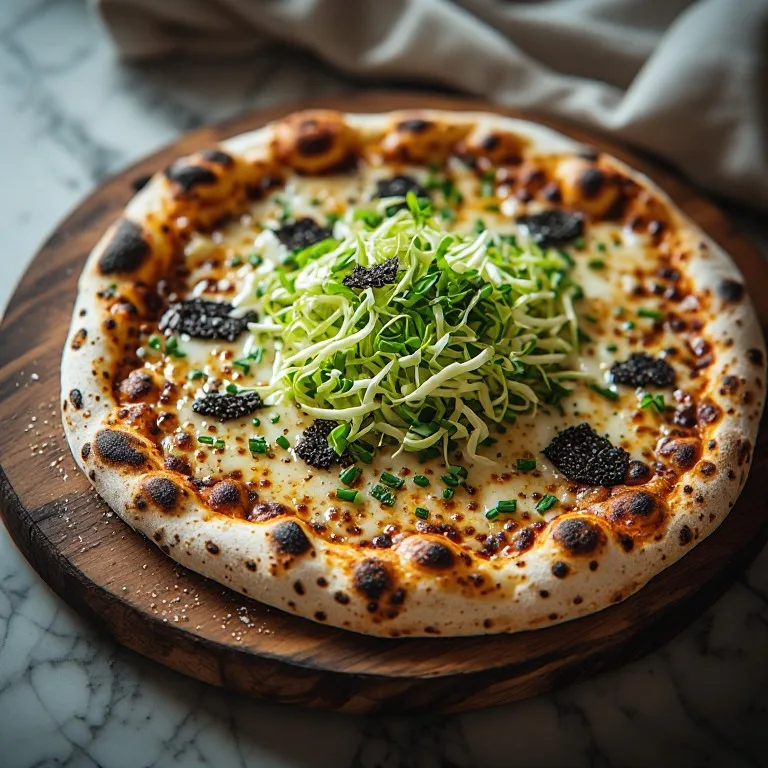
Quick answer: Make the truffle sauce: drain one small jar of black truffle peelings (reserve the liquid) and process them with 3 tablespoons white truffle oil in a food processor until smooth. Season with salt and pepper. Make the truffle vinaigrette: whisk together 1.5 tablespoons of the reserved truffle juice, 1.5 tablespoons fresh lemon juice, 1.5 tablespoons soy sauce, 6 tablespoons extra-virgin olive oil, and a pinch of black pepper. Place a pizza stone or steel in your oven on the top rack and heat to 550°F (or as high as your oven goes) for 45 minutes. Divide store-bought or homemade pizza dough into two 5-ounce balls. On a floured surface, stretch each ball into a thin round about 10 to 11 inches across. Transfer to a lightly floured pizza peel. Spread 3 tablespoons of truffle sauce evenly across each round, leaving a half-inch border. Scatter 1.5 ounces (42g) of grated fontina over the sauce — distribute it evenly so every bite has cheese, but don't pile it deep. Slide onto the hot stone and bake 8 to 10 minutes until the crust has char blisters and the fontina has melted and just begun to color at the edges. Remove from the oven. In a small bowl, toss a loose handful of frisée with just enough truffle vinaigrette to coat the leaves, plus a pinch of salt. Place the dressed frisée in the center of the hot pizza. Scatter chopped chives over everything. Eat immediately. At The Mark Hotel, this pizza costs around $50. Two homemade pizzas cost roughly $15 in ingredients.

Shop the tools

Gear matched to this recipe. These are Amazon affiliate links — we may earn a small commission if you buy, at no extra cost to you.

As an Amazon Associate, Copycat Spices earns from qualifying purchases. Product images are generic illustrations, not the exact item listed.

Jean-Georges Black Truffle Pizza (The $50 Mark Hotel Pizza, Made at Home)

The famous Jean-Georges black truffle pizza from The Mark Hotel, made at home. Truffle sauce baked into the crust, Val d'Aosta fontina, bitter frisée with a soy-lemon-truffle vinaigrette. Costs about $15 to make vs. $50 at the restaurant.

Medium Prep: 25 min (plus dough rise if homemade) Cook: 10 min Total: 35 min2 personal pizzas servings ~$4.50/serving
Prep25 min (plus dough rise if homemade)
Cook10 min
Total35 min
Servings
2
At home~$4.50/serving
vs
Restaurant~$20.25/serving
You save ~78%

The Story Behind the Recipe

The famous Jean-Georges black truffle pizza from The Mark Hotel, made at home. Truffle sauce baked into the crust, Val d'Aosta fontina, bitter frisée with a soy-lemon-truffle vinaigrette. Costs about $15 to make vs. $50 at the restaurant.

Ingredients

  • Truffle sauce (makes enough for 2 to 3 pizzas)
  • Truffle vinaigrette (makes about 1/2 cup — use what you need, refrigerate the rest)
  • Per pizza (recipe makes 2)

Instructions

💡
Pro tip: This recipe tastes even better the next day. The flavors need time to meld together in the fridge.
❄️
Storage: Keeps in an airtight container in the fridge for up to 2 weeks. Freezer-friendly for up to 3 months.
~300-500 cal/serving
🎃 Free Halloween cookbook — download now The Copycat Halloween Cookbook A ready-made, photo-illustrated PDF of our best halloween copycat recipes — free to download, no building required. Pay what you want to support if you love it.

Free PDF — instant download. We'll also send new seasonal copycat recipes now and then; unsubscribe anytime. Or just download it →

The black truffle pizza at The Mark Restaurant by Jean-Georges has been on the menu since before it was at The Mark. Chef Jean-Georges Vongerichten developed it when building the original menu for Mercer Kitchen, his SoHo restaurant. It moved across his restaurant group — ten to fifteen properties by his count — and the version at The Mark Hotel on the Upper East Side became the one people specifically travel for. Ina Garten has said she and Jeffrey go to the hotel bar just for this pizza. She first had it while dining with Tina Fey. It costs around $50 for a personal pizza that fits on one plate.

The good news: the sauce that makes the pizza what it is uses jarred truffle peelings and white truffle oil. This is Jean-Georges Vongerichten’s own published recipe. The home version is not a workaround — the foundation of the dish, the component that saturates the crust with truffle flavor, is made from the same jarred peelings you can find at Whole Foods or order online.


  • The “sauce” is a truffle paste — black truffle peelings + white truffle oil, pureed smooth — spread directly on the dough. No tomato. No cream.
  • The cheese is Val d’Aosta fontina, not mozzarella. Fontina melts without releasing water, carries the truffle flavor instead of diluting it.
  • The dressed frisée is not a garnish. Bitter greens in a soy-lemon-truffle vinaigrette placed on the hot pizza are the acid cut that keeps the whole thing from being cloying.
  • The char blisters are intentional. 550°F oven, pizza stone, 8 to 10 minutes.
  • Cost at the restaurant: ~$50. Cost at home for two pizzas: about $15.

Why this pizza has a line at a hotel bar on East 77th Street

The Mark Hotel is not a pizza destination by reputation. It is a hotel where a suite costs several thousand dollars per night and the bar serves bottles of Champagne. The pizza is not on a separate menu or treated as a curiosity — it is the thing. It has been the thing at multiple Jean-Georges properties for two decades, and at The Mark it has become one of those New York dishes that people name when asked where they go when they want something specific and not negotiable.

The reason is structure: it solves a problem most white pizzas create. A white pizza with nothing but cheese and fat-based toppings is satisfying for two bites and exhausting by the sixth. This pizza has the frisée. The bitter, acid-dressed greens placed on the hot crust right before serving change the physics of the dish — they provide the bite that lets you eat the whole pizza and want more. That, and the truffle paste baked into the base, which is not a drizzle-and-serve move but a foundational baking technique.

At The Mark, the restaurant also has access to fresh black truffles shaved over the top when they are in season. That is not reproducible at a reasonable home cost. Everything else is.

The sauce is truffle, not tomato — and why that matters

Every pizza has a base sauce that defines its character. Most of Jean-Georges’s restaurants have a version of this pizza on the menu, and they have all published the recipe: the sauce is black truffle peelings processed with white truffle oil until finely ground, seasoned with salt and pepper. Vongerichten’s own version calls for two small cans; scaled down for two personal pizzas at home, a single small jar (0.88 to 1 ounce drained) is plenty.

The difference between this approach and the more common “drizzle truffle oil on a finished pizza” is where the truffle flavor lives. Spread as a sauce base and baked at high heat, the truffle paste becomes part of the crust — the aroma compounds in truffle oil are volatile and primarily fat-soluble, which means they penetrate into the dough and bind with the cheese above rather than evaporating off the surface. Every square inch of the pizza, including the bite that is mostly crust, carries truffle flavor.

Truffle oil applied as a finish after baking is a surface note. It hits your nose when you first pick up the slice and fades. The sauce approach is different: the truffle is in the bread, and it does not go anywhere.

A small jar of black truffle peelings runs $12 to $18 at Whole Foods or specialty grocers. Combined with three tablespoons of quality white truffle oil, it makes enough sauce for two to three personal pizzas. Save the liquid from the jar — it goes into the vinaigrette that dresses the frisée.

Why fontina carries truffle when mozzarella cannot

The choice of cheese is not interchangeable. Val d’Aosta fontina — produced in the Aosta Valley along the French-Italian border, aged in mountain caves — has a fat content roughly 30 percent higher than fresh mozzarella, and it melts at a lower temperature into a smooth, even pool rather than stretching and pulling. This matters for two reasons.

First: fresh mozzarella is 52 to 60 percent water by weight. At 550°F, that water releases immediately, steams the truffle sauce beneath the cheese, and dilutes the paste you carefully spread. Fontina releases almost none. The truffle sauce layer stays intact through the entire bake.

Second: the flavor. Val d’Aosta fontina has a funky, nutty character — slightly pungent in a way that enhances rather than competes with earthy truffle aroma. This is a classical northern Italian pairing that predates the pizza by centuries. Mozzarella is mild and lactic; it does not have the register to hold up against or amplify truffle. The pizza would be pleasant rather than interesting.

If Val d’Aosta fontina is unavailable at your store, Danish fontina works well — milder, less funky, closer to havarti, but still fat-rich and low-water. Gruyère at about half the quantity of fontina is the best flavor substitute: more assertive, nuttier, and it carries truffle cleanly. Low-moisture mozzarella will produce a good pizza but a different one — call it a white pizza with truffle oil, not a Jean-Georges pizza.

The frisée is the balance mechanism

A white pizza covered in truffle paste and melted fontina is a rich, fat-heavy thing. Left alone, it has no lift — no element to cut through the density of the base and reset your palate between bites. The dressed frisée placed in the center after baking is that element.

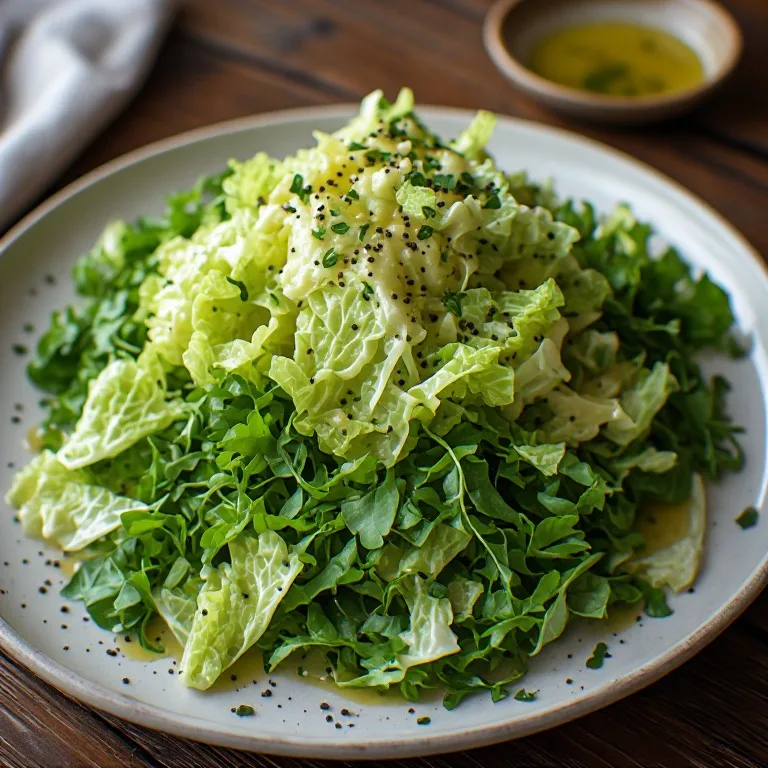
The vinaigrette — truffle juice (from the jar), lemon juice, soy sauce, olive oil — is built to be acidic and umami-forward. The soy sauce is Vongerichten’s characteristic move: used in small quantity, it adds savory depth without announcing itself. The dressing does not taste Asian; it tastes like something made by a chef who has been solving flavor problems for forty years. The frisée in that dressing, placed on a hot pizza, wilts slightly at the base from the crust’s heat while the top leaves stay crisp. Each bite of pizza with frisée delivers the rich truffle and cheese plus the bitter, acid counterpoint simultaneously.

Do not put the frisée on before the pizza goes into the oven. Do not use arugula — arugula is peppery, not bitter, and the bitterness is what does the work. Use the pale yellow interior of a head of frisée (curly endive), not the tough outer green leaves.

Eat immediately. Within about two minutes of plating, the frisée fully wilts and the crust begins to soften from the steam of the greens. The five-minute window after the pizza comes out of the oven is when this dish is what it is supposed to be.

Getting the char right at home

The restaurant uses a professional deck oven that sustains temperatures well above what most home ovens reach. The goal for home replication is maximum heat with real thermal mass.

A pizza steel — heavier than stone, stores more heat, recovers faster between pizzas — is the best tool. A pizza stone works. An inverted cast-iron skillet works as a fallback. Whatever you use: preheat it for a minimum of 45 minutes at your oven’s maximum temperature, usually 500 to 550°F. The stone or steel needs to be as hot as possible when the pizza lands on it — that is what creates the immediate crust-set and char marks on the bottom.

Eight to ten minutes is the target bake time. The crust is done when the edges have dark spots that verge on burnt, the fontina has melted and started to color at the edges, and the center of the crust feels set rather than soft when you tip the pizza with a peel. Pull it when it looks like it has gone a step further than you would normally pull a pizza. The restaurant’s recipe description says “bake until well crisped and blisters are a bit burned.” That is the correct endpoint.
Frequently Asked Questions

What is the Jean-Georges black truffle pizza and where does it come from?

The black truffle pizza is a signature dish created by chef Jean-Georges Vongerichten, currently served at The Mark Restaurant by Jean-Georges in The Mark Hotel at 25 East 77th Street on the Upper East Side of Manhattan — and at roughly 10 to 15 other Jean-Georges properties worldwide, including locations in Paris, London, and Park City, Utah. Vongerichten developed the pizza when he was building the menu for Mercer Kitchen, his SoHo restaurant (now closed), and it became one of the most copied dishes across his whole restaurant group. The dish is a white pizza: no tomato sauce, no cream, just a truffle emulsion serving as the base, Val d'Aosta fontina on top, and dressed bitter frisée placed in the center after baking. Food Network's Ina Garten has publicly said that she and her husband Jeffrey visit The Mark bar specifically to eat this pizza — she first had it while dining with Tina Fey — and it costs around $50 per personal pizza at the restaurant.

Can I really make this at home without fresh black truffles?

Yes — and here is the surprising part: the published Jean-Georges recipe, shared by multiple properties including The Mark and the Shangri-La Vancouver and the J&G Grill in Park City, uses canned or jarred truffle peelings and white truffle oil as the sauce base. Not fresh truffles. Fresh truffles are shaved on top at the restaurant when in season, but the foundational truffle sauce — the component that saturates every bite of the crust — is made from the same jarred truffle peelings you can find at Whole Foods, specialty grocery stores, or online. The recipe works because the food processor breaks down the peelings' cell structure and the truffle oil amplifies their aromatic compounds, creating a concentrated paste that bakes into the dough and spreads truffle flavor across every square inch. Fresh truffle is a luxury finish; the sauce itself is genuinely home-accessible.

What kind of truffle peelings should I buy, and where?

You want jarred black truffle peelings in brine or juice — not white truffle, not truffle carpaccio, and not truffle paste, which often has fillers. A small jar (0.88 oz to 1 oz net weight after draining) is enough for two personal pizzas. Brands to look for: Sabatino Tartufi (widely available at Whole Foods), Urbani Truffles, or Roland Foods. Cost runs $12 to $18 per jar at retail; significantly less per unit on Amazon if you buy a multi-pack. Save the liquid from the jar — that is your truffle juice for the vinaigrette. Do not rinse the peelings before processing.

Why fontina instead of mozzarella?

Val d'Aosta fontina has roughly 30 percent higher fat content than fresh mozzarella, which changes how it behaves on a hot pizza in two critical ways. First: it melts into a smooth, creamy pool rather than the stringy pull of mozzarella, which means it coats the truffle sauce layer rather than sitting on top of it. Second: fresh mozzarella is roughly 52 to 60 percent water by weight. At high heat, that water releases, steams the crust below, and dilutes the truffle emulsion it sits on. Fontina releases almost no water at pizza temperatures. The third reason is flavor: fontina has a funky, nutty, lightly pungent character that is a classic northern Italian pairing with truffles. The earthy musky truffle and the buttery funk of Alpine fontina amplify each other. Mild mozzarella does not have this register — it would taste fine but would feel like a generic white pizza with truffle oil drizzled on it. If you cannot find Val d'Aosta fontina, Danish fontina (milder, waxier) works reasonably well. Gruyère at about half the quantity of fontina is a stronger substitute — more pungent, less classic, but carries the truffle better than mozzarella.

Can I use truffle paste or truffle oil alone instead of making the sauce?

No to truffle paste — commercial truffle pastes are typically mostly mushroom (porcini, shiitake) with a small percentage of actual truffle and added flavoring. They produce a mushroom-forward result, not a truffle result. Truffle oil alone also falls short: drizzled on top, truffle oil is a surface note; baked into a sauce base, it penetrates the dough and distributes throughout every bite. The sauce — peelings + oil processed together — is the difference between a pizza that tastes like truffle and a pizza that smells like truffle. If jarred truffle peelings are unavailable and fresh black truffles are in season and budget, you can make the sauce with 1 oz of fresh black truffle, minced very fine, plus 3 tablespoons white truffle oil. Process or stir together. Fresh truffle yields a brighter, more aromatic result but is not necessary for an excellent pizza.

Why does the recipe add soy sauce to the vinaigrette?

This is a characteristic Jean-Georges technique. Vongerichten studied under Paul Bocuse and has spent decades blending French technique with Asian ingredients — soy sauce, fish sauce, ginger, lemongrass appear across his menu in small amounts where they add depth without announcing themselves. In the truffle vinaigrette, the soy sauce provides umami that makes the dressing taste savory and rounded rather than merely acidic. It does not make the vinaigrette taste Asian; it makes it taste like a dressing that belongs on an expensive pizza rather than a salad. You need only a small amount: too much and it becomes detectable as soy. The correct proportion is roughly equal by volume to the truffle juice and lemon juice, diluted by about four times its volume in olive oil.

What is the frisée for? Can I substitute arugula?

The frisée serves two functions. First: bitterness. Val d'Aosta fontina and truffle emulsion are rich, fatty, and umami-heavy. Bitter greens provide the counterpoint that keeps the pizza from feeling cloying after two bites. Arugula is peppery, not bitter — it will work but differently. Frisée (curly endive) is the correct texture for this application: the tight, pale-yellow interior leaves are crisp, hold the vinaigrette without immediately wilting, and deliver bitter contrast in each bite. The second function is structural: frisée placed in the center of the hot pizza wilts slightly at the bottom from the heat while the tops stay crisp, creating a contrast of textures within a single forkful of pizza. Place the frisée right before serving and eat immediately — if the pizza sits, the frisée fully wilts and the crust softens. You can use arugula in a pinch; baby endive or escarole hearts are better substitutes.

I don't have a pizza stone or steel. Can I still make this?

Yes, but the result will differ. A cold sheet pan placed in a 500°F oven produces a pale, soft bottom rather than a charred, crispy one. The best non-stone workaround: invert a heavy cast-iron skillet (12-inch or larger) and heat it in the oven at maximum temperature for 30 minutes, then slide the pizza directly onto the bottom surface of the skillet. This provides direct metal-to-dough contact and approximates the thermal mass of a pizza stone. The char blisters will not be as numerous or as deep, but the crust will be significantly better than a sheet pan. A Lodge cast-iron skillet or Dutch oven base are the best home substitutes. If you make this pizza more than once, a pizza steel is worth the investment — it outperforms both stone and cast iron for thin-crust pizza.

Love this recipe? Share it!

Free PDF: our 12 most-wanted copycat recipes — instant download.

Made it? Buy us a coffee

Every recipe here is free, with no paywalls. If this one was a hit at your table, a small tip keeps new copycats coming.

$

Jean-Georges is a trademark of its owner, used here only to describe the dish this recipe recreates. This is an independent copycat written in our own words — Copycat Spices is not affiliated with, endorsed by or sponsored by Jean-Georges.

Ratings & Reviews

—
No ratings yet

Rate this recipe

Click a star to rate

Leave a Review

0/500

CS

Copycat Spices Editorial

Researched + fact-checked. Every recipe on Copycat Spices is built from published sources — official ingredient lists, brand-published recipes, interviews and food-science references — and fact-checked before it goes live, then written as clear, step-by-step instructions for home cooks of all skill levels.

Learn more about our mission →