


Pin It

Jean-Georges Molten Chocolate Cake (The Accidental Original, Made at Home)

Jean-Georges Molten Chocolate Cake (The Accidental Original, Made at Home)
Jump to Recipe
Prep 15 min active (plus 2 hrs chill if making ahead) Cook 7 min Serves 4
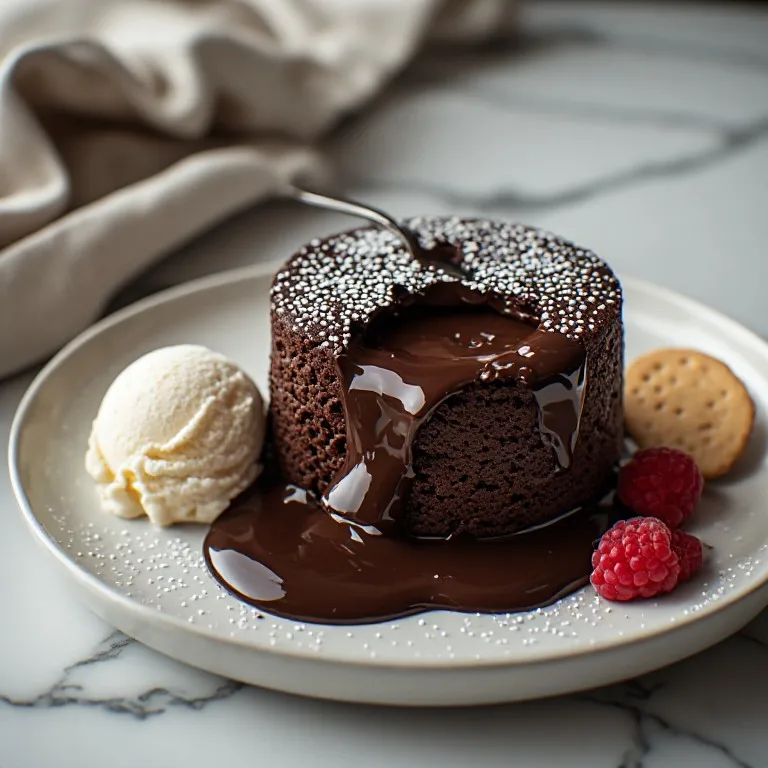
Quick answer: Melt 6 oz of chopped 70% bittersweet chocolate (Valrhona 66% is ideal) with 8 tablespoons of unsalted butter in a double boiler or heatproof bowl set over barely simmering water, stirring occasionally until completely smooth. Remove from heat and let cool for 5 minutes. In a separate bowl, whisk together 2 large eggs, 2 large egg yolks, and 1/4 cup of granulated sugar until pale yellow and slightly thickened, about 2 minutes by hand. Pour the cooled chocolate mixture into the egg mixture in a steady stream, whisking constantly. Sift in 2 tablespoons of all-purpose flour and a pinch of fine sea salt. Fold with a spatula until just combined — do not overmix. Butter four 6-ounce ramekins generously. Dust with cocoa powder or granulated sugar, tapping out the excess. Divide the batter evenly among the four ramekins — they should be about two-thirds full. At this point, refrigerate for at least 2 hours or up to 24 hours (this is the key step: cold batter entering a hot oven is what creates the molten center). When ready to bake, preheat the oven to 450°F with a rack in the center. Place the cold ramekins on a small baking sheet. Bake 6 to 7 minutes. The sides should look set and just starting to pull away from the ramekin; the top will be matte and firm at the edges but will jiggle very slightly in the center when you tap the baking sheet. This is exactly right — do not bake longer. Remove from the oven and let the cakes rest in their ramekins for exactly 1 minute. Run a small offset spatula or butter knife around the edge of each cake. Invert a small dessert plate over the ramekin, then flip the plate and ramekin together in one confident motion. Lift the ramekin straight up. The cake will hold its shape on the outside and flow at the cut. Serve immediately with vanilla ice cream or a pinch of fleur de sel.

Shop the tools

Gear matched to this recipe. These are Amazon affiliate links — we may earn a small commission if you buy, at no extra cost to you.

As an Amazon Associate, Copycat Spices earns from qualifying purchases. Product images are generic illustrations, not the exact item listed.

Jean-Georges Molten Chocolate Cake (The Accidental Original, Made at Home)

The original molten lava cake — invented by Jean-Georges Vongerichten in 1987 when 500 cold ramekins dropped his oven temperature at once. Six ingredients, 7 minutes, and the batter refrigerates for 24 hours. Made at home for under $10.

Easy Prep: 15 min active (plus 2 hrs chill if making ahead) Cook: 7 min Total: 2h 22m4 servings ~$3.15/serving
Prep15 min active (plus 2 hrs chill if making ahead)
Cook7 min
Total2h 22m
Servings
4
At home~$3.15/serving
vs
Restaurant~$14.17/serving
You save ~78%

The Story Behind the Recipe

Jean-Georges Vongerichten did not set out to invent one of the most replicated desserts in the world. In 1987, while running catering at his early New York restaurant, he was baking 500 individual chocolate sponge cakes for a private party. Too many cold ramekins crowded the oven at once, the temperature dropped, and the cakes came out with liquid centers. He tasted one instead of throwing it away, recognized what he had, and put it on the menu that night.

Within five years the molten chocolate cake had spread from fine dining to hotel restaurants to chain bistros worldwide — often without attribution. Today it appears on hundreds of thousands of menus. At his two-Michelin-star flagship Jean-Georges, at 1 Central Park West, the dessert runs around $20 per serving. At home, six ingredients make four cakes for under $10, and the batter refrigerates for 24 hours — meaning the entire restaurant moment takes 7 minutes from a cold oven.

Nutrition Facts

Per serving (4 servings)
Calories550
Total Fat43g
Total Carbs36g
Dietary Fiber3g
Sugars26g
Protein9g
Sodium80mg

* Estimated values based on standard recipe preparation. Actual values may vary.

Ingredients

Instructions

💡
Pro tip: This recipe tastes even better the next day. The flavors need time to meld together in the fridge.
❄️
Storage: Keeps in an airtight container in the fridge for up to 2 weeks. Freezer-friendly for up to 3 months.
🎃 Free Halloween cookbook — download now The Copycat Halloween Cookbook A ready-made, photo-illustrated PDF of our best halloween copycat recipes — free to download, no building required. Pay what you want to support if you love it.

Free PDF — instant download. We'll also send new seasonal copycat recipes now and then; unsubscribe anytime. Or just download it →

One of the most copied desserts in the world came from a mistake. In 1987, Jean-Georges Vongerichten was baking a large batch of individual chocolate sponge cakes when too many cold ramekins crowded his oven at once and dropped the temperature. The cakes came out with liquid centers. He tasted one instead of starting over, recognized it as something new, and put it on the menu.

By the mid-1990s, the molten chocolate cake had moved from fine dining to hotel restaurants to bistros worldwide. Most menus do not acknowledge the origin. The Jean-Georges version remains the simplest and most reliable: six ingredients, one bowl, seven minutes, and no ganache insert — just underbaked batter, which is the point.


  • Six ingredients: bittersweet chocolate, butter, 2 eggs + 2 yolks, sugar, flour. No vanilla. No cream. That’s the recipe.
  • Refrigerate the batter in the ramekins for at least 2 hours — cold batter in a hot oven is the mechanism that produces the liquid center.
  • Bake at 450°F for 6 to 7 minutes. The center should quiver when you tap the sheet.
  • Bake one extra as a test cake on your first attempt — cut it at 6 minutes to calibrate your oven.
  • The batter keeps refrigerated for up to 24 hours, making it a practical make-ahead dinner-party dessert.

The accident that created a restaurant staple

Jean-Georges Vongerichten opened JoJo on East 64th Street in 1991, but the lava cake story traces to his catering work four years earlier. In the rush of baking 500 individual chocolate cakes for a private event, he crowded too many cold ramekins into the oven at once, the temperature dropped, and the cakes were pulled before the centers set. Rather than discarding them, he tasted one and understood immediately what had happened: the outside was fully baked, the inside was hot flowing batter, and the combination was better than the intended product.

He refined the recipe and put it on his menu. By the time Jean-Georges opened at 1 Central Park West in 1997, the molten chocolate cake was among the most recognized dishes in his kitchen. His 1998 cookbook “Jean-Georges: Cooking at Home with a Four-Star Chef” published the recipe — it went on to win the James Beard Foundation’s cookbook award in 1999 — and made the dessert accessible to anyone who wanted to replicate it. Within a few years it was ubiquitous — appearing on hundreds of thousands of restaurant menus worldwide, occasionally described as “warm chocolate lava cake,” occasionally as “mi-cuit” or “fondant,” almost never credited to Jean-Georges by name.

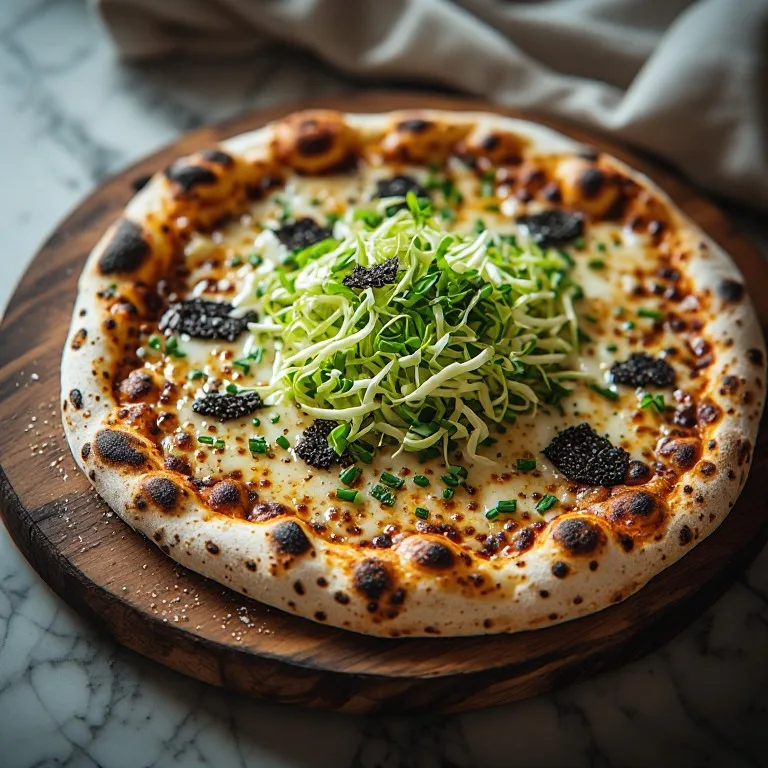
The version at Jean-Georges costs approximately $20 per serving. The version at home costs under $3 per serving and is made from the same six ingredients. If you want to build a full Jean-Georges tasting at home, pair it with his savory signature — the black truffle and fontina pizza — for the restaurant’s two best-known dishes in one meal.

Why the batter must be cold

Most chocolate cake recipes are baked from room temperature. This recipe depends on the batter being cold when it enters the oven. The reason is thermodynamic: when cold batter meets a very hot oven, the heat must travel inward from the outside edges. The ramekin wall conducts heat into the outer half-inch of batter quickly, setting it. The center of the cake, insulated by the batter around it, heats much more slowly. At exactly 6 to 7 minutes, the outer shell is fully baked — no raw egg, no raw flour — while the geometric center is still at a temperature low enough that it has not set.

If the batter goes in warm or at room temperature, it heats through more evenly. The gradient flattens. The center sets alongside the edges, and you get a very good dense chocolate cake rather than a lava cake. The two-hour refrigeration is not a make-ahead convenience; it is the structural mechanism of the dessert.

The practical benefit is that it also works as a genuine make-ahead. You can prepare the batter in the morning, fill the ramekins, cover them, and refrigerate for up to 24 hours. Bake them directly from the refrigerator when needed.

The 6-ingredient purity is not a shortcut

The recipe’s brevity — no vanilla, no cream, no espresso powder, no salt beyond a pinch — is intentional. Jean-Georges’s approach to this dessert is that the chocolate should be the only flavor. Every additional ingredient either amplifies or competes, and in this case he chose to amplify by elimination: just fat, egg protein, a small amount of starch, and a small amount of sugar, all in service of the chocolate.

The consequence is that the chocolate you choose determines everything. Valrhona’s 66% Caraïbe has a fruity, rounded character; the 70% Guanaja is more bitter and intense. Both are appropriate. A supermarket bittersweet chocolate rated 60% or below will produce a noticeably sweeter, flatter result — still good, but without the complex bitterness that makes the dessert taste like something that belongs in a restaurant.

The egg yolks carry fat and emulsify the chocolate-butter mixture, producing a smooth batter that sets with a slightly firm, almost fudgy exterior. The whole eggs provide protein for structure at the edges. The 2 tablespoons of flour are enough to make the exterior fully cake-like — not a loose chocolate custard — while contributing no detectable flour flavor. The proportions are exact, and changing them significantly will change the result.

Timing is the only technique that matters

This is a simple recipe that depends almost entirely on timing. The batter comes together in one bowl. The technique is mixing, not rolling pasta or searing meat. What requires attention is the final 7 minutes.

The most reliable approach for your first batch: bake five cakes instead of four if possible, removing one at 6 minutes and cutting into it immediately to check. A fully liquid center at 6 minutes means your oven is accurate; you will bake the remaining cakes exactly 7 minutes. If the center is mostly set at 6 minutes, your oven runs hot — calibrate down by 25 degrees for the next batch.

The visual cue at the right baking point: the edges of the top surface look matte and set; the center quivers slightly when you tap the baking sheet. This is the only moment to pull them. From that point forward, each additional 30 seconds reduces the molten center.
🥗

Make It Healthier

Love Jean-Georges Molten Chocolate Cake (The Accidental Original, Made at Home) but want a lighter version? Try these simple swaps:

  • ✓Use 85% dark chocolate instead of 70% — same technique, roughly 20% less sugar per serving, and a more intense bittersweet flavor that tastes just as rich.
  • ✓Skip the vanilla ice cream and serve with a small scoop of non-fat plain Greek yogurt and fresh raspberries — saves 150-300 calories and the tartness sharpens the chocolate.
  • ✓Reduce butter by 2 tablespoons and replace with 2 tablespoons of full-fat cream cheese — holds the batter structure, cuts saturated fat by about 25%, barely perceptible in the final cake.
  • ✓The batter keeps refrigerated for up to 24 hours, so bake just 1 or 2 cakes at a time — this is the best portion-control trick for a dessert this rich.

Frequently Asked Questions

What exactly is the 'lava' — why does the center stay liquid?

The lava is unbaked batter. Jean-Georges's recipe is not a cake with a ganache center or a raw chocolate disk inserted before baking — it is a regular chocolate cake batter baked for so short a time that only the outer edge sets while the center remains fluid. This works because of a thermal gradient: the edges of a ramekin receive conducted heat from all sides and set quickly; the geometric center of the cake receives heat only by conduction from the outside and stays cooler much longer. At exactly 6 to 7 minutes at 450°F, the shell of the cake is fully baked (no raw egg, no raw flour) while the core is still molten batter. This is why the batter must be cold when it enters the oven — warm or room-temperature batter would heat through more evenly and produce a fully set center. The 2-hour minimum refrigeration is not a make-ahead convenience trick; it is what makes the dessert work structurally.

How do I know when they're done without cutting one open?

The two reliable visual cues: the sides of the cake will look matte and set — not wet-shiny — and will have just barely started to pull away from the ramekin wall; and the top will be firm at the edges but will quiver noticeably in the center when you tap the baking sheet. If the entire top looks uniformly set and does not jiggle anywhere, you have overbaked it. If the top looks wet and shiny across the whole surface, give it another 30 seconds. The baking window between perfect molten center and fully set cake is about 90 seconds — this dessert rewards precision over guessing. For your first batch, underbake by intention: at 6 minutes, the center will be very loose and the cake may partially collapse when unmolded, but you will learn exactly what underdone looks like. Add 30 seconds the next time until you find the exact point where the cake unmolds cleanly and flows at the cut.

My cakes fully set in the center — what went wrong?

Three likely causes. First: the batter was warm when it went into the oven. If you skipped the refrigeration step or used room-temperature batter, the cake heats through too evenly. Always refrigerate for at least 2 hours. Second: your oven runs hot. Oven thermostats are frequently off by 25 to 50 degrees. If the oven is actually 500°F when set to 450°F, the outside will set faster than the center expects, and the center will set through rather than stay molten. Use an oven thermometer and adjust accordingly. Third: overbaking. The window is narrow. If you bake at 7 minutes and get a set center, try 6 minutes next time. The recipe is calibrated for cold batter in a properly preheated 450°F oven — any deviation in any direction has a noticeable effect.

Can I make the batter ahead of time?

Yes — and this is one of the recipe's best features for home entertaining. The batter keeps refrigerated in the ramekins, covered tightly with plastic wrap, for up to 24 hours before baking. This means you can prepare the entire dessert in the morning, refrigerate the ramekins, and bake for 7 minutes while guests are finishing their main course. There is no compromise in quality — the overnight refrigeration actually helps by chilling the batter more deeply, ensuring the center stays molten. Do not try to freeze the batter in ramekins; the eggs do not perform the same way after freezing and thawing.

What chocolate should I use — does it matter?

Quality matters more for this recipe than most chocolate desserts because the chocolate is the entire flavor profile. There are no other spices, no vanilla extract in the standard recipe, no coffee to amplify the cocoa — just chocolate, butter, eggs, sugar, and flour. Jean-Georges Vongerichten's own recipe specifies Valrhona — the 66% Caraïbe or the 70% Guanaja are the ones his restaurant uses most often. Valrhona produces chocolate with exceptional fruity complexity and a clean, non-waxy melt. The result has a depth of flavor that generic supermarket bittersweet chocolate does not have. That said, any high-quality 66-72% bittersweet chocolate works: Callebaut, E. Guittard, Ghirardelli 72%, Scharffen Berger. The one thing to avoid is unsweetened baking chocolate — the recipe's 1/4 cup of sugar is calibrated for bittersweet chocolate, and using unsweetened will produce a noticeably harsh, bitter result.

What is the best way to unmold the cake without it breaking?

Three steps make the difference. First, butter the ramekins very generously — not a light coating, but enough that the butter is visibly pooled in the bottom before you add the batter. Then dust with cocoa powder or granulated sugar (not flour, which can paste against the cake) and tap out the excess. Second, run a small offset spatula or thin butter knife around the full perimeter of the cake, pressing gently against the ramekin wall rather than the cake itself — you are just breaking the surface tension, not carving. Third, when you flip, do it in one confident motion: hold the plate firmly against the ramekin top and invert in a single turn, then lift the ramekin straight up without tilting. Hesitation or tilting is what causes cakes to slide off-center and crack. If a cake does crack on unmolding, it still tastes identical — just serve it in the ramekin with a spoon and call it a 'warm chocolate pudding.'

Is Jean-Georges actually the person who invented this dish?

He is the most credible claimant, though there is genuine dispute. French chef Michel Bras has claimed to have created a version called le coulant de chocolat in 1981 at his restaurant in Laguiole — his version uses a ganache center frozen inside the batter, producing a different technical approach and a different texture. Jean-Georges's version uses pure underbaked batter, no insert. The two techniques are different enough that both origin stories can be true simultaneously. What is historically clear is that Jean-Georges's version — simpler, easier to replicate, and requiring no special insert preparation — is the one that spread internationally through the 1990s and became the template for the dessert as it exists on most restaurant menus today. His story of the accidental underbake in 1987 is supported by contemporaneous accounts, and he published the recipe in his 1998 cookbook 'Jean-Georges: Cooking at Home with a Four-Star Chef,' which won the James Beard Foundation's cookbook award in 1999.

Is Jean-Georges restaurant still open and do they still serve this?

Yes. Jean-Georges at 1 Central Park West in the Trump International Hotel and Tower has been operating continuously since 1997. The molten chocolate cake has been on the dessert menu since the restaurant opened — it is arguably the most famous dish the restaurant has ever served, which makes it effectively permanent. The restaurant earned three Michelin stars in the inaugural New York guide (2006) and held them through the 2017 guide, then was demoted to two stars in the 2018 guide, where it remains as of the 2025 and 2026 guides. The dessert runs approximately $20 at current menu prices, and reservations are available through Resy and the restaurant's own site.

Love this recipe? Share it!

Free PDF: our 12 most-wanted copycat recipes — instant download.

Made it? Buy us a coffee

Every recipe here is free, with no paywalls. If this one was a hit at your table, a small tip keeps new copycats coming.

$

Jean-Georges is a trademark of its owner, used here only to describe the dish this recipe recreates. This is an independent copycat written in our own words — Copycat Spices is not affiliated with, endorsed by or sponsored by Jean-Georges.

Ratings & Reviews

—
No ratings yet

Rate this recipe

Click a star to rate

Leave a Review

0/500

CS

Copycat Spices Editorial

Researched + fact-checked. Every recipe on Copycat Spices is built from published sources — official ingredient lists, brand-published recipes, interviews and food-science references — and fact-checked before it goes live, then written as clear, step-by-step instructions for home cooks of all skill levels.

Learn more about our mission →