


Pin It

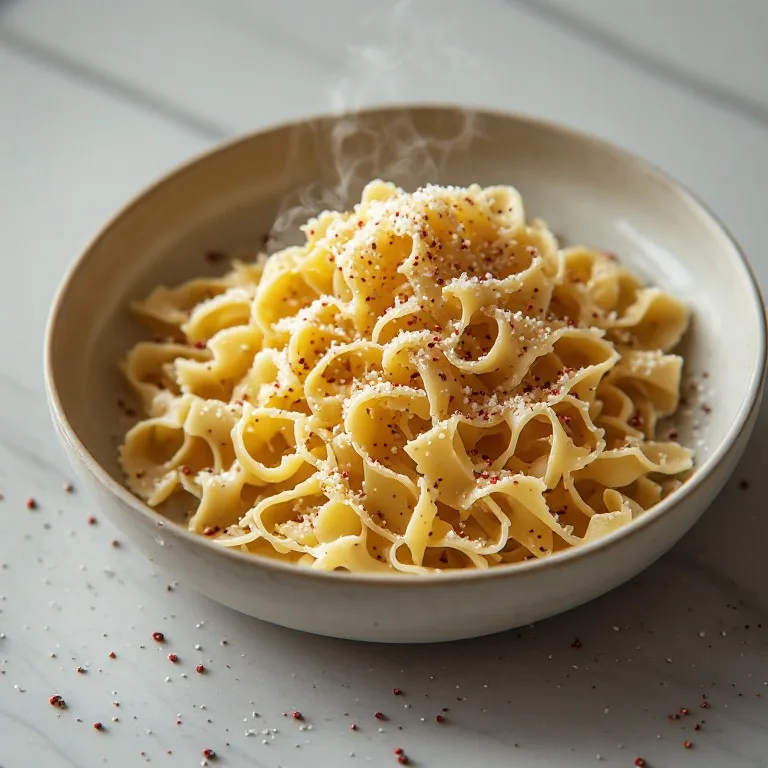
Lilia Mafaldine with Pink Peppercorns (Brooklyn's Most Coveted Pasta, Made at Home)

Lilia Mafaldine with Pink Peppercorns (Brooklyn's Most Coveted Pasta, Made at Home)
Jump to Recipe
Prep 5 min Cook 15 min Serves 4 to 6
Quick answer: Bring a large pot of water to a boil and salt it aggressively — it should taste like mild seawater. Coarsely crack 3 tablespoons of pink peppercorns under a heavy pan; you want broken fragments, not powder. Boil 1 lb 4 oz (567 g) of mafaldine for 5 to 8 minutes, to just under al dente. While it cooks, set a wide sauté pan over low heat, add one ladleful (about 1 cup) of the starchy pasta water, then whisk in half of 1/2 cup (114 g) of cold cubed unsalted butter a little at a time until it emulsifies into a glossy, slightly thickened sauce. Using tongs, lift the pasta straight into the pan (don't fully drain it — the water clinging to it helps). Raise the heat to medium and toss for about 2 minutes to marry the pasta and sauce, adding the rest of the butter as you go. If it tightens, add a splash more pasta water; the sauce should cling to the pasta but still glide in the pan. Pull the pan off the heat entirely, then add 1 cup (about 90 g) of finely grated Parmigiano-Reggiano and most of the cracked pink peppercorns, tossing until the cheese melts smoothly — off heat is what keeps it from turning grainy. Divide into warm bowls and finish each with more grated Parmigiano and a pinch of pink peppercorns. There is no cream and no oil — the whole sauce is butter, cheese, and starchy pasta water emulsified together.

Shop the tools

Gear matched to this recipe. These are Amazon affiliate links — we may earn a small commission if you buy, at no extra cost to you.

As an Amazon Associate, Copycat Spices earns from qualifying purchases. Product images are generic illustrations, not the exact item listed.

Lilia Mafaldine with Pink Peppercorns (Brooklyn's Most Coveted Pasta, Made at Home)

Lilia in Williamsburg serves the most talked-about pasta in Brooklyn: mafaldine with pink peppercorns, made from just four ingredients — mafaldine, cold butter, Parmigiano-Reggiano, and cracked pink peppercorns. This is the full recipe, including the butter-and-pasta-water emulsion technique that makes it work and keeps the sauce from breaking.

Easy Prep: 5 min Cook: 15 min Total: 20 min4 to 6 servings ~$1.75/serving
Prep5 min
Cook15 min
Total20 min
Servings
4
At home~$1.75/serving
vs
Restaurant~$7.88/serving
You save ~78%

The Story Behind the Recipe

Lilia in Williamsburg serves the most talked-about pasta in Brooklyn: mafaldine with pink peppercorns, made from just four ingredients — mafaldine, cold butter, Parmigiano-Reggiano, and cracked pink peppercorns. This is the full recipe, including the butter-and-pasta-water emulsion technique that makes it work and keeps the sauce from breaking.

Nutrition Facts

Per serving (4 to 6 servings)
Calories545
Total Fat21g
Total Carbs72g
Dietary Fiber3g
Sugars2g
Protein18g
Sodium480mg

* Estimated values based on standard recipe preparation. Actual values may vary.

Ingredients

Instructions

💡
Pro tip: This recipe tastes even better the next day. The flavors need time to meld together in the fridge.
❄️
Storage: Keeps in an airtight container in the fridge for up to 2 weeks. Freezer-friendly for up to 3 months.
🎃 Free Halloween cookbook — download now The Copycat Halloween Cookbook A ready-made, photo-illustrated PDF of our best halloween copycat recipes — free to download, no building required. Pay what you want to support if you love it.

Free PDF — instant download. We'll also send new seasonal copycat recipes now and then; unsubscribe anytime. Or just download it →

Copycat Lilia Mafaldine with Pink Peppercorns (Brooklyn’s Most Coveted Pasta, Made at Home)

Prep time: 5 min Cook time: 15 min Servings: 4 to 6

Lilia is a pasta restaurant on Union Avenue in Williamsburg, Brooklyn, opened in 2016 by chef Missy Robbins. The New York Times gave it two stars. Robbins has been recognized with James Beard Awards for her cooking in New York, and the restaurant is one of the hardest tables in the city to get.

The dish people specifically come for is a pasta made from four ingredients: mafaldine, cold butter, Parmigiano-Reggiano, and cracked pink peppercorns. That’s it. No cream, no garlic, no oil, no herbs. Robbins has said it started almost by accident — she was at home testing pasta bowls for the restaurant with only butter and Parmigiano on hand, and finished the noodles with ground pink peppercorns to add a little color. It became one of Lilia’s signature plates and one of the most copied pasta dishes in New York.

The reason it’s worth making at home isn’t the ingredient list — anyone has those. It’s the technique. Four ingredients means there’s nowhere to hide, and the difference between a great version and a greasy one comes down to how you build the sauce.

The Sauce Is an Emulsion, Not Melted Butter

This is the single most important thing to understand, and it’s what most home copies get wrong: there is no cream in this dish. The rich, glossy sauce that coats every ruffle is an emulsion of cold butter and starchy pasta water, finished with finely grated Parmigiano.

Here’s the mechanism. Pasta cooking water is full of dissolved starch. That starch is an emulsifier — it lets fat (the butter) and water bind into a single smooth, slightly thickened sauce instead of separating into a greasy puddle. If you just melt butter in a pan and toss pasta in it, you get oily noodles. If you whisk cold butter, a little at a time, into warm starchy pasta water over low heat, you get a unified, creamy-looking sauce made entirely of butter and water. That’s the trick behind cacio e pepe and real Roman Alfredo too — both are also cream-free — and it’s exactly what’s happening here.

Add the butter gradually and keep it moving. Cold cubes emulsify better than a single melted lump because you’re incorporating them slowly enough for the starch to do its job. Warm water, not boiling; low heat, not high. Rushing it is how the sauce breaks.

Pink Peppercorns Are Not Pepper

This matters for the recipe. Pink peppercorns are dried berries from the Schinus terebinthifolia tree — a species in the cashew family, not related to the plants that produce black, white, or green peppercorns. They have a papery outer shell, a hollow interior, and a flavor that is fruity, slightly resinous, and gently warming without the prolonged burn of true peppercorns.

When you crack them roughly under a heavy pan — coarse fragments, not powder — you release the fruity aromatic oils in the outer shell. The fragrance sits somewhere between rose and juniper. In the finished pasta, the pink pepper is the thing that makes a butter-and-cheese sauce smell like something specific rather than just rich. The heat level is genuinely mild; this is not a spicy dish. If you’re expecting the build and burn of a black-pepper cacio e pepe, you’ll be surprised — the sensation is gentler and more floral.

One safety note worth knowing: because Schinus is in the cashew family, a small number of people with tree-nut allergies can react to pink peppercorns. It’s not a common reaction and pink peppercorns are widely sold as a food, but if you’re cooking for someone with a serious nut allergy, use coarsely cracked black pepper instead — you’ll lose the floral note but keep the dish intact.

Why the Pasta Shape Is Part of the Recipe

Mafaldine is a wide, flat ribbon with ruffled edges on both sides. Each ruffled edge creates dozens of tiny ridges and pockets. In a butter emulsion, those pockets trap and hold the sauce the way a sponge holds water — mafaldine carries noticeably more sauce than a smooth-edged flat noodle like fettuccine, and the ruffles give a slight extra chew.

Lilia extrudes its own mafaldine through a bronze die, which leaves the surface faintly rough — another feature that helps sauce grip. At home, good dried bronze-die mafaldine does the same job. If you can’t find it: pappardelle is the best substitute (wide, flat, similar coating behavior), tagliatelle works, and regular fettuccine works but carries less sauce. Short shapes — rigatoni, penne — don’t; the sauce was built for the geometry of a long, ruffled ribbon.

Pasta Water Is Not Optional

With no cream to fall back on, the starch in the pasta water is the only thing holding this sauce together. It does two jobs: it emulsifies the butter into a sauce at the start, and it loosens and re-binds the sauce during the final toss as the cheese goes in and the pasta drinks some of it up.

Reserve at least two cups before draining — more than you think you’ll need. Start the sauce with about one cup, then add the rest in small splashes as you toss. The target texture is a sauce that clings to the pasta but still glides in the pan when you tilt it: not pooled at the bottom, not clumped and dry. If it’s too tight, splash in more water; if it’s too loose, toss a little longer to let it thicken.

Reserve the water in a measuring cup, not the pot, and pull it out before you drain. The most common way to ruin this dish is to tip the whole pot into the sink out of habit.

Add the Cheese Off the Heat

Finely grate the Parmigiano on a Microplane — not the pre-grated stuff, which has anti-caking agents that resist melting — and add it only after the pan is off the burner. Grated cheese dropped into a pan over a live flame seizes: the proteins tighten and clump before they can melt smoothly, and you get a grainy, stringy sauce instead of a glossy one. The residual heat of the pasta and the emulsion is plenty to melt freshly grated Parmigiano into a silky finish. If the sauce stiffens as the cheese goes in, loosen it with a small splash of pasta water and keep tossing.

Mafaldine vs. Fettuccine Alfredo: They’re Cousins

Both are flat pasta in a butter-and-Parmesan sauce, and the comparison is fair. Real Roman Alfredo — the original, not the American cream-and-flour version — is butter emulsified with pasta water and Parmigiano, exactly the technique used here. The differences are the pasta and the finish: Lilia uses a ruffled ribbon that holds more sauce, and it finishes with cracked pink peppercorns, which give the dish an aromatic, faintly floral edge that plain Alfredo doesn’t have.

So if you already know how to make a proper Italian Alfredo, you know the core of this dish. And if you’ve only ever had the heavy, cream-thickened American version, this is the one that shows you how much richness butter and cheese can produce on their own — no cream required.

Storage and Reheating

This pasta is best eaten the moment it’s plated. The sauce is an emulsion, and emulsions tighten and can split as they cool, so reheated mafaldine never quite matches the fresh bowl.

If you do have leftovers: reheat gently in a small skillet over low heat with a generous splash of water, tossing constantly until the sauce loosens and re-emulsifies and the pasta warms through. Do not microwave — it heats unevenly, breaks the sauce, and turns the pasta gummy. Leftovers are perfectly edible; they’re just not the same dish.

Because there are only four ingredients and no make-ahead sauce base to speak of, this is genuinely a cook-to-order recipe. The good news is that it comes together in the time it takes the pasta to boil — start to finish, it’s a fifteen-minute dish.
🥗

Make It Healthier

Love Lilia Mafaldine with Pink Peppercorns (Brooklyn's Most Coveted Pasta, Made at Home) but want a lighter version? Try these simple swaps:

  • ✓Cut the butter to 6 tablespoons (85 g) and lean harder on the pasta water for body — the Parmigiano still gives you a coherent, glossy sauce, and you save roughly 60 calories per serving.
  • ✓Use 1 lb (450 g) of pasta for six starter-sized portions instead of four mains — the same amount of butter and cheese over less pasta reads as richer and more restaurant-like, at about 400 calories per plate.
  • ✓Add a big handful of baby spinach or peas to the pasta water in the last minute of cooking, then toss it into the sauce — it folds in cleanly, adds fiber and color, and doesn't fight the pink pepper.

Frequently Asked Questions

What is Lilia and why is their mafaldine so famous?

Lilia is an Italian restaurant at 567 Union Avenue in Williamsburg, Brooklyn, opened in 2016 by chef Missy Robbins — who spent years as executive chef at A Voce in Manhattan before opening her own place. The New York Times gave Lilia two stars soon after it opened, and Missy Robbins has been recognized with James Beard Awards for her cooking in New York. The restaurant is famously hard to book. The mafaldine with pink peppercorns became its signature almost immediately: a pasta made from only four ingredients that tastes far more luxurious than that list suggests. Robbins has said the dish started at home — she was testing pasta bowls with only butter and Parmigiano on hand, and finished the pasta with ground pink peppercorns for a little color. It became one of Lilia's most-ordered plates and one of the most photographed and copied pasta dishes in New York.

What are pink peppercorns and do they taste like black pepper?

Pink peppercorns are not actually true peppercorns. They are dried berries from Schinus terebinthifolia (Brazilian pepper tree) or Schinus molle (Peruvian pepper tree) — both in the cashew family, not the Piperaceae family that produces black, white, and green peppercorns. The flavor is fruity, slightly resinous, and gently warming, with a perfumed quality sometimes compared to rose or juniper. The heat is mild and brief — nothing like the sustained burn of black pepper. Their texture is different too: the dried berry has a thin, papery shell around a hollow interior, so when cracked they shatter into fragments with a snap rather than grinding to fine powder. In this pasta they are the primary aromatic — the thing that makes a butter-and-cheese sauce smell like something specific. Buy them whole in a spice shop or online (Burlap & Barrel, Diaspora Co.) or as standard McCormick jars at most grocery stores. (One note for people with tree-nut allergies: because Schinus is in the cashew family, a small number of nut-allergic people react to pink peppercorns; if that's you, substitute coarsely cracked black pepper.)

Does Lilia's mafaldine have cream in it?

No. This is the detail most home versions get wrong. There is no heavy cream, no milk, and no oil in the dish. The sauce that coats the pasta so richly is an emulsion of cold butter and starchy pasta water, finished with finely grated Parmigiano-Reggiano off the heat. The starch dissolved in the pasta water lets the butter and cheese bind into a smooth, glossy sauce that clings to every ruffle — the same principle behind cacio e pepe and true Alfredo, both of which are also cream-free. If you add cream, you get a heavier, different dish; the whole point of Lilia's version is how much richness comes from so little.

How do I keep the butter sauce from breaking or turning greasy?

Three things keep the emulsion together. First, use cold cubed butter and add it gradually to warm (not boiling) pasta water over low heat, whisking or swirling so it emulsifies rather than just melting into a greasy pool. Second, use genuinely starchy pasta water — don't over-fill the pot or over-salt to the point of dilution; the starch is the emulsifier. Third, add the Parmigiano off the heat. Grated cheese dropped into a pan over an active burner seizes and turns grainy; the residual warmth of the pasta and sauce is enough to melt it smoothly. If the sauce ever looks broken or oily, pull it off the heat and toss in a splash of pasta water vigorously — the starch usually pulls it back together.

What is mafaldine and what can I substitute?

Mafaldine (also called mafalda or mafalde) is a flat, ribbon-shaped pasta a little under an inch wide with ruffled edges on both sides — said to be named for Princess Mafalda of Savoy, its crown-like ruffles a nod to royalty. The ruffled edges are not just decorative: they increase each noodle's surface area and create pockets that catch and hold a butter emulsion far better than a smooth flat noodle. Lilia extrudes its own mafaldine in-house. For home cooks, good dried mafaldine is available from De Cecco, La Molisana, and Rustichella d'Abruzzo and works excellently. If you can't find it: pappardelle is the best substitute (wide, flat, holds the sauce well), tagliatelle is a close second, and regular fettuccine works. Short shapes like rigatoni or penne don't — the sauce is built for the geometry of a long, ruffled ribbon.

How much pasta water do I actually need, and why does it matter so much?

Reserve at least 2 cups before you drain — you'll use more than you expect. Pasta water is the entire binding mechanism here: there's no cream to carry the sauce, so the dissolved starch is what emulsifies the butter and later the cheese into something that coats the pasta instead of sliding off it. Start the sauce with about one cup (one ladleful) of pasta water and the first half of the butter, then add more water in small splashes during the toss to keep the sauce loose enough to glide. The finished sauce should cling to the pasta but still move in the pan — not pool at the bottom, and not clump. If you drain the pasta completely down the sink and forget the water, there is no rescuing this dish; keep a ladle in the pot before the pasta finishes.

Should I use fresh pasta or dried?

Lilia extrudes fresh mafaldine in-house through a bronze die, but good dried bronze-die mafaldine performs excellently at home. Because the sauce is a starchy butter emulsion, dried pasta develops plenty of cling and coating after a couple of minutes of tossing in the pan. Fresh pasta cooks faster (2 to 3 minutes versus 5 to 8 for dried) and has a slightly silkier texture — if you can find fresh mafaldine at a specialty pasta shop, it's a nice upgrade. But this is emphatically not a recipe that needs fresh pasta to be good. The technique — the butter-and-pasta-water emulsion and adding the cheese off heat — matters far more than the pasta source.

How do I make a bigger or smaller batch?

The recipe scales cleanly because the ratios are simple. Missy Robbins' proportions are roughly 1 lb 4 oz (567 g) mafaldine to 1/2 cup (114 g) butter, about 4 oz (112 g) Parmigiano, and 3 tablespoons (8 g) pink peppercorns, serving four to six. For two, halve everything and use a 10-inch pan. Keep the pasta water generous no matter the batch — the emulsion depends on it. When doubling for a crowd, work in two pans rather than one overcrowded one; a wide pan is what lets the pasta actually contact the sauce during the toss.

What wine pairs well with mafaldine with pink peppercorns?

The dish's flavor pillars are browned-butter richness, salty umami from the Parmigiano, and the fruity-floral aromatic of pink pepper. Whites with body and a little texture work best. A white Burgundy (Chardonnay from Meursault or Mâcon-Villages) stands up to the butter without competing with the pepper. A Greco di Tufo or Fiano from Campania — Italian whites with weight and subtle stone-fruit notes — pairs beautifully and is reasonably priced. Viognier amplifies the floral quality of the pink peppercorns. Avoid very lean, mineral whites (Muscadet, steely Sancerre) — the butter needs some body against it. A light, low-tannin red also works: Barbera d'Asti, young Langhe Nebbiolo, or a Beaujolais cru like Morgon or Fleurie.

Is this the same thing as fettuccine Alfredo?

They're cousins. Real Roman Alfredo is also cream-free — just butter, Parmigiano, and pasta water emulsified together over fettuccine. Lilia's mafaldine uses the same butter-and-starch emulsion, but on a ruffled ribbon that holds more sauce, and finishes with cracked pink peppercorns instead of the plain-butter simplicity of Alfredo. The pink pepper is what makes it taste specific rather than blank. So if you can make a proper Alfredo (the Italian kind, not the American cream version), you already know the core technique — this is that method with a Brooklyn signature on top.

Love this recipe? Share it!

Free PDF: our 12 most-wanted copycat recipes — instant download.

Made it? Buy us a coffee

Every recipe here is free, with no paywalls. If this one was a hit at your table, a small tip keeps new copycats coming.

$

Lilia is a trademark of its owner, used here only to describe the dish this recipe recreates. This is an independent copycat written in our own words — Copycat Spices is not affiliated with, endorsed by or sponsored by Lilia.

Ratings & Reviews

—
No ratings yet

Rate this recipe

Click a star to rate

Leave a Review

0/500

CS

Copycat Spices Editorial

Researched + fact-checked. Every recipe on Copycat Spices is built from published sources — official ingredient lists, brand-published recipes, interviews and food-science references — and fact-checked before it goes live, then written as clear, step-by-step instructions for home cooks of all skill levels.

Learn more about our mission →