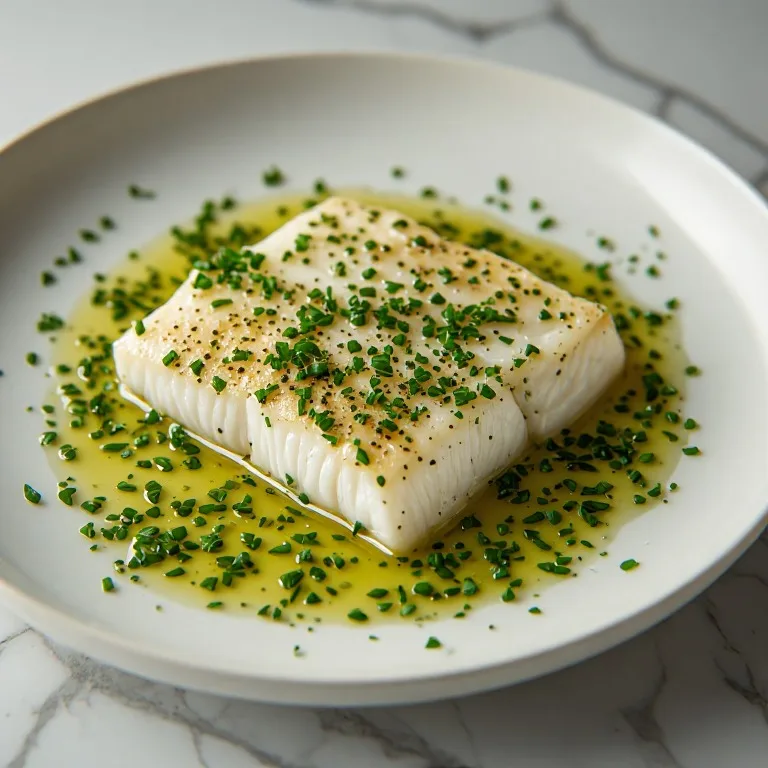



Copycat Le Bernardin Poached Halibut (Made at Home)
Prep time: 15 min Cook time: 20 min (10 min for liquid, 5–6 min for fish) Servings: 4
Why Most Poached Halibut Recipes Get This Wrong
The most widely circulated versions of Eric Ripert’s poached halibut recipe make two mistakes, often both at once.
The first is the poaching liquid. Home cooks substitute plain salted water, a classic court bouillon (white wine, herbs, vegetables, peppercorns), or in some cases skip poaching entirely and pan-sear the fish. None of these produce the same result. Ripert’s published recipe — in the 1998 Le Bernardin Cookbook, on his PBS show site Avec Eric, on Food Network, and in the Michelin Guide’s own version of the recipe — uses water thickened with a flour slurry. The thickening is not decorative. It changes the thermal behavior of the poaching liquid in a way that allows more even, controlled cooking.
The second mistake is the vinaigrette temperature. A cold vinaigrette — made in advance and refrigerated, or simply assembled at room temperature and never warmed — shocks the barely-warm fish when it hits the plate and fights it on the palate. The published recipe calls for warming the vinaigrette gently just before plating, to body temperature, so fish and sauce arrive as a unified temperature. Most pages either don’t mention this step or actively contradict it.
The Poaching Liquid: What the Flour Actually Does
The poaching medium in this recipe is closer to a very thin velouté than to a classic poaching liquid. Ripert whisks 6 tablespoons of flour into a quarter cup of cold water to create a slurry, stirs it into boiling water, then adds vermouth, lemon juice, and orange juice.
The thickened liquid transfers heat to the fish more slowly and evenly than water. Water is an aggressive conductor of heat — it pulls temperature from the exterior of a fish fillet faster than the interior can equalize, creating the familiar gray ring (overcooked protein at the perimeter) around an underdone center. The slightly viscous liquid that results from the flour slurry creates a gentler thermal envelope around the fillet that allows the whole piece to climb to temperature more uniformly.
The vermouth contributes mild botanical aromatic complexity — Noilly Prat, the standard dry white vermouth in French kitchens, has a subtle herbal quality that is less assertive than wine but more complex than water alone. The lemon and orange juices provide bright acidity and a faint citrus sweetness that will carry into the fish’s exterior.
One note on consistency: after the flour and liquids go in, the liquid should be noticeably thicker than water but not viscous — it should coat a spoon lightly. If it looks like thick gravy, you used too much flour; if it behaves like water, whisk in a small amount of additional flour-water slurry. The target is somewhere between consommé and very thin cream soup.
The Barely Touched Philosophy
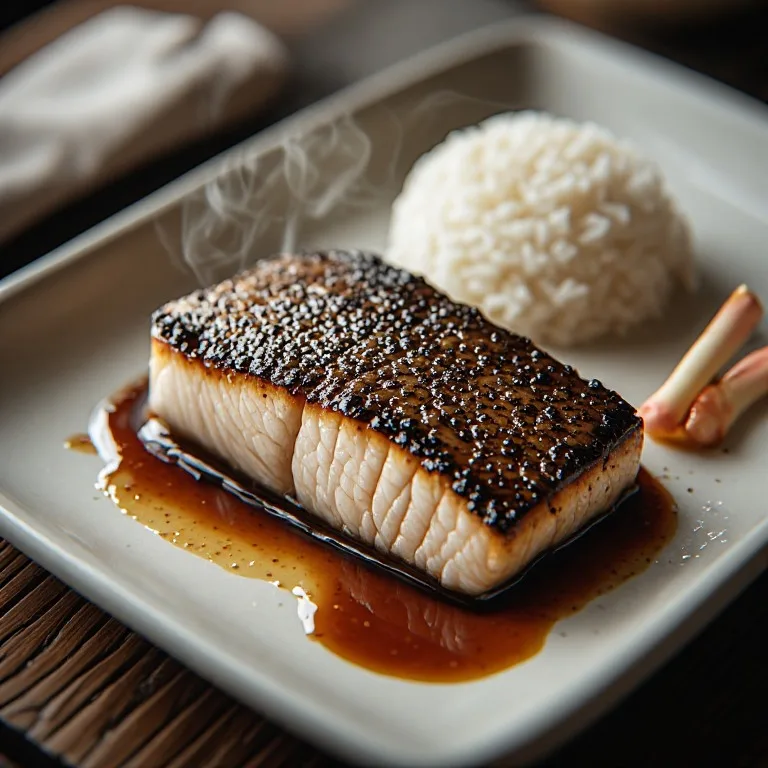
Le Bernardin’s menu is organized not by course or by preparation style but by degree of cooking: Almost Raw, Barely Touched, and Lightly Cooked. Halibut typically lives in the Barely Touched section — cooked to just above raw, warm in the center but still silky and translucent at the very middle.
Gilbert Le Coze, who founded the restaurant in Paris in 1972 and opened the New York location in 1986, built the kitchen around the idea that the fish is the point. Every decision — how much heat, what sauce, what accompaniment — exists to make the fish’s own flavor more legible, not to transform it. Eric Ripert, who has run the kitchen since Gilbert’s sudden death in 1994, has spent 30 years deepening that philosophy. The halibut preparation is one of its clearest expressions.
The practical implication for home cooks: target rare to medium-rare, not “cooked through.” The fish should be just opaque at the edges and barely warm at the center. If it flakes easily and looks white throughout, it is overcooked for this preparation.
The Fines Herbes Vinaigrette
Fines herbes is the classic four-herb blend of French cooking: chives, flat-leaf parsley, French tarragon, and chervil. All four are used fresh, cut fine, and added at the very last moment before plating — they should never be cooked in the vinaigrette.
The base is sherry vinegar whisked with Dijon mustard into an emulsion with olive oil and a smaller amount of canola oil. The canola oil reduces the bitterness that a pure olive oil vinaigrette can carry; the mustard keeps the emulsion stable and adds a mild pungency that complements the fish without fighting it.
Chervil is the sourcing challenge. It is a staple in French cooking and grows easily in European herb gardens, but it is genuinely uncommon in American supermarkets. If you find it at a farmers’ market, buy more than you need — it keeps poorly and is worth using abundantly. If you cannot find it: extra tarragon plus additional flat-leaf parsley is the closest substitution. A very small amount of fennel frond or fennel seed (ground to a powder and used sparingly) can also approximate some of chervil’s softness.
What to Serve With It
Keep the accompaniments as restrained as the fish. The dish is built around clean, warm halibut and a bright herb vinaigrette, so a side that competes on richness or acidity will unbalance it. What works:
- Steamed or boiled fingerling potatoes, halved, tossed with a little of the same vinaigrette or plain olive oil and salt. The starch is a neutral canvas for the herbs.
- Braised or wilted greens — leeks softened in butter, or spinach wilted with nothing but salt — echo the delicate treatment of the fish.
- A spoonful of the poaching liquid, strained and reduced by half, makes an optional light broth around the fish for anyone who wants more moisture on the plate.
- A crisp, unoaked white — white Burgundy (Chablis, Meursault), a dry Loire (Sancerre, Muscadet), or a mineral Riesling — mirrors the vinaigrette’s acidity without overpowering the fish. Le Bernardin’s cellar leans heavily on exactly these.
Avoid tomato-heavy, garlic-forward, or cream-based sides — they belong to a different, louder style of cooking than this dish is after.
About Le Bernardin
Le Bernardin opened in Paris in 1972, founded by siblings Gilbert and Maguy Le Coze. It earned its first Michelin star in 1976. The New York location opened on West 51st Street in Midtown Manhattan in 1986 and earned four stars from the New York Times within three months of opening — still one of the fastest star ascents in the paper’s history. Eric Ripert joined the kitchen in 1991, working under Gilbert until Gilbert’s sudden death from a heart attack in 1994. Ripert has been executive chef and co-owner since, and the restaurant has held three Michelin stars continuously since the first New York Michelin guide in 2005.
The menu price in 2026 is $218 for the four-course prix-fixe, $285 for six courses, and $350 for the full chef’s tasting menu. The bar at Le Bernardin offers a smaller à la carte menu and is the most accessible way to experience the kitchen for the first time.
Frequently Asked Questions
Why does the Le Bernardin recipe add flour to the poaching liquid?
This is the most counterintuitive step in the recipe, and the one most copycat pages omit or quietly substitute. The flour-water slurry creates a slightly thickened, velouté-like liquid that transfers heat to the fish more slowly and evenly than plain water. The result is more even cooking from edge to center without the overcooked gray perimeter that aggressive poaching in water produces. The technique is published verbatim in the 1998 Le Bernardin Cookbook, on Avec Eric, on Food Network, and in the Michelin Guide’s version of the recipe — it is the restaurant’s actual method, not a home cook’s adaptation.
What is the barely warm skewer test, and why not use a thermometer?
Insert a thin metal skewer through the thickest part of the fillet and hold it at the center for exactly 5 seconds. Touch the tip to your inner wrist or lower lip. Barely warm means done — the center is at approximately 115 to 125°F (Ripert’s target: rare to medium-rare). Hot means overcooked. Cold means another minute. An instant-read thermometer works as a confirmation (target 118 to 125°F) but the skewer test is faster and non-invasive. This is Ripert’s standard doneness check for all of Le Bernardin’s gently cooked fish.
What are fines herbes, and what do I use if I can’t find chervil?
Fines herbes is the four-herb French blend: chives, flat-leaf parsley, French tarragon, and chervil. All four are used fresh. Chervil is hard to find in American supermarkets — the best substitute is extra tarragon plus additional flat-leaf parsley. Do not use dried herbs, basil, dill, or cilantro; they will take the vinaigrette in a different direction.
Why must the vinaigrette be warm?
Cold vinaigrette drops the surface temperature of barely-warm fish and creates an unintended temperature contrast. The recipe calls for warming the vinaigrette gently — to body temperature, not hot — just before plating. The goal is to remove the refrigerator chill so fish and sauce arrive as a unified temperature.
What kind of halibut should I buy?
Center-cut Pacific halibut fillets at least 1 inch thick, skin removed. Pacific halibut is in season March through November; Atlantic halibut works outside those windows. Ask for thick center-cut portions — thin tail pieces will overcook before the interior reaches temperature. The closest substitutes are turbot, thick-cut black sea bass, or John Dory.
How is this dish placed in Le Bernardin’s menu?
In Le Bernardin’s “Barely Touched” section — the middle of the restaurant’s three-tier cooking-intensity menu (Almost Raw / Barely Touched / Lightly Cooked). The Barely Touched section is where fish is treated to just enough heat to be warm, and nothing more. The current (2026) restaurant preparation of the halibut uses a daikon-ginger dashi and radish medley; the fines herbes vinaigrette version is the canonical published home recipe from the 1998 cookbook.
What does dinner at Le Bernardin actually cost?
The four-course prix-fixe is $218 per person; the six-course is $285; the eight-course chef’s tasting is $350. With wine and service, dinner for two typically runs $600 to $800. The bar menu offers à la carte dishes at $40 to $55 per entrée and is the most accessible entry point.