
Pin It

Nobu New Style Sashimi (The Hot-Oil Pour, Made at Home)

Nobu New Style Sashimi (The Hot-Oil Pour, Made at Home)
Jump to Recipe
Prep 20 min Cook 2 min Serves 2 (appetizer)
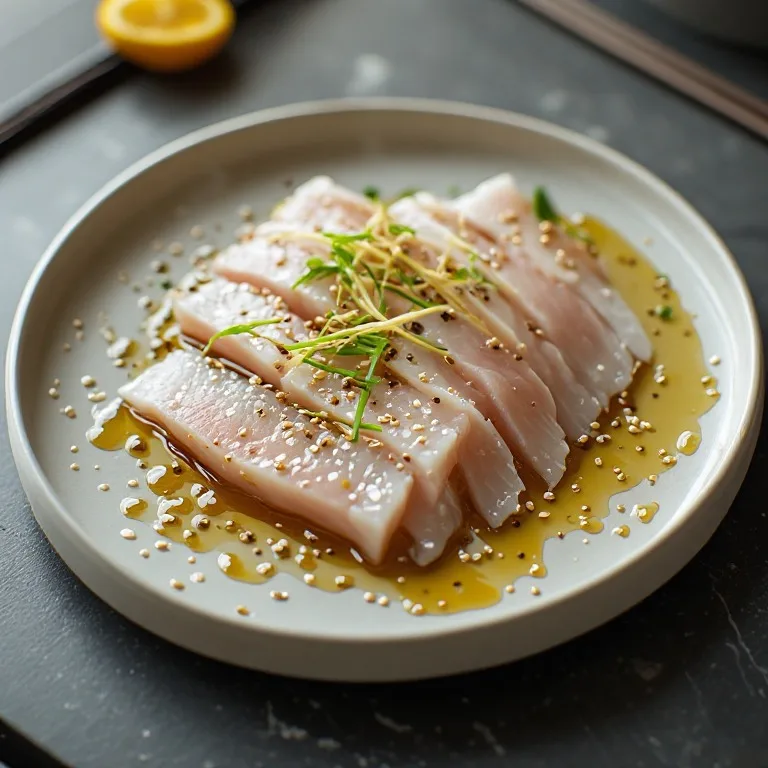
Quick answer: Nobu's New Style Sashimi has two parts: cold fish on a plate, and hot oil poured over at the last moment. Start by making the yuzu soy: stir together 3 tablespoons soy sauce and 1 tablespoon yuzu juice (or fresh lemon juice) in a small bowl and set aside. Slice 6 oz of sashimi-grade halibut or fluke (hirame) into very thin pieces — about 1/8 inch thick and 2 to 2.5 inches long, cutting against the grain with a sharp knife. The slices need to be genuinely thin; at 1/4 inch they will not sear properly from the hot oil. Cut a 2-inch knob of peeled ginger into fine julienne strips (matchstick-thin, 1.5 to 2 inches long). Thinly slice two scallions on the bias, about 1/16 inch. Grate one small garlic clove to a smooth purée. Chill two flat plates for 10 minutes. Spoon the yuzu soy over the chilled plates to form a shallow pool. Smear a very faint dab of garlic onto each fish slice (about 1/4 teaspoon total for the whole plate), then lay the slices garlic-side down in a single overlapping layer on the sauce. Arrange ginger julienne strips and scallion over the fish. In a very small saucepan, combine 3 tablespoons pure olive oil with 1 teaspoon toasted sesame oil. Heat over high heat until the surface shimmers and the oil is just beginning to smoke — hot enough that a drop of water flicked in sizzles and evaporates on contact. (Nobu's cookbook describes heating the oil until it shimmers, just short of a boil; many home cooks push it to the first wisps of smoke for a more pronounced sear.) Immediately pour the hot oil evenly over the fish; you will hear a sharp sizzle as the oil sears the surface of each slice. Scatter toasted sesame seeds over the plates and serve within 30 seconds.

Shop the tools

Gear matched to this recipe. These are Amazon affiliate links — we may earn a small commission if you buy, at no extra cost to you.

As an Amazon Associate, Copycat Spices earns from qualifying purchases. Product images are generic illustrations, not the exact item listed.

Nobu New Style Sashimi (The Hot-Oil Pour, Made at Home)

Nobu Matsuhisa's New Style Sashimi at home: paper-thin halibut or fluke over yuzu soy, topped with ginger julienne and scallion, hit with sizzling-hot olive-sesame oil poured tableside. The technique that defined Nobu's cuisine — for about $15.

Medium Prep: 20 min Cook: 2 min Total: 22 min2 (appetizer) servings ~$4.50/serving
Prep20 min
Cook2 min
Total22 min
Servings
2
At home~$4.50/serving
vs
Restaurant~$20.25/serving
You save ~78%

The Story Behind the Recipe

Nobu Matsuhisa's New Style Sashimi at home: paper-thin halibut or fluke over yuzu soy, topped with ginger julienne and scallion, hit with sizzling-hot olive-sesame oil poured tableside. The technique that defined Nobu's cuisine — for about $15.

Nutrition Facts

Per serving (2 (appetizer) servings)
Calories180
Total Fat9g
Total Carbs3g
Dietary Fiber0g
Protein22g

* Estimated values based on standard recipe preparation. Actual values may vary.

Ingredients

  • For the yuzu soy
  • For the fish
  • For the garnish
  • For the hot oil

Instructions

💡
Pro tip: This recipe tastes even better the next day. The flavors need time to meld together in the fridge.
❄️
Storage: Keeps in an airtight container in the fridge for up to 2 weeks. Freezer-friendly for up to 3 months.
🎃 Free Halloween cookbook — download now The Copycat Halloween Cookbook A ready-made, photo-illustrated PDF of our best halloween copycat recipes — free to download, no building required. Pay what you want to support if you love it.

Free PDF — instant download. We'll also send new seasonal copycat recipes now and then; unsubscribe anytime. Or just download it →

Nobu Matsuhisa solved a problem his guests didn’t know they had.

When he opened Matsuhisa in Beverly Hills in 1987, he was cooking a cuisine most Americans had barely encountered: Japanese technique fused with the Peruvian flavors he had absorbed during years working in Lima. The food was precise, beautiful, and largely raw — and one evening a guest told him, politely but clearly, that she wasn’t comfortable eating completely raw fish.

His response was New Style Sashimi.

He took paper-thin slices of halibut — hirame, the Japanese flounder — and arranged them over yuzu soy on a cold plate. He topped each slice with thin ginger julienne and scallion. Then he heated olive oil and sesame oil together until smoking, and poured the oil over the fish in one fast, tableside stream.

The sizzle was immediate and theatrical. The oil seared the surface of each slice in under a second. The ginger wilted and bloomed. The yuzu soy emulsified briefly at the edges. The fish was simultaneously seared and raw — barely-cooked at the surface, fully raw inside, with a texture and flavor that had no equivalent in any other dish Matsuhisa served.

The guest was satisfied. The dish became a signature. Thirty-five years later it is still on the menu at every Nobu location worldwide.

What Makes This Dish Work

There are four elements that must all be right:

The fish. Halibut or fluke (hirame) is the classic choice — lean, delicate, almost translucent when fresh, with a mild clean flavor that shows the ginger and the oil rather than competing with them. At home, sashimi-grade halibut from a Japanese grocery (Mitsuwa, H Mart) or a reputable fishmonger is the target. Salmon works well and is easier to source. Sea bass is a good option. Avoid anything too firm or assertive.

The slice thickness. Paper-thin, about 1/8 inch. This is the detail home cooks most often skip. At 1/4 inch, the hot oil sears the very surface but doesn’t affect enough of the slice to produce the textural contrast. At 1/8 inch, the oil’s contact heat reaches further into the fish — the result is a slice that is almost uniformly changed at the surface while the center holds raw. Use the sharpest knife you have and cut against the grain.

The oil temperature. Hot enough to sear and sizzle on contact. Nobu’s cookbook heats the oil until the surface shimmers, just short of a boil; many home cooks push it to the first wisps of smoke for a stronger sear. Either way, oil that’s merely warm only wets the fish — it does not sear, does not wilt the ginger, does not create the sizzle. The thermometer-free test is a drop of water: if it sizzles and evaporates on contact, the oil is ready. The window between “ready” and “scorched” is about 30 seconds at high heat — watch it constantly and pour the moment it’s there.

The oil blend. Mostly olive oil with a small amount of sesame — Nobu’s cookbook recipe uses about 3 tablespoons pure olive oil to 1 teaspoon toasted sesame oil per serving. The olive oil provides the fat volume and slight fruitiness; the sesame is present primarily for its aroma, and a little goes a long way. Pure olive oil (rather than extra-virgin) gives more control because its higher smoke point holds up better as you heat the oil to the shimmering, sear-ready point. Use toasted (dark) sesame oil, not light — the nutty roasted scent is what the dish smells like.

The Yuzu Soy Base

The yuzu soy goes on first — a shallow pool that the fish floats in and the hot oil hits. It does two things: seasons the fish from underneath as it sits briefly on the cold plate, and creates the dramatic sizzle when the smoking oil hits the cool citrus-soy. Nobu’s recipe is simple: three parts soy sauce to one part yuzu juice. Bottled yuzu ponzu (Kikkoman or Mizkan) works well as a ready-to-use substitute. Keep it thin — it should pool, not sit in a thick layer.

At the Table

The pour is the moment. Nobu servers bring the plated fish to the table, then heat the oil in the kitchen and walk it out. The pour happens in front of guests: one fast, even stream over the fish, immediate sizzle, immediate service. The drama is real and deliberate — Nobu built this dish to be seen as well as eaten.

At home, you can do the same: plate the fish in the kitchen, bring the plates to the table, then heat the oil and carry it out. Or do the whole thing in the kitchen if a tableside pour is impractical. Either way, serve within 30 seconds of the pour — the heat dissipates fast and the dish should still be faintly sizzling when it arrives.

The restaurant charges $28 to $32 for an appetizer portion. At home: about $20 for two, mostly the cost of the fish.
Frequently Asked Questions

What fish does Nobu's New Style Sashimi use, and what are the best substitutes?

The classic version of New Style Sashimi at Nobu uses halibut or fluke (the Japanese name is hirame — a flat, lean, delicate white fish with clean flavor and almost translucent flesh when very fresh). Nobu Matsuhisa developed the dish at Matsuhisa Beverly Hills in the late 1980s, and the original restaurant still serves it primarily with hirame. At different Nobu locations, the fish varies: you may see salmon, sea bass, yellowtail, or even tuna listed as New Style Sashimi on the menu — the technique is the constant, and the restaurant adapts it to the best available fish. For the home version, halibut and fluke are the ideal. Both are lean, mild, and firm enough to slice very thin without falling apart, yet delicate enough that the sizzling hot oil visibly changes the surface. Salmon works well and is much easier to source sashimi-grade; its fat content means it stays silky even after the brief oil contact. Sea bass (branzino or striped bass) is a good option at a Japanese fishmonger. What does not work: anything too firm and lean (swordfish, tuna steak) — the hot oil lands differently on a steak-cut slice than on a paper-thin piece of delicate white fish, and you lose the half-raw, half-barely-cooked texture that defines the dish.

What makes this different from Nobu's cold yellowtail jalapeño sashimi — aren't they the same dish?

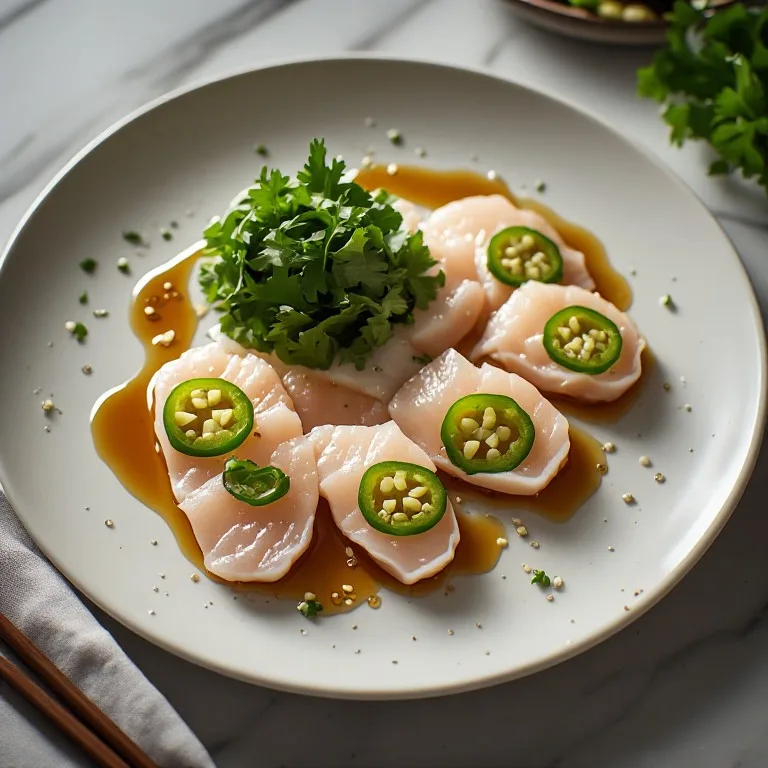
They are completely different dishes that share only the word 'sashimi.' Nobu Yellowtail Jalapeño is a cold preparation: sashimi-grade hamachi, a whisper of garlic, thin jalapeño rounds, a cilantro leaf, and yuzu soy — nothing is heated, the fish is fully raw, and the sauce goes on at room temperature. New Style Sashimi is defined by one thing: the tableside pour of sizzling-hot oil over the plated fish, which briefly sears the exterior of each thin slice while the interior stays raw — a half-second of cooking by contact heat, not by oven or broiler. The flavor profiles are completely different: yellowtail jalapeño is citrus-sharp and herbaceous; New Style Sashimi is savory and nutty from the hot olive-sesame oil hitting the yuzu soy, with the gentle heat and aroma of ginger. The oil pour is the whole point of New Style — the sizzle, the scent, the slight caramelization of the ginger and scallion as the oil hits them. If a recipe for yellowtail jalapeño tells you to drizzle hot oil over the fish, it has confused the two dishes. They are sold separately at Nobu and were created for different purposes.

Why does Nobu use olive oil in a Japanese dish — isn't that unusual?

Yes, and it is intentional. Nobu Matsuhisa grew up in Japan and trained classically in Tokyo, but he spent years cooking in Peru before opening Matsuhisa in Beverly Hills in 1987. The Peruvian cooking he encountered — and the local California ingredients available to him — shaped what became his signature style: Japanese precision applied to non-Japanese ingredients and techniques, specifically the fusion of Japanese technique with Peruvian and South American flavors. The olive oil in New Style Sashimi is one of the most visible markers of this. In a strictly traditional Japanese kitchen, you would never use olive oil for a sashimi preparation — sesame oil (or occasionally grapeseed) is the reference point. But Nobu's cookbook recipe uses mostly olive oil — roughly 3 tablespoons olive oil to 1 teaspoon sesame oil per serving — with the sesame present primarily for aroma rather than as the dominant fat. Pure (sometimes labeled 'classic' or 'light') olive oil rather than extra-virgin is the sensible choice because its higher smoke point (~460°F) gives more headroom when you heat the oil to the shimmering, sear-ready point; extra-virgin starts smoking and turning acrid earlier, which is cutting it close. The small amount of toasted sesame oil carries the nutty, savory Japanese character while the olive oil provides the fat volume and a faint fruitiness that reads as slightly Californian. Use toasted (dark) sesame oil, not light — the flavor is the entire point of including sesame.

How hot does the oil need to be, and how do I know it's ready?

The oil needs to be genuinely hot — hot enough to sear and sizzle on contact, not a warm drizzle. Nobu's cookbook recipe describes heating the olive-and-sesame oil until the surface shimmers, just short of a boil; many home cooks push it a little further, to the first wisps of smoke, for a more dramatic sear. Either target works, and the test is the same and thermometer-free: flick one drop of water into the oil — if it sizzles and evaporates on contact, the oil is ready. At that heat the oil contact-sears the upper surface of each paper-thin slice in about a second — the fish's color shifts from translucent to very faintly opaque at the surface, and the ginger and scallion wilt and turn fragrant. When it hits the yuzu soy on the plate you'll hear a loud, immediate sizzle and see a small billow of steam. The mistake to avoid is the opposite one: pouring oil that only feels warm. Lukewarm oil wets the fish without searing it, dilutes the yuzu soy without the sizzle, and leaves a greasy, flat result. Use the smallest saucepan or butter warmer you have (less oil heats faster), use high heat, and watch it constantly — once it shimmers it climbs toward scorching within about 30 seconds, so pour the moment it's ready.

What sauce goes on New Style Sashimi — is it ponzu or yuzu soy?

The sauce in Nobu's cookbook recipe is yuzu soy: soy sauce and yuzu juice at a ratio of roughly 3 parts soy to 1 part yuzu. It is simpler than ponzu — yuzu soy is just citrus and soy, with no mirin, no dashi, no kombu. Ponzu is a more complete sauce (soy, citrus, mirin, often a brief infusion of kelp or bonito flakes) and has more depth, but for New Style Sashimi the restaurant uses the purer yuzu-soy version. Yuzu juice is the key ingredient: a Japanese citrus with an intensely aromatic, floral flavor that a mix of lemon and lime approximates but does not fully replicate. Bottled yuzu juice is available at Japanese and Korean grocers (Mitsuwa, H Mart) and online — it keeps for months in the fridge once opened. If you cannot find yuzu juice, fresh lemon juice is the closest substitute; a 50/50 lemon and lime blend comes a bit closer. Bottled yuzu ponzu (Kikkoman or Mizkan makes it) can substitute for the yuzu soy with no preparation — use it straight. The sauce should be thin enough to pool and spread on the plate rather than sitting in a thick layer under the fish.

Does the hot oil actually cook the fish? Is the interior still raw?

Yes, the interior is still raw — and intentionally so. This is the point of the thin slice: the hot oil's contact with the top surface of each piece sears only the outermost layer, maybe a millimeter or two, while the center of even a paper-thin slice stays fully raw. The effect is a textural and flavor contrast between a barely-seared, faintly caramelized top and a silky-raw interior — not fully cooked fish, not fully raw fish, but something precisely between the two. Nobu Matsuhisa reportedly invented this technique because a guest at his early restaurant was uneasy about eating completely raw fish. He found a way to bring the fish to a state between raw and cooked — just barely altered at the surface — so it no longer felt to that guest like an entirely raw preparation, while preserving the texture and freshness of sashimi. The dish succeeded so completely that it became one of his signature preparations, not a workaround. The thinner the slice, the more the hot oil affects the proportion of seared exterior to raw interior. At 1/8 inch, the sear reaches nearly the center and you get a more uniform texture change. At 1/4 inch, the center remains clearly and completely raw with a thin seared cap. Both are correct depending on your preference; 1/8 inch is closer to the restaurant preparation.

Can I substitute a kitchen torch for the hot oil pour?

A torch produces a seared surface on the fish, but the result is meaningfully different from the hot oil technique and is not an equivalent substitute. The hot oil does three things at once: sears the fish surface, wilts the ginger and scallion, and hits the yuzu soy on the plate to create a sharp sizzling sound and a brief emulsification of oil and citrus-soy around the base of the fish. A torch sears the fish only — it does not interact with the ginger, the scallion, or the yuzu soy in the same way, and there is no sizzle or hot fat to carry the oil's nutty flavor into the sauce pool. The flavor and textural impact of the sesame-olive oil blend is significant; much of what makes New Style Sashimi taste like New Style Sashimi comes from the olive-sesame oil flavor cooked briefly into the ginger and around the yuzu soy. A torch produces a visually similar result — browned surface — but a different dish. That said, if you are concerned about handling a very small amount of extremely hot oil at the table, practice the pour in the kitchen first: use a tiny butter warmer or very small saucepan, heat only 1 tablespoon total of oil, and pour from low rather than high to control splatter. Once you've done it once, it is less dramatic than it seems.

How much does New Style Sashimi cost at Nobu, and is making it at home worth it?

At Nobu Tribeca in New York City, New Style Sashimi runs roughly $26 to $32 for an appetizer portion — the price varies by fish and location. At the Malibu, Las Vegas, or international Nobu locations, the price is similar or slightly higher. A full dinner at Nobu with a few plates and drinks typically runs $150 to $250 per person. At home: 6 oz of sashimi-grade halibut or fluke will cost approximately $14 to $22 depending on your source, plus a few dollars in pantry ingredients (soy, lemon, lime, sesame oil, olive oil, ginger, scallion). The total for two appetizer portions is roughly $20 to $28. The technique itself — once you have sourced good fish and understand the oil temperature — takes about 20 minutes. The main barrier is the fish source: you need genuinely fresh, sashimi-grade halibut or fluke, which means a Japanese or Korean grocery (Mitsuwa, H Mart, Marukai), a reputable fishmonger, or an online sashimi supplier. If you can buy the fish, the dish comes together without specialized equipment or difficult technique. The one non-negotiable is the oil temperature: the sizzle when the hot fat hits the yuzu soy is what makes the dish.

Love this recipe? Share it!

Free PDF: our 12 most-wanted copycat recipes — instant download.

Made it? Buy us a coffee

Every recipe here is free, with no paywalls. If this one was a hit at your table, a small tip keeps new copycats coming.

$

Nobu is a trademark of its owner, used here only to describe the dish this recipe recreates. This is an independent copycat written in our own words — Copycat Spices is not affiliated with, endorsed by or sponsored by Nobu.

Ratings & Reviews

—
No ratings yet

Rate this recipe

Click a star to rate

Leave a Review

0/500

CS

Copycat Spices Editorial

Researched + fact-checked. Every recipe on Copycat Spices is built from published sources — official ingredient lists, brand-published recipes, interviews and food-science references — and fact-checked before it goes live, then written as clear, step-by-step instructions for home cooks of all skill levels.

Learn more about our mission →