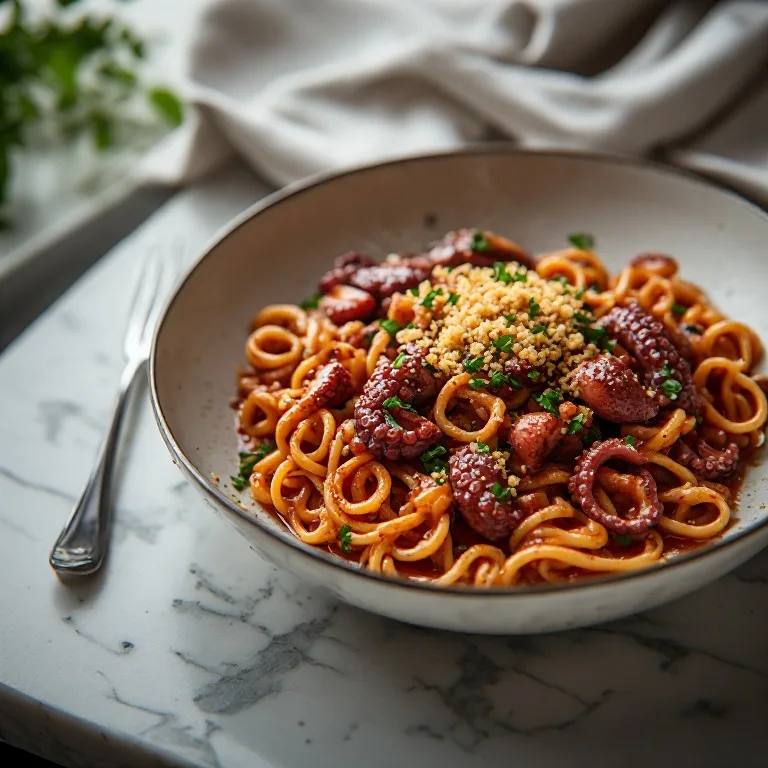



Copycat Marea Fusilli with Braised Octopus and Bone Marrow (Made at Home)
Prep time: 20 min | Cook time: 1 hr 40 min | Servings: 4
Marea opened in 2009 at 240 Central Park South, one block from Columbus Circle. The name means “tide” in Italian. Chef Michael White had spent years training in northern Italy — he staged at serious regional restaurants in Emilia-Romagna, Friuli, and the Veneto before returning to the United States and cooking his way through the New York fine-dining world. At Marea, he built a menu around Italian seafood: crudi, whole branzino, pasta with uni and crab. Every dish was specific, restrained, and technically precise.
The restaurant received 2 Michelin stars soon after opening. In 2010, it won the James Beard Foundation Award for Best New Restaurant. It has long been regarded as one of the best Italian restaurants in the country and home to some of the best pasta in New York City. More than fifteen years later, Marea is still open on Central Park South, and this dish is still on the menu.
The fusilli with red wine-braised octopus and bone marrow has been on the menu since the beginning and currently runs about $42 a plate. Food writers who have covered New York restaurants for over a decade cite it routinely — not as one of many good dishes but as the dish, a specific argument for what Italian-American pasta could be at its most serious.
Michael White described the logic of the dish this way: “The way the bone marrow and octopus interact here is sublime — another argument for the marriage of meat and marine, with the red wine and tomato sauce offering a suitably robust backdrop.” The recipe appears in his cookbook Classico e Moderno, published in 2013.
This is a home cook’s version. The bones of the dish are unchanged: the same octopus braise, the same bone marrow finish, the same pangrattato. The main accommodation is dried fusilli in place of fresh-extruded, which performs excellently here.
Where to Find Baby Octopus
This is the question that stops most home cooks. The answer is: any Asian grocery store.
Baby octopus — whole, cleaned, and frozen — is a standard item at H Mart, Ranch 99, 99 Ranch, and most independently operated Korean, Chinese, or Japanese grocery stores. It is usually sold in 1 to 2 lb bags for $5 to $9 per pound. Spanish and Portuguese grocery stores also carry them, fresh or frozen. If you live near a well-stocked fishmonger, call ahead and ask.
If you can only find large octopus (the 2 to 4 lb single animal), ask the fishmonger to clean it and have them cut the tentacles from the head. The tentacles braise identically to baby octopus — cut them into 2-inch pieces before adding to the pot.
Frozen is fine. Freezing ruptures the muscle fibers slightly, which shortens the braise time and helps the octopus reach consistent tenderness. Thaw overnight in the refrigerator, rinse under cold water, and use directly.
Understanding the Octopus Braise
Octopus is almost entirely protein and collagen — almost no fat. Raw octopus is firm and chewy in a way that is inedible as a finished dish. The entire point of the long braise is converting the collagen in the muscle into gelatin, which turns a tough protein into something tender and silky.
This conversion happens reliably between 160°F and 185°F, and it takes time — roughly 60 to 80 minutes at a very gentle simmer. The key mistake is high heat: if the braise bubbles vigorously, the octopus tightens and becomes rubbery in a different way. A barely perceptible simmer — what Italian cooks call fremito, a trembling — is what you want for the 60 covered minutes.
When the octopus is done, a fork pressed against a piece should meet no resistance. The skin will be softened and deep reddish-purple from the wine and tomatoes. The tips of the tentacles will have curled in on themselves and softened completely.
Do not rush this step.
The Bone Marrow Step
Bone marrow is the soft, fatty tissue inside femur and shank bones. It is very cheap — butchers often have it on hand for $2 to $4 per pound and sometimes give it away — and it is what separates this dish from a standard octopus tomato pasta.
When the raw marrow hits a hot pan with butter, it melts almost immediately into a rich, mineral liquid. Stirred into the finished braise, it adds an unctuous body that coats the pasta differently than olive oil or cream. Michael White called it a marriage of meat and marine: the marrow reads as deeply savory and animal against the seafood and wine.
Ask your butcher for “crosscut” or “center-cut” marrow bones, typically 2 to 3 inches thick. From 4 bones you will get about half a cup of marrow. If you would rather not scoop raw marrow, the roasting method (15 minutes at 400°F) is straightforward and produces clean results.
If you cannot source marrow bones at all, whisk 2 tablespoons of cold unsalted butter into the sauce off heat at the very end — it provides similar emulsifying properties, though the flavor is lighter and less specific.
The Pangrattato (Garlicky Breadcrumbs)
The pangrattato is not garnish. It is a structural component of the dish.
Fusilli braised in a rich octopus sauce is heavy. The textural contrast of the crunchy, garlic-forward breadcrumbs against the silky pasta and tender octopus is what keeps every bite interesting. Without the pangrattato, the dish is a single texture all the way through.
Use coarse fresh breadcrumbs if you can — crumble a slice of stale rustic bread by hand, then pulse it briefly in a food processor. Panko works as a substitute and has a similar coarse crunch. Fine dried breadcrumbs are too uniform and will turn paste-like when they contact the wet sauce.
Make the pangrattato before you start the braise, or while it is in its final uncovered stage. It holds for 3 days at room temperature.
What Fusilli Shape to Use
Fusilli at its most specific refers to a tight spring-coil spiral pasta — not the wavy cavatappi, not the short corkscrew rotini sold in American supermarkets as “fusilli,” but the elongated, tight-wound spring shape. This shape is what Marea’s kitchen extruded in-house.
For the home cook: look for fusilli or “fusilli col buco” from Italian brands — Rustichella d’Abruzzo, Setaro, De Cecco, or Rummo. Any tight-spiral fusilli will work; the goal is a shape with enough surface area to trap the chunky octopus braising liquid rather than letting it pool in the bowl.
If you can only find the short corkscrew “rotini” common in American grocery stores, use it — it performs similarly and the distinction matters less than the technique.
The Pasta Finish
The braise is thick and concentrated. Adding the fusilli directly to the pot and tossing it over medium heat for 2 full minutes — adding starchy pasta water as you go — does several things at once: it finishes cooking the pasta (which went into the boiling water 2 minutes early to allow for this), it loosens the thick braise to a sauce consistency, and it helps the braising liquid adhere to the pasta’s surface rather than separating.
This step is not optional. It is what distinguishes a pasta dish finished at the restaurant level from one where the sauce and noodles sit in the same bowl but never properly unite. Have your pasta water ready, ladle it in as needed, and toss with intent.
Comparison: Marea vs. Similar Octopus Pasta Dishes
| Marea Fusilli | Standard Octopus Pasta | Greek-style Stewed Octopus | |
|---|---|---|---|
| Octopus treatment | Long braise, 80 min | Varies | Stewed with tomato |
| Bone marrow | Yes, flash-fried | No | No |
| Wine | Sangiovese-based | Varies | Red or white |
| Pasta shape | Fusilli (extruded) | Various | Not always pasta |
| Breadcrumb topping | Yes, pangrattato | Rarely | No |
| Result | Silky, complex, layered | Simpler | Earthier, stew-like |
The Marea version is more elaborate than most home octopus pasta recipes, but the technique is the same at its core: long gentle braise, fatty enrichment, pasta finished in the sauce. The steps are not difficult — they just take time.
Internal Links
If you enjoy recreating famous NYC restaurant dishes at home:
- Copycat Carbone Spicy Rigatoni Vodka — the caramelized-tomato-paste foundation, at $8 a plate
- Copycat Nobu Black Cod Miso — the Saikyo miso marinade, 2 to 3 days ahead
- Copycat Don Angie Pinwheel Lasagna — West Village’s most viral pasta format
- Copycat Rao’s Famous Meatballs — the slow-simmered Sunday sauce method
- Copycat Balthazar French Onion Soup — chicken stock, ruby port, thick country-bread croutons