Prep 45 min (plus overnight freeze)Cook 35 minServes Two 10-inch pies (16 slices)
Serves Two 10-inch pies (16 slices)45 min (plus overnight freeze) prepJump to Recipe ↓
Quick answer: Make the oat cookie first: cream 115g (1 stick) room-temp butter with 75g (⅓ cup) light brown sugar and 40g (3 tbsp) granulated sugar on medium until fluffy, about 2 minutes. Beat in 1 egg yolk. Add 80g (⅔ cup) all-purpose flour, 120g (1½ cups) old-fashioned rolled oats, ½ tsp baking powder, a pinch baking soda, and ½ tsp kosher salt; mix on low until just combined. Spread onto a parchment-lined baking sheet in a flat slab and bake at 375°F for 12 to 14 minutes, until golden at the edges. Cool completely. Break into chunks and pulse in a food processor to a coarse, wet-sand texture. Transfer to a bowl and mix in 55g (4 tbsp) melted butter, 15g (1 tbsp) brown sugar, and a pinch of salt until clumpy. Divide between two 10-inch pie tins (or one 9-inch + one 8-inch) and press firmly up the sides and across the bottom. Freeze while you make the filling. For the filling: combine 300g (1½ cups) granulated sugar, 180g (¾ cup packed) light brown sugar, 20g (3 tbsp) nonfat dry milk powder, 24g (¼ cup) corn flour (superfine corn powder — NOT cornstarch, NOT cornmeal; see notes), and 6g (1½ tsp) fine kosher salt in a stand mixer fitted with the paddle attachment. Mix on LOW until evenly blended. With mixer still on low, add 225g (2 sticks) melted, cooled butter. Paddle on low for 2 to 3 minutes until all the dry ingredients are moistened. Add 160g (⅔ cup) heavy cream and 2g (½ tsp) vanilla. Paddle on low for another 2 to 3 minutes until no white streaks remain. Add 8 egg yolks and paddle on low just until the mixture is glossy and the yolks are fully incorporated — about 30 seconds. Never increase the speed above low at any point; aeration is the enemy of this filling. Divide the filling between the two frozen crusts. Bake at 350°F for 15 to 18 minutes: the edges will look set and slightly puffed, but the center should still wobble noticeably when you jiggle the tin — like firm Jell-O. Do not wait for the center to look baked. Cool to room temperature, then freeze for at least 3 hours or overnight. Slice directly from frozen, let pieces sit 10 minutes at room temperature before serving. One 10-inch Milk Bar Pie costs $80 from the bakery; this recipe makes two for about $18 in ingredients.
Shop the tools
Gear matched to this recipe. These are Amazon affiliate links — we may
earn a small commission if you buy, at no extra cost to you.
As an Amazon Associate, Copycat Spices earns from qualifying purchases.
Product images are generic illustrations, not the exact item listed.
Milk Bar Crack Pie (Now 'Milk Bar Pie') — Christina Tosi's Iconic Gooey Custard Pie, Made at Home
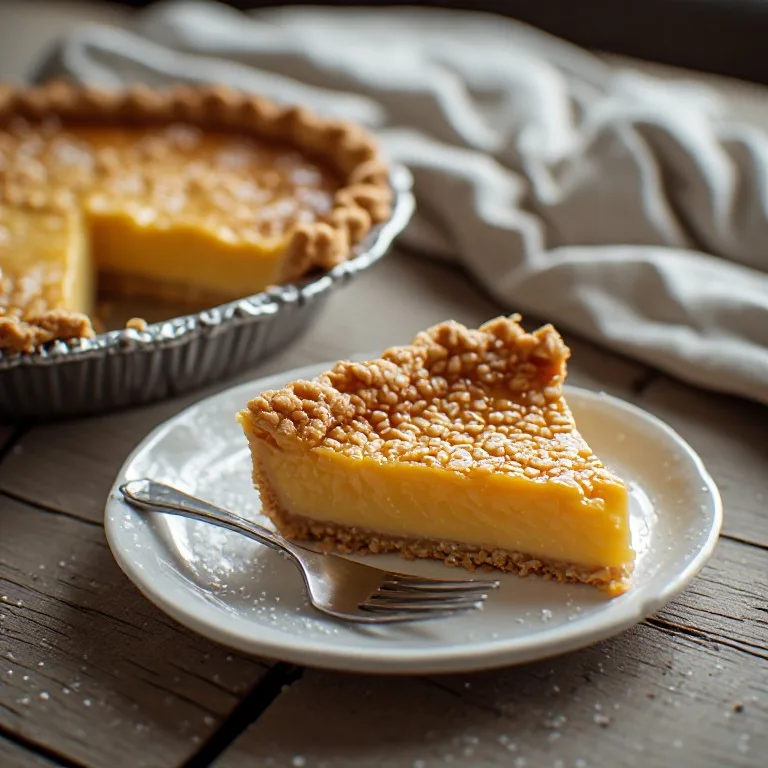
Christina Tosi's Milk Bar Pie (the pie formerly known as Crack Pie) at home: an oat cookie crust pressed into tins and filled with a dense, gooey custard of butter, brown sugar, egg yolks, milk powder, and corn flour. The two steps most recipes get wrong — low-speed-only mixing and the mandatory freeze — explained in full.
Medium
Prep: 45 min (plus overnight freeze)
Cook: 35 min
Total: 1h 20mTwo 10-inch pies (16 slices) servings
~$4.50/serving
Prep45 min (plus overnight freeze)
Cook35 min
Total1h 20m
Servings
4
At home~$4.50/serving
vs
Restaurant~$20.25/serving
You save ~78%
The Story Behind the Recipe
Christina Tosi's Milk Bar Pie (the pie formerly known as Crack Pie) at home: an oat cookie crust pressed into tins and filled with a dense, gooey custard of butter, brown sugar, egg yolks, milk powder, and corn flour. The two steps most recipes get wrong — low-speed-only mixing and the mandatory freeze — explained in full.
Ingredients
Oat Cookie Crust (makes enough for two 10-inch pies)
Crust Assembly (after baking cookie)
Filling
Instructions
💡
Pro tip: This recipe tastes even better the next day. The flavors need time to meld together in the fridge.
❄️
Storage: Keeps in an airtight container in the fridge for up to 2 weeks. Freezer-friendly for up to 3 months.
~350-550 cal/serving · Rich & Indulgent🔥
🎃 Free Halloween cookbook — download now
The Copycat Halloween Cookbook
A ready-made, photo-illustrated PDF of our best halloween copycat
recipes — free to download, no building required. Pay what you want to support if you love it.
Free PDF — instant download. We'll also send new seasonal copycat recipes now
and then; unsubscribe anytime.
Or just download it →
🎉 Your Halloween Cookbook is ready!
It's free — but if it's worth something to you, you can pay what you want.
It keeps the recipes coming.
$
✓ Downloading your free Halloween Cookbook — check your downloads folder. Happy cooking!
CopycatSpices
Milk Bar Crack Pie (Now 'Milk Bar Pie') — Christina Tosi's Iconic Gooey Custard Pie, Made at Home
Christina Tosi's Milk Bar Pie (the pie formerly known as Crack Pie) at home: an oat cookie crust pressed into tins and filled with a dense, gooey custard of butter, brown sugar, egg yolks, milk powder, and corn flour. The two steps most recipes get wrong — low-speed-only mixing and the mandatory freeze — explained in full.
milk-bar · momofuku · crack-pie · milk-bar-pie
🕑Prep45 min (plus overnight freeze)
🍳Cook35 min
⏱Total1h 20m
🍽ServesTwo 10-inch pies (16 slices)
⭐DifficultyMedium
Ingredients
Oat Cookie Crust (makes enough for two 10-inch pies)
115g (8 tablespoons / 1 stick) unsalted butter, at room temperature
75g (⅓ cup packed) light brown sugar
40g (3 tablespoons) granulated sugar
1 egg yolk (not a whole egg)
80g (⅔ cup) all-purpose flour, spooned and leveled
24g (¼ cup) corn flour / corn powder — superfine, freeze-dried corn ground fine (NOT cornstarch, NOT cornmeal; see FAQ)
6g (1½ teaspoons) fine kosher salt
225g (16 tablespoons / 2 sticks) unsalted butter, melted and cooled to room temperature
160g (⅔ cup) heavy cream, at room temperature
2g (½ teaspoon) vanilla extract
8 large egg yolks, at room temperature (NO egg whites)
Instructions
1.Bake the oat cookie. Preheat oven to 375°F. Line a half-sheet pan with parchment. Fit a stand mixer with the paddle; beat the room-temperature butter, brown sugar, and granulated sugar on medium for 2 minutes until fluffy. Beat in the egg yolk on medium for 1 minute. Reduce to low; add the flour, oats, baking powder, baking soda, and salt all at once. Mix 20 to 30 seconds until just combined — do not overmix. Turn the dough onto the parchment-lined sheet and press it flat into a thin, even slab about ¼-inch thick (it will cover roughly half the pan). Bake 12 to 14 minutes until the edges are golden and the surface looks dry. Cool completely on the pan — at least 30 minutes. The cookie will crisp as it cools.
2.Make the crust. Break the cooled oat cookie into chunks and transfer to a food processor. Pulse until the texture resembles coarse, wet sand — you want pieces no larger than a small pea, with plenty of fine powder. Transfer to a bowl. Drizzle in the melted butter, brown sugar, and salt. Mix with your hands until the crumbles are evenly coated and clump together when squeezed. Divide between two 10-inch pie tins (or one 9-inch and one 8-inch). Press firmly and evenly across the bottoms and up the sides, using the bottom of a measuring cup to compact the base. The crust should be about ¼ inch thick throughout. Freeze the crusts for at least 20 minutes while you make the filling.
3.Mix the dry filling ingredients. Fit the stand mixer with the paddle attachment. Add the granulated sugar, brown sugar, milk powder, corn powder, and salt. Mix on LOW — never above low — for 1 minute until evenly blended and no lumps remain.
4.Add the butter. With the mixer still on low, stream in the melted, room-temperature butter. Paddle on low for 2 to 3 minutes, scraping the bowl halfway through, until all the dry ingredients are fully moistened and the mixture looks smooth and cohesive.
5.Add the cream and vanilla. Still on low, add the heavy cream and vanilla. Paddle on low for 2 to 3 minutes until no white streaks remain and the mixture is uniformly glossy. If any dry bits cling to the paddle or bowl sides, scrape them down and mix briefly.
6.Fold in the egg yolks. Add all 8 egg yolks. Paddle on low for 20 to 30 seconds — just until the yolks are fully incorporated and the filling is homogeneous and glossy. Stop the moment no yolk streaks remain. This is the most critical moment: any extra mixing introduces air that will ruin the dense texture.
7.Fill the crusts immediately. Pour the filling into the two frozen crusts, dividing it evenly. The filling should reach to about ½ inch below the rim of each tin. Do not let the filling rest — use it within 30 minutes of mixing.
8.Bake at 350°F. Lower the oven temperature to 350°F. Place both pies on the center rack (or bake one at a time if your oven runs hot at the edges). Bake 15 to 18 minutes. The pies are done when the edges look set and are slightly puffed, but the center 3 to 4 inches of each pie wobbles visibly when you gently jiggle the tin — like firm Jell-O or a barely-set panna cotta. This is correct and intentional. Do not wait for the center to look baked.
9.Cool to room temperature. Remove from the oven and let cool on a wire rack for at least 1 hour, until the pies reach room temperature. Do not refrigerate while still warm — condensation will collect on the surface and affect the texture.
10.Freeze overnight. Once fully cooled, place the pies uncovered in the freezer for at least 3 hours; overnight is better and is how Milk Bar prepares them for retail. The filling must freeze solid to achieve its characteristic dense, gooey, toffee-like texture. The pies keep frozen, tightly wrapped, for up to 1 month.
11.Slice and serve. Remove a pie from the freezer 10 minutes before serving. Slice with a sharp knife dipped in warm water and wiped dry between cuts. Let each slice rest 5 to 10 minutes at room temperature before eating — the exterior should be slightly crisp from the freezer, the center still cold and dense but yielding. Dust lightly with powdered sugar if desired.
Notes
Milk Bar Pie — the dessert sold as Crack Pie until 2019 — is Christina Tosi’s gooey, barely-set sugar custard baked in a crumbled oat-cookie crust and finished, crucially, in the freezer. It is Milk Bar’s bestselling item, and this recipe reproduces all three of its parts at home: the oat cookie crust, the corn-and-milk-powder custard filling, and the freeze protocol that gives the pie its dense, toffee-like bite.
Christina Tosi created it in 2008 when she opened Momofuku Milk Bar in New York. She called it Crack Pie — a name an Australian kitchen worker coined after tasting a test version, meaning only that it was addictive. The name stuck for eleven years, through the bakery’s national expansion and two seasons of a television competition. In April 2019, after sustained criticism that the name trivialized the crack cocaine epidemic’s devastation of Black communities during the mandatory-minimum era, Tosi renamed it Milk Bar Pie. The recipe was not changed.
The pie is a cousin to chess pie and transparent pie — that category of extremely rich, barely-set Southern sugar custard — but four deliberate deviations make it its own thing:
An oat-cookie crust, baked as a flat cookie first, then crumbled and pressed into the tin — not a pastry shell.
Corn powder and milk powder in the filling — a dairy-caramel depth and toasted-corn note found in no other custard pie.
Egg yolks only, never whole eggs — the single change that keeps the filling dense instead of airy.
A mandatory overnight freeze — the freezer, not the oven, is where the texture is actually made.
Each of these choices matters. None can be safely skipped or substituted without changing the result.
The recipe has two failure modes that account for most disappointing home attempts: mixing the filling too fast (any speed above low introduces air, destroying the density), and skipping or abbreviating the freeze (a refrigerator-only version is softer, harder to slice, and missing the defining texture). Get both right and the rest of the recipe is forgiving.
Frequently Asked Questions
What is 'corn powder' and what can I substitute if I can't find it?
Corn powder — sometimes labeled 'freeze-dried corn powder' or 'fine corn flour' — is the recipe's most elusive ingredient. Milk Bar's version is a superfine powder ground from whole dried corn kernels, distinct from cornmeal (too coarse, gritty), cornstarch (pure starch, no corn flavor), and masa harina (alkali-treated, different flavor). It contributes two things: a subtle toasted-corn sweetness that deepens the filling's flavor, and a fine, starchy body that helps the custard set into its characteristic dense, slightly chewy consistency. The best substitute is to grind freeze-dried sweet corn (Trader Joe's sells bags of it, as does Amazon under brands like Augason Farms) in a spice grinder or blender until it becomes a fine powder; pass through a fine-mesh sieve to remove any coarse bits. In a pinch, King Arthur Flour sells a product labeled 'corn flour' (an American-milled superfine cornmeal, not cornstarch) that is the closest off-the-shelf equivalent. Cornstarch alone substitutes the thickening but loses the corn flavor; cornmeal alone gives grittiness. If you genuinely cannot source either, a mix of 18g (3 tbsp) cornstarch and 6g (1 tbsp) fine cornmeal is the best workaround — the texture will be close, the flavor slightly less complex.
Why does this recipe only use egg yolks, not whole eggs? What does it change?
Egg whites are mostly water (about 88%) and protein, and both work against this recipe. Water creates steam during baking, which lightens and aerates the filling; the proteins, when beaten or heated, form a network that gives the filling springiness and a bouncy, almost custard-like texture. Both effects are the opposite of what Milk Bar Pie wants. By using only the yolks — which are mostly fat (about 30%) and emulsifying proteins — the filling stays completely unaerated and dense. The fat from the yolks contributes richness and helps bind the butter, cream, and sugars into a smooth, cohesive mass. The yolk proteins set gently during baking to give the filling its characteristic wobbly-but-sliceable consistency after freezing. Any trace of white in the filling — even a teaspoon — will cause the custard to rise, become airier, and lose its signature density. Tosi's cookbook notes this explicitly. Separate eggs one at a time into a bowl before adding them to the mixer; if a yolk breaks and you get white, set it aside for scrambled eggs and use a clean one.
Why do you have to freeze it? What happens if you just refrigerate it?
The freeze is not optional — it is the primary technique that creates Milk Bar Pie's specific texture. Here is what happens at each stage: baked at 350°F, the filling comes out wobbly and loose, essentially a warm, fluid custard that has just barely set at the edges. At room temperature and then refrigerated, it firms but stays relatively soft — spreadable, almost like a very thick caramel sauce. When frozen, the dissolved sugars (which remain somewhat fluid down to their glass-transition temperature) lock into a denser, almost toffee-like consistency: still gooey and yielding when you bite it, but firm enough to slice cleanly and hold its shape on a plate. Milk Bar ships all its pies frozen for exactly this reason — the frozen state is the intended state. When you slice directly from the freezer and let pieces rest 10 minutes at room temperature, you get that slightly crispy frozen-surface edge with a dense, gooey, barely-thawed center: the exact texture you experience at the bakery. A refrigerator-only version is good but softer, harder to slice cleanly, and missing the specific toffee-gooey quality.
Why is it called 'Crack Pie' and why did Milk Bar rename it?
Christina Tosi named it Crack Pie when she opened Milk Bar in 2008 — the name came from an Australian kitchen worker at Momofuku who tasted an early version and said 'this pie is like crack.' The name was meant to signal addictiveness. By 2019, it had become controversial: critics, most prominently Boston Globe food writer Devra First in a column titled 'There's nothing cute about crack pie,' argued that using 'crack' as a food descriptor trivializes the devastation of the crack cocaine epidemic of the 1980s and 1990s, which systematically targeted Black communities through racially disparate mandatory minimum sentencing. Tosi published a statement in April 2019 acknowledging the critique and renaming the pie 'Milk Bar Pie.' The recipe itself was not changed. In recipes, search results, and home cookbooks, both names still circulate — 'crack pie recipe' still generates heavy search traffic because so many articles and personal recipe cards predate the 2019 rename.
How is this different from chess pie, transparent pie, or buttermilk pie?
All four belong to the same family of Southern sugar-custard pies — old, sugar-forward, egg-thickened, and extraordinarily rich. Chess pie, the archetype, uses whole eggs (not just yolks), butter, sugar, and either cornmeal or flour, often with a tablespoon of vinegar or buttermilk for a faint tang and to prevent the surface from cracking. Transparent pie (an Appalachian Kentucky tradition) uses flour instead of cornmeal and no acid, producing a slightly clearer, more fragile set. Buttermilk pie adds buttermilk and lemon for a more pronounced tartness. Milk Bar Pie's differences: yolks only (dramatically denser), milk powder (adds a dairy-caramel depth no chess pie has), corn powder (distinct from chess pie's cornmeal — finer texture, corn flavor), an oat cookie crust rather than a standard pastry shell, and the freeze protocol (no other custard pie recipe calls for this). The flavor is distinctly more buttery, less acidic, more caramel-adjacent than chess pie. The texture after freezing — dense and slightly toffee-like — is unlike any other pie in the family.
The center still jiggles when I take it out of the oven. Is it done or underdone?
It is done. A properly baked Milk Bar Pie looks underdone when it comes out of the oven — the edges should be lightly puffed and visibly set, but the center 3 to 4 inches should wobble like a thick gelatin dessert when you jiggle the tin. This is intentional. The filling contains a very high ratio of sugar and fat to protein (8 egg yolks, 2 sticks of butter, 160g cream), and that ratio means the filling needs the freezer — not continued oven time — to achieve its final consistency. If you bake until the center looks fully set and no longer jiggles, the edges will be overdone, dry, and slightly grainy by the time the center is set. Take it out wobbly, cool it to room temperature (about 1 hour), then freeze it. The freezer is the final stage of cooking.
Can I make just one pie instead of two?
Halving the recipe works but has caveats. The oat cookie recipe scales down cleanly to make one pie's worth of crust — use half of every ingredient. The filling is trickier: 4 egg yolks in a stand mixer bowl is a small quantity that doesn't paddle well; the mixer paddle barely reaches it, and you can end up with poorly blended dry spots. If making a half batch, use a hand mixer on the lowest speed for the same result, or consider making the full filling recipe and freezing the excess in an airtight container (it keeps frozen for 1 month). The full recipe makes exactly two 10-inch pies, which is also how Milk Bar sells them — it's the right unit.
My filling looks grainy or separated after mixing. What went wrong?
Three things cause this. The most common: mixing too fast. The filling must stay on low speed from the first dry-ingredient mix through the final yolk incorporation. Any speed above low introduces air bubbles that make the filling look grainy and separate when baked. Second: butter that is too hot when added. Melt the butter and let it cool to room temperature (about 80°F) before adding it; hot butter melts the sugar before the proteins can hold the emulsion together. Third: pre-made filling that has rested too long. The filling should go into the crusts and into the oven within 30 to 45 minutes of mixing — it separates if it sits, with the denser sugars settling to the bottom. If your filling looks grainy in the bowl, mix on low for another 30 seconds before pouring; if it looks grainy after baking and freezing, the issue was aeration or over-resting.
Every recipe here is free, with no paywalls. If this one was a hit at your table, a small tip keeps new copycats coming.
$
💛 Support checkout is coming soon — the cookbook stays free either way.
Milk Bar is a trademark of its owner, used here only to describe the dish this recipe recreates.
This is an independent copycat written in our own words — Copycat Spices is not affiliated with,
endorsed by or sponsored by Milk Bar.
Researched + fact-checked. Every recipe on Copycat Spices is built from published sources — official ingredient lists, brand-published recipes, interviews and food-science references — and fact-checked before it goes live, then written as clear, step-by-step instructions for home cooks of all skill levels.
Before you go — grab The Copycat Halloween Cookbook 🎃
Our best Halloween copycat recipes in one photo-illustrated PDF. Free, instant download.
Free PDF — instant download. We'll also send new seasonal copycat recipes now
and then; unsubscribe anytime.
Or just download it →
✓ Downloading your free Halloween Cookbook — check your downloads folder. Happy cooking!
We use privacy-friendly analytics to understand what recipes people love. By continuing, you consent to our use of cookies. Learn more
🎃 Get The Copycat Halloween Cookbook — freeInstant PDF, no sign-in. Pay what you want only if you'd like to support us. One email a week, unsubscribe anytime.