


Pin It

Eleven Madison Park Granola (The Parting Gift from a $385-a-Head Restaurant, Made at Home)

Eleven Madison Park Granola (The Parting Gift from a $385-a-Head Restaurant, Made at Home)
Jump to Recipe
Prep 10 min Cook 45 min Serves 14 (about 7 cups)
Quick answer: Preheat your oven to 300°F and line a large rimmed baking sheet with parchment. In a large bowl, combine 2¾ cups rolled oats, 1 cup shelled pistachios (unsalted, roughly chopped), 1 cup large unsweetened coconut chips (not shredded flakes), ⅓ cup pumpkin seeds (pepitas), and 1 tablespoon Diamond Crystal kosher salt (or ½ tablespoon Morton's). In a small saucepan over low heat, stir together ½ cup packed light brown sugar, ⅓ cup pure maple syrup, and ⅓ cup extra-virgin olive oil until the sugar just dissolves, about 3 minutes. Do not boil. Pour the warm syrup over the dry mix and stir until every oat is coated. Turn the mixture onto the prepared baking sheet and spread it into an even layer about ¼ inch thick. Press down firmly and evenly with a flat spatula — the more compact the layer, the bigger the clusters will be. Bake for 40 to 45 minutes, rotating the pan once at the halfway mark. Do not stir. The granola will look slightly pale when you pull it — that is correct. While it is still warm, scatter ½ cup dried sour cherries over the surface and press them gently into the granola. Let the pan cool completely at room temperature, at least 1 hour. Only once it is fully cool and firm should you break it into clusters. It will crisp as it cools; do not judge the texture hot. Stored in an airtight container, it keeps for 3 weeks at room temperature. This recipe makes approximately 7 cups. A ½-cup serving is about 250 calories.

Shop the tools

Gear matched to this recipe. These are Amazon affiliate links — we may earn a small commission if you buy, at no extra cost to you.

As an Amazon Associate, Copycat Spices earns from qualifying purchases. Product images are generic illustrations, not the exact item listed.

Eleven Madison Park Granola (The Parting Gift from a $385-a-Head Restaurant, Made at Home)

Every diner at Eleven Madison Park leaves with a jar of granola. The recipe uses olive oil instead of butter, no cinnamon, and a single 300°F bake without stirring — the restraint is what makes it extraordinary. This is the full recipe, including the three things most home cooks get wrong.

Easy Prep: 10 min Cook: 45 min Total: 55 min14 (about 7 cups) servings ~$4.20/serving
Prep10 min
Cook45 min
Total55 min
Servings
14
At home~$4.20/serving
vs
Restaurant~$18.90/serving
You save ~78%

The Story Behind the Recipe

Every diner at Eleven Madison Park leaves with a jar of granola. The recipe uses olive oil instead of butter, no cinnamon, and a single 300°F bake without stirring — the restraint is what makes it extraordinary. This is the full recipe, including the three things most home cooks get wrong.

Nutrition Facts

Per serving (14 (about 7 cups) servings)
Calories250
Total Fat13g
Total Carbs30g
Dietary Fiber3g
Sugars15g
Protein5g
Sodium310mg

* Estimated values based on standard recipe preparation. Actual values may vary.

Ingredients

  • Dry ingredients
  • Wet ingredients
  • Finish (add after baking)

Instructions

💡
Pro tip: This recipe tastes even better the next day. The flavors need time to meld together in the fridge.
❄️
Storage: Keeps in an airtight container in the fridge for up to 2 weeks. Freezer-friendly for up to 3 months.
🎃 Free Halloween cookbook — download now The Copycat Halloween Cookbook A ready-made, photo-illustrated PDF of our best halloween copycat recipes — free to download, no building required. Pay what you want to support if you love it.

Free PDF — instant download. We'll also send new seasonal copycat recipes now and then; unsubscribe anytime. Or just download it →

Copycat Eleven Madison Park Granola (The Parting Gift from a $385-a-Head Restaurant, Made at Home)

Prep time: 10 min active Cook time: 45 min Makes: about 7 cups (14 half-cup servings)

Every guest who dines at Eleven Madison Park leaves with a jar.

Not a business card, not a receipt — a small glass jar of granola, sealed with a lid, carried home in whatever coat pocket or bag you arrived with. You eat it over the following week and it keeps reminding you of the meal. That is the point.

Eleven Madison Park sits at 11 Madison Avenue in Manhattan, in the landmarked art deco lobby of the old Metropolitan Life building, with 25-foot ceilings and views over Madison Square Park. Chef Daniel Humm arrived as executive chef in 2006 from Campton Place in San Francisco, and together with front-of-house partner Will Guidara (who later wrote the hospitality book Unreasonable Hospitality), bought the restaurant from Danny Meyer’s Union Square Hospitality Group in 2011. By 2017, EMP had climbed to number one on the World’s 50 Best Restaurants list. It holds three Michelin stars.

Dinner currently costs $385 per person for the full tasting menu — before wine, tax, or gratuity. A table for two, with a modest wine pairing, will comfortably reach $1,000.

And at the end of it, they give you a jar of granola.

Why the Granola Matters

The recipe has been printed in the EMP cookbook (published 2011), adapted by Sam Sifton for the New York Times (published May 2020), and reproduced on hundreds of food blogs. It is not a secret. And yet most home versions miss the texture and restraint of the original, because the recipe looks deceptively simple and people improvise in ways that push it toward something more ordinary.

The granola has three qualities that are unusual among home-made recipes: olive oil instead of butter, virtually no spice (no cinnamon, no vanilla), and a high-salt content relative to its sweetness. Each of these is a deliberate choice, not an oversight, and each one is easy to undo by instinct.

The Three Things Most Copycat Recipes Get Wrong

1. Swapping the olive oil for butter. Butter tastes rich and dairy-sweet — it is delicious in granola, but it is also familiar in a way that makes the granola taste like a home kitchen instead of a restaurant. Extra-virgin olive oil contributes a faintly fruity, very slightly grassy note that you cannot name but that shifts everything. It also makes the clusters crisper: butter contains about 16 percent water, which creates steam during baking and softens the oat bed; olive oil has no water, so the oats fry rather than steam. Use a good oil — not a neutral canola, not a blasting-hot peppery Sicilian. A clean, fruit-forward one.

2. Stirring during baking. Most granola recipes tell you to stir the pan every 10 minutes for even browning. EMP granola is pressed flat before it goes into the oven and left completely alone until it comes out 40 minutes later. Every time you stir, you break apart the bonds forming between oats and nuts and return everything to individual pieces. The clusters form because the syrup coating fuses everything it touches into a unified slab — you have to trust it and leave it.

3. Undersalting. The recipe calls for a full tablespoon of Diamond Crystal kosher salt, which is about twice what you would use in a standard home granola of the same volume. The salt is not background noise here — the salty-sweet tension is the central flavor mechanism. It prevents the maple syrup and brown sugar from reading as flat sweetness and turns them into something with friction. Do not cut it.

What Happened to EMP in 2020

In May 2020, two months into the COVID-19 pandemic, Humm closed the dining room and turned EMP into what he called the Community Kitchen, partnering with the nonprofit Rethink Food to produce 3,000 meals per day for New York healthcare workers and food-insecure residents. He kept the kitchen staff employed throughout.

It was also the month that the granola recipe circulated most widely. Sifton’s New York Times adaptation spread across the food internet at a moment when people were baking obsessively. The association between the granola and that specific period of pandemic cooking is now part of its history. If you made it in 2020, you were not alone.

The Texture Goal: Big, Irregular Clusters

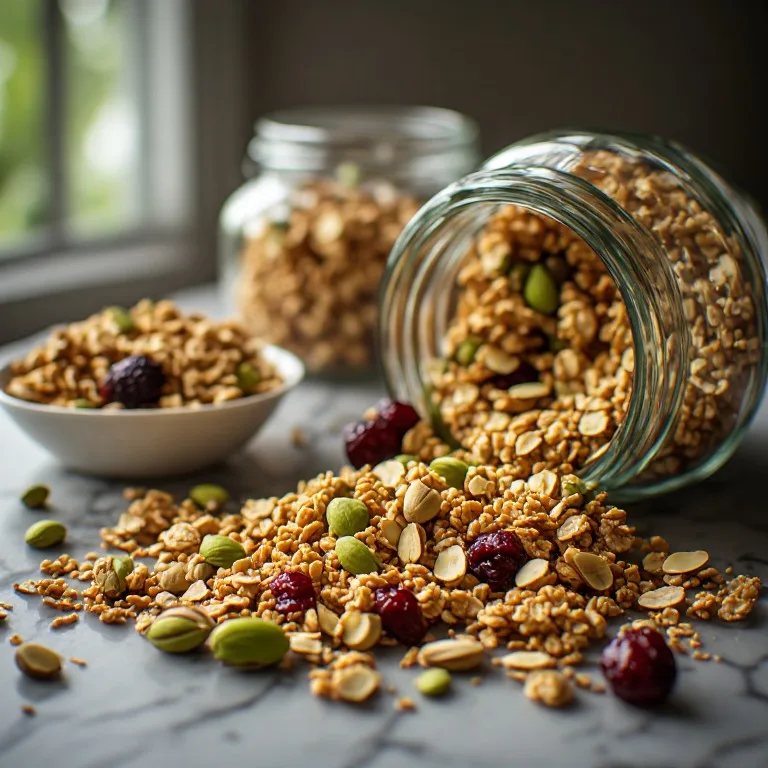
What you are aiming for is not a fine, loose crumble. You want large, irregular shards — some the size of a playing card, some smaller, with dried cherries embedded in them — that snap when you break them and hold their shape in a bowl of yogurt for several minutes before softening. The coconut chips are part of this: large, toasted sheets of coconut that crunch in a way that fine shredded coconut cannot.

EMP RestaurantHomemade (full batch)
Per serving~$27 (⅟₁₄ of a $385 dinner)~$1.75
Full batch (14 servings)~$385+ dinner~$24 ingredients
Parting jar (½ cup)Included with dinnerFree

The math is what it is.

🥗

Make It Healthier

Love Eleven Madison Park Granola (The Parting Gift from a $385-a-Head Restaurant, Made at Home) but want a lighter version? Try these simple swaps:

  • ✓Reduce the brown sugar to ⅓ cup (from ½ cup) — the maple syrup carries most of the sweetness anyway, and the difference in sweetness is minor while the calorie reduction is meaningful (~25 calories per serving).
  • ✓Swap half the pistachios for raw almonds or walnuts — both are lower in fat per ounce than pistachios and contribute more omega-3s (walnuts) or vitamin E (almonds). The texture changes slightly toward denser clusters.
  • ✓Use unsweetened dried cherries instead of sweetened ones if you can find them — most 'dried sour cherries' in stores are still lightly sweetened; look for 'unsweetened tart cherries' to reduce sugar by another 3 to 4g per serving.

Frequently Asked Questions

Why does Eleven Madison Park use olive oil in granola instead of butter?

It is the defining decision of the recipe and the reason EMP granola tastes different from every other granola you have made or bought. Butter is dairy-forward — it contributes a rich, milky sweetness that reads as familiar and comfortable. Extra-virgin olive oil contributes a fruity, slightly grassy, very faintly savory note that you cannot consciously identify but that shifts the entire register of the granola toward complexity rather than richness. In a tasting menu where precision of flavor is the ethos, that olive oil is a statement: this is not a cozy, sweet breakfast cereal. It is a considered thing with actual tension in it. The practical effect at home is just as meaningful. Olive oil granola stays crispier longer than butter granola (olive oil's higher smoke point means the oats fry more evenly), and the clusters are more cohesive because there is no water content in the fat — butter is about 16 percent water, which creates steam during baking and can soften the oat bed. Use a good-quality extra-virgin olive oil; you will taste it. Not an intensely herbaceous Tuscan oil, but a clean, fruity one. The oil is not a neutral carrier here — it is an ingredient.

What is the parting-gift granola tradition at Eleven Madison Park?

Every guest at Eleven Madison Park leaves with a small jar of granola. This practice started in the early years of Daniel Humm's tenure and has become one of the most discussed details about dining at the restaurant — partly because it is charming and partly because the granola is genuinely excellent. The jar goes home with you, you eat it over the following week, and it keeps reminding you of the meal. Hospitality directors call this a 'retention anchor': a physical object that extends the emotional memory of an experience beyond the table. It is also, in retrospect, a very clever piece of marketing. Thousands of people have tried to recreate the granola after tasting it in that jar. The recipe has been published in the EMP cookbook (released in 2011), adapted by Sam Sifton for the New York Times, and written up on hundreds of food blogs. What makes this unusual is that a three-Michelin-star restaurant whose dinner currently costs $385 per person gives away one of its most searched-for recipes freely. That generosity fits the EMP identity: the food philosophy there has always been that restraint and openness are more interesting than obscurity.

What is the story of Eleven Madison Park during COVID?

In March 2020, EMP shut its dining room like every other restaurant in New York City. In May 2020, Humm reopened the kitchen — not as a restaurant, but as what he called the EMP Community Kitchen, in partnership with the nonprofit Rethink Food. The team committed to producing 3,000 meals per day for New York healthcare workers and food-insecure residents, funding the operation through donations, with the kitchen staff kept employed throughout. The Community Kitchen ran for months and served well over a million meals. The granola recipe got significantly wider circulation during this period — it was during May 2020 that the New York Times published Sam Sifton's adaptation of the recipe, and it spread across the food internet at a moment when people were baking obsessively and paying more attention to food than usual. The timing meant the granola became associated not just with a famous restaurant but with a specific moment of pandemic generosity. If you made this granola in 2020 or 2021 from a recipe you found online, this is the story behind it.

What is the difference between the cookbook version and the NYT version?

The EMP cookbook (2011) and the later NYT adaptation both center on olive oil, maple syrup, brown sugar, and oats, but the supporting ingredients differ. The cookbook version uses pistachios and pumpkin seeds as its nuts and seeds, with large coconut chips as the textural centerpiece — this is the version served at the restaurant today and reproduced in this recipe. The NYT version, adapted by Sam Sifton from a 2020 recipe Humm shared, broadens the nuts and seeds — it keeps the pistachios but adds pecans and sunflower seeds, folds in a small quantity of cornflakes for extra crunch, and finishes with dried sour cherries. Both are excellent; they have different personalities. The pistachio version is more restrained and savory-leaning, with the pistachios' subtle green richness playing against the coconut's sweetness. The pecan version is warmer and more familiar, with the pecans' buttery-sweet flavor closer to what most people associate with premium granola. For this recipe, we use the pistachio version because it is the one that comes in the jar. If you prefer pecans, swap them 1:1 and add 2 tablespoons of cornflakes to the dry mix.

Why should I not stir the granola during baking?

Clusters are formed by the wet coating binding dry ingredients together under heat, and that binding only holds if the granola has time to set undisturbed. Every time you stir, you break apart the nascent clusters, recoating loose oats that would have fused and returning them to a free-floating state. What you get from constant stirring is a granola that looks evenly browned but has the texture of individual toasted oat flakes — good, but not the chunky, shatter-able slabs that come in the EMP jar. The key is the initial press. Before the granola goes into the oven, use a flat spatula or the bottom of a measuring cup to compress the entire surface as firmly as you can — you are basically making a granola slab. As the wet coating dries and crisps during baking, it locks everything into the pressed configuration. Rotate the pan once at the midpoint to compensate for oven hot spots; otherwise do nothing. Remove the pan when the edges are deep golden and the center looks slightly underdone. The center firms as it cools. If you bake until the center looks done, the edges will have burned.

How much salt does the EMP granola actually use, and is it really that salty?

The recipe calls for 1 tablespoon of Diamond Crystal kosher salt for a batch that makes about 7 cups — roughly ½ teaspoon per cup of finished granola. That is about twice the salt of a standard home granola recipe, which typically uses ½ to ¾ teaspoon total for the same volume. It sounds aggressive, and it is intentional. The salty-sweet tension is the most important quality in the granola's flavor. The salt does not make it taste 'salty' the way a pretzel is salty; it counterbalances the maple syrup and brown sugar to prevent sweetness from becoming cloying, amplifies the nuttiness of the pistachios and the earthiness of the olive oil, and creates a background hum that makes you reach for another handful. If you use Morton's kosher salt or fine sea salt, halve the quantity — Diamond Crystal is twice as large-crystaled as Morton's and much less dense by volume. Table salt would require a further reduction. The most common reason a home version of this granola falls flat is not the wrong fat or the wrong nuts — it is undersalting.

What current price does EMP charge for dinner, and how does that affect the value of making this at home?

As of April 2026, the full tasting menu at Eleven Madison Park costs $385 per person, not including beverages, tax, or gratuity. A couple dining at EMP will spend approximately $1,000 for the full experience before leaving. The parting jar of granola, which is included in that price, represents roughly $5 worth of ingredients if made at home. That is not a criticism of EMP — the granola is a gracious gesture, not a cost item. But it does put a useful frame on this recipe: you can make the exact granola that a $385-a-head restaurant considers worthy of sending guests home with, at home, with ten minutes of active prep and under $25 of ingredients. The batch makes about 7 cups — roughly 14 servings — which means the per-serving cost is under $2. EMP went fully plant-based in 2021 and has partially reintroduced animal proteins as an optional track since 2024, but the granola has been on the menu continuously since the early 2010s and is not going anywhere.

Can I use shredded coconut instead of large coconut chips?

No, and the distinction matters. Large unsweetened coconut chips — also called coconut flakes, though they are different from the fine-shredded kind — are thin, irregular, wide slices cut from the fresh coconut flesh. When baked, they toast into crisp, curved wafers with concentrated coconut flavor and a snap that contrasts with the softer oats. Shredded coconut, which is the narrow, thread-like type found in most baking aisles, toasts into a dry, fibrous texture that either burns quickly or disappears into the background. The EMP granola is built around the coconut chips' textural contribution — finding a cluster with a big toasted chip in it is part of the pleasure. Buy coconut chips from a health food store, Trader Joe's, or online; they are widely available. Make sure the package says 'unsweetened' — the sweetened kind is moist and will not achieve the right texture.

Love this recipe? Share it!

Free PDF: our 12 most-wanted copycat recipes — instant download.

Made it? Buy us a coffee

Every recipe here is free, with no paywalls. If this one was a hit at your table, a small tip keeps new copycats coming.

$

Eleven Madison Park is a trademark of its owner, used here only to describe the dish this recipe recreates. This is an independent copycat written in our own words — Copycat Spices is not affiliated with, endorsed by or sponsored by Eleven Madison Park.

Ratings & Reviews

—
No ratings yet

Rate this recipe

Click a star to rate

Leave a Review

0/500

CS

Copycat Spices Editorial

Researched + fact-checked. Every recipe on Copycat Spices is built from published sources — official ingredient lists, brand-published recipes, interviews and food-science references — and fact-checked before it goes live, then written as clear, step-by-step instructions for home cooks of all skill levels.

Learn more about our mission →