


Pin It

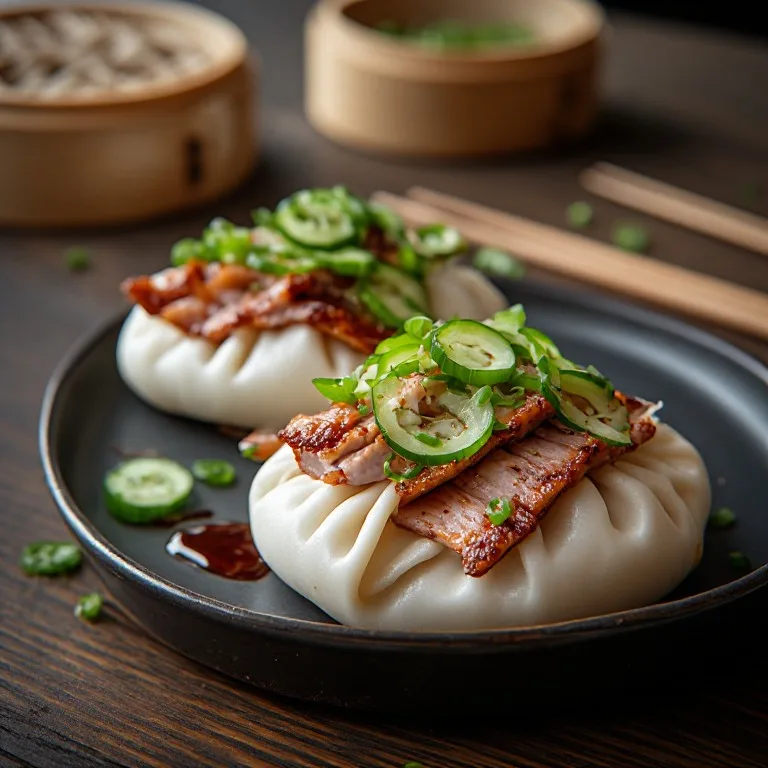
Momofuku Pork Buns (The Famous One from Noodle Bar, Made at Home)

Momofuku Pork Buns (The Famous One from Noodle Bar, Made at Home)
Jump to Recipe
Prep 45 min (plus 4 hr cure) Cook 1 hr 15 min Serves 8
Quick answer: Combine 1 teaspoon kosher salt and 1 teaspoon sugar per pound of skin-on, bone-out pork belly. Rub thoroughly all over and refrigerate uncovered for at least 4 hours (overnight is better). Remove from the fridge 30 minutes before cooking. Roast skin-side up on a rack at 450°F for 1 hour until the fat is deeply golden and beginning to render, then flip and roast 15 more minutes. Cool completely in the fridge until firm, at least 2 hours — pork belly slices cleanly only when cold. While it roasts, make the bun dough: combine 1½ cups warm water, 2¼ teaspoons active dry yeast, and 1 tablespoon plus 1 teaspoon sugar. Let foam 5 minutes. Add 3½ cups all-purpose flour, ½ teaspoon baking powder, ¼ teaspoon baking soda, 1 teaspoon salt, and 1½ teaspoons neutral oil. Knead 8 minutes until smooth. Let rise 1 hour. Divide into 16 equal pieces. Roll each into a 4-inch oval. Brush one half lightly with melted lard or neutral oil — this prevents the fold from sealing during steaming. Fold the oiled half over the other to make a wallet shape. Place on parchment squares and let proof 30 minutes. Steam in a bamboo steamer or heatproof colander over boiling water, 10 minutes covered. Make quick pickles by combining 1 thinly sliced English cucumber with 1 tablespoon rice vinegar, 1 teaspoon sugar, and ½ teaspoon salt; let sit 20 minutes. To serve: slice cold pork belly ¼-inch thick, sear in a dry skillet 2 minutes per side until caramelized and heated through. Open each bun, smear with hoisin sauce, tuck in 2 to 3 pork belly slices and a few pickle rounds, and scatter with sliced scallions. At Momofuku Noodle Bar, pork buns run about $8 to $12 for two; this batch makes 16 buns for roughly $25.

Shop the tools

Gear matched to this recipe. These are Amazon affiliate links — we may earn a small commission if you buy, at no extra cost to you.

As an Amazon Associate, Copycat Spices earns from qualifying purchases. Product images are generic illustrations, not the exact item listed.

Momofuku Pork Buns (The Famous One from Noodle Bar, Made at Home)

The famous Momofuku pork buns made at home: salt-and-sugar-cured roasted pork belly, quick-pickled cucumber, hoisin, and pillowy steamed buns. The East Village restaurant that launched a thousand bao bars, solved at your stove.

Medium Prep: 45 min (plus 4 hr cure) Cook: 1 hr 15 min Total: 6h 0m8 servings ~$4.50/serving
Prep45 min (plus 4 hr cure)
Cook1 hr 15 min
Total6h 0m
Servings
8
At home~$4.50/serving
vs
Restaurant~$20.25/serving
You save ~78%

The Story Behind the Recipe

The famous Momofuku pork buns made at home: salt-and-sugar-cured roasted pork belly, quick-pickled cucumber, hoisin, and pillowy steamed buns. The East Village restaurant that launched a thousand bao bars, solved at your stove.

Nutrition Facts

Per serving (8 servings)
Calories480
Total Fat24g
Total Carbs42g
Dietary Fiber1g
Sugars6g
Protein22g
Sodium680mg

* Estimated values based on standard recipe preparation. Actual values may vary.

Ingredients

  • Pork belly
  • Steamed buns (makes 16)
  • Quick-pickled cucumbers
  • For serving

Instructions

💡
Pro tip: This recipe tastes even better the next day. The flavors need time to meld together in the fridge.
❄️
Storage: Keeps in an airtight container in the fridge for up to 2 weeks. Freezer-friendly for up to 3 months.
🎃 Free Halloween cookbook — download now The Copycat Halloween Cookbook A ready-made, photo-illustrated PDF of our best halloween copycat recipes — free to download, no building required. Pay what you want to support if you love it.

Free PDF — instant download. We'll also send new seasonal copycat recipes now and then; unsubscribe anytime. Or just download it →

Copycat Momofuku Pork Buns (The Famous Ones from Noodle Bar, Made at Home)

Prep time: 45 min (plus 4 hr cure) Cook time: 1 hr 15 min Servings: 8 (2 buns per person)

David Chang named his first restaurant after Momofuku Ando, the Japanese inventor of instant ramen noodles. Chang opened Momofuku Noodle Bar in August 2004 at 163 First Avenue in New York’s East Village. The menu focused on ramen. The pork bun was not part of the original concept — it was added after opening, as an almost incidental decision. It became the dish that defined the restaurant.

The bun is often mistaken for a deliberate riff on gua bao, the Taiwanese folded-bun street food. It isn’t. Chang modeled the dish on the steamed clamshell buns served with Peking duck at Oriental Garden in Manhattan’s Chinatown — he swapped the duck for the pork belly he already had left over from his ramen service, and the resemblance to gua bao was accidental. He has said plainly that he wasn’t thinking about gua bao when he built it. That origin explains the flavor: no braising, no five-spice, no mustard greens — just salt, sugar, heat, and a pork belly that develops its character from a dry cure and a roasting pan rather than a soy-laden braise. The result is cleaner and firmer than gua bao — a belly that holds a clean slice rather than falling apart.

The condiments are equally spare: hoisin on the bun, quick-pickled cucumber for acidity and crunch, scallion for bite. Four components, all of them pulling in the same direction. The richness of the belly, the sweetness of the hoisin, the acid from the pickle, the sharpness of the scallion. Nothing extra.

Momofuku Noodle Bar has since expanded, and the pork bun is now served across multiple Momofuku locations. It has been copied by thousands of restaurants since 2004 — an entire category of bao bars exists in part because this one dish, at this one East Village restaurant, demonstrated that a soft steamed bun folded around pork belly could anchor a serious restaurant menu. For about $25 in groceries, the version at home lands the same way.

The Published Recipe (And What It Actually Means)

Chang published the recipe in the Momofuku cookbook in 2009 (with Peter Meehan, Clarkson Potter). The pork belly recipe is a dry cure: equal parts salt and sugar by volume, rubbed all over the belly, left overnight. No marinade, no liquid, no spice. The dough for the bun is a slightly sweetened, yeast-leavened dough that also uses baking powder — double leavening, which produces the distinctively pillowy texture.

The three things home recipes most often get wrong:

The cure. Many copycat recipes braise the pork belly with soy sauce, ginger, and aromatics, producing a deeply flavored, falling-apart belly that tastes excellent but breaks into chunks rather than slicing cleanly. The Momofuku cure produces a belly that holds together, slices precisely, and caramelizes fast when seared per slice. The flavor is less complex but the texture is more controlled.

The pickles. Fresh cucumber turns watery inside a warm bun. A 20-minute quick pickle draws moisture out and introduces acidity that cuts through the belly fat and the sweet hoisin. It costs nothing extra and takes 20 minutes.

The bun fat. Brushing the inside of the fold with fat before folding is the step most home recipes omit. Without it, the steam causes the dough to bond, and the bun tears when you try to open it. One brush of melted lard or neutral oil prevents this.

Building the Buns

The assembly is the fast part. The bulk of the work is timing: the belly needs to be roasted and fully chilled before slicing (pork belly only slices cleanly when cold and firm), the bun dough needs about 2 hours total from mix to steam, and the pickles need 20 minutes. None of these steps is technically difficult, but they need to happen in the right order.

Roast the belly first, let it cool in the fridge. While it roasts, make the bun dough and let it rise. Shape the buns, let them proof, then steam. Make the pickles during the proof. When everything is ready, slice and sear the cold belly per order — 2 minutes per side in a dry, very hot skillet — and build the buns immediately.

The sear is worth doing even if you plan to serve the whole batch at once. Cold sliced pork belly has the right texture but not enough heat or caramelization; 2 minutes per side in a cast-iron pan without oil finishes the exterior and brings the temperature up without cooking the interior further.

The Fat Layer

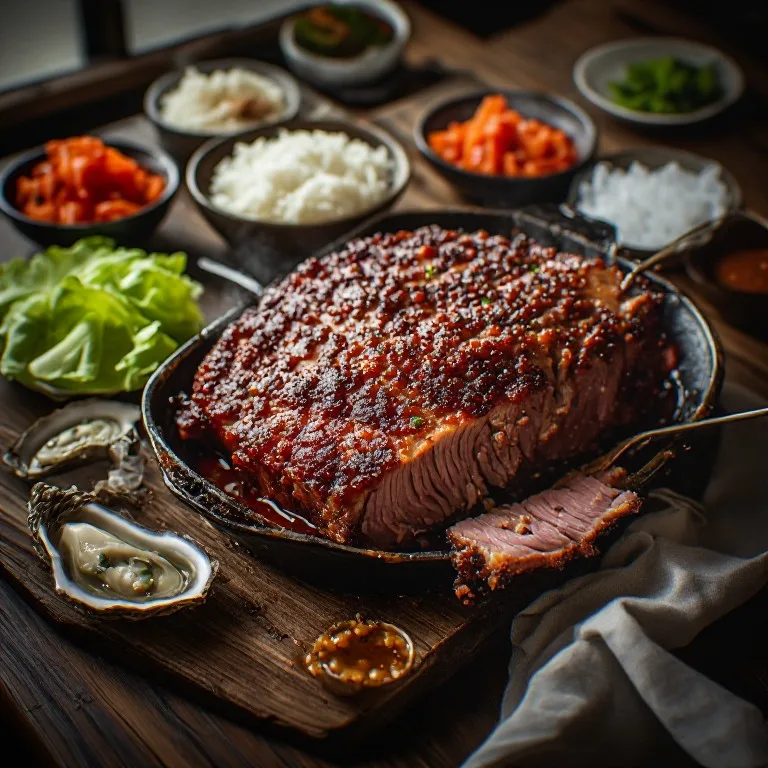
Pork belly has a thick fat cap on one side. Some home recipes instruct you to remove it. Do not. The fat layer is structural and flavor-generating. It renders during roasting, basting the meat below it. When you sear a cold slice in a dry pan, that fat layer caramelizes first — it is the first surface to contact the hot pan — and the Maillard products from caramelized fat are a significant part of what makes the seared slice taste right. The fat is also what makes the bun forgiving: a bite that hits mostly fat still has the hoisin, pickle, and scallion carrying it. A too-lean bite of the same dish is noticeably less satisfying.

The pork belly for this application should be purchased skin-on if possible, or with the fat cap intact. Skinless pork belly works; pork belly that has been trimmed of fat does not.
🥗

Make It Healthier

Love Momofuku Pork Buns (The Famous One from Noodle Bar, Made at Home) but want a lighter version? Try these simple swaps:

  • ✓Swap pork belly for a thicker slice of roasted pork tenderloin — the fat content drops substantially, though the belly's characteristic richness goes with it. Cure and roast the tenderloin the same way; sear per slice.
  • ✓For the buns, whole wheat flour can replace up to one-third of the all-purpose flour — any more and the gluten structure weakens and the buns won't steam cleanly.
  • ✓Double the pickled cucumbers and add shredded carrots — the extra vegetable bulk makes two pork slices go as far as three without feeling sparse.

Frequently Asked Questions

Why does the Momofuku pork belly just use salt and sugar — no soy, no braising liquid?

This is the detail that surprises people most. The canonical Momofuku pork belly is a dry cure, not a braise. Salt and sugar in equal parts — about 1 teaspoon of each per pound — are rubbed all over the belly and left to work for several hours or overnight. Salt draws moisture out through osmosis, then that moisture (now carrying the dissolved salt and sugar) is reabsorbed back into the meat over time, seasoning the belly from within rather than just on the surface. The roasting at high heat does the rest: the fat renders and caramelizes from the heat, the sugar in the cure helps the exterior brown, and the belly develops a lacquered, deeply savory exterior with a fatty, yielding interior. Braising would make the pork fattier and falling-apart, which is delicious but wrong for this application — the sliced belly needs to hold together for service. The simplicity is intentional. Salt, sugar, heat. That is the recipe.

Why does the bun dough use both yeast AND baking powder?

Each does a different job. Yeast ferments the dough over time, producing carbon dioxide slowly and developing flavor — the slight sweetness and the subtly fermented quality that makes a great steamed bun taste like more than just flour. Baking powder is a chemical leavener that activates instantly when it hits moisture and heat, giving an additional lift specifically during the steaming process itself. Together they produce a bun that is light throughout (yeast) and pillowy with a slight spring (baking powder) rather than dense and chewy. Skipping the baking powder produces a bun that is chewier and less airy — still edible, but noticeably denser. Skipping the yeast produces a quick bun with no fermented depth. The combination is standard in steamed bao across Chinese bakeries and Taiwanese-style gua bao shops, and the Momofuku version follows the same logic.

Why fat on the inside of the bun before folding?

The fold in a steamed bun is held together only by gravity and the gentle tuck of the dough — it is not pinched or sealed like a dumpling. During the 10 minutes in the steamer, the inside surfaces of the fold get wet from steam and would bond together if left bare. A thin film of fat (melted lard or neutral oil) on the interior surface of the fold acts as a release agent, preventing the steam from causing the two halves to stick permanently. When you pull the bun open at the table, it opens cleanly. Without fat, you risk tearing the bun apart trying to open it. A small thing, but it is the step most home bun recipes skip — they either forget to mention it or substitute parchment paper, which works but is messier.

Why quick-pickled cucumber and not fresh?

Fresh cucumber inside the bun reads as watery and slightly bland against the richness of the pork belly and the sweetness of hoisin. The quick pickle — a 20-minute sit in rice vinegar, sugar, and salt — does two things fresh cucumber cannot: it draws water out (concentrating cucumber flavor and making the slices crisper, not limp), and it introduces acidity. That acidity is structural: it cuts through the fat of the pork belly and the sweetness of the hoisin, giving the bun a brightness that makes each bite reset rather than accumulating into heaviness. The pickle takes 20 minutes and uses a tablespoon of vinegar; it is not a project. Chang calls it a 'quick pickle' in the cookbook, and it is. No canning, no sterilizing, just salt and acid doing their job.

Why roast at 450°F and not lower and slower?

Pork belly has two things that need to happen: the fat needs to render, and the exterior needs to brown and develop flavor. Lower temperatures (300°F, 325°F) render the fat well but produce a pale, unappealing surface that lacks the caramelization you want. 450°F is high enough to brown the exterior aggressively before the interior overcooks. The key detail is that the pork belly in this application is not meant to be pull-apart tender — it gets sliced thin when cold and then seared in a skillet right before service, which provides a second round of caramelization. The two-stage cooking (roast → chill → sear per slice) means you are not trying to achieve full tenderness from the oven alone. The roast develops the rendered, caramelized foundation; the per-slice sear finishes each piece to order. This approach also means you can roast the belly days ahead and slice and sear on demand.

Where does the name Momofuku come from?

David Chang named his first restaurant after Momofuku Ando, the Japanese inventor of instant ramen noodles. Ando developed Cup Noodles in 1971 and is credited with democratizing a cheap, accessible, shelf-stable noodle product that became ubiquitous globally. Chang, who opened Momofuku Noodle Bar in 2004 in the East Village with a menu centered on ramen, took the name as both a tribute to Ando's cultural impact and a wink at the distance between instant noodles and fresh handmade ramen. The restaurant's evolution into a more upscale, globally influential operation — and Chang's emergence as one of the most influential chefs of his generation — made the name increasingly ironic in the best way. Momofuku Noodle Bar opened at 163 First Avenue in August 2004; the pork buns were added to the menu after opening, almost as an afterthought, and became the dish that defined the restaurant's early identity.

Can I use store-bought bao buns instead of making the dough?

Yes, and it is a legitimate shortcut. Frozen steamed bao buns (folded, not round/filled) are sold at most Asian grocery stores and increasingly at regular supermarkets — brands like Wei Chuan and C.F. Fresh are widely available. Steam them directly from frozen in a bamboo steamer for 8 to 10 minutes. They are made with the same basic dough logic — yeast, baking powder, a little fat — and while they are slightly sturdier and less pillowy than fresh-made buns, they hold the filling well and save about an hour of prep. The pork belly is where most of the flavor lives in this dish, and the pickle and hoisin are load-bearing. A good store-bought bun with excellent pork belly and fresh pickles is better than a scratch bun with mediocre pork.

How does Momofuku's version differ from Taiwanese gua bao?

They look like close relatives, but the resemblance is famously accidental. Gua bao (Taiwanese folded buns) typically uses braised pork belly (lu rou fan-style, slow-cooked with soy, rice wine, five-spice), fresh or lightly pickled mustard greens, crushed peanuts, and fresh cilantro. The pork is softer and more fragrant from the braising aromatics. The Momofuku version uses a salt-and-sugar-cured roasted belly with a cleaner, less spiced flavor profile, quick-pickled English cucumber rather than greens, and hoisin rather than any soy-braised sauce. The bun shape is essentially the same — but that is coincidence, not homage. Chang, who is Korean-American, has been candid that he modeled the dish on the steamed clamshell buns served with Peking duck at Oriental Garden in Manhattan's Chinatown, swapped in the pork belly he had left over from his ramen, and was not thinking about gua bao at all when he built it. The Momofuku version is leaner in spice and brighter in pickle; the Taiwanese version is richer and more aromatic.

Love this recipe? Share it!

Free PDF: our 12 most-wanted copycat recipes — instant download.

Made it? Buy us a coffee

Every recipe here is free, with no paywalls. If this one was a hit at your table, a small tip keeps new copycats coming.

$

Ratings & Reviews

—
No ratings yet

Rate this recipe

Click a star to rate

Leave a Review

0/500

CS

Copycat Spices Editorial

Researched + fact-checked. Every recipe on Copycat Spices is built from published sources — official ingredient lists, brand-published recipes, interviews and food-science references — and fact-checked before it goes live, then written as clear, step-by-step instructions for home cooks of all skill levels.

Learn more about our mission →