


Pin It

Night + Market Khao Soi

Night + Market Khao Soi
Jump to Recipe
Prep 25 min Cook 40 min Serves 4
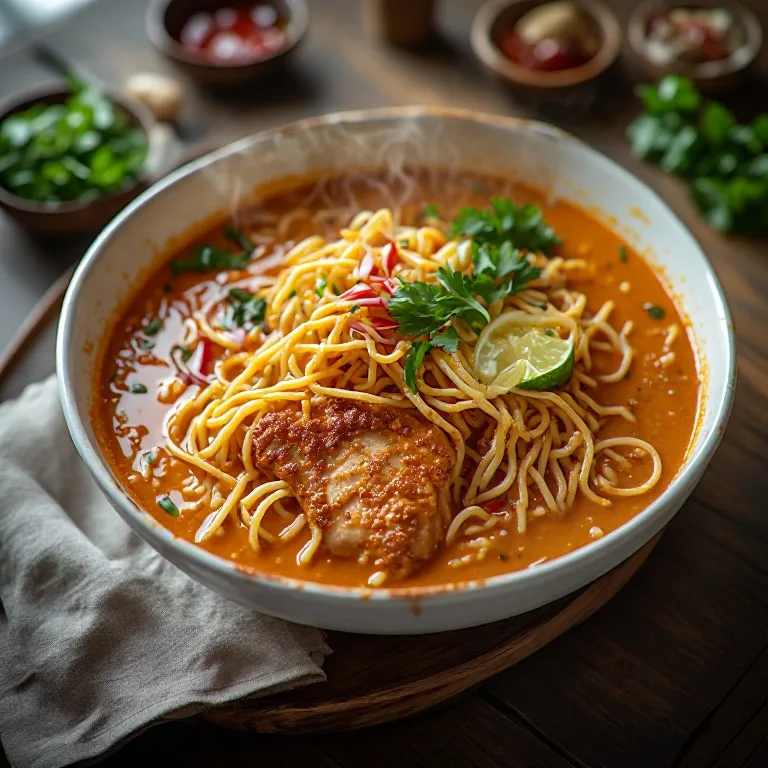
Quick answer: Make a paste from soaked dried red chilies, fresh turmeric, charred ginger and shallots, coriander seeds, and black cardamom. Scoop the thick cream from the top of two unshaken coconut milk cans; heat it in a dry pot until the fat splits and the cream sizzles — about 5 minutes. Stir in the paste and fry until fragrant and darkened, 3–4 minutes. Pour in remaining coconut milk and 2 cups chicken broth, add fish sauce and palm sugar, then drop in 1.5 lb bone-in chicken thighs. Simmer 25–30 minutes. Meanwhile fry a small handful of raw egg noodles in ½ inch of oil until puffed and golden (90 seconds); boil the rest until tender. To serve: soft noodles, braised chicken, broth — then the crispy noodle nest, pickled mustard greens, raw shallot, lime, and chili oil alongside.

Night + Market Khao Soi

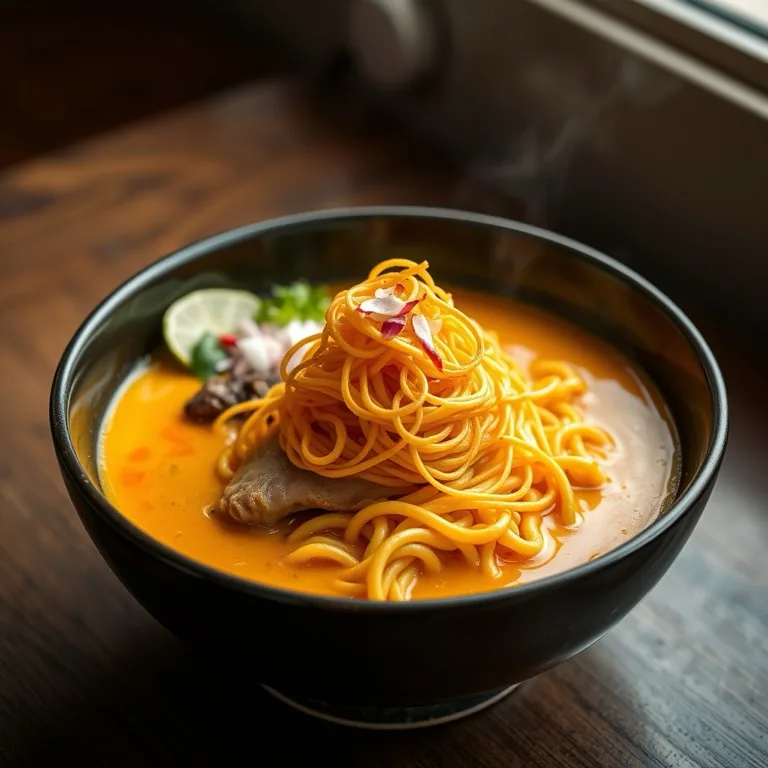
Kris Yenbamroong's LA take on Northern Thailand's greatest dish — a cracked-coconut-cream curry broth with black cardamom, egg noodles two ways (soft in the soup, shatteringly crispy on top), and the condiment spread that makes every bowl different. About $7 at home vs. $18 at Night + Market Song.

Medium Prep: 25 min Cook: 40 min Total: 1h 5m4 servings ~$4.50/serving
Prep25 min
Cook40 min
Total1h 5m
Servings
4
At home~$4.50/serving
vs
Restaurant~$20.25/serving
You save ~78%

The Story Behind the Recipe

Kris Yenbamroong grew up busing tables at Talesai, the upscale Thai-American restaurant his family ran in West Hollywood — a place that softened Thai flavors for American palates in the 1980s. When he opened Night + Market in 2012, he did the opposite: the funky, aggressive kap klaem (Thai drinking food) his grandmother cooked at home, nothing Americanized. Food & Wine named him a Best New Chef in 2016, and his 2017 cookbook — written with Garrett Snyder — became a cult document of uncompromising Thai cooking. The khao soi is the book's most-requested recipe: an honest Northern Thai coconut curry noodle soup with Burmese and Chinese Muslim roots that Kris refused to dial back. At Night + Market Song in Silver Lake, the bowl runs about $18. This recipe feeds four for around $28 total, roughly $7 a bowl. The key technique is cracking the coconut cream — heating thick coconut fat alone until the emulsion breaks and the oil separates before you add the paste. This concentrates every flavor molecule before a drop of liquid enters the pot. The black cardamom in the paste is the detail that makes Night + Market's version distinctively Northern Thai rather than a yellow curry riff: its smoky camphor note is the fingerprint of the Burmese-Chinese trading routes that shaped Chiang Mai cuisine. The dual noodle technique is non-negotiable — soft noodles in the broth and a shatteringly crispy fried nest on top, both textures at once.

Nutrition Facts

Per serving (4 servings)
Calories720
Total Fat34g
Total Carbs56g
Dietary Fiber3g
Sugars9g
Protein40g
Sodium1020mg

* Estimated values based on standard recipe preparation. Actual values may vary.

Ingredients

  • Khao soi paste
  • Broth and chicken
  • Noodles
  • Condiments (set on the table)

Instructions

💡
Pro tip: This recipe tastes even better the next day. The flavors need time to meld together in the fridge.
❄️
Storage: Keeps in an airtight container in the fridge for up to 2 weeks. Freezer-friendly for up to 3 months.
🎃 Free Halloween cookbook — download now The Copycat Halloween Cookbook A ready-made, photo-illustrated PDF of our best halloween copycat recipes — free to download, no building required. Pay what you want to support if you love it.

Free PDF — instant download. We'll also send new seasonal copycat recipes now and then; unsubscribe anytime. Or just download it →

Night + Market chef Kris Yenbamroong didn’t grow up eating the Americanized Thai food his family served at their restaurant Talesai — he ate the real thing in back. When he opened Night + Market in West Hollywood in 2012, he stopped translating. This khao soi, documented in his 2017 cookbook, is the result: full-power Northern Thai coconut curry noodle soup with Burmese black cardamom in the paste and the cracked-coconut-cream technique non-negotiable.

What is khao soi?

Khao soi (ข้าวซอย) is Northern Thailand’s most celebrated dish — a coconut curry noodle soup from Chiang Mai, shaped by Burmese and Chinese Muslim traders who moved through the Lanna Kingdom for centuries. It never became part of central Thai cooking, which is why most Thai restaurants in the US don’t serve it. The dish’s defining feature is the dual noodle technique: some egg noodles go into the broth to turn silky and tender; a handful get deep-fried until shatteringly crispy and perched on top. Both textures simultaneously are the whole point.

At Night + Market Song in Silver Lake, the bowl costs about $18. This recipe serves four for roughly $28 total — about $7 a bowl.

The paste: where this dish lives

The khao soi paste is where Night + Market’s version diverges from shortcuts. Kris uses black cardamom — the large, smoky pod central to Burmese and Chinese cooking — as the flavor that signals real Northern Thai khao soi rather than a generic coconut curry. The paste takes about 10 minutes to blend and keeps in the refrigerator for up to 2 weeks or frozen for 3 months; if you make a double batch, the second pot of khao soi costs almost nothing.

The cracked coconut cream technique

Open the coconut milk cans without shaking, and spoon off all the thick cream that has risen to the top. Heat this cream alone in the pot for 5–6 minutes until the fat visibly separates — the surface turns oily, the cream sizzles, and the solids start to brown. This cracking step creates a concentrated coconut fat that fries the curry paste instead of just warming it. Recipes that skip this step and add paste to neutral oil are making a different dish.

Protein options

Chicken thighs are the most traditional version — braised directly in the curry broth for 25–30 minutes, they absorb it deeply. Night + Market also serves Khao Soi Neua, a braised hanger steak and tendon version that is arguably their most distinctive take. For hanger steak at home: brown pieces of hanger steak in the cracked coconut cream before adding the paste, then braise 2–2.5 hours at very low heat until pull-tender. The vegetarian version (Khao Soi Jay, which Night + Market serves) uses pan-seared firm tofu or oyster mushrooms, white miso in place of shrimp paste, and soy sauce for fish sauce.

The condiment setup

Khao soi without its accompaniments is like a taco without salsa. Pickled mustard greens cut through the coconut richness. Raw shallot adds sharp bite. Lime brightens everything. Chili oil dials up the heat. Set everything at the center of the table so each diner can adjust their bowl as they eat — this is kap klaem, the Thai term for food designed around the pleasure of eating together.
🥗

Make It Healthier

Love Night + Market Khao Soi but want a lighter version? Try these simple swaps:

  • ✓Use light coconut milk for the broth (keep full-fat only for cracking the cream) to save about 90 calories per serving without sacrificing the essential technique.
  • ✓Boneless skinless chicken thighs work fine — reduce braising time to 18 minutes and skim any excess fat from the broth before serving.
  • ✓Use rice vermicelli instead of egg noodles to make the dish gluten-free; pan-toast a small portion dry in a skillet until crispy for the garnish.
  • ✓Skip the fried noodle garnish and substitute a small handful of toasted coconut flakes for crunch without the added oil.

Frequently Asked Questions

What is khao soi and where does it come from?

Khao soi (ข้าวซอย) is Northern Thailand's most iconic dish — a coconut curry noodle soup from the Chiang Mai region, shaped by Burmese and Chinese Muslim traders who moved through the old Lanna Kingdom for centuries. It's virtually absent from central Thai (Bangkok-style) restaurant menus. In the US, Night + Market and Lotus of Siam in Las Vegas are the two restaurants most responsible for introducing it to American diners.

What makes Night + Market's khao soi different from other versions?

Kris Yenbamroong's version leans into the Burmese-Chinese side of khao soi's heritage — specifically the black cardamom that gives his paste its smoky, camphor-like depth. Most US Thai restaurants shortcut the paste with Mae Ploy yellow or red curry paste; Night + Market's is from scratch in the kap klaem spirit — bold enough to hold up alongside natural wine and heavy drinking. The braised hanger steak + tendon version (Khao Soi Neua) on their menu is particularly distinctive and has no equivalent at other US Thai restaurants.

What is black cardamom and do I really need it?

Black cardamom (Amomum subulatum) is a large, smoky pod used in Chinese and Burmese cooking — distinct from the small green cardamom in chai. Its smokiness comes from drying over open flame. It's the flavor marker of authentic Northern Thai khao soi and what separates it from any yellow coconut curry. Find it at Indian or Chinese grocery stores, often labeled 'tsao ko.' If unavailable, substitute ¼ tsp ground allspice + ¼ tsp smoked paprika — approximate but it preserves some of the character.

Can I use store-bought curry paste as a shortcut?

Yes. Maesri brand khao soi curry paste is the best widely-available shortcut — use 3–4 tablespoons and still fry it in cracked coconut cream. Mae Ploy yellow curry paste is the next-best alternative. Whichever you use, add the toasted seeds of one black cardamom pod to the paste before frying. Do not use red or green curry paste — different flavor profiles entirely. The from-scratch paste takes about 10 minutes in a blender and produces a meaningfully richer result.

What noodles should I use?

Fresh Chinese-style round egg noodles (sold refrigerated at Asian grocery stores, labeled 'chow mein' or 'wonton noodles') are the best match — medium-thick, springy, yellow from egg. Dried wide egg noodles work but need a few extra minutes. Do not use rice noodles or pad thai noodles — khao soi is specifically an egg noodle dish. If no egg noodles are available, thick spaghetti cooked al dente is a workable substitute, though it lacks the color and slight chew of real egg noodles.

Can I make a vegetarian version?

Yes — Night + Market itself serves Khao Soi Jay (vegetarian) with firm tofu and oyster mushrooms. At home: replace chicken with pan-seared extra-firm tofu or a mix of oyster and king oyster mushrooms. Replace shrimp paste with 2 tsp white miso. Use vegetable broth instead of chicken broth, and soy sauce instead of fish sauce, starting with 1½ tablespoons. The coconut broth is already plant-based.

What are pickled mustard greens and where do I find them?

Pickled mustard greens (phak gad dong, or Chinese salted mustard greens) are sold in jars or vacuum bags at any Chinese or Southeast Asian grocery, labeled 'preserved mustard greens' or 'salted mustard greens.' They add essential sour, briny contrast to the rich coconut broth — the dish is significantly less interesting without them. Rinse before using (they're salty). If unavailable, quick-pickle shredded napa cabbage: toss with 1 tsp salt, 2 tbsp rice vinegar, pinch of sugar; let sit 20 minutes and drain.

Love this recipe? Share it!

Free PDF: our 12 most-wanted copycat recipes — instant download.

Made it? Buy us a coffee

Every recipe here is free, with no paywalls. If this one was a hit at your table, a small tip keeps new copycats coming.

$

Night + Market is a trademark of its owner, used here only to describe the dish this recipe recreates. This is an independent copycat written in our own words — Copycat Spices is not affiliated with, endorsed by or sponsored by Night + Market.

Ratings & Reviews

—
No ratings yet

Rate this recipe

Click a star to rate

Leave a Review

0/500

CS

Copycat Spices Editorial

Researched + fact-checked. Every recipe on Copycat Spices is built from published sources — official ingredient lists, brand-published recipes, interviews and food-science references — and fact-checked before it goes live, then written as clear, step-by-step instructions for home cooks of all skill levels.

Learn more about our mission →