

Pin It

Lotus of Siam Khao Soi (The Best Thai in America, Made at Home)

Lotus of Siam Khao Soi (The Best Thai in America, Made at Home)
Jump to Recipe
Prep 25 min Cook 40 min Serves 4
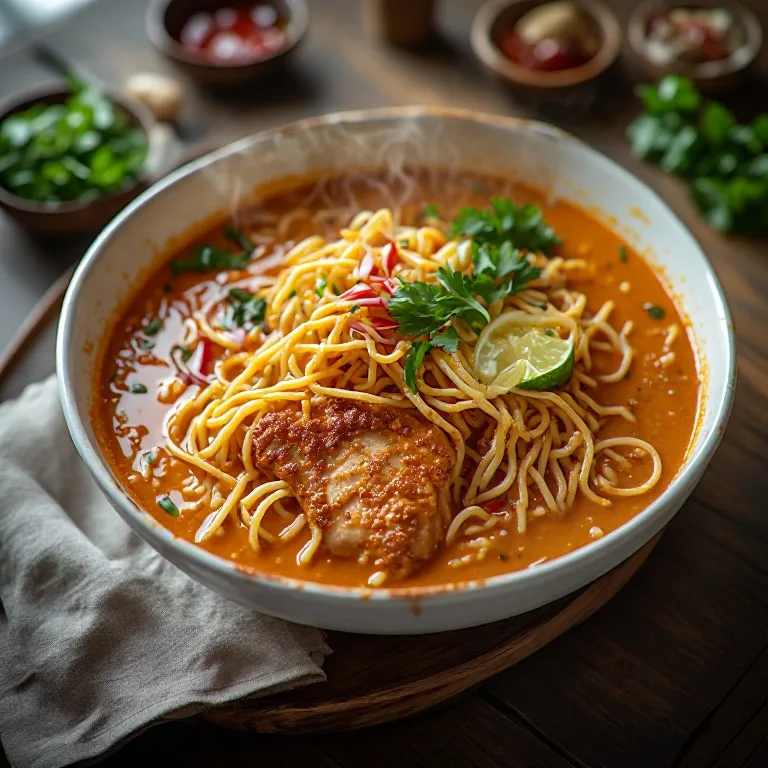
Quick answer: Bloom a homemade khao soi paste — dried red chilies, turmeric, coriander, shallots, garlic, and ginger — in the thick layer of coconut cream from the top of two unshaken cans (do not use oil). Fry a small nest of raw egg noodles in a half-inch of oil until golden and crispy; set aside for garnish. Add the full coconut milk, 3 cups of chicken stock, fish sauce, and palm sugar to the bloomed paste, then simmer 1.5 lb of bone-in chicken thighs for 25 minutes until pull-tender. Cook the remaining egg noodles in salted boiling water until just tender, drain, and portion into deep bowls. Ladle the broth and a piece of chicken over the noodles. Crown each bowl with the crispy noodle nest, a pile of thinly sliced shallots, a tablespoon of pickled mustard greens, a wedge of lime, and a drizzle of chili oil. The dish runs $17–22 at Lotus of Siam; at home, each bowl costs roughly $5 in ingredients.

Lotus of Siam Khao Soi (The Best Thai in America, Made at Home)

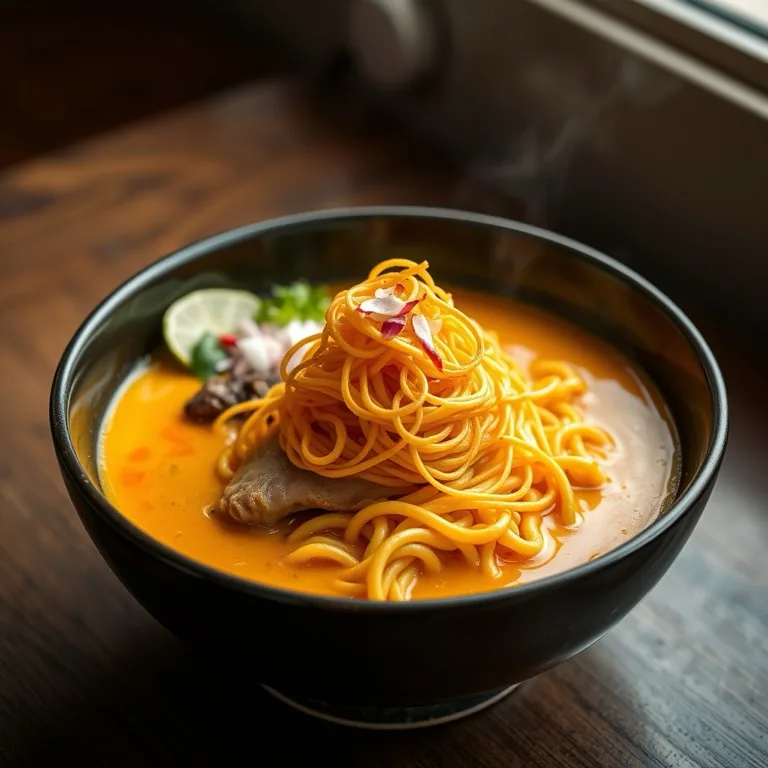
Jonathan Gold called it the best Thai restaurant in North America. Chef Saipin's khao soi — soft egg noodles in a turmeric-golden coconut curry broth, crowned with crispy fried noodles — at home for about $5 a bowl instead of $22.

Medium Prep: 25 min Cook: 40 min Total: 1h 5m4 servings ~$4.50/serving
Prep25 min
Cook40 min
Total1h 5m
Servings
4
At home~$4.50/serving
vs
Restaurant~$20.25/serving
You save ~78%

The Story Behind the Recipe

Jonathan Gold wrote in Gourmet in August 2000 that Lotus of Siam was "the single best Thai restaurant in North America" — a verdict reinforced by Anthony Bourdain, Adam Platt of New York Magazine, and the James Beard Foundation, which gave chef Saipin Chutima its Best Chef Southwest award in 2011. She was the first Asian-born chef to win a Beard for cooking the cuisine of her homeland. The restaurant is a strip-mall spot on East Sahara Avenue in Las Vegas, which makes none of this any less true. Khao soi is Northern Thailand's answer to ramen: a coconut-rich curry noodle soup with roots in the old Lanna Kingdom and the Burmese and Yunnanese Muslim traders who moved through Chiang Mai. What sets it apart from any Bangkok-style curry is the double-texture noodle technique — half the egg noodles go in the broth, the other half get deep-fried until shattering-crispy and piled on top. A bowl at Lotus runs $17–22 depending on protein. At home, chicken thighs and pantry-accessible ingredients bring it to about $5 a bowl.

Nutrition Facts

Per serving (4 servings)
Calories580
Total Fat28g
Total Carbs48g
Dietary Fiber3g
Sugars6g
Protein32g
Sodium920mg

* Estimated values based on standard recipe preparation. Actual values may vary.

Ingredients

  • Khao soi curry paste (blender)
  • For the broth and chicken
  • Noodles
  • Garnishes (per bowl)

Instructions

💡
Pro tip: This recipe tastes even better the next day. The flavors need time to meld together in the fridge.
❄️
Storage: Keeps in an airtight container in the fridge for up to 2 weeks. Freezer-friendly for up to 3 months.
🎃 Free Halloween cookbook — download now The Copycat Halloween Cookbook A ready-made, photo-illustrated PDF of our best halloween copycat recipes — free to download, no building required. Pay what you want to support if you love it.

Free PDF — instant download. We'll also send new seasonal copycat recipes now and then; unsubscribe anytime. Or just download it →

Copycat Lotus of Siam Khao Soi (The Best Thai in America, Made at Home)

Prep time: 25 min Cook time: 40 min Servings: 4

Khao soi is Northern Thailand’s answer to ramen: egg noodles in a turmeric-golden coconut curry broth, served with a shattering crown of deep-fried crispy noodles. At Lotus of Siam — the Las Vegas restaurant Jonathan Gold called the best Thai in North America — a bowl runs $17 to $22. At home, with chicken thighs and a blender paste, it comes to about $5.

The key technique is the double noodle and the coconut cream bloom. Half the noodles go in the broth, half get deep-fried until golden. The curry paste is bloomed in the thick top layer of unshaken coconut milk — not oil — which gives the broth its characteristic silky richness rather than an oily one.

What Makes This the Lotus of Siam Version

Lotus of Siam serves Northern Thai (Lanna) food, not the Bangkok-style Thai most American restaurants cook. Khao soi is the defining dish of that region — a coconut curry noodle soup carried into Chiang Mai by Burmese and Yunnanese Muslim traders. Three things separate a real Lotus-caliber bowl from a generic coconut curry:

  • A house-made paste, bloomed in coconut cream. Frying the paste in the thick cream skimmed off the top of unshaken cans (never in oil) is the Lanna method. The cream splits, the paste toasts in its own fat, and the broth ends up silky rather than greasy.
  • The double noodle. Half the egg noodles go soft into the broth; the other half are deep-fried into a shattering nest on top. Skip the crispy nest and you have not made khao soi — you have made a coconut noodle soup.
  • The acid-and-allium garnish. Thinly sliced raw shallots, rinsed pickled mustard greens, and a hard squeeze of lime are not optional trimmings. They cut the richness and are half the reason the bowl stays interesting to the last spoonful.
The Coconut Cream Bloom, Step by Step

This is the one step that decides whether the bowl tastes like Lotus of Siam or like a jarred curry. Do not shake the coconut milk cans — you want the cream and the thin liquid to stay separate. Spoon the firm cream off the top into a heavy pot and heat it until it “cracks”: it goes from smooth to slightly grainy and oily-looking, about 3 to 4 minutes. Add the paste and stir-fry it in that cracked cream for a full 4 to 6 minutes, mashing constantly, until it darkens and the fat beads at the edges. Only then do you add the liquid. Rushing this step — or blooming in plain oil — is the single most common reason a homemade khao soi tastes flat.

Make-Ahead and Storage

The curry paste keeps refrigerated in an airtight container for up to 3 days, or frozen for up to 2 months — make a double batch and freeze half in a flat bag.

The broth and chicken hold well: refrigerate up to 3 days and reheat gently on the stove (do not boil hard, which can break the coconut). It actually deepens overnight.

The noodles are the exception. Cook the soft noodles fresh at serving time — they turn mushy in stored broth. Fry the crispy nest the same day; it goes stale and loses its shatter overnight. If you are meal-prepping, store the broth separately and finish both noodle components à la minute.

More Asian Noodle and Bowl Recipes Made at Home
🥗

Make It Healthier

Love Lotus of Siam Khao Soi (The Best Thai in America, Made at Home) but want a lighter version? Try these simple swaps:

  • ✓Use light coconut milk for the broth (not the coconut cream bloom — keep that full-fat) to cut about 80 calories per serving and roughly 8 grams of saturated fat. The broth will be slightly less rich but still very good.
  • ✓Swap chicken thighs for chicken breast — poach directly in the simmering broth for 18 minutes, then slice; saves about 70 calories per serving. Breast is easier to dry out, so pull it at the moment it is just cooked through.
  • ✓Skip the deep-fried noodle garnish and use a small handful of crushed, baked whole-grain crispbreads instead. Not authentic, but the textural contrast is partially preserved and you save the frying oil entirely. Each portion of fried noodles is roughly 120 calories.

Frequently Asked Questions

What makes Lotus of Siam's khao soi different from a typical Thai restaurant version?

Most Thai restaurants in the US serve central Thai (Bangkok-style) cuisine — pad thai, green and red curries, tom yum. Khao soi is a Northern Thai dish from the Lanna Kingdom, and very few restaurants outside Chiang Mai and a handful of US spots do it well. The Lotus version is defined by the quality of the curry paste (house-made with dried chilies, fresh turmeric when possible, and proper technique) and the richness of the coconut cream base. Chef Saipin Chutima's cooking comes from a family tradition over 100 years old in Northern Thailand; her khao soi uses the bloomed-in-coconut-cream method (not oil) that is specific to Lanna cooking and produces a richer, less oily finish. The braised short rib version — one of their signature preparations — is particularly distinctive. The chicken version here is the most traditional approach and the closest to what you get in Chiang Mai.

What are the crispy noodles on top and can I skip them?

The crispy noodles are not optional if you want to make khao soi honestly. They are the defining textural element of the dish — what separates khao soi from any other coconut curry noodle soup. They are made by deep-frying a small amount of the same raw egg noodles you use for the broth in about a half-inch of neutral oil until puffed and golden, about 90 seconds. They soften slightly as they sit in the steam of the bowl but stay crispy enough to shatter against the spoon. The contrast between the silky coconut broth, tender soft noodles, and shattering crispy nest is the whole point. If you genuinely cannot fry, crush a handful of ramen cakes (uncooked instant ramen) and use those — they are pre-fried and produce a passable substitute. But the fresh-fried version is easy and far better.

Can I use store-bought curry paste instead of making my own?

Yes, with caveats. Maesri brand sells a khao soi curry paste in the Thai section of most Asian grocery stores; it is the best widely available substitute and produces a recognizable result. Mae Ploy yellow curry paste is the next-best alternative — it is not the same, but the flavor profile is close enough that you will get a good bowl. Use 3 to 4 tablespoons of paste per batch and bloom it in coconut cream for 4 to 6 minutes before adding liquid. Do not use red curry paste (too sweet and spicy in a different direction) or green curry paste (completely different character). The homemade paste in this recipe takes about 10 minutes to make in a blender and produces a meaningfully better result — more depth, better turmeric freshness, and the right dried chili flavor. Make it if you can.

What kind of egg noodles should I use?

Fresh Chinese-style egg noodles (the kind sold refrigerated in bags at Asian grocery stores, labeled 'chow mein noodles' or 'lo mein noodles') are the closest to what is used in Northern Thailand. Look for round, medium-thick fresh egg noodles — not the flat lo mein variety. Dried egg noodles work but need slightly longer cooking and produce a slightly more elastic texture. Do not use rice noodles (pad thai noodles) — khao soi is specifically an egg noodle dish; rice noodles change the character entirely. If you cannot find fresh or dried egg noodles, thick spaghetti cooked to a firm al dente is a workable emergency substitute, though it lacks the yellow color and slightly springy bite of real egg noodles.

Should I use chicken, duck, or short rib?

Chicken thighs (bone-in, skin-on) are the most traditional and most accessible version — they braise in 25 minutes in the simmering broth, shred cleanly, and absorb the coconut curry perfectly. This is the version you would get in a Chiang Mai market. Lotus of Siam also offers crispy duck (the version most often cited as the house standout — the rendered duck fat adds extraordinary richness to the broth) and braised short rib. For duck at home: roast or confit duck legs until crispy, then serve on top of the broth and noodles rather than simmering in the broth (you want to keep the skin crispy). For short rib: braise separately in the curry broth for 2.5 to 3 hours until pull-tender. Chicken is the best starting point; duck is the upgrade.

What are pickled mustard greens and where do I find them?

Pickled mustard greens (kiam chai in Cantonese, or pak dong in Thai) are a fermented/pickled vegetable sold in jars or vacuum-sealed pouches in the refrigerated section of most Asian grocery stores, usually labeled 'preserved mustard greens' or 'salted mustard greens.' They are bright yellow-green, slightly sour, and salty. Rinse them before using — they are often quite salty straight from the package. They are not optional in a proper khao soi bowl: their acidic, briny tang cuts directly through the richness of the coconut curry and is part of the flavor balance. If you genuinely cannot find them, a tablespoon of quick-pickled cabbage (thinly sliced cabbage macerated in rice vinegar, salt, and a pinch of sugar for 30 minutes) is a workable substitute. Western sauerkraut is not a substitute — too sour, wrong flavor entirely.

Can I make this vegetarian or vegan?

Yes. Replace the chicken with extra-firm tofu cubed and pan-fried until golden, or with 2 cups of cooked chickpeas added to the broth in the last 5 minutes. Replace the shrimp paste in the curry paste with 1 tablespoon of white miso plus an extra teaspoon of soy sauce. Use vegetable stock instead of chicken stock, and swap fish sauce for soy sauce or a mix of soy sauce and a small squeeze of lime. The coconut cream and milk are already plant-based. The result is genuinely good — the turmeric and dried chili paste carries most of the flavor. Lotus of Siam offers a vegetarian khao soi on their menu.

Love this recipe? Share it!

Free PDF: our 12 most-wanted copycat recipes — instant download.

Made it? Buy us a coffee

Every recipe here is free, with no paywalls. If this one was a hit at your table, a small tip keeps new copycats coming.

$

Lotus of Siam is a trademark of its owner, used here only to describe the dish this recipe recreates. This is an independent copycat written in our own words — Copycat Spices is not affiliated with, endorsed by or sponsored by Lotus of Siam.

Ratings & Reviews

—
No ratings yet

Rate this recipe

Click a star to rate

Leave a Review

0/500

CS

Copycat Spices Editorial

Researched + fact-checked. Every recipe on Copycat Spices is built from published sources — official ingredient lists, brand-published recipes, interviews and food-science references — and fact-checked before it goes live, then written as clear, step-by-step instructions for home cooks of all skill levels.

Learn more about our mission →