

Pin It

Per Se Oysters and Pearls (Thomas Keller's Most Iconic Dish, Made at Home)

Per Se Oysters and Pearls (Thomas Keller's Most Iconic Dish, Made at Home)
Jump to Recipe
Prep 30 min (plus overnight soak) Cook 35 min Serves 4 (as a first course)
Quick answer: Night before: rinse 3 tbsp small pearl tapioca (not instant), cover with cold water, soak overnight. Day of — tapioca: drain the soaked tapioca, combine with 1¼ cups heavy cream, ¼ tsp salt, and a pinch of white pepper in a small heavy saucepan. Cook over very low heat, stirring constantly, 15 to 20 minutes until every pearl is completely translucent and the cream has thickened to a loose pudding consistency. Keep warm over the lowest possible heat. Oysters: shuck 8 fresh oysters (2 per person), reserving every drop of their liquor. Combine the oysters and their liquor in a small saucepan. Over very low heat, warm just until the edges of the oysters barely begin to curl — 45 seconds to 1 minute. Remove from heat immediately. Sabayon: in a medium bowl set over a pot of barely simmering water (the bowl should not touch the water), whisk together 3 large egg yolks and 3 tbsp dry Champagne or dry sparkling wine. Whisk constantly and vigorously for 6 to 8 minutes until the mixture triples in volume, turns pale yellow, and holds a ribbon when the whisk is lifted. Remove from heat. In a separate chilled bowl, whip ¼ cup heavy cream to soft peaks. Fold the whipped cream into the egg yolk mixture in two additions. Season with salt and white pepper. Assemble immediately: spoon 2 to 3 tbsp of the warm tapioca into the center of each warmed shallow bowl. Nestle 2 warm oysters on top of the tapioca. Spoon the sabayon generously over the oysters and tapioca — it should pool around and over them. Top with a small quenelle or generous spoonful of caviar (about ¼ tsp per person, or more if you like). Garnish with a single chive tip. Serve within 3 minutes of assembly — the sabayon deflates if it waits.

Shop the tools

Gear matched to this recipe. These are Amazon affiliate links — we may earn a small commission if you buy, at no extra cost to you.

As an Amazon Associate, Copycat Spices earns from qualifying purchases. Product images are generic illustrations, not the exact item listed.

Per Se Oysters and Pearls (Thomas Keller's Most Iconic Dish, Made at Home)

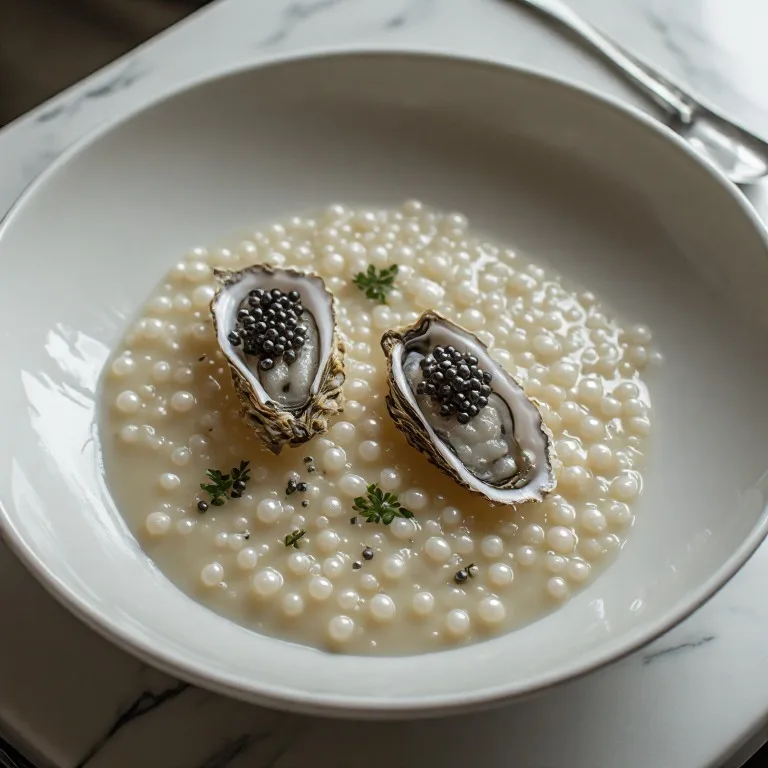
Thomas Keller's 'Oysters and Pearls' has appeared on Per Se's $425 tasting menu every single night since 2004 — pearl tapioca sabayon, Island Creek oysters, and Osetra caviar. This is the recipe with the four technique details that separate home versions that work from ones that don't.

Hard Prep: 30 min (plus overnight soak) Cook: 35 min Total: 1h 5m4 (as a first course) servings ~$4.50/serving
Prep30 min (plus overnight soak)
Cook35 min
Total1h 5m
Servings
4
At home~$4.50/serving
vs
Restaurant~$20.25/serving
You save ~78%

The Story Behind the Recipe

Thomas Keller says he designed 'Oysters and Pearls' around a tension he wanted every guest to feel: the most humble and the most extravagant ingredients he could think of, in the same spoonful. Small pearl tapioca — the starch of school cafeteria pudding, costing pennies — beside Osetra caviar. The tapioca mimics the shape and sheen of caviar pearls; the oysters share the name and occasion. The dish has appeared on the tasting menu at The French Laundry in Yountville since the mid-1990s and at Per Se in New York every night since it opened in February 2004. Keller has never taken it off. Per Se's nine-course menu runs $425 per person before wine; this dish is one of the courses included.

The recipe is published in The French Laundry Cookbook (Keller with Michael Ruhlman, Artisan Books, 1999) and is one of the most-reproduced fine-dining recipes online — though most home versions fail on one of four specific technique points: tapioca cooked too quickly (grainy centers), oysters cooked too long (rubbery), sabayon over high heat (scrambled), or assembly too slow (sabayon deflated). Each one is avoidable with the right sequence. At home, a small tin of farmed American caviar ($25 to $35) and a dozen Island Creek Oysters by mail order bring the dish to around $60 for four people — a fraction of the $425 tasting menu per person, and the one course that transfers most cleanly out of Keller's kitchen.

Nutrition Facts

Per serving (4 (as a first course) servings)
Calories420
Total Fat38g
Total Carbs12g
Dietary Fiber0g
Sugars3g
Protein8g
Sodium450mg

* Estimated values based on standard recipe preparation. Actual values may vary.

Ingredients

  • For the pearl tapioca
  • For the oysters
  • For the champagne sabayon
  • To finish

Instructions

💡
Pro tip: This recipe tastes even better the next day. The flavors need time to meld together in the fridge.
❄️
Storage: Keeps in an airtight container in the fridge for up to 2 weeks. Freezer-friendly for up to 3 months.
🎃 Free Halloween cookbook — download now The Copycat Halloween Cookbook A ready-made, photo-illustrated PDF of our best halloween copycat recipes — free to download, no building required. Pay what you want to support if you love it.

Free PDF — instant download. We'll also send new seasonal copycat recipes now and then; unsubscribe anytime. Or just download it →

Thomas Keller has served “Oysters and Pearls” every night at The French Laundry and Per Se since the mid-1990s. It has never left either menu. On a $425 tasting menu, it is the dish people remember and describe first.

The name is the dish. Small pearl tapioca — cooked slowly in heavy cream until every bead is translucent, the cream thickened to pudding — provides the pearls. Fresh Island Creek Oysters from Duxbury, Massachusetts, barely warmed in their own briny liquor, provide the oysters. A champagne sabayon, light and airy from vigorous whisking over a double boiler, pools warm over both. Cold Osetra caviar goes on top at the last second — the temperature contrast between the warm cream and the cold caviar is deliberate, and it is part of what makes the dish feel like more than the sum of its ingredients.

Keller described the inspiration in an interview with Ruhlman during the development of The French Laundry Cookbook: he wanted the most humble ingredient he could think of paired with the most luxurious. Tapioca is school cafeteria pudding. Caviar is the other thing. The tapioca pearls echo the shape and gloss of caviar pearls. The combination is not ironic — it is Keller’s actual aesthetic: the pleasure of contrast, the idea that nothing is intrinsically beneath or above anything else in a kitchen if it tastes right.

Four technique points that make home versions fail

The tapioca must soak overnight. Small pearl tapioca has a dense starch core that does not hydrate during a 20-minute cook in cream — it will seem soft on the outside while staying chalky and gritty inside. Overnight in cold water is what fully hydrates the center so that the cream cook produces even, completely translucent pearls.

The oysters should be warmed, not cooked. An oyster goes from custardy and silky to rubbery and firm in under a minute of direct heat. The target is barely-warmed — 45 to 60 seconds in their own liquor over the lowest heat, just until the edges begin to curl. That is the signal to pull the pan.

The sabayon must be made over barely simmering water, not boiling. Too much heat and the egg yolks scramble at the sides of the bowl before the center has set. The bowl should not touch the water. The goal is a slow, even heat that gently sets the yolks while constant whisking incorporates air. The ribbon test — the sabayon falls from the whisk and sits on the surface for three to four seconds — is the indicator, not time.

Assemble immediately and serve within two to three minutes. The champagne sabayon is a foam stabilized primarily by heat. It begins deflating as soon as it leaves the double boiler. A sabayon that has sat for ten minutes looks nothing like a sabayon made two minutes ago. Have the tapioca warm, the oysters warm, and the caviar ready to go before you start making the sabayon — assembly should take ninety seconds.

On the ingredients

Tapioca: Small pearl tapioca, 2 to 3mm in diameter. Bob’s Red Mill is widely available. Not instant; not tapioca flour; not the large boba-style pearls. The small ones are what visually echo the caviar and what fit alongside the oysters without overwhelming the composition.

Oysters: Island Creek Oysters from Duxbury, Massachusetts, ship overnight by mail order from the Island Creek Oyster Co. For a dinner party, this is the right call — they arrive the day of, are precisely what Keller uses, and cost about $30 for a dozen. Blue Points from Long Island, Wellfleet from Cape Cod, or Pemaquid from Maine all share the clean, medium-brine profile that works here. Pacific Kumamotos are beautiful but sweeter and creamier — a different dish in taste, though not wrong.

Caviar: Per Se uses Osetra, which has medium-sized amber-brown pearls and a rich, nutty brine. For home use, farmed domestic caviar from American Caviar Co., Tsar Nicoulai, or Regiis Ova runs $25 to $45 per ounce and is more than adequate. You need about ¼ teaspoon per person — less than half an ounce for four. Salmon roe (ikura) is the right substitute if caviar feels too expensive; its large orange pearls look beautiful against the cream and the brine reads correctly.

Champagne: The sabayon needs a dry sparkling wine with some acidity. Genuine Champagne is ideal; Spanish Cava (very dry) or Italian Prosecco (again, extra-dry, not sweet) both work. A sweet sparkling wine turns the sabayon cloying. You only need three tablespoons — open a split if you don’t want to open a full bottle.

About Per Se

Per Se is at 10 Columbus Circle in New York City (the Deutsche Bank Center, fourth floor) and has held three Michelin stars since 2005. The tasting menu is $425 per person before wine, tax, or gratuity; a $200 deposit is required at reservation. The French Laundry, at 6640 Washington Street in Yountville, California, has held three Michelin stars since 2007. Both restaurants are booked months in advance. “Oysters and Pearls” is served at both, with the same recipe, on every night either restaurant is open.

The recipe appears in The French Laundry Cookbook (Thomas Keller with Michael Ruhlman and Susie Heller, Artisan Books, 1999), which is the most technically precise American restaurant cookbook published in the 1990s and remains in print. Several of its recipes — the cornets, the oysters and pearls, the salmon en papillote — have been reproduced in food media more often than almost any other fine-dining source.

Timing for a dinner party

The tapioca can be made up to one hour ahead and kept warm, covered, on the lowest heat with a splash of cream stirred in if it thickens too much. The oysters should be shucked no more than 30 minutes before serving and kept cold in their shells on ice. The sabayon must be made at the last moment and cannot be held. The assembly sequence: warm the bowls, pull the tapioca to temperature, warm the oysters, make the sabayon, assemble, caviar, serve. With practice this runs about four minutes from the moment you start the sabayon.
🥗

Make It Healthier

Love Per Se Oysters and Pearls (Thomas Keller's Most Iconic Dish, Made at Home) but want a lighter version? Try these simple swaps:

  • ✓Salmon roe (ikura) replaces Osetra caviar at about 1/10th the price and with nearly identical briny impact — it's higher in omega-3s and still photographs beautifully against the cream.
  • ✓Substituting crème fraîche for the heavy cream in the sabayon fold-in adds a pleasant tang that cuts the richness; just whisk it lightly with a fork rather than whipping to peaks before folding.
  • ✓The tapioca itself is the main carb source — reduce to 2 tbsp (from 3) for a lighter base; the dish still reads as luxurious with a thinner tapioca pool.
  • ✓Oysters are among the most nutrient-dense proteins in existence: 2 medium oysters deliver zinc, iron, vitamin B12, and omega-3s for about 20 calories — serving 2 per person keeps the dish light while keeping the elegance.

Frequently Asked Questions

What exactly is 'Oysters and Pearls' at Per Se?

The dish's full name is 'Oysters and Pearls' — 'Sabayon' of Pearl Tapioca with Island Creek Oysters and Osetra Caviar. The 'pearls' are small pearl tapioca cooked slowly in heavy cream until translucent and thick — the size and glossy appearance of tapioca pearls deliberately echoes caviar pearls. The 'oysters' are Island Creek Oysters from Duxbury, Massachusetts, barely warmed in their own liquor so they stay custardy and raw-adjacent. The sabayon is a warm, airy champagne custard sauce made by whisking egg yolks and sparkling wine over a double boiler until tripled in volume, then folded with whipped cream to lighten it. The caviar — Osetra at Per Se — goes on last, cold, so it sits against the warm cream base as a temperature contrast. The dish appears in The French Laundry Cookbook (Keller with Michael Ruhlman, Artisan Books, 1999) and has been served at both The French Laundry and Per Se every night since each restaurant opened.

What is pearl tapioca and where do I find it?

Pearl tapioca is dried cassava starch formed into small spheres, sold in bags in the baking aisle of most supermarkets or at Asian grocery stores. For this recipe you want 'small pearl tapioca' — the beads should be about 2 to 3mm in diameter, roughly the size of a caviar pearl, not the large bubbles used in boba drinks (those are 8 to 10mm). The most common supermarket brand is Bob's Red Mill Small Pearl Tapioca. You will also find it labeled 'tapioca pearls' in the international or baking aisle at stores like Whole Foods, H-Mart, or 99 Ranch Market. Do not use instant tapioca, tapioca flour, or tapioca starch — these are different products that will not produce the texture you need. The pearls must soak overnight in cold water before cooking; this softens the starch core so they cook through evenly.

Can I skip the caviar or substitute something less expensive?

Yes — the dish is still remarkable without caviar, but the temperature contrast and briny punctuation caviar provides is load-bearing to what makes it Keller's dish. The best substitutes in descending order of quality: (1) salmon roe (ikura) from a Japanese grocery, which has large, jewel-like orange pearls and a pronounced brine — $8 to $12 per ounce, vs. $30 to $60 per ounce for Osetra; (2) trout roe, similar to salmon roe but smaller and milder; (3) flying fish roe (tobiko), very small and slightly crunchy, a more subtle option. For an affordable home version, salmon roe is the right call — the dish photographs beautifully and the brine reads correctly on the palate. If you want actual caviar for a special occasion, farmed domestic options from American Caviar Co., Tsar Nicoulai, or Regiis Ova run $25 to $45 per ounce and serve 4 people generously (you need about ¼ to ½ oz total).

Why does the tapioca need to soak overnight? Can I skip it?

The overnight soak is not optional. Dry pearl tapioca has a hard, dense starch core that does not soften during cooking if you skip the soak — the outside becomes soft and sticky while the center stays chalky and gritty. Soaking in cold water overnight hydrates the core evenly so that when you cook the pearls in cream, they soften from the inside out, producing a completely translucent, evenly tender pearl with no hard center. You can soak for as little as 2 to 3 hours as a shortcut, but overnight produces the most consistent results. After soaking, drain thoroughly — excess water dilutes the cream as the tapioca cooks and prevents the sauce from thickening properly.

How warm should the oysters be? Won't cooking them ruin the texture?

Yes — over-cooking is the single most common failure point for the oyster component. Oysters should be warmed, not cooked. The distinction matters: a cooked oyster is firm, rubbery, and has lost the silky, custardy texture that makes raw oysters worth eating. A barely-warmed oyster still has that custardy interior but is no longer ice-cold — it carries the heat of the warm sabayon and tapioca without fighting it thermally. The target temperature is about 120 to 130°F — just above the point where the oyster's brine begins to steam faintly in the pan. Over a very low flame, this takes 45 seconds to 1 minute. Watch for the very first sign that the edges of the oysters begin to curl and pull back slightly from their shape — that is your signal to remove the pan from heat immediately. If the oysters turn firm and opaque, they are overcooked and should be replaced.

What oysters should I use? Do I have to use Island Creek?

Island Creek Oysters from Duxbury, Massachusetts, are the original because Thomas Keller values their consistent salinity, plump meaty body, and mild, clean brine — they taste of the Atlantic without being aggressively fishy or metallic. They are widely available by mail order directly from Island Creek Oyster Co. For home cooks, any fresh East Coast oyster in the 2 to 2.5-inch range will work well: Blue Points (Long Island), Wellfleet (Cape Cod), or Pemaquid (Maine) all share Island Creek's clean mineral brine. West Coast oysters — Kumamoto, Hama Hama, or Olympia — have a creamier, sweeter, more cucumber-like flavor that is less traditional for this dish but not wrong. Whatever you choose, buy them the day you plan to serve the dish, keep them cold, and shuck them yourself immediately before cooking. Pre-shucked oysters in jars lose the liquor you need for warming and taste significantly less fresh.

How do I make a sabayon? Is it the same as zabaglione?

Yes — sabayon (French) and zabaglione (Italian) are the same technique: egg yolks whisked vigorously with a liquid (wine, champagne, citrus juice) over a double boiler until the mixture thickens from the heat and aerates from the mechanical whisking, producing a foam that is both stable and silky. The water in the double boiler should be barely simmering, not boiling — the goal is gentle, even heat that cooks the egg yolks slowly. If the water boils aggressively, the yolks cook unevenly and scramble at the edges of the bowl. You will know the sabayon is ready when it has roughly tripled in volume from where it started, turned pale yellow, and holds a ribbon — meaning when you lift the whisk and let the sabayon fall back into the bowl, it sits on the surface for 3 to 4 seconds before dissolving back in. Keller's version adds lightly whipped cream at the end to stabilize the foam and make it slightly richer. The resulting sauce should look like a very light mousse — airy enough that it barely sags when spooned, but thick enough to coat the oysters.

Love this recipe? Share it!

Free PDF: our 12 most-wanted copycat recipes — instant download.

Made it? Buy us a coffee

Every recipe here is free, with no paywalls. If this one was a hit at your table, a small tip keeps new copycats coming.

$

Ratings & Reviews

—
No ratings yet

Rate this recipe

Click a star to rate

Leave a Review

0/500

CS

Copycat Spices Editorial

Researched + fact-checked. Every recipe on Copycat Spices is built from published sources — official ingredient lists, brand-published recipes, interviews and food-science references — and fact-checked before it goes live, then written as clear, step-by-step instructions for home cooks of all skill levels.

Learn more about our mission →