


Pin It

Candied Yams (Southern Stovetop Sweet Potatoes)

Candied Yams (Southern Stovetop Sweet Potatoes)
Jump to Recipe
Prep 15 min Cook 35 min Serves 8
Quick answer: Peel and slice 4 lbs of garnet or jewel sweet potatoes into ½-inch rounds. Melt 6 tablespoons of unsalted butter in a wide 12-inch skillet over medium heat. Stir in 1 cup packed dark brown sugar, 1 teaspoon cinnamon, ½ teaspoon nutmeg, ¼ teaspoon ground ginger, 1 teaspoon vanilla extract, 2 tablespoons fresh orange juice, and ½ teaspoon kosher salt — cook, stirring, for about 2 minutes until the sugar dissolves into a bubbling syrup. Add the sweet potato slices and turn to coat. Reduce the heat to medium-low, cover tightly, and cook for 18 to 22 minutes, turning the slices gently every 5 minutes, until a knife slides through the thickest piece with no resistance. Remove the lid, increase heat to medium, and cook for 8 to 10 more minutes — spoon the thickening syrup over every slice every 1 to 2 minutes. The glaze is done when it coats a spoon thickly and falls off in a slow sheet rather than running. Don't rush the reduction; watery candied yams almost always mean not enough time in the uncovered phase.

Shop the tools

Gear matched to this recipe. These are Amazon affiliate links — we may earn a small commission if you buy, at no extra cost to you.

As an Amazon Associate, Copycat Spices earns from qualifying purchases. Product images are generic illustrations, not the exact item listed.

Candied Yams (Southern Stovetop Sweet Potatoes)

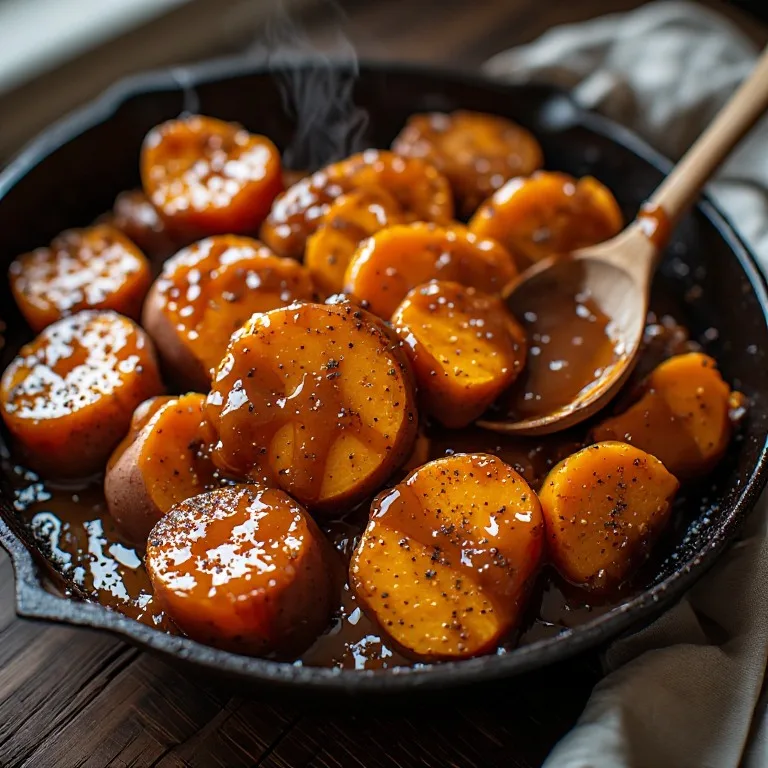
The viral TikTok candied yams recipe with the thick, glossy brown sugar glaze — stovetop method that lets the sauce reduce right in front of you. Butter, dark brown sugar, warm spices, and a splash of orange juice, cooked covered to steam the sweet potatoes tender, then uncovered and basted until every slice is coated in a deep amber caramel.

Easy Prep: 15 min Cook: 35 min Total: 50 min8 servings ~$4.50/serving
Prep15 min
Cook35 min
Total50 min
Servings
8
At home~$4.50/serving
vs
Restaurant~$20.25/serving
You save ~78%

The Story Behind the Recipe

Candied yams appear in American cookbooks as far back as the 1890s, making them one of the older fixtures of Thanksgiving cooking — predating the green bean casserole by decades. The name carries a built-in misnomer: the orange-fleshed sweet potatoes sold in almost every US grocery store as "yams" are Ipomoea batatas, not true yams. True yams (Dioscorea) are a different plant, native to West Africa and Asia, rarely sold in American supermarkets, and far starchier and less sweet. American grocers and food companies started labeling the moister orange varieties as "yams" in the 1930s to distinguish them from the pale, dry-flesh types, and the name held so firmly that the USDA now requires "sweet potato" to appear alongside "yam" on produce labels — a rule most shoppers have never noticed.

Every November, stovetop candied yam videos cycle back through TikTok with millions of views, and they work as content because the shot sells itself: the lid comes off a dark, bubbling skillet, a hand reaches in with a large spoon and lifts a slow pour of amber syrup back over glistening orange slices. What the videos demonstrate is also the actual technique — cover first to steam the sweet potatoes completely soft, then uncover and baste repeatedly to reduce the liquid into a thick glaze. At a restaurant, a candied yam side dish runs $10–14. At home, this recipe costs $4–7 for eight generous servings, and it reheats cleanly enough that it belongs in any Thanksgiving make-ahead plan.

Nutrition Facts

Per serving (8 servings)
Calories355
Total Fat9g
Total Carbs68g
Dietary Fiber5g
Sugars38g
Protein3g
Sodium200mg

* Estimated values based on standard recipe preparation. Actual values may vary.

Ingredients

  • Optional garnishes

Instructions

💡
Pro tip: This recipe tastes even better the next day. The flavors need time to meld together in the fridge.
❄️
Storage: Keeps in an airtight container in the fridge for up to 2 weeks. Freezer-friendly for up to 3 months.
🦃 Free Thanksgiving cookbook — download now The Copycat Thanksgiving Cookbook A ready-made, photo-illustrated PDF of our best thanksgiving copycat recipes — free to download, no building required. Pay what you want to support if you love it.

Free PDF — instant download. We'll also send new seasonal copycat recipes now and then; unsubscribe anytime. Or just download it →

Candied Yams — the Stovetop Version With the Thick Glaze

Prep: 15 min | Cook: 35 min | Serves: 8 | Great for Thanksgiving make-ahead

Every November, stovetop candied yam videos cycle back through TikTok with millions of views. The shot is always the same: lid off the skillet, a hand reaches in with a spoon, lifts a slow pour of dark amber syrup, and lets it fall back over glistening orange sweet potato slices. The shot works because it’s genuinely satisfying to watch — and it’s also showing you exactly what to do.

Cover first to steam the sweet potatoes completely soft. Then uncover and baste until the liquid reduces into a thick, glossy caramel glaze. That’s the whole technique.

The Two-Stage Cook

Candied yams fail for two reasons: the sweet potatoes aren’t fully soft before the glazing phase, or the glaze doesn’t reduce long enough. Understanding why the two stages exist prevents both problems.

Stage one (covered, medium-low heat, 18–22 minutes): The butter-sugar mixture doesn’t have nearly enough liquid to submerge the sweet potato slices. That’s fine — the cover traps steam, and the steam does the cooking. As the sweet potatoes cook, they also release their own moisture into the pan. By the time the lid comes off, the liquid in the pan is significantly more than what you started with, and it’s thin and watery.

Stage two (uncovered, medium heat, 8–10 minutes): The released moisture needs to evaporate. What you’re left with is a concentrated mixture of butter, brown sugar, orange juice, and sweet potato starch that reduces to a thick, sticky syrup. Basting is the mechanism: the sauce reduces fastest at the edges and bottom of the pan where the heat is highest, and spooning it over the tops of the sweet potato slices coats every surface evenly and keeps the sugar from burning in one spot.

The visual cues matter: the bubbles slow down and get larger as the sauce gets thicker. When a spoonful lifted from the pan falls back in a slow, heavy sheet rather than running like water, it’s done.

Why Dark Brown Sugar

Dark brown sugar has roughly twice the molasses content of light brown sugar. Molasses is what gives caramel its complexity — the bitterness that keeps sweet from becoming cloying, the depth that makes the glaze taste more caramelized than just sweet. In candied yams, this difference is noticeable but not dramatic. The light brown sugar version is milder and more straightforwardly sweet; the dark brown sugar version tastes richer and slightly more complex. Both work. Dark is better.

Make-Ahead for Thanksgiving

Candied yams are one of the more reliable make-ahead Thanksgiving dishes. The glaze reheats cleanly, the sweet potatoes don’t turn grainy in the refrigerator, and the whole dish can be done 2 days in advance.

Two days before: Cook through the complete recipe, including the glazing phase. Transfer to a baking dish or covered container, cool completely, and refrigerate. The glaze will firm up as it chills — this is expected.

Thanksgiving day: Remove from the refrigerator 30 minutes before reheating. Cover with foil and warm in a 325°F oven for 20 minutes. Remove the foil, baste once with any liquid in the dish, and bake another 5 minutes uncovered to re-glaze. Or reheat in the skillet over medium-low with 2 tablespoons of water to loosen.

Marshmallows or No Marshmallows
Glazed OnlyMarshmallow Top
TextureSticky, saucy, softGooey, pull-apart
Make-aheadYes, 2 daysMarshmallows go on day-of only
VisualGlossy amber (better for TikTok)Browned-marshmallow stretch
Most likeSouthern stovetop traditionMid-century American classic

The crowd-pleasing approach: make the glazed version as written, then scatter mini marshmallows over the top in the final 5 minutes of uncovered cooking, cover briefly to let them melt, and serve. It satisfies both camps at the table and requires no extra work.

Stovetop vs. Oven
StovetopOven
Glaze controlHigh — you can see and adjust in real timeMedium — check every 5 minutes uncovered
Burner loadOne burner, 35 minutesFrees stovetop; uses oven space
Batch sizeBest up to 4 lbsHandles 5+ lbs in a 9×13 dish
The TikTok shotYes — the lid-off reveal works hereLess dramatic

For a crowded Thanksgiving oven and stovetop, the oven version (375°F, 30 min covered + 20 min uncovered, basting every 5 minutes) is practical. For the classic result and the video, stovetop.

Variations

With toasted pecans: In the last 3 minutes of the uncovered glazing phase, scatter 1 cup of roughly chopped toasted pecans over the sweet potatoes. The pecans absorb the glaze and add a crunch that contrasts the soft sweet potato — the most modern, TikTok-forward version.

Spiced orange: Double the orange juice to ¼ cup and add ½ teaspoon of orange zest to the glaze base along with ⅛ teaspoon of cayenne. The heat reads as warmth rather than spice and prevents the dish from being one-note sweet.

Maple-glazed: Replace ½ cup of the brown sugar with ¼ cup of pure maple syrup, added at the same time as the other glaze ingredients. Maple’s sugars are less prone to crystallizing than sucrose, which gives the final glaze a slightly silkier texture with a more complex, earthy sweetness.

Ginger-forward: Double the ground ginger and add 1 teaspoon of freshly grated ginger root. The combination of both forms — ground for warmth, fresh for brightness — gives the spice profile a more pronounced, multi-dimensional edge that pairs especially well with turkey or ham.
🥗

Make It Healthier

Love Candied Yams (Southern Stovetop Sweet Potatoes) but want a lighter version? Try these simple swaps:

  • ✓Reduce the brown sugar to ¾ cup and add 2 tablespoons of pure maple syrup — maple's more complex flavor compensates for the lower sugar level, and the glaze stays properly glossy
  • ✓Use 4 tablespoons of butter instead of 6, replacing the other 2 tablespoons with coconut oil — similar richness and a barely-detectable tropical note that actually works well with the warm spices
  • ✓Add 1 teaspoon of freshly grated ginger root in addition to (or in place of) the ground ginger — fresh ginger is more pungent and bright, and holds its flavor better through the long cook
  • ✓For a lower-total-sweetener version: use ½ cup dark brown sugar + 3 tablespoons honey; honey's sugars crystallize differently from sucrose and help the glaze stay glossy at a lower total amount

Frequently Asked Questions

What are the best sweet potatoes to buy for candied yams?

Look for garnet sweet potatoes (deep orange-red flesh, brownish-red skin) or jewel sweet potatoes (bright orange flesh, lighter reddish-gold skin). These are what almost every American grocery store carries and sells interchangeably as 'sweet potatoes' or 'yams.' Both are moist, very sweet, and caramelize beautifully in this recipe. Avoid Japanese sweet potatoes (purple skin, pale yellow-white flesh) — they're nutty and less sweet, and don't caramelize the same way. Avoid white sweet potatoes too; they're starchier and drier, closer to a regular potato in texture and less suitable for candying.

Why are yams called yams if they're actually sweet potatoes?

American grocers and food companies began labeling the moister orange-flesh sweet potato varieties as 'yams' in the 1930s and 1940s to distinguish them from the drier, paler varieties on the same shelf. True yams (Dioscorea species) are a completely different plant, native to West Africa and parts of Asia, starchy rather than sweet, and rarely available in US supermarkets. The naming stuck so completely that the USDA now requires produce labeled 'yam' to also carry the words 'sweet potato' — which is why grocery store tags often read 'sweet potato (yam).' For this recipe, buy whatever your store calls 'yams' — it's the right thing.

Can I make candied yams in the oven instead of on the stovetop?

Yes. Prepare the glaze base exactly as written in step 2. Arrange the sweet potato slices in a 9×13 baking dish in slightly overlapping rows and pour the glaze over the top. Cover tightly with foil and bake at 375°F for 30 minutes until completely tender. Remove the foil, baste the slices with the liquid in the dish, and return to the oven uncovered for 15 to 20 more minutes, basting every 5 minutes, until the sauce thickens and caramelizes at the edges. The stovetop version gives more direct control over glaze thickness; the oven version is more hands-off and better suited to a crowded Thanksgiving stove.

Can I make candied yams ahead of time?

Yes, up to 2 days ahead. Complete the full recipe through the final glazing step, transfer to a covered container or the dish you'll reheat them in, and refrigerate. The glaze will set firm in the fridge — this is normal. To reheat: cover with foil and warm at 325°F for 20 minutes until heated through, then remove the foil and heat 5 more minutes to re-glaze the tops. Alternatively, reheat in the skillet over medium-low with 2 tablespoons of water to loosen the glaze, basting as it warms.

Why are my candied yams watery?

Almost always from not completing the uncovered reduction phase long enough. The covered cook phase intentionally releases moisture from the sweet potatoes — the uncovered phase exists specifically to evaporate that moisture and concentrate the glaze. If the sauce still looks thin after 10 minutes uncovered, keep cooking. Increasing heat speeds reduction but risks burning the sugar at the edges; medium heat with continuous basting is the right pace. The other common cause: soaking peeled sweet potatoes in water before cooking. The absorbed water dilutes the glaze significantly. Peel, slice, and cook immediately without soaking.

Should I use marshmallows or no marshmallows?

Both versions are legitimate. Marshmallow candied yams trace back to a 1917 Angelus Marshmallow Company recipe booklet and became standard through the mid-century. The plain glazed version (this recipe) is the older Southern stovetop tradition and what TikTok creators typically film because the glaze is more visually dramatic. The crowd-pleasing approach for a big family table: make the glazed version as written, then scatter mini marshmallows over the top in the last 5 minutes of the uncovered cook, cover briefly until they melt, and serve with the gooey top facing up. Everyone gets what they're expecting.

Love this recipe? Share it!

Free PDF: our 12 most-wanted copycat recipes — instant download.

Made it? Buy us a coffee

Every recipe here is free, with no paywalls. If this one was a hit at your table, a small tip keeps new copycats coming.

$

Ratings & Reviews

—
No ratings yet

Rate this recipe

Click a star to rate

Leave a Review

0/500

CS

Copycat Spices Editorial

Researched + fact-checked. Every recipe on Copycat Spices is built from published sources — official ingredient lists, brand-published recipes, interviews and food-science references — and fact-checked before it goes live, then written as clear, step-by-step instructions for home cooks of all skill levels.

Learn more about our mission →