Viral TikTok Chicken Adobo Recipe — The Filipino Dish Everyone Is Making Right Now
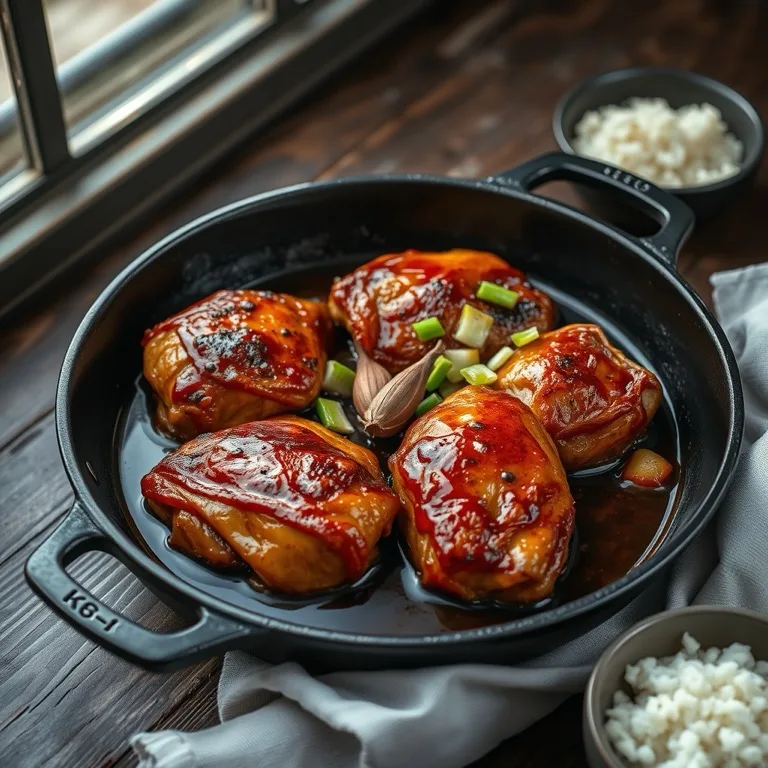
Quick answer: Pat dry 2 lbs bone-in, skin-on chicken thighs and season with salt and pepper. In a wide pan over medium-high heat, sear the chicken skin-side down in 1 tablespoon oil for 5–6 minutes until deep golden. Flip and sear 2 minutes on the other side. Remove the chicken and drain all but 1 tablespoon of fat from the pan. Add 8 smashed garlic cloves and cook 1 minute until fragrant. Return the chicken to the pan skin-side up. Pour in ½ cup soy sauce and ½ cup white cane vinegar (or white wine vinegar — do NOT use balsamic) around the chicken without pouring directly over the skin. Add 3 dried bay leaves and 1 teaspoon whole black peppercorns. Bring to a boil and once you see it boiling, DO NOT STIR for 3 minutes — letting the vinegar cook off unmolested is the key step. After 3 minutes, reduce heat to medium-low, cover, and simmer 20 minutes. Uncover, flip the chicken skin-side down, and cook an additional 10–12 minutes, spooning the sauce over the meat occasionally, until the sauce has reduced by half and coats the chicken in a glossy glaze. Serve over steamed white rice with the pan sauce drizzled over.
Shop the tools
Gear matched to this recipe. These are Amazon affiliate links — we may earn a small commission if you buy, at no extra cost to you.
 Illustrative imageLodge 10.25" Cast Iron SkilletThe restaurant-grade sear most copycats depend onCheck price on Amazon →
 Illustrative imageInstant-Read Digital ThermometerNail fry-oil and doneness temps every timeCheck price on Amazon →
 Illustrative imageNordic Ware Half Sheet PanCommercial-quality aluminum, bakes dead evenCheck price on Amazon →
As an Amazon Associate, Copycat Spices earns from qualifying purchases. Product images are generic illustrations, not the exact item listed.
Viral TikTok Chicken Adobo Recipe — The Filipino Dish Everyone Is Making Right Now
The viral TikTok chicken adobo recipe that's taking over Filipino food content: chicken thighs braised in soy sauce, cane vinegar, and garlic until the sauce reduces to a sticky, tangy glaze. Here's the exact technique that makes it work.
Easy
Prep: 10 min
Cook: 40 min
Total: 50 min4 servings
~$4.50/serving
At home~$4.50/serving
vs
Restaurant~$20.25/serving
You save ~78%
The Story Behind the Recipe
Chicken adobo is the closest thing the Philippines has to a national dish — a braise of chicken thighs in soy sauce, vinegar, garlic, bay leaves, and black peppercorns that cooks down to a sticky, intensely savory glaze. The dish predates Spanish colonization: Filipinos were already preserving meat in vinegar before the Spanish arrived in the 1500s; the colonizers just gave the technique the name "adobo" (from "adobar," to marinate or season). What the Spanish saw as similar to their own adobado was actually an entirely separate culinary tradition. Today there are hundreds of regional Filipino adobo variations — some add coconut milk, some use pork, some finish in a dry adobo with all the sauce cooked off. The TikTok version that went viral is the "wet" style: the sauce reduces but stays saucy, and the chicken is finished by frying briefly in its own rendered fat to crisp the skin while keeping the braise underneath.
The ingredient list is deceptively short — soy sauce, vinegar, garlic, bay leaves, peppercorns — but the technique has one non-obvious constraint that every Filipino home cook knows: do not stir after you add the vinegar. Adding vinegar and letting it boil untouched for the first few minutes drives off the harsh, sharp edge of the acid so it mellows into a rounded tartness. Stirring it too soon, before it has a chance to reduce on the surface, suspends the acidity throughout the sauce instead of letting it cook off gradually, and the finished dish tastes sharp rather than complex. That one step separates an adobo that tastes right from one that tastes like chicken in vinegar.
Nutrition Facts
Per serving (4 servings)Calories380
Total Fat22g
Total Carbs8g
Dietary Fiber1g
Sugars3g
Protein32g
Sodium890mg
* Estimated values based on standard recipe preparation. Actual values may vary.
Ingredients
- Chicken
- Adobo braising liquid
- To serve
Instructions
Pro tip: This recipe tastes even better the next day. The flavors need time to meld together in the fridge.
Storage: Keeps in an airtight container in the fridge for up to 2 weeks. Freezer-friendly for up to 3 months.
Free PDF — instant download. We'll also send new seasonal copycat recipes now and then; unsubscribe anytime. Or just download it →
🎉 Your Halloween Cookbook is ready!
It's free — but if it's worth something to you, you can pay what you want. It keeps the recipes coming.
$
✓ Downloading your free Halloween Cookbook — check your downloads folder. Happy cooking!
Make It Healthier
Love Viral TikTok Chicken Adobo Recipe — The Filipino Dish Everyone Is Making Right Now but want a lighter version? Try these simple swaps:
- ✓Use skinless chicken thighs to cut roughly 80 calories and 9 grams of fat per serving. Without the skin to protect the meat during the braise, the chicken will still be tender because thighs are fatty by nature, but it won't have the same texture contrast between the braised meat and semi-crisped skin. Sear skinless thighs for the same 5–6 minutes to develop browning, then proceed as written.
- ✓Reduce soy sauce to ⅓ cup and substitute 2–3 tablespoons of coconut aminos for the balance. This cuts sodium by roughly 200mg per serving while adding a slight sweetness that works well with the brown sugar. Coconut aminos are available at most grocery stores in the soy sauce aisle.
- ✓Serve over cauliflower rice instead of white rice to eliminate roughly 200 calories and 45 grams of carbs from the meal. The sauce is intense enough to make cauliflower rice feel satisfying — it absorbs exactly the way white rice does.
Frequently Asked Questions
What is the viral TikTok chicken adobo, and why is it trending?
Filipino chicken adobo took over TikTok's #FoodTok community as part of the larger Filipino food cultural moment that accelerated from 2024 through 2026. Filipino creators — many of them sharing their family recipes and grandmothers' techniques — posted adobo videos that reached tens of millions of views because the dish is genuinely surprising to non-Filipino viewers: the ingredient list is almost nothing (soy sauce, vinegar, garlic, bay leaves), but the result is a deeply complex, sticky, savory glaze that's unlike anything most American home cooks have made. The specific technique of not stirring after adding the vinegar, and the final uncovered reduction that caramelizes the sauce, became the key moments that food creators highlighted to explain why restaurant-style adobo tastes so much better than a dumbed-down version.
What vinegar should I use for chicken adobo?
Filipino cane vinegar is the traditional choice — brands like Datu Puti or Silver Swan are available at Asian grocery stores and increasingly at mainstream grocery stores. It's made from fermented sugarcane and has a mild, slightly sweet edge that the sharper distilled vinegars lack. If you can't find it, white wine vinegar is the best substitute: it has the right acidity without being harsh. Plain white distilled vinegar (5% acidity) also works and is what most home cooks use as a fallback. Apple cider vinegar adds fruitiness that competes with the garlic. Rice vinegar is too mild and the dish tastes flat. Balsamic, sherry, and red wine vinegars all change the flavor profile significantly — avoid them.
Can I use chicken breasts instead of chicken thighs?
Technically yes, but the dish will be meaningfully different. Chicken breasts dry out significantly over the 30-plus minutes of braising — the extended cooking time in liquid is what makes thighs so good here (the connective tissue and intramuscular fat keep the meat moist). If using breasts, reduce the covered simmer time to 12 minutes and check for doneness at that point (internal temperature of 165°F). Bone-in, skin-on breasts hold up better than boneless skinless. The most common complaint from adobo recipes using breasts is that the meat becomes stringy and chalky. Thighs are the correct choice for this dish.
Why does my chicken adobo taste too sharp or vinegary?
Almost always one of two causes. First, you stirred during the first 3-minute open boil (the no-stir step) — see the technique note in the instructions. Second, you used too strong a vinegar: white wine vinegar is milder than distilled white vinegar, and Filipino cane vinegar is milder still. The fix after the fact: add 1 teaspoon of brown sugar to the sauce and stir over medium heat for 2 minutes. The sugar doesn't make the dish sweet, but it balances the acidity significantly. For next time, try reducing the vinegar to ⅓ cup and increasing the soy sauce to ⅔ cup — the ratio shift makes the sauce richer and less tart without changing the fundamental dish.
How do I store and reheat leftover chicken adobo?
Adobo is one of the best meal-prep dishes in Filipino cuisine precisely because it stores so well. Refrigerate in an airtight container for up to 5 days — the vinegar acts as a natural preservative, and many cooks say the flavor actually improves on day 2 and 3 as the sauce penetrates the meat further. Freeze for up to 3 months. To reheat: place in a small pan over medium-low heat with 2 tablespoons of water, cover, and warm for 5–6 minutes, flipping once. Microwave reheating works but tends to dry the surface of the meat; if using a microwave, cover with a damp paper towel and reheat at 70% power in 90-second intervals.
What makes Filipino adobo different from Mexican or Spanish adobo?
The three are completely unrelated except for the name. Mexican adobo is a thick chili paste made from dried chiles (like chipotles in adobo sauce); it's a marinade or sauce with earthy, smoky, and slightly sweet notes from the dried peppers. Spanish adobo (adobar) is a vinegar-based preservation marinade that often includes paprika, oregano, and garlic — closer to a pickling brine for meat. Filipino adobo is a separate, pre-colonial technique of braising in vinegar and aromatics that the Spanish colonists simply gave a name to because of the surface-level similarity. The Filipino version is characterized specifically by the soy sauce + vinegar combination, which creates its unique sweet-sour-salty profile. You could not substitute one for the other in a recipe.
Love this recipe? Share it!
Made it? Buy us a coffee
Every recipe here is free, with no paywalls. If this one was a hit at your table, a small tip keeps new copycats coming.
$
💛 Support checkout is coming soon — the cookbook stays free either way.
Ratings & Reviews
Rate this recipe
Click a star to rate