Pin It

Viral TikTok Cucumber Sushi Rolls (No Rice, No Nori, Looks Like Art)

Viral TikTok Cucumber Sushi Rolls (No Rice, No Nori, Looks Like Art)
Jump to Recipe
Prep 20 min Cook 0 min Serves 2
Quick answer: Slice English cucumber lengthwise on a mandoline at 1/8 inch (3mm) — thin enough to flex, thick enough not to tear. Pat the sheets completely dry. Lay 3–4 strips overlapping by about half to form a wide mat. Spread room-temperature cream cheese thinly across the mat — it's the structural binder replacing both sticky rice and nori. Add a thin line of sushi-grade salmon and avocado along one edge, roll tight, refrigerate 15–20 minutes, then slice with a sharp wet knife. This is the Naruto roll, a recognized sushi style that TikTok popularized in summer 2024. Use only fish specifically labeled for raw consumption — commercially frozen to FDA parasite-kill standards.
Viral TikTok Cucumber Sushi Rolls (No Rice, No Nori, Looks Like Art)

Viral TikTok Cucumber Sushi Rolls (No Rice, No Nori, Looks Like Art)

Mandoline-cut cucumber sheets replace nori and rice in this stunning low-carb sushi. The Naruto roll explained: correct 1/8-inch thickness, sushi-grade fish safety, cream cheese mechanics, why home attempts fall apart, and 4 filling combinations.

Medium Prep: 20 min Cook: 0 min Total: 20 min2 servings ~$3.85/serving
Prep20 min
Cook0 min
Total20 min
Servings
2
At home~$3.85/serving
vs
Restaurant~$17.32/serving
You save ~78%

Ingredients

Instructions

💡
Pro tip: This recipe tastes even better the next day. The flavors need time to meld together in the fridge.
❄️
Storage: Keeps in an airtight container in the fridge for up to 2 weeks. Freezer-friendly for up to 3 months.
~250-450 cal/serving · Rich & Indulgent🔥

The Story Behind the Recipe

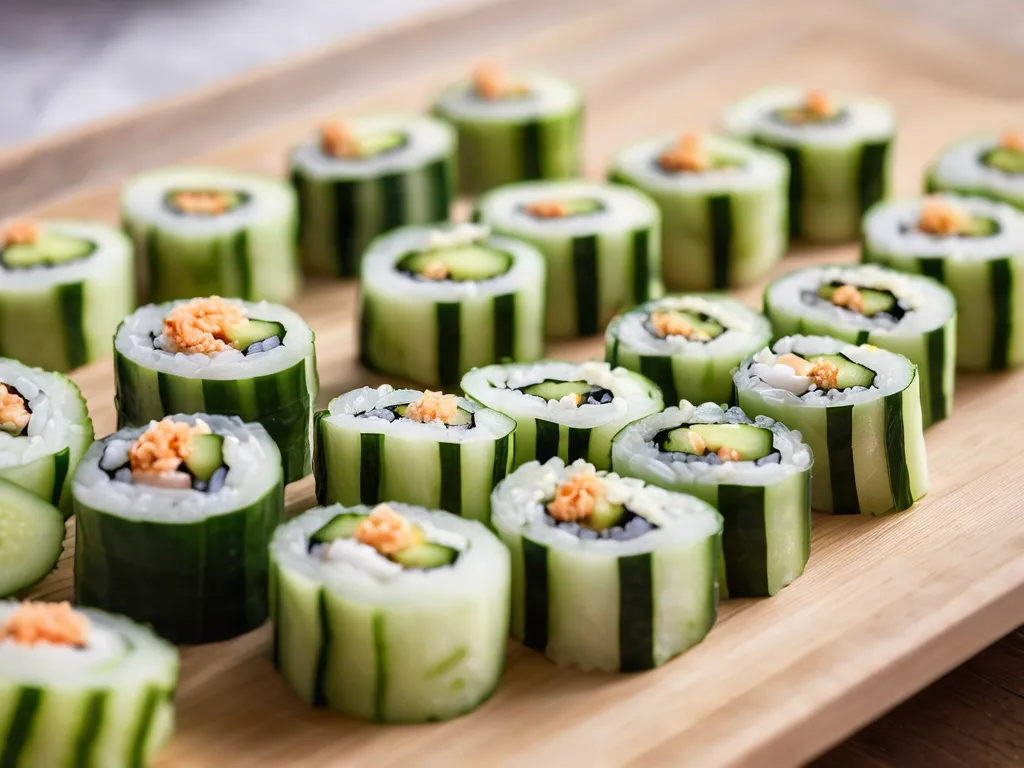
Cucumber sushi rolls look like they belong in an omakase restaurant. The cross-section — translucent green cucumber, white cream cheese, bright salmon, creamy avocado — is one of the most photogenic food compositions TikTok produced in 2024. Creators with no sushi training were making these in apartment kitchens and producing something that rivaled the visual quality of professional sushi bars.

What most TikTok versions didn’t explain: the structural mechanics that make the roll hold together. The cream cheese isn’t a flavor choice — it’s the only element that replaces both the sticky rice and nori’s adhesion. The pat-dry step isn’t optional. The chilling before cutting is what separates rolls that slice cleanly from ones that collapse under the knife.

TL;DR

English cucumber only. Mandoline at 1/8 inch (3mm) — thin enough to flex, thick enough not to tear. Pat the strips completely dry on paper towels. Overlap strips by half their width to form the mat. Room-temperature cream cheese spread thin — this is the structural binder. Sushi-grade fish only. Thin filling line — no thicker than your index finger. Roll tight. Refrigerate 15–20 minutes before slicing. Sharp wet knife, one motion per cut.

What This Actually Is: The Naruto Roll

Cucumber-wrapped sushi has a professional name: the Naruto roll, named for the narutomaki fish cake with the swirl pattern visible in cross-section. Japanese sushi chefs have used thin cucumber sheets as a low-carb nori substitute for decades. This is not a TikTok invention — it’s a recognized sushi style that TikTok brought to home kitchens.

In summer 2024, Logan Moffitt — a Canadian creator known as “The Cucumber Guy” — published a series of cucumber-focused videos that accumulated hundreds of millions of views. His content included a cucumber-as-sushi-wrapper format that sparked widespread attempts at home. What his videos showed clearly (the beautiful cross-section, the translucent wrapper) and what they underexplained (the structural mechanics, the importance of drying the cucumber, the chilling step) explains both why the trend went enormous and why so many home attempts fell apart on the cutting board.

Why It Went Viral

The visual is the primary driver. The semi-translucent green wrapper lets you see the colored fillings from the outside, and slicing produces a cross-section that’s essentially a natural color wheel. It photographs in a single shot without any styling.

The low-carb math resonated with a specific audience at the right time. Standard maki rolls contain roughly 28–38g of carbs per 8 pieces from the rice alone. The cucumber version has approximately 8–12g of carbs per serving. For the large keto and low-carb community on TikTok, a dish that looks exactly like sushi but eliminates nearly all the carbs had obvious appeal — and the flavor is genuinely good, not a compromise.

The zero cooking factor made it native to short-form video. Full preparation happens on camera in under two minutes with no stove.

Choosing the Right Cucumber

English cucumbers are the correct choice. Regular field cucumbers fail for specific reasons: shorter body (produces strips too narrow to wrap fillings), large seed pockets in the center (create hollow spots in your sheets), and thick skin that resists the mandoline unevenly.

English cucumbers solve all three problems: 12–15 inches of usable length, nearly no seeds, and skin thin enough to slice through without peeling. Persian cucumbers are too narrow for full rolls. Japanese cucumbers are the best substitute — similar dimensions and the same low-seed profile.

The cucumber should be cold before slicing. A chilled cucumber is denser and produces cleaner cuts with less compression.

The Mandoline: Setting, Technique, and Why a Knife Falls Short

Set the mandoline to 1/8 inch (3mm) — this is the consensus thickness for flexibility without tearing. Thicker than 3mm and the sheets crack when bent for rolling; they’re too rigid. Much thinner than 2mm and they tear from rolling pressure. At 3mm, the sheets are semi-translucent (the visual that went viral) while remaining flexible and structurally sound.

Slice lengthwise along the cucumber’s length to produce wide sheets, not rounds. Work from the outside in: make parallel passes, rotating the cucumber slightly between cuts, and stop when you reach the seedy core. Discard the core (or dice it for another use).

Test each sheet by folding it gently in half: if it bends without cracking, thickness is correct. Discard the first and last slices from each side — they’re mostly skin with minimal width.

Pat every sheet dry. This is the step most TikTok creators skipped. Lay the sheets on paper towels, press another layer on top, and apply firm pressure for 2 minutes. Wet cucumber prevents cream cheese from adhering during rolling, turns the interior soggy within 10 minutes of assembly, and ensures the roll falls apart when sliced. Dry sheets bond to the cream cheese cleanly.

Can I use a knife? Technically yes, but expect inconsistent results. Hand-cut sheets vary in thickness across their length, creating spots that crack at the thick sections and tear at the thin ones. A mandoline costs about $30 (Benriner Japanese model is the standard recommendation) and makes the technique reliable.

Sushi-Grade Fish: What It Actually Means

“Sushi-grade” is not an FDA-defined term — any retailer can put it on a label. What it signals in practice is that the fish was commercially frozen to FDA parasite-kill standards before being sold for raw consumption:

  • -4°F (-20°C) for 7 days minimum, or
  • -31°F (-35°C) for 15 hours (commercial flash-freezing), or
  • -31°F until solid, then held at -4°F for 24 hours

These temperatures eliminate Anisakis roundworms, the primary parasite risk in wild salmon. Home freezers run at approximately 0°F — that is not cold enough to meet FDA standards. The correct approach is buying fish that has already been commercially frozen before you buy it.

Wild-caught Pacific salmon carries a higher natural parasite load than farmed Atlantic (farmed fish eat controlled feed, not wild prey). Most sushi-grade salmon at grocery stores is farmed Atlantic for this reason, though reputable retailers freeze either type before selling for raw use.

Where to buy reliably: Whole Foods, H Mart, Mitsuwa, Trader Joe’s (their ahi tuna is specifically labeled for raw consumption), and any dedicated fish market. Ask specifically: “Is this intended for raw consumption?” — not just whether it’s fresh. Fresh does not mean safe for raw eating.

Farmed Atlantic salmon, sushi-grade tuna (ahi, bigeye), and hamachi (yellowtail) are the standard raw options. Smoked salmon is a cooked alternative with the same visual impact and no sourcing complexity.

The Cream Cheese Mechanic

Cream cheese is doing structural work in this recipe. Understanding what it replaces is the key to understanding why it can’t be omitted carelessly.

In a traditional sushi roll, sushi rice provides the interior mass that gives the roll its body, and nori — when it contacts moisture — activates its own stickiness to seal the roll. Cucumber has neither property. Its surface is smooth and slightly waxy. It doesn’t adhere to itself or to other surfaces, and it releases water continuously rather than absorbing it.

Room-temperature cream cheese resolves both problems simultaneously: it spreads smoothly across the cucumber mat, bonds the overlapping layers together, and maintains adhesion through rolling so the cream cheese layers throughout the roll form a continuous structural network.

Cold cream cheese tears the cucumber sheets when spread — there’s enough resistance that the offset spatula drags and damages the thin strips. The cream cheese must be at full room temperature: pull it from the refrigerator at least 30 minutes before you need it, ideally an hour.

Spread it thin. The layer should be just enough to cover — if you can see the cucumber clearly through it, that’s about right. A thick cream cheese layer is too rich, will compress and squeeze out the sides during rolling, and overwhelms the delicate fish flavor.

Four Filling Combinations

Classic spicy salmon — sushi-grade salmon in thin planks, avocado slices, sriracha drizzle at the end. The most popular version.

Spicy tuna crunch — sushi-grade tuna diced small and mixed with Kewpie mayo and sriracha into a spreadable paste. Apply as a layer rather than sliced planks — the even distribution helps the roll close cleanly and provides more contact surface with the cream cheese.

California roll, no raw fish — imitation crab (surimi) mixed with Kewpie mayo and sriracha, avocado alongside. Fully cooked, easy sourcing, same visual language as traditional California rolls.

Vegetarian mango and avocado — ripe mango sliced thin, avocado, finished with a drizzle of chili crisp. The sweetness of mango with cool cucumber is underrated.

What to avoid inside cucumber rolls: cooked salmon (releases water that softens the wrapper), shredded carrot or other rigid vegetables (too stiff to compress during rolling, the roll cracks trying to enclose them), anything with high water content like tomato. Maximum two filling components — more and the roll won’t close.

Related Recipes

For more raw salmon preparations, salmon tartare covers sushi-grade sourcing and food safety in detail, with the ring mold technique that produces similar restaurant-quality presentation. The Emily Mariko salmon bowl is the no-cook leftover salmon format with the ice cube reheating trick. For a baked sushi format that uses no raw fish, sushi bake casserole uses spicy crab and furikake baked over seasoned rice. If the cucumber sushi looks like a lot of work, miso glazed salmon is five ingredients broiled in 10 minutes and produces a result most people find more impressive.

Nutrition Facts

Per serving (2 servings)
Calories320
Total Fat22g
Total Carbs10g
Dietary Fiber5g
Sugars4g
Protein20g
Sodium620mg

* Estimated values based on standard recipe preparation. Actual values may vary.

🥗

Make It Healthier

Love Viral TikTok Cucumber Sushi Rolls (No Rice, No Nori, Looks Like Art) but want a lighter version? Try these simple swaps:

  • Replace cream cheese with pressed firm tofu mixed with a little sesame oil — the roll is slightly more fragile but holds if assembled carefully and eaten promptly.
  • Use smoked salmon instead of raw sushi-grade salmon — it requires no special sourcing and has the same visual impact.
  • Cucumber rolls are already dramatically lower in carbs than rice-based sushi — roughly 10g carbs per serving versus 30–40g in traditional maki. The recipe is low-carb by default.
  • Use low-sodium soy sauce for the dipping sauce and reduce sodium by about 150mg per serving.

Equipment You'll Need

Mandoline slicer

Required — a knife cannot produce consistent 1/8-inch sheets. The Benriner Japanese mandoline (~$30) and OXO Good Grips both work well at this thickness.

Sharp chef's knife

Dull knives crush the roll before slicing through it; wet the blade between each cut

Offset spatula or butter knife

For spreading cream cheese without tearing the cucumber; a spoon back also works

Paper towels

Essential for patting cucumber dry before assembly — skip this and the roll won't adhere

Frequently Asked Questions

What is a Naruto roll, and is this actually a real sushi style?

Yes. The cucumber-wrapped roll has a recognized name in professional sushi: the Naruto roll (also spelled Narutomaki roll), named after the narutomaki fish cake with its distinctive swirl pattern visible in cross-section when the roll is sliced. Japanese sushi chefs have used paper-thin cucumber sheets as a nori substitute for decades — primarily for low-carb presentations and to highlight filling ingredients visually. TikTok popularized the home version starting in summer 2024, largely through Logan Moffitt, a Canadian creator known for his cucumber-focused content. Moffitt's cucumber salad and cucumber-as-sushi-wrapper videos collectively accumulated hundreds of millions of views. The 2024 wave brought a professional technique to home kitchens but also introduced the most common point of failure: most creators on TikTok did not explain the structural mechanics that make the roll hold (cream cheese adhesion, patting dry, chilling before cutting), so many viewers' attempts fell apart.

What does sushi-grade mean, and is raw salmon safe to eat at home?

Sushi-grade is a retail marketing term — the FDA does not regulate or define it. In practice, it signals that the fish was commercially frozen before sale to FDA parasite-kill standards: -4°F (-20°C) for 7 days minimum, or -31°F (-35°C) for 15 hours, or -31°F until solid then stored at -4°F for 24 hours. These temperatures eliminate parasites (primarily Anisakis roundworms common in wild salmon) that standard refrigeration cannot. One important caveat: home freezers run at approximately 0°F, which does not meet the FDA -4°F standard. Buying fish that has already been commercially frozen is the correct approach — look for labels that say 'previously frozen' or ask the fishmonger if it was frozen for sashimi-safe use. Wild-caught Pacific salmon requires freezing treatment; farmed Atlantic salmon has a lower natural parasite risk (farm-raised fish don't eat wild prey), but reputable retailers freeze it before selling for raw use regardless. Where to buy with confidence: Whole Foods Market, H Mart, Mitsuwa, Trader Joe's (their ahi tuna is specifically labeled for raw consumption), and reputable fish markets. Pregnant women, immunocompromised individuals, very young children, and the elderly should follow FDA guidance and avoid raw fish.

Which cucumber works best, and why not regular cucumbers?

English cucumbers (also sold as European, hothouse, or seedless cucumbers) are strongly preferred for three specific reasons: they grow 12–15 inches long, which produces wide sheets when sliced lengthwise; they're nearly seedless, so there are no hollow spots in your sheets; and their skin is thin and edible, so you don't need to peel before slicing. Regular field cucumbers fail at all three points — shorter body produces narrower strips, large seed pockets create structural holes, and thick skin resists the mandoline unevenly and produces an unpleasant texture in the wrapper. Persian cucumbers are too narrow for full-size rolls. Japanese cucumbers are the best substitute if English aren't available — same thin skin, same minimal seeds, similar length. The cucumber should be cold when you slice it; a chilled cucumber is firmer and slices more cleanly.

Why is cream cheese in a cucumber sushi roll — can I use something else?

Cream cheese is doing structural work that most substitutes can't replicate. In traditional sushi, sticky sushi rice provides interior mass and nori activates its own stickiness when it contacts moisture to seal the roll. Cucumber has neither property: its surface is smooth and waxy, it doesn't adhere to itself, and it releases water continuously. Room-temperature cream cheese solves this — it spreads smoothly, bonds the overlapping cucumber strips together, and maintains cohesion through rolling so the finished roll holds its shape when sliced. Cold cream cheese tears the delicate cucumber sheets when spread; always bring it to full room temperature (30+ minutes out of the refrigerator). Alternatives that work partially: mashed avocado has similar binding properties but produces a looser roll with a shorter hold time; hummus binds adequately but adds strong flavor competition; Neufchâtel (lower-fat cream cheese) works identically to full-fat and cuts about 30% of the calories. Full-fat cream cheese is the most reliable structural choice.

What fillings work beyond salmon and avocado?

Four reliable combinations: (1) Spicy tuna — sushi-grade tuna diced small (about ¼ inch) and mixed with Kewpie mayo and sriracha into a spreadable paste, applied as a layer rather than sliced planks, which distributes filling weight more evenly; (2) California roll style — imitation crab (surimi) mixed with Kewpie mayo and sriracha, with avocado alongside; this uses no raw fish and is easier for home cooks uncomfortable with raw sourcing; (3) Mango and avocado vegetarian — ripe mango sliced thin, avocado, finished with chili crisp; (4) Smoked salmon — not raw, no special sourcing needed, same visual as fresh salmon. What doesn't work well: cooked salmon releases water that softens the cucumber wrapper; shredded carrots and other rigid vegetables resist rolling and crack the cucumber; any additional ingredient with high water content (tomato, cucumber matchsticks inside the roll) creates double the moisture problem. Maximum two filling components — more than that and the roll won't close cleanly.

Why do cucumber sushi rolls fall apart, and how do I prevent it?

Five causes with specific fixes. (1) Cucumber not patted dry: wet cucumber prevents cream cheese adhesion and turns the roll soggy from the inside; pat sheets dry with paper towels before assembly and let them sit 2 minutes under light pressure. (2) Cream cheese too cold: cold cream cheese tears the cucumber when spread and doesn't bond as you roll; it must be at full room temperature. (3) Insufficient overlap in the mat: strips overlapping edge-to-edge (barely touching) creates seams that open during rolling; overlap each strip by about half its width. (4) Overfilling: the line of filling should be no thicker than your index finger; more filling creates internal pressure that splits the cucumber. (5) Cutting without chilling first: an unchilled roll is soft throughout and compresses before the knife can cut; refrigerate 15–20 minutes before slicing.

How far ahead can I make cucumber sushi rolls?

Assemble no more than 30–45 minutes before serving. Cucumber releases water continuously, which softens the cream cheese layer and causes the roll to lose structural integrity over time. The practical approach for parties: prep all components ahead (soften cream cheese, slice the cucumber sheets and pat dry, prep the fish and avocado), then assemble in small batches 15–20 minutes before you want to serve each batch. Uncut assembled rolls can be refrigerated seam-side down for up to 1 hour before slicing — the cold significantly slows water migration. Sliced pieces should be served immediately; cut faces weep moisture quickly. Do not make this dish more than an hour ahead under any circumstances.

Love this recipe? Share it!

Shop the tools

The right tools make all the difference. We earn a small commission if you buy through these links — at no extra cost to you.

Free PDF: our 12 most-wanted copycat recipes — instant download.

Ratings & Reviews

No ratings yet

Rate this recipe

Click a star to rate

Leave a Review

0/500

CS

Copycat Spices Test Kitchen

Every recipe on Copycat Spices is developed and tested in our home test kitchen. We reverse-engineer beloved restaurant dishes and refine each one until the flavors and the instructions work reliably for home cooks of all skill levels.

Learn more about our mission →