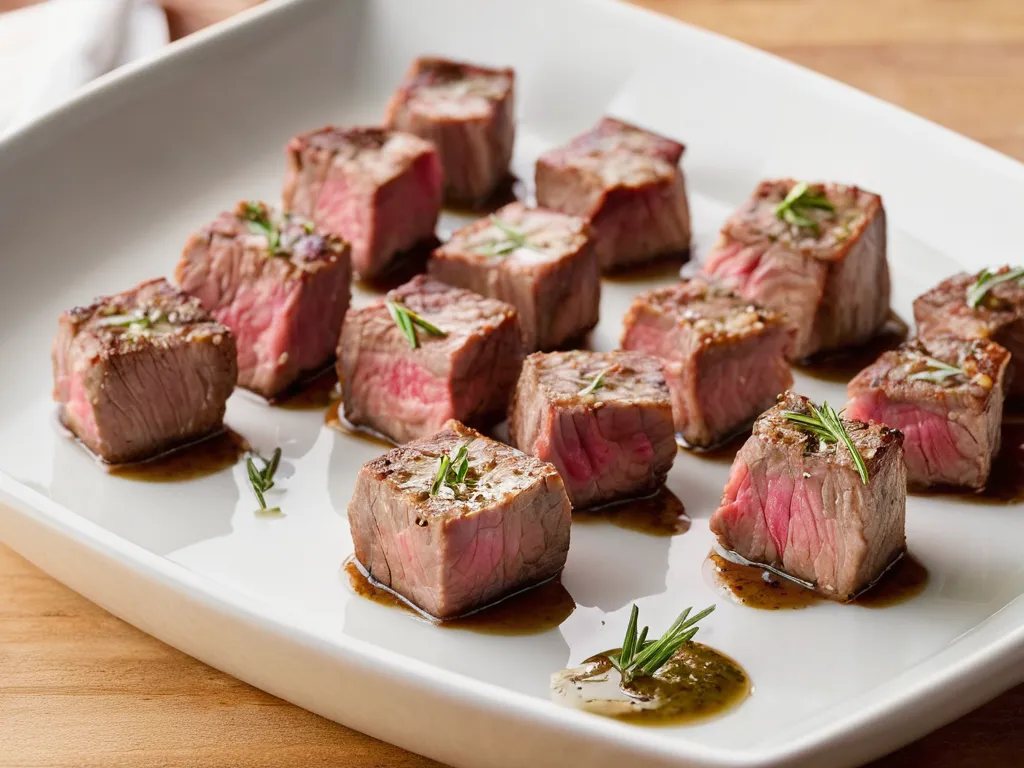
Garlic Butter Steak Bites
Prep: 5 min | Cook: 10 min | Serves: 2 | Cost: ~$11–14 vs. $25–35 at a steakhouse
Garlic butter steak bites accumulated over 500 million views on TikTok not because the concept is new — searing steak with butter and garlic has been a French bistro staple for decades — but because TikTok showed people it was achievable at home in 10 minutes. The sizzle of steak hitting a screaming-hot cast iron pan, the foam of garlic butter, the caramelized crust on each bite: it’s visually convincing in a way that a finished plate photo never is.
The technique is real. These genuinely taste like a steakhouse entrée if you do three things correctly: get the pan hot enough, keep the steak dry, and add the garlic at the right time. Most versions that disappoint skip at least one of those.
Choosing the Right Cut
Not all steak cubes are equal. The cut you use changes the flavor, texture, and cost significantly.
Sirloin top (the standard choice). Moderate marbling, firm texture that holds up as cubes, meaty beef flavor. Most grocery stores sell sirloin for $9–14 per pound. It’s the right starting point — enough fat to taste good, enough structure to sear cleanly.
Ribeye (the upgrade). Much higher fat content (the visible white streaks within the muscle). In cube form, that fat melts during searing and creates intensely rich, beefy bites. The tradeoff: more fat renders out and pops in the pan, the pan can smoke aggressively, and the cost runs $18–25 per pound at most stores. If you’ve had garlic butter steak bites at a restaurant and they tasted noticeably richer than your home version, ribeye was probably the cut.
New York strip (the middle ground). Leaner than ribeye, more flavorful than sirloin because of its position along the short loin. Good choice if you want more flavor than sirloin without the full fat content of ribeye.
Tenderloin (filet) — not recommended for this recipe. It’s the most tender cut but has almost no intramuscular fat, which means minimal beefy flavor. The luxury of tenderloin is its texture, not its taste — in a quick high-heat application where texture becomes secondary to crust and garlic butter, you’re wasting the premium.
Flank or skirt — not ideal for cubes. Both are highly flavorful but are best cut into thin slices across the grain, not 1-inch cubes. The grain structure of these muscles makes cubed flank/skirt chewy regardless of how you cook it.
| Cut | Flavor | Fat | Cost/lb | Best For |
|---|---|---|---|---|
| Sirloin | Good | Moderate | $9–14 | Everyday version |
| Ribeye | Excellent | High | $18–25 | Weekend/special occasion |
| NY Strip | Very Good | Moderate-high | $15–20 | Balance of both |
| Tenderloin | Mild | Low | $25–40 | Skip for this recipe |
Pan Temperature Is Everything
The most common failure in home steak bites is an underheated pan. “High heat” is not enough instruction. The pan needs to be genuinely smoking — not just hot, not just starting to shimmer. You know it’s ready when a drop of water hits the surface and vaporizes instantly into a tight ball rather than spreading and sizzling.
Cast iron is the right vessel because it holds heat better than any other common cookware. When cold steak cubes (around 40°F coming from the fridge) hit the pan, they drop the surface temperature. A thin stainless or non-stick pan loses 100–150°F instantly and takes 30+ seconds to recover. Cast iron holds its temperature through the thermal mass and immediately rebounds. That sustained contact heat is what forms the crust in 60–90 seconds instead of slowly turning the steak gray.
Preheat the cast iron over high heat for 2–3 minutes before you add anything. It will start to smoke slightly — that’s the right sign. Add the first tablespoon of butter and let it foam; once the foam starts to brown (not quite burn), the steak goes in.
Why Patting Dry Matters
Water on the surface of the steak sabotages the sear. The Maillard reaction — the browning process that creates crust, aroma, and flavor compounds — only starts above about 280°F (138°C). Water boils at 212°F (100°C). If the surface is wet, the pan’s heat is spent evaporating water rather than browning meat. The steak surface stays pinned at 212°F until the water is gone, by which point the steak is already partway cooked and the pan has cooled.
The fix is 30 seconds with paper towels. Press firmly on all sides of each cube until the paper towel comes away with no visible moisture. This is the highest-leverage step in the entire recipe for people who get gray, lackluster steak bites.
The Garlic Timing Problem
Garlic burns fast. On a 500°F cast iron surface, minced garlic goes from raw to burned in under a minute. Burned garlic tastes acrid and bitter and cannot be fixed — it ruins the whole pan.
The solution is sequencing: sear the steak with only butter (or a neutral oil + butter) in the pan, then reduce heat before adding garlic. After the sear, reduce to medium-high, add your remaining butter plus garlic and thyme together. The lower heat lets the garlic soften and turn golden — about 30–45 seconds — before the basting starts. The garlic infuses directly into the butter foam and coats every steak bite during basting.
Some recipes add garlic to the oil from the start. Those recipes either use low heat (no proper crust) or call for whole garlic cloves (which brown more slowly than minced but still add less flavor). Minced garlic after the sear, in the basting butter, is the correct approach.
Butter Basting: What It Actually Does
Basting — continuously spooning foaming butter over the steak — accomplishes more than just adding fat. Hot butter transfers heat to the top surface of the steak (the side facing up) at the same time the bottom is searing. You’re essentially cooking both sides simultaneously. This speeds the overall cook time and reduces the temperature differential between the crust and interior.
The foam in the butter is water vapor. It indicates the butter is at the right temperature — hot enough to transfer heat efficiently but not so hot that the milk solids have burned. Once the foam subsides and the butter clarifies, it’s getting too hot and you should reduce the heat or add a fresh tablespoon.
Tilt the pan about 20–30 degrees so the butter pools at one edge. A large spoon lets you scoop the pooled butter and pour it continuously over the steak. Do this for a full 60 seconds. You’ll see the color of the top surface change — it stops looking raw and takes on a slightly darker, cooked appearance even though you haven’t flipped.
Soy Sauce and Worcestershire: Why Both
The final glaze step — soy sauce and Worcestershire — is what separates a competent steak from a great one in this format.
Soy sauce contributes glutamate-based umami. It amplifies the savory perception of the beef without tasting like soy sauce, especially in small amounts (1 tablespoon for 1 lb of steak). It also creates a glossy, lacquered coating as it hits the hot pan and reduces in seconds.
Worcestershire sauce is more complex: it’s fermented and contains tamarind, anchovies, molasses, vinegar, and spices. The result is a deep, slightly sweet umami that’s different in character from soy’s direct hit. A small amount — 1 teaspoon — adds a background note of complexity you’d notice was missing if you left it out.
Neither sauce should dominate. Used at these ratios, they taste like intensely seasoned, deeply savory steak, not like condiments.
Doneness Guide for Steak Bites
Steak bites cook faster than a whole steak because the small size means heat penetrates all the way through quickly. The window between medium-rare and overcooked is narrow — about 30–45 seconds.
| Doneness | Pull Temperature | Target Temperature |
|---|---|---|
| Medium-rare | 125°F | 130°F after rest |
| Medium | 135°F | 140°F after rest |
| Medium-well | 145°F | 150°F after rest |
| Well done | 155°F | 160°F after rest |
An instant-read thermometer is the most reliable tool. Insert it horizontally into the side of a cube (not the top — you want to reach the center). Without a thermometer: for medium-rare, the center should be bright pink-red with a thin band of gray at the very edge when you cut one open. If the center is all pink with no red, you’re at medium. All gray throughout = well done.
Pull the steak off heat early. Carryover cooking in a residual-heat cast iron pan adds roughly 5°F after you stop the flame — less than the 10–15°F a thick whole steak carries, because the small cubes have less mass to keep cooking themselves.
Common Mistakes
Crowding the pan. More than one layer of steak bites in the pan traps steam between the pieces, dropping the surface temperature and preventing browning. Every piece needs direct contact with the hot pan surface, with a few millimeters of air between cubes. Work in two batches if needed — the first batch stays warm while the second cooks.
Adding garlic at the start. Covered above. It burns.
Skipping the rest. Two minutes off heat lets the muscle fibers relax and the juices redistribute. Steak bites cut immediately after cooking lose visible liquid to the cutting board.
Cutting cubes too small. Anything under ¾ inch cooks to well-done before a crust can form. Stick to 1-inch cubes for the right balance of crust and pink center.
Using cold butter for basting. Cold butter drops the pan temperature and takes longer to foam. Let butter sit at room temperature for 10 minutes before cooking if you’re working from a block.
Variations
Chimichurri steak bites. Skip the soy/Worcestershire and serve with a spoonful of chimichurri (fresh parsley, cilantro, garlic, red wine vinegar, olive oil, red pepper flakes) over the top. The herbaceous, acidic sauce cuts the richness of the butter baste.
Asian-inspired. Replace the soy sauce with 2 tablespoons of oyster sauce and add a teaspoon of sesame oil at the finish. Garnish with toasted sesame seeds and sliced green onions instead of parsley.
Hot honey glaze. After the soy/Worcestershire step, drizzle 1 tablespoon of hot honey (or regular honey + ½ teaspoon red pepper flakes) over the bites and toss for 10 seconds. The honey caramelizes slightly on the hot surface and creates a sweet-spicy-savory coating.
Mediterranean. Use 1 tablespoon of olive oil instead of the first tablespoon of butter for searing. During the basting step, add a teaspoon of dried oregano alongside the thyme. Finish with a squeeze of fresh lemon instead of soy/Worcestershire, and crumble feta over the top before serving.
What to Serve With Them
The pan drippings — garlic butter darkened with steak juices and glaze — are too good to leave in the pan. Pour them over whatever you serve alongside.
Mashed potatoes are the most natural pairing: the drippings function as a rich gravy.
Crusty bread or garlic bread to mop up the sauce. Don’t skip this if you’re serving steak bites as the main.
Simple salads — arugula with lemon and parmesan, or butter lettuce with red wine vinaigrette. The heat of the pan drippings slightly wilts the greens and acts as a warm dressing.
Rice or cauliflower rice for a lower-carb base that absorbs every drop of the garlic butter.
Asparagus or broccolini roasted separately at 425°F for 12 minutes alongside the recipe.
Cost Comparison
| At a Steakhouse | At Home | |
|---|---|---|
| 6 oz sirloin entrée | $25–35 | Sirloin 1 lb: $10–14 |
| Garlic butter sauce | Included | Butter + garlic + thyme: ~$1.50 |
| Total | $25–35 per person | ~$6–8 per serving |
| Time | 45 min (including wait) | 15 min |
The home version wins on cost, speed, and customization — and you have direct control over doneness, which is more than can be said for a crowded steakhouse kitchen on a Friday night.
More Steak and Quick Beef Dinners
- Copycat Benihana Hibachi Steak — sirloin cubes seared on a flat-top with soy-garlic butter and sesame oil; the Japanese steakhouse version of the same technique
- Copycat Texas Roadhouse Ribeye — a full ribeye with TR’s signature seasoning blend and the same butter basting technique scaled up
- Copycat Applebee’s Bourbon Street Steak — bourbon-Worcestershire marinade on a sirloin; similar flavor profile in a full-steak format
- Copycat P.F. Chang’s Mongolian Beef — thin-sliced flank steak in a soy-brown sugar glaze; a different take on quick high-heat beef
- Viral TikTok Marry Me Chicken — for when you want the same one-pan approach but with chicken; sun-dried tomato cream sauce
- Viral TikTok Lemon Butter Chicken — butter basting applied to chicken thighs with lemon and capers