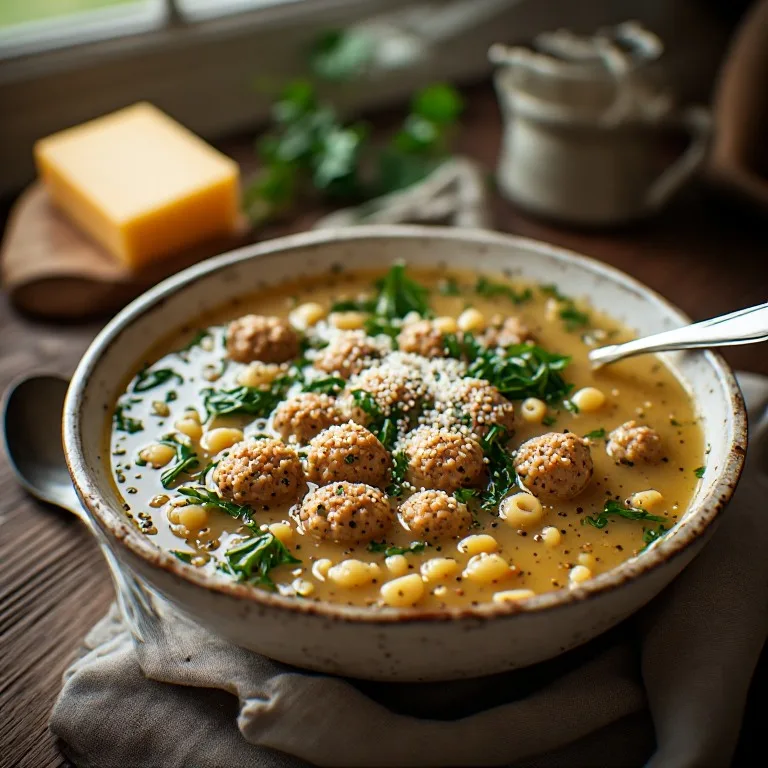


Italian wedding soup is the sort of recipe that TikTok rediscovers every fall for good reason: tiny meatballs, golden broth, ribbons of wilted escarole, and enough acini di pepe pasta to make every spoonful satisfying. It looks like a project. It is not a project. And the name has nothing to do with weddings.
The Name
The Italian is minestra maritata — “married soup.” The marriage is the union of meat and bitter greens in broth: two things that balance each other, each bringing out qualities in the other that neither has alone. The escarole’s bitterness softens in the broth; the broth takes on the escarole’s depth. When the recipe traveled to American kitchens in the early 20th century, maritata got translated as “wedding” rather than “married,” and the false origin story — soup served at Italian weddings — attached itself and never let go. It’s a Neapolitan and Lazio dish, originally peasant food made with winter greens and scraps of meat.
Why This Keeps Going Viral
The TikTok footage is a specific sequence of events: someone rolls 45 tiny meatballs by hand (oddly satisfying ASMR), bakes them until just set, drops them into golden simmering broth, watches the escarole disappear from a pile as tall as the pot into ribbons floating in the broth, and then serves a bowl that looks like it came from a grandmother’s kitchen in Naples. The comments are always the same: “I didn’t know this was so easy.”
The Four Things That Make It Right
Meatballs must be tiny. One inch or smaller. The goal is a meatball you can fit on a soup spoon and eat in one bite. Larger and the ratio of meatball-to-broth-to-pasta shifts in the wrong direction. The dish becomes a meatball dish with some soup around it, not a soup where the meatballs are one of several things floating together. Use a ½-teaspoon measure or cookie scoop — you want consistency so they cook evenly.
Bake the meatballs first. Dropping raw meatballs into simmering broth is a shortcut that comes with a tax: the meatballs release their fat and moisture into the broth before their exterior has set, and they have a tendency to break apart with any stirring. Twelve minutes in a 400°F oven sets the outside while leaving the inside just cooked — they go into the broth with structural integrity and don’t fall apart when the pasta stirs against them.
Use a Parmesan rind. This is not fancy restaurant technique — it’s the thing Italian home cooks do with the end of every block of Parmesan. Simmered in broth for 15 minutes, a rind releases concentrated umami and a subtle nuttiness that makes the broth taste like it simmered for hours. Buy them bagged at the deli counter for a few dollars, or save your own in the freezer. You can’t taste the rind itself in the finished soup — only what it leaves behind.
Don’t overcook the pasta. Acini di pepe is tiny and cooks fast — 8 minutes in simmering broth gets it to al dente. It continues cooking as the soup sits, and overnight it absorbs most of the broth. Pull the pot off heat when the pasta still has a bit of chew, and add broth when reheating leftovers.
Escarole: What It Is and Why It’s Here
Escarole is a mildly bitter green in the chicory family — looks like a loose-leafed romaine with ruffly, slightly waxy edges. Raw, it has a pleasant bitterness that would overpower a delicate broth. Cooked for 5 to 7 minutes in the simmering soup, it loses most of that sharpness and becomes a dark, silky, earthy green that reinforces the Parmesan-chicken base without competing with it.
It’s also hearty enough to stay intact in the broth — it doesn’t dissolve the way spinach does. A spoonful with meatball + pasta + escarole is the dish working the way it’s supposed to.
If you can’t find escarole, spinach works and takes 90 seconds instead of 6 minutes. The soup will be milder and less interesting, but still very good.
The Parmesan Rule
Use Parmigiano-Reggiano from a block and grate it yourself over the finished bowls. Pre-shredded Parmesan contains anti-caking agents that prevent it from melting cleanly and blunts the flavor. This is a Parmesan-forward soup — the cheese in the meatballs, the rind in the broth, and the fresh Parmesan over the finished bowl are the through-line. It deserves the real thing. A generous grating over a hot bowl of broth melts immediately into the soup and transforms the flavor of the last few spoonfuls.
Serving
This soup needs nothing. But if you’re serving it to people who eat bread, get a crusty loaf on the table — the broth is worth mopping. A generous pour of good olive oil over each finished bowl is traditional and not optional.
If You Liked This
For Italian broth-based soups in the same family, pasta e fagioli is the heartier cannellini-and-pasta version with similar broth logic, and zuppa toscana runs on sausage and potato with a cream finish. For the meatball-in-sauce direction, viral TikTok French onion meatballs uses the same baking-first technique with a caramelized onion braise. Tomato tortellini soup and lasagna soup are the richer, tomato-based Italian soup cousins. For the one-pot marry-everything dinner, marry me soup is the creamy answer.