



Pin It

Balthazar Croque Monsieur (The SoHo Brasserie Classic, Made at Home)

Balthazar Croque Monsieur (The SoHo Brasserie Classic, Made at Home)
Jump to Recipe
Prep 15 min Cook 20 min Serves 2
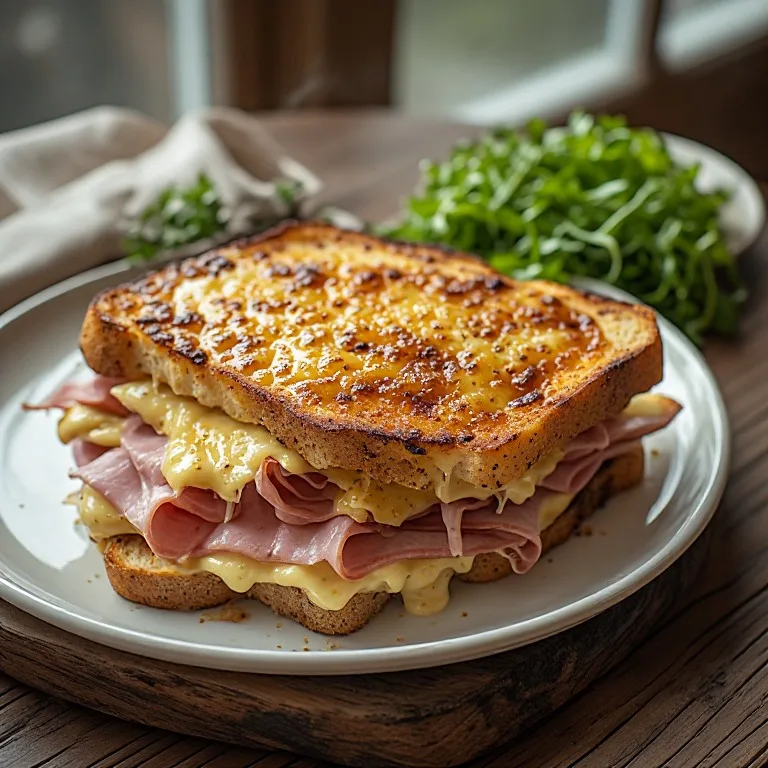
Quick answer: Make the béchamel first: melt 1.5 tablespoons of unsalted butter in a small heavy saucepan over medium heat, whisk in 2 tablespoons of all-purpose flour and cook, stirring constantly, for 2 to 3 minutes until the roux smells faintly nutty. Gradually whisk in 3/4 cup of warm whole milk, then stir over medium heat for another 3 to 4 minutes until the sauce is thick enough to pull away from the pan edges — pudding consistency. Remove from heat, stir in 1 teaspoon of Dijon mustard and 1/4 teaspoon of freshly grated nutmeg, and season with salt and white pepper. Set aside. Preheat the oven to 400°F. Toast 4 slices of pain de mie (3/4 inch thick) on a sheet pan for 5 minutes until just firm. Spread a thin layer of Dijon on one side of each slice. On 2 of the slices, lay 2 to 3 thin slices of jambon de Paris (French cooked ham) and a generous handful of hand-grated Gruyère. Spoon about 2 tablespoons of béchamel over the ham and cheese on each sandwich. Cap with the remaining slices, Dijon-side down. Return the assembled sandwiches to the sheet pan. Spoon the remaining béchamel thickly over the top of each sandwich — about 3 tablespoons per sandwich, covering the whole surface. Scatter a generous layer of hand-grated Gruyère over the béchamel. Bake at 400°F for 10 minutes until heated through and the edges are crisping. Switch to broil on high and broil for 2 to 3 minutes, watching constantly, until the top is deeply golden and bubbling. Serve immediately with frisée dressed in a sharp Dijon vinaigrette. At Balthazar, the croque monsieur is $23 on the breakfast menu; each homemade version costs roughly $5 to $7 in ingredients.

Balthazar Croque Monsieur (The SoHo Brasserie Classic, Made at Home)

Balthazar's croque monsieur uses jambon de Paris, hand-grated Gruyère, and a Dijon béchamel that goes both inside the sandwich and thick on top before broiling. Here's the full recipe, plus the three things most home versions skip.

Medium Prep: 15 min Cook: 20 min Total: 35 min2 servings ~$3.85/serving
Prep15 min
Cook20 min
Total35 min
Servings
2
At home~$3.85/serving
vs
Restaurant~$17.32/serving
You save ~78%

The Story Behind the Recipe

Balthazar's croque monsieur uses jambon de Paris, hand-grated Gruyère, and a Dijon béchamel that goes both inside the sandwich and thick on top before broiling. Here's the full recipe, plus the three things most home versions skip.

Nutrition Facts

Per serving (2 servings)
Calories670
Total Fat38g
Total Carbs40g
Dietary Fiber2g
Sugars5g
Protein36g
Sodium1080mg

* Estimated values based on standard recipe preparation. Actual values may vary.

Ingredients

  • For the béchamel

Instructions

💡
Pro tip: This recipe tastes even better the next day. The flavors need time to meld together in the fridge.
❄️
Storage: Keeps in an airtight container in the fridge for up to 2 weeks. Freezer-friendly for up to 3 months.
🎃 Free Halloween cookbook — download now The Copycat Halloween Cookbook A ready-made, photo-illustrated PDF of our best halloween copycat recipes — free to download, no building required. Pay what you want to support if you love it.

Free PDF — instant download. We'll also send new seasonal copycat recipes now and then; unsubscribe anytime. Or just download it →

Balthazar opened on April 21, 1997, in a former textile warehouse at 80 Spring Street in SoHo. Keith McNally — who had already opened Odeon and Café Luxembourg — built a French brasserie interior from scratch: 180 seats across high-backed red leather banquettes, scarred brass mirrors that made the room look like it had been there for fifty years, high tin ceilings, and a zinc bar. The restaurant also has its own bakery at the same address, which supplies the bread and pastries and sells to the public before the kitchen opens each morning.

The croque monsieur is $23 on the breakfast menu, served with mixed greens. It is not a signature dish the way the French onion soup has been analyzed and replicated. It’s a brasserie standard — on every menu at every comparable restaurant in France. What makes the Balthazar version worth replicating is that it’s done with the ingredients and technique those standards actually require, rather than shortcuts most home recipes make without realizing.

Three Things Most Croque Monsieur Recipes Get Wrong

Only béchamel on top, none inside. A proper brasserie croque monsieur has béchamel in two places: inside the sandwich (about 2 tablespoons spooned over the ham before the top bread slice goes on) and thick on top before broiling (about 3 tablespoons per sandwich). Most home recipes — and most online versions — skip the internal layer entirely and only sauce the outside. The result is a toasted ham-and-cheese sandwich under a sauced crust, which is not the same thing. The inside béchamel is what coats every bite through the interior, makes the Gruyère inside melt into something cohesive, and creates the indulgent quality that defines the dish. Without it, the interior is dry.

American deli ham instead of jambon de Paris. Balthazar’s menu lists “French ham” — jambon de Paris, the mild, cooked-and-pressed white ham that has no smoke, no brine assertiveness, and very little salt. Its purpose in the sandwich is to add a layer of clean savory protein without competing with the Gruyère and béchamel. Black Forest ham turns the sandwich into a different dish. Honey ham is too sweet against the Dijon and Gruyère. Regular American deli ham is too briny. Jambon de Paris lets the sauce and cheese lead; everything else fights them.

Pre-shredded Gruyère. Anti-caking agents in bagged cheese prevent proper melting. Under the broiler, pre-shredded Gruyère stays grainy and melts pale and uneven. Hand-grated from a block, Gruyère melts smooth and caramelizes into a deeply golden, slightly crunchy, bubbling crust — which is the whole point of the top layer.

The Ham

Jambon de Paris is available at Whole Foods (deli section, often labeled “uncured ham” or “Paris-style ham”), at specialty food stores, and from French deli suppliers online. Boar’s Head makes a product called Deluxe Ham that is mild and unsmoked and works well as a substitute. Any high-quality mild cooked ham with no smoke and no sweetness works.

Two to three thin slices per sandwich is correct. More than that and the inside becomes assertively salty; the ham’s flavor will push through the béchamel and Gruyère rather than sitting quietly underneath them.

The Béchamel Is the Dish

Remove the béchamel from a croque monsieur and you have a toasted ham and cheese. The sauce is not a condiment; it is the structural element that defines what the dish is and separates it from a panino or a melt.

For a clean, nutty béchamel with no raw-flour taste: cook the roux — the butter-and-flour mixture — for 2 to 3 minutes before the milk goes in. Most home recipes call for 30 to 60 seconds; the longer cook time is what burns off the floury flatness and develops the faint nuttiness that makes the sauce taste like food rather than a thickener. The roux should smell slightly toasted, not raw.

Add the milk in a thin, steady stream while whisking — not all at once. All at once creates lumps that are difficult to whisk out; thin stream while whisking creates an emulsion that thickens evenly. Target thickness: the sauce should pull away from the pan edges when you draw the spatula across the bottom, and should hold its shape when spooned. If it’s runny, it will slide off the top of the sandwich before it can caramelize under the broiler. If it’s too thick, a splash of milk and another minute of stirring over medium heat will loosen it.

The Dijon goes in off the heat — whisked into the finished sauce, not stirred in while it’s still cooking. Cooking drives off the volatile compounds that give Dijon its sharpness; added off the heat, it retains its characteristic sting and keeps the sauce tasting like something.

Inside and Outside

Divide the finished béchamel into roughly two portions: a smaller one (about 4 tablespoons total, 2 per sandwich) that goes inside, and a larger one (about 6 tablespoons total, 3 per sandwich) that goes on top.

For the inside: spoon the smaller portion over the ham and Gruyère before the top slice of bread goes on. It doesn’t need to be hot; room-temperature béchamel applied inside will heat through completely in the oven. The application doesn’t need to be precise — spread it roughly across the ham surface with the back of a spoon.

For the outside: once the sandwiches are assembled and back on the sheet pan, spoon the remaining béchamel over the top surface of each, covering the entire face so no dry bread is showing. Cover the béchamel with hand-grated Gruyère, enough to form a layer. This is what goes under the broiler and caramelizes.

The Broiler Is the Finishing Step

Ten minutes at 400°F heats the sandwich through and starts crisping the bread edges. The broiler is what finishes the top — blistering the Gruyère into a caramelized, deeply golden crust with a few spots of brown.

Broil on high, rack in the upper third, and watch without moving. The window between properly caramelized and burnt is around 30 to 45 seconds at full broiler temperature. The signal to pull: the Gruyère is deeply golden across most of the surface with real spots of caramelized color, the béchamel visible at the edges is beginning to color, and the bread perimeter is visibly crisped. Pull the moment that combination is there.

The béchamel under the crust should still be soft — not dried out. The crust is the exterior; the sauce underneath remains yielding.

The Salad Alongside

A dressed green salad is not optional decoration. The bitterness of frisée and the acid of a sharp Dijon vinaigrette cut through the fat of the béchamel and Gruyère and make the second half of the sandwich taste as good as the first. Without it, the richness accumulates.

A two-minute Dijon vinaigrette: 1 tablespoon Dijon, 1 tablespoon white wine vinegar, 3 tablespoons olive oil, a pinch of salt, whisked together. Dress the greens just before the sandwiches come out of the oven. Cornichons on the side — four or five small ones — do the same job if you’d rather skip the salad: their brine and crunch are the natural foil for a fat-rich sandwich.

Scaling

This recipe makes 2 sandwiches. The béchamel scales directly: double every quantity for 4 sandwiches. Made-ahead béchamel (up to 3 days in the refrigerator, plastic wrap pressed directly on the surface) means the active work is 15 minutes from start to plate. The sandwiches must be assembled and broiled fresh — assembled sandwiches sitting in béchamel on a counter soften.
Frequently Asked Questions

What is Balthazar and why is its croque monsieur worth replicating?

Balthazar is a French brasserie at 80 Spring Street in SoHo, Manhattan, opened by British restaurateur Keith McNally on April 21, 1997. It seats 180 across high-backed red leather banquettes under high tin ceilings and scarred brass mirrors — a French brasserie interior McNally built from scratch in a former textile warehouse, and one that became one of the most imitated restaurant rooms in the country. Balthazar has its own bakery at the same address, which supplies the restaurant's bread and pastries and also sells to the public. The croque monsieur — French ham, Gruyère, béchamel — is $23 on the breakfast menu and is one of the brasserie workhorses that has been there since 1997. It's worth replicating because it represents the ur-version of what a brasserie croque monsieur should be: classical technique, no shortcuts, and a specific ingredient set (jambon de Paris, pain de mie from their own bakery, Gruyère grated in-house) that most everyday versions don't bother with.

What is jambon de Paris and where do I find it?

Jambon de Paris — also called jambon blanc, or just French cooked ham — is a very mild, pale pink, cooked-and-pressed pork ham that has no smoke and very little brine. Its flavor is clean and delicate: mostly pork, slightly sweet, neutral enough that it functions as a background layer rather than a dominant flavor. This is the point. In a croque monsieur, the ham's job is to add a layer of savory protein and richness without competing with the Gruyère and béchamel — the two elements that are supposed to define the dish. American deli ham is too briny; Black Forest ham is too smoky; honey ham is too sweet; all three push the sandwich in the wrong direction. In the US, jambon de Paris is available at Whole Foods (often under the 'Uncured Ham' designation in the deli section), specialty food stores like Zabar's or Murray's Cheese Shop, and online from French deli suppliers. Boar's Head makes a style called 'Deluxe Ham' that is mild and unsmoked and works well as a substitute. If you cannot source jambon de Paris or an equivalent, any high-quality mild unsmoked cooked ham works; the sandwich will taste slightly different but still good. Just avoid anything smoked, heavily cured, or sweet.

Why does béchamel go inside the sandwich, not just on top?

A brasserie-quality croque monsieur has béchamel in two places: a layer inside the sandwich (between the ham and the top bread slice, about 2 tablespoons per sandwich) and a thick layer on top before broiling (about 3 tablespoons per sandwich). Most home recipes — and most online copycat versions — only apply béchamel to the top. Skipping the internal layer is the single thing that makes the finished sandwich feel dry and one-dimensional rather than indulgent when you bite through. The inside béchamel serves a different function than the outside béchamel: it coats the ham in sauce so every bite from the interior has that creamy, mustard-forward layer, and it helps the Gruyère inside the sandwich melt into something cohesive rather than a separate cheese slice. The outside béchamel is what caramelizes under the broiler into a browned, slightly crunchy crust. Both layers are present in a proper brasserie version; both are in this recipe.

What is the difference between croque monsieur and croque madame?

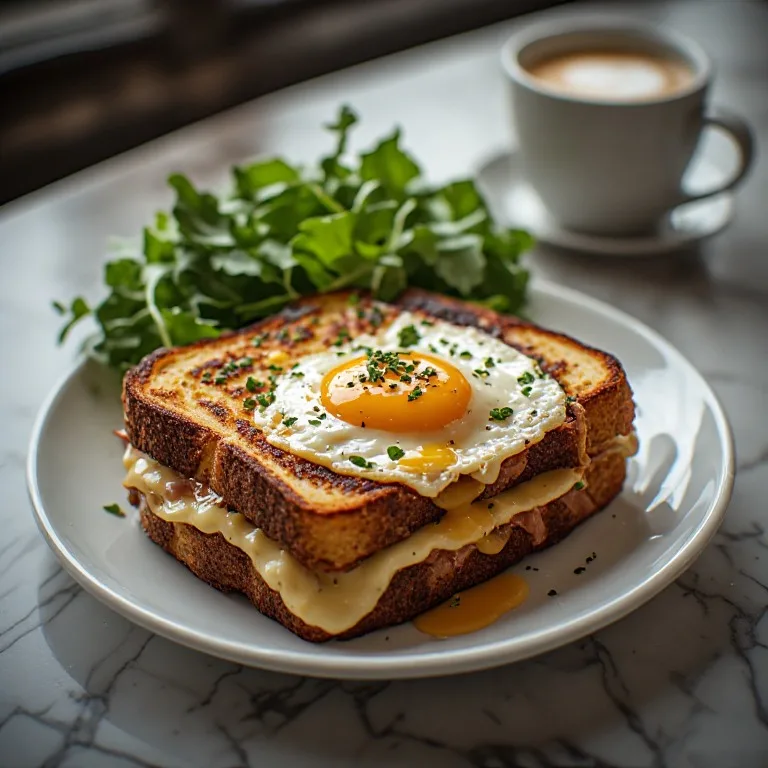
A croque monsieur is a hot French ham-and-cheese sandwich — pain de mie, ham, Gruyère, béchamel, broiled until the top caramelizes. A croque madame is the same sandwich with a fried egg placed on top. The name is a visual pun: the egg resembles a hat, and 'madame' implies the hat-wearing figure. In practice, the egg transforms the sandwich from a brasserie snack into a more substantial brunch plate — the yolk runs into the béchamel and bread when cut, adding another layer of richness. Balthazar serves both on its menu: the croque monsieur at $23 (breakfast) and the croque madame at $26 (brunch). This recipe makes the monsieur version — no egg. To make the madame, follow this recipe exactly and fry a sunny-side-up or over-easy egg in butter while the sandwiches are under the broiler; place it on top when serving.

What bread works best if I can't find pain de mie?

Pain de mie (Pullman bread) is the right choice: dense, fine-crumbed, slightly sweet, with no sourdough tang and a tight crust that holds up under the weight of the béchamel. Its structure is what makes it a brasserie bread choice — it absorbs the béchamel without collapsing, toasts to a firm edge while staying slightly soft inside, and keeps the sandwich from turning soggy before you can eat it. If you cannot find it: a thick-cut brioche loaf (not brioche rolls) is the best substitute, slightly richer. A firm, fine-crumbed white sandwich loaf — not the airy supermarket kind — works reasonably well. Avoid sourdough (the tang competes with the Dijon and Gruyère), ciabatta (the holes let béchamel fall through), and standard supermarket sandwich bread (too airy — soaks and collapses). Cut it yourself to 3/4 inch thick. Pre-toast the bread completely — 5 minutes at 400°F until the surfaces are dry and lightly golden — before assembling. Bread that goes into the sandwich soft and then sits under béchamel in a hot oven will steam and go mushy.

Can I make any of this ahead of time?

The béchamel keeps well in the refrigerator for up to 3 days, with a piece of plastic wrap pressed directly onto the surface to prevent a skin from forming. Reheat over low heat, stirring, with a splash of whole milk if it has thickened too much; it should spoon slowly and hold its shape. With the béchamel pre-made, the active work is 15 minutes: toast the bread, build the sandwiches, broil. The sandwiches themselves should always be assembled and broiled fresh — assembled sandwiches with béchamel on them soften quickly. The béchamel is the one component that benefits from being made in advance; the assembly and broiling cannot be.

Why hand-grated Gruyère? Can I use pre-shredded?

Pre-shredded cheese contains anti-caking agents — usually cellulose or potato starch — that coat each strand and prevent proper melting. When you try to broil pre-shredded Gruyère on top of béchamel, it stays grainy, melts unevenly, and produces a pale, flat crust instead of the deeply golden, bubbly, caramelized layer you want. Hand-grated Gruyère has no coating; it melts into a smooth, even layer and caramelizes under the broiler into the golden crust that is the whole point of the dish's top. A box grater (coarse side) and 5 minutes is the difference. Any genuine Gruyère from a block works; Emmental or Comté are acceptable substitutes with slightly different flavor profiles. Avoid domestic 'Swiss' cheese (which is a vague generic, not the same thing) and any cheese that says 'Swiss-style' — neither melts or browns correctly for this application.

What should I serve alongside?

At Balthazar, the croque monsieur comes with mixed greens. The salad is not decorative — the bitterness and acidity cut through the fat of the béchamel and Gruyère and make the second half of the sandwich taste as good as the first. A Dijon vinaigrette is the right dressing: 1 tablespoon Dijon, 1 tablespoon white wine vinegar, 3 tablespoons olive oil, salt and pepper, whisked together. Frisée, mâche, or any sturdy green with some bitterness works better than tender baby greens (which wilt too quickly on a warm plate). Cornichons on the side — 4 to 5 small ones per plate — serve a similar function if you want to skip the salad: the brine and crunch are a natural foil for the richness of the sandwich. A glass of Chablis or a sparkling water with lemon are the obvious drinks alongside.

Love this recipe? Share it!

Free PDF: our 12 most-wanted copycat recipes — instant download.

Made it? Buy us a coffee

Every recipe here is free, with no paywalls. If this one was a hit at your table, a small tip keeps new copycats coming.

$

Balthazar is a trademark of its owner, used here only to describe the dish this recipe recreates. This is an independent copycat written in our own words — Copycat Spices is not affiliated with, endorsed by or sponsored by Balthazar.

Ratings & Reviews

—
No ratings yet

Rate this recipe

Click a star to rate

Leave a Review

0/500

CS

Copycat Spices Editorial

Researched + fact-checked. Every recipe on Copycat Spices is built from published sources — official ingredient lists, brand-published recipes, interviews and food-science references — and fact-checked before it goes live, then written as clear, step-by-step instructions for home cooks of all skill levels.

Learn more about our mission →