


The French Onion Format, Applied to Chicken
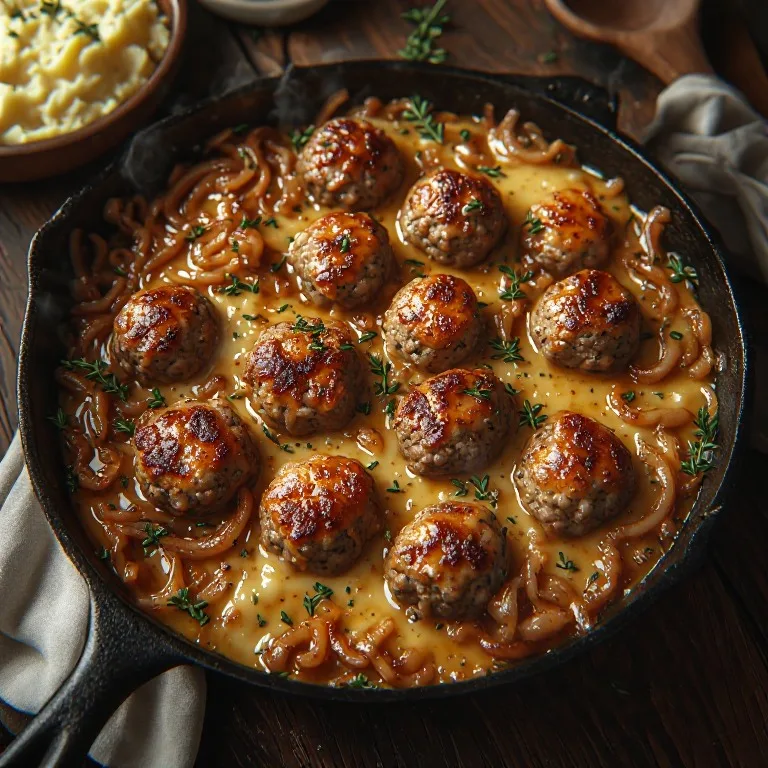
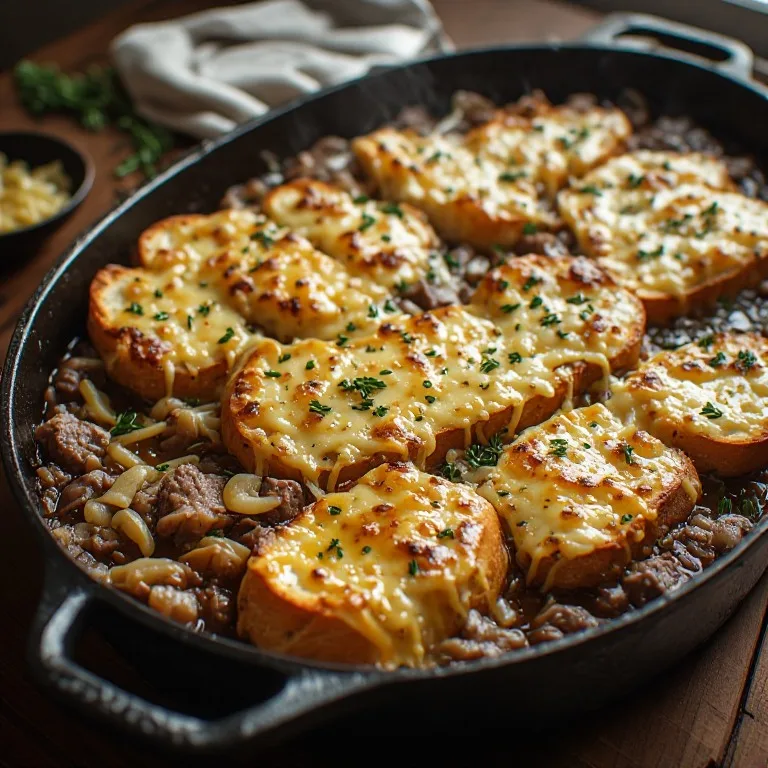
French onion meatballs went viral because the formula is almost perfect: a single skillet, caramelized onion broth, Gruyère under the broiler, and a result that photographs better than almost anything that takes under an hour to make.
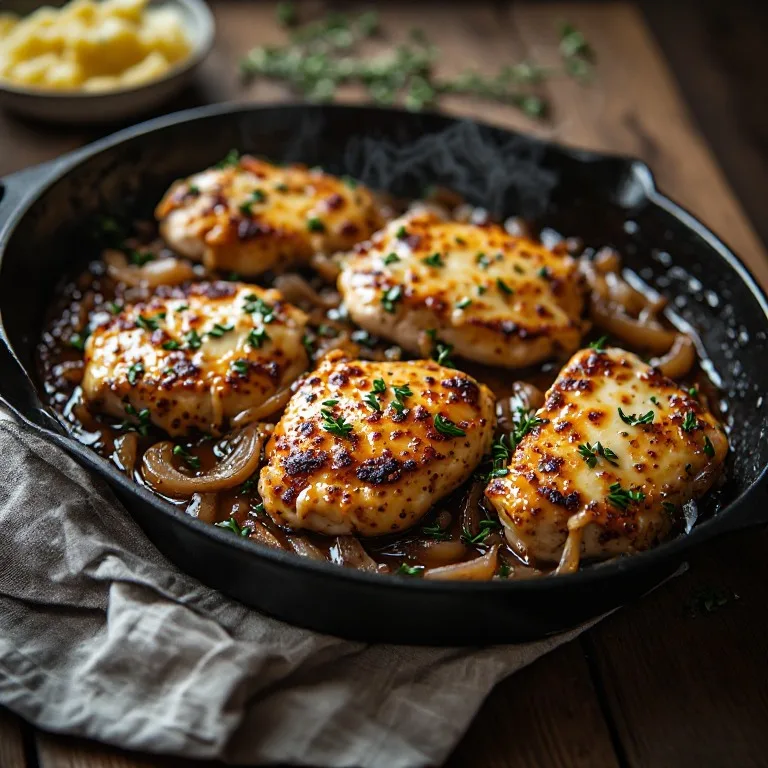
French Onion Chicken applies the same format to bone-in, skin-on chicken thighs — and it changes the recipe in three important ways.
First, the chicken sears skin-side down in a dry pan, rendering its own fat into the skillet. That fat becomes the foundation for caramelizing the onions, carrying chicken flavor into the sauce base from the very start. Second, the braise uses white wine instead of cognac — chicken is lighter than beef, and the brightness of a dry Chardonnay or Sauvignon Blanc cuts through the onion sweetness more cleanly than the dark fruit of cognac. Third, the chicken goes back into the pan skin-side up, with the skin sitting above the broth level. Under the broiler, the Gruyère melts over skin that is still partially crisp — a different texture payoff than the meatball version, which goes entirely into the sauce.
The TikTok visual: when you pull the cheese-broiled skillet from the oven, the Gruyère has formed a golden crust over the chicken. Break through it with a spoon and the dark caramelized onion broth pools out around the chicken. That reveal is the reason this dish works in 15 seconds of video.
Dry Pan Searing: Why No Oil
Most chicken recipes call for heating oil first and adding the chicken to a slicked pan. This recipe does the opposite: the chicken goes into a hot, completely dry cast iron skillet, skin-side down.
The reason is fat content. Bone-in, skin-on chicken thighs are already well-marbled, and the skin carries a significant fat reservoir. When you place the skin directly on a hot, dry surface, the heat begins rendering the fat out of the skin within the first minute. That rendered fat pools in the pan and essentially fries the skin from below as it renders — producing a crispness and color you cannot get if the pan is pre-oiled, because oil-in-oil does not produce the same browning rate as fat-rendering-into-a-dry-pan.
The other benefit: rendered chicken fat in the pan carries concentrated chicken flavor. When the onions go in after the sear, they cook in that fat — picking up the chicken’s Maillard compounds and incorporating them into the sauce base before you have added a single drop of liquid.
Heat the dry skillet over medium-high until it is hot throughout, about 2 minutes, then lay the thighs in skin-side down. Press each thigh down for 30 seconds to ensure full skin contact. Then leave it alone for 8 to 10 minutes. The skin will stick and resist being lifted — that is correct. It releases on its own when the crust is fully formed. Forcing it off early tears the skin.
The Onion Caramelization: Forty Minutes of Patience
The most common mistake in French onion cooking of any kind is pulling the onions too early. Pale golden onions are not caramelized — they are softened. The Maillard reaction and caramelization that produce the deep, savory-sweet compounds you want only begin in earnest after the onions have lost most of their water and the temperature of the onion surfaces rises above what is possible when moisture is still evaporating.
In a 12-inch skillet over medium-low heat, properly caramelized onions take 35 to 40 minutes. There is no shortcut that produces equivalent flavor. Adding baking soda speeds browning but produces a mushy texture and a different, soapy flavor. High heat produces burnt spots before the interior softens.
The timeline:
- 0 to 15 min: Onions look pale and unchanged. This is fine. They are softening and releasing moisture.
- 15 to 25 min: Onions begin to collapse and turn faintly golden. Stir every 5 minutes.
- 25 to 35 min: Golden and deepening. The pan bottom may begin to show dark spots — add a tablespoon of water and scrape them up. This is fond, not burning, and it dissolves into flavor.
- 35 to 40 min: Deep mahogany. Intensely fragrant. The volume has reduced to about a third of the original. This is the target.
For a guide on caramelizing onions as a standalone technique, see the how-to-caramelize-onions guide.
Why Beef Broth, Not Chicken Stock
This is not a matter of preference. French onion soup gets its characteristic depth from beef broth — specifically from the glutamates and color compounds in a reduced beef stock that make the liquid dark, savory, and umami-forward. Swapping to chicken stock produces a lighter-colored, thinner-tasting sauce that lacks the identity of the dish. It tastes like chicken in onion gravy — which is a different and less interesting thing.
Low-sodium beef broth from a carton (Swanson, Pacific Foods, Kitchen Basics) works well. A high-quality beef bone broth gives even deeper body. If you want to approximate a restaurant-quality depth: combine ¾ cup beef broth with ¼ cup water and 1 teaspoon beef Better Than Bouillon dissolved together — this is what many restaurant kitchens use to intensify commercial broth.
The one-cup measurement in this recipe produces a sauce that is thin enough to ladle over mashed potatoes and coat the plate. If you want a thicker sauce, stir 1 teaspoon of all-purpose flour into the caramelized onions before adding the broth and let the mixture cook 1 minute before the liquid goes in.
The Faster TikTok Cutlet Version
The version that circulates most widely on TikTok — and is the fastest to cook — uses boneless, skinless chicken breast cutlets rather than bone-in thighs. Each large breast is cut in half lengthwise and pounded to a uniform half-inch thickness. The four resulting cutlets fit flat in the pan, cook through in 8 to 10 minutes of stovetop simmering in the sauce (no oven needed), and produce a version of this dish that goes from raw ingredients to table in about 40 minutes.
The tradeoff: boneless breasts have no rendered fat to build the sauce base, so you rely entirely on butter for caramelizing the onions. They also have less margin for error — at 165°F they are exactly done; at 175°F they are dry. A thermometer is essential.
If you want the faster version: skip steps 1 and 3. Season and sear the cutlets 2 to 3 minutes per side over medium-high in 1 tablespoon of butter or oil, just until golden (they will cook through in the sauce later). Remove, caramelize the onions in 2 tablespoons of butter, deglaze, add broth. Return the cutlets skin-side up (there is no skin — just nestle them in). Simmer uncovered on medium-low for 8 to 10 minutes to 165°F. Top with Gruyère and broil.
This bone-in thigh version in the main recipe produces a richer, more deeply flavored dish with better texture and more forgiveness.
Four Ways to Change It Up
Mushroom French onion chicken. Once the onions reach golden (around the 25-minute mark), add 8 oz of sliced cremini mushrooms and cook 5 more minutes before deglazing. The mushrooms deepen the savory side of the sauce and add a meaty bite — a good move if an all-onion sauce tastes too sweet to you.
Baked, no-sear (hands-off). Skip the stovetop sear entirely. Caramelize the onions separately in butter, deglaze with wine, add the beef broth and thyme, then pour the mixture over seasoned bone-in thighs arranged skin-up in a baking dish. Bake uncovered at 400°F for 35 to 40 minutes, top with Gruyère, and broil 3 to 4 minutes. You give up the crisp skin and the seared fond, but the oven does all the work.
Slow cooker. Caramelize the onions on the stovetop first — a slow cooker holds too much moisture to brown them — then transfer everything with the chicken to the cooker. Cook on LOW 5 to 6 hours or HIGH 3 to 4 hours, move the thighs to a broiler-safe dish, top with cheese, and broil to finish.
Chicken-and-noodle skillet. After braising, pull the meat off the bone, shred it back into the sauce, and toss with 8 oz of cooked egg noodles or pappardelle. Top with Gruyère and run it under the broiler. This is a broth-forward pasta — distinct from the cream-based French onion soup pasta on this site.
White Wine Over Cognac
The French Onion Meatballs on this site deglaze with cognac, and for good reason — beef and cognac share dark, rich, caramel-adjacent flavors that reinforce each other. Chicken requires a different approach.
Chicken is leaner, milder in flavor, and produces a lighter broth. The caramelized onions already bring substantial sweetness to the sauce. Adding cognac or sherry at this point builds more sweetness and more heaviness — the sauce starts to taste more like dessert than dinner.
Dry white wine does the opposite: its acidity cuts through the onion sweetness, its fruitiness adds complexity without adding richness, and it evaporates cleanly, leaving a broth with brightness that balances the cheese.
Use a wine you would drink. Chardonnay, Sauvignon Blanc, or dry Pinot Gris all work. Dry vermouth (Noilly Prat or Dolin dry) is an excellent pantry option — it keeps for months in the refrigerator, and its herbal notes complement thyme well. Do not use cooking wine, which contains salt, or sweet whites like Riesling, which push the sauce over into sweetness.
Non-alcohol option: an additional ¼ cup of chicken stock plus 1 teaspoon of white wine vinegar. The vinegar replaces the wine’s acidity.
Keeping the Skin Crisp
The chicken’s skin position when it returns to the pan determines the texture at the end of the dish.
Skin-side down — submerged in the onion broth — produces soggy skin that no amount of broiling can fix. The liquid softens the collagen in the skin during the 20-minute braise, and there is not enough heat from the broiler to restore crispness from that state.
Skin-side up — with the skin sitting above the broth level — allows the broth to braise the meat from below and the sides while the oven’s dry heat circulates over the skin. By the time the cheese goes on, the skin is still partially firm. The broiler finishes it: the Gruyère melts over the skin and the cheese’s fat crisps slightly where it contacts the skin surface.
“Partially submerged” is the target: push the chicken thighs down until the meat side is in contact with the broth but the skin is above the liquid line. In a 12-inch skillet with 4 thighs and about 1.5 cups of total liquid, this happens naturally — there is not enough broth to cover the skin.
The Four Failure Modes
1. Soggy, pale skin. The chicken went in skin-down into the broth. The solution is positioning — skin must stay above the liquid for the entire braise. If you are already at the end of the braise with soggy skin, remove the chicken to a wire rack, pat the skin dry, brush with a little melted butter, and broil the bare skin for 3 to 4 minutes before adding the cheese.
2. Flat, sweet sauce. The onions caramelized correctly (good), but the broth lacks savory backbone. Add Worcestershire in small amounts — it contributes umami depth without tasting like Worcestershire in the finished dish. A drop of balsamic vinegar or soy sauce works the same way.
3. Dry, stringy chicken. Either the oven temperature was too high, the braise ran too long, or you used boneless chicken breasts without adjusting timing. Bone-in thighs are almost impossible to ruin at 375°F — the bone insulates the meat and the thigh’s high fat content buffers against dryness. If you used breasts, pull at 160°F and rest for 5 minutes.
4. Cheese did not brown. Either the oven rack was too far from the broiler element (should be 6 to 8 inches), the broiler did not preheat fully, or pre-shredded cheese with anti-caking agents was used. Freshly grated Gruyère from a block browns correctly under a properly preheated broiler in 3 to 4 minutes.
French Onion Chicken vs. Meatballs vs. Soup Pasta
These three recipes share the caramelized onion broth and Gruyère but are structurally different in ways that matter for planning:
French Onion Chicken (this recipe): Braised whole bone-in pieces, white wine broth, skin crisps under cheese. The chicken stays in one piece on the plate. Best served over mashed potato or with crusty bread.
French Onion Meatballs: Beef and pork, cognac-deglazed, meatballs fully submerged in the braise and covered with cheese. The sauce is richer and sweeter. Best over egg noodles or mashed potato. Requires forming meatballs (15 min more prep).
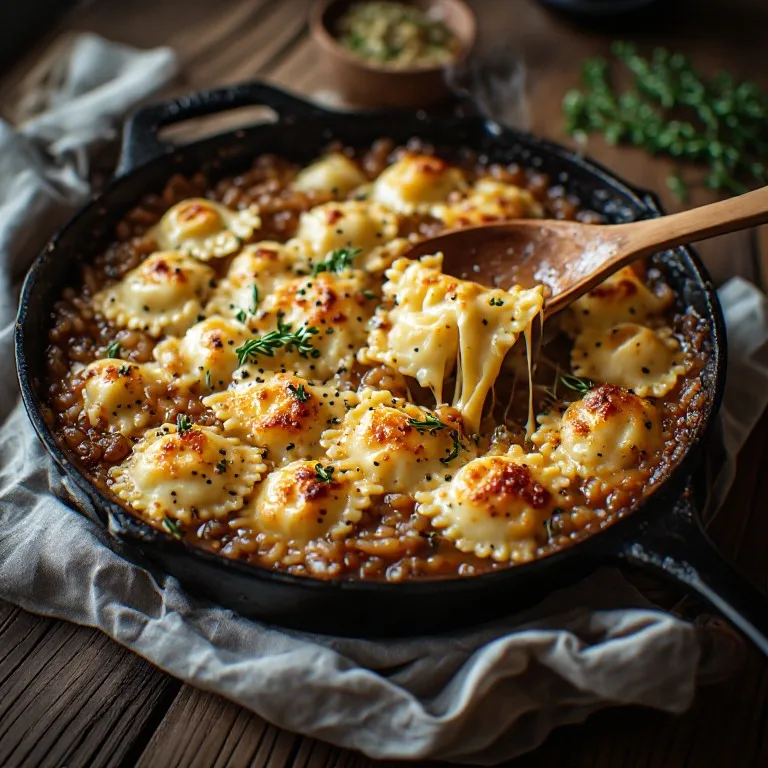
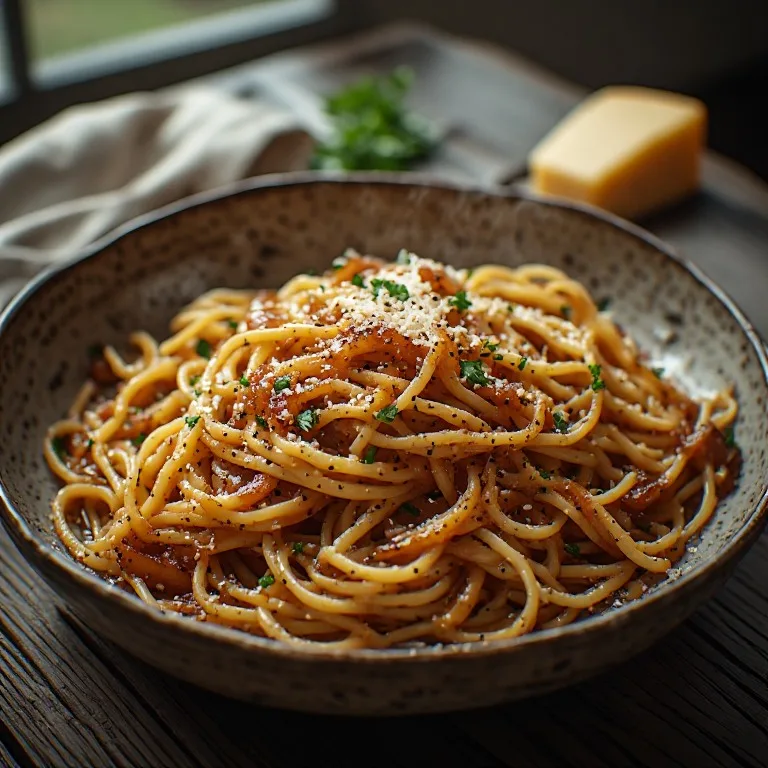
French Onion Soup Pasta: Cream-based, no protein in the base recipe, cheese whisked into the sauce rather than broiled on top. More like a French onion Alfredo than a braise. Fastest of the three — about 40 minutes total. See French Onion Soup Pasta and French Onion Meatballs.
Storage and Reheating
The chicken and onion broth refrigerate together for up to 3 days — the flavors deepen and the sauce becomes more cohesive overnight.
To reheat: Place the covered skillet over medium-low heat for 8 to 10 minutes until the chicken is warmed through and the sauce is simmering gently. Scatter fresh Gruyère over the chicken and broil for 3 to 4 minutes just before serving. The skin will not re-crisp fully from refrigerated, but the sauce will be noticeably better than the day you made it.
Freezing is not ideal for the chicken pieces — the texture changes after freezing and thawing. The onion broth alone freezes well for up to 3 months and makes an excellent base for French onion soup.