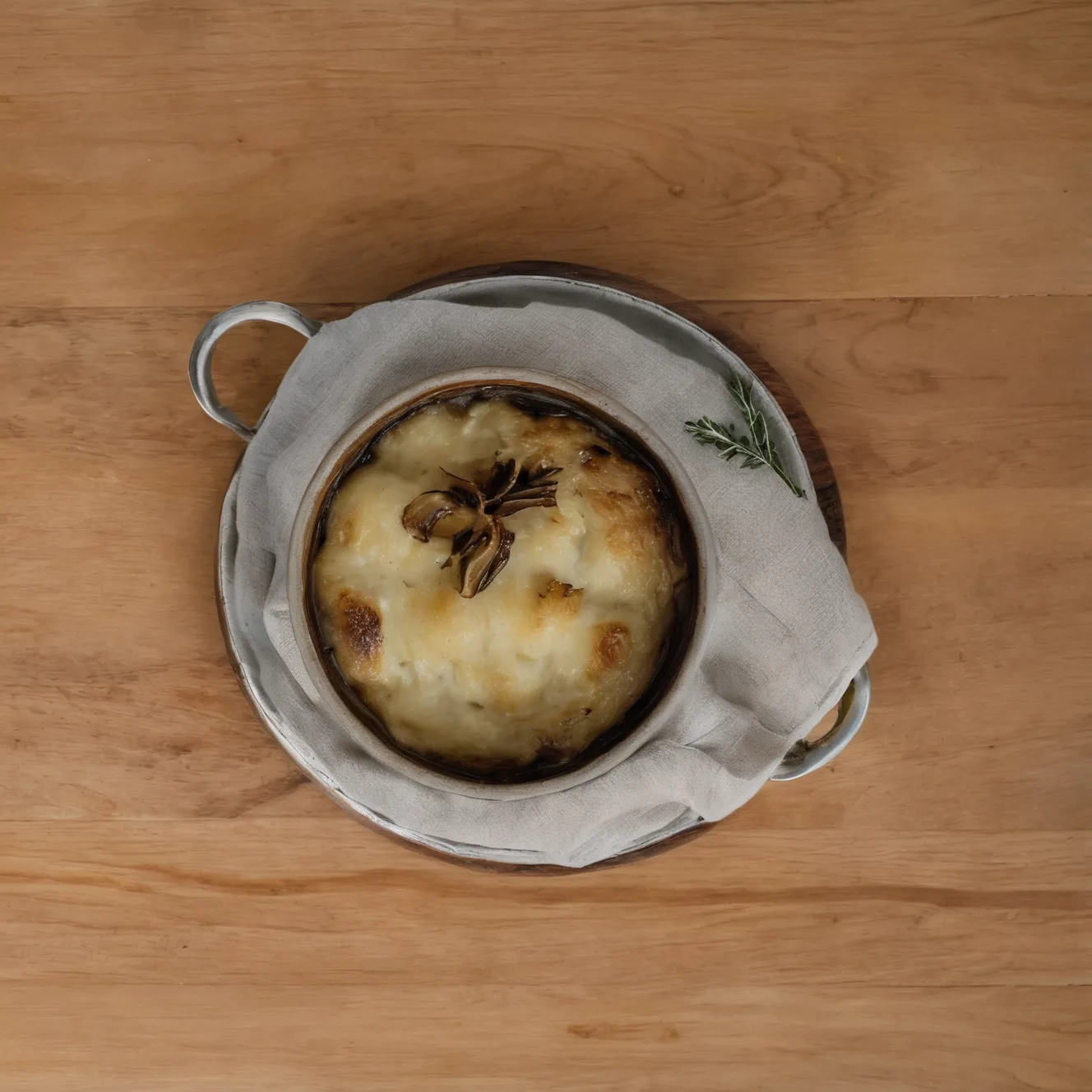
Panera’s Bistro French Onion Soup sits on the menu year-round, but most people only notice it once the weather turns. It’s one of the chain’s more technically interesting soups — not because French onion soup is complicated, but because Panera’s version makes deliberate departures from the classic that aren’t obvious until you look at the ingredient list. Chicken stock instead of beef. Gruyère instead of the old Asiago-Parmesan. A sherry wine vinegar gastrique buried in the broth that almost no copycat recipe replicates. Here’s what’s actually in it, how the nutrition breaks down, and how to make it at home.
TL;DR
Panera Bistro French Onion Soup: year-round, not vegetarian (chicken stock + chicken flavor), topped with Gruyère cheese and black pepper focaccia croutons. Cup is ~230 cal / 8g protein / 960mg sodium; bowl is ~380 cal / 13g protein / 1,500mg sodium. The two things most copycat recipes get wrong: (1) skipping the gastrique (sugar + sherry vinegar + tomato concentrate = the tartness and mahogany color), and (2) rushing the onion caramelization. The onions need 45–60 minutes. Everything else is straightforward.
What Makes Panera’s Bistro French Onion Soup Different
The 2016 “Bistro” rebrand changed two visible things — Gruyère replaced the Asiago-Parmesan crouton topping, and black pepper focaccia croutons replaced whatever was there before. But the official ingredient statement reveals the more interesting details.
Chicken stock, not beef. Classic French onion soup is always beef-based — the richness of a long-simmered beef stock is part of what makes the dish satisfying. Panera uses chicken stock and natural chicken flavor. The result is lighter and less intensely savory than a traditional French restaurant preparation. The depth comes from the caramelized onions themselves, the gastrique, and the soy sauce — not the broth.
A gastrique in the broth. Panera’s ingredient list includes gastrique made from sugar, tomato concentrate, sherry wine vinegar, and caramel. A gastrique is a classical French sweet-and-sour reduction — it adds tartness that cuts through the butter and cream, deepens the broth color to mahogany, and creates a complexity that makes the soup taste like it’s been simmering longer than it has. This is the ingredient that almost no copycat recipe mentions. A simplified version takes 3 minutes and uses pantry staples.
Tomato sauce in the broth. Panera adds tomato sauce (tomatoes, salt, onion powder, garlic powder, red pepper, citric acid) to the soup base. It contributes body and umami without making the soup taste tomato-forward. Combined with the tomato paste in the gastrique, it gives the broth a subtle savory depth.
Soy sauce. Soy sauce in French onion soup sounds wrong but works well — it adds glutamate-driven umami that reads as “beefiness” even in a chicken stock base. It’s a practical shortcut that explains how Panera gets so much savory depth from chicken broth.
Nutrition and Allergens
| Cup (approx. 8 oz) | Bowl (approx. 12 oz) | |
|---|---|---|
| Calories | ~230 | ~380 |
| Fat | 10g | 17g |
| Saturated Fat | 4.5g | 7g |
| Protein | 8g | 13g |
| Carbohydrates | 28g | 46g |
| Fiber | 2g | 4g |
| Sugar | 9g | 13g |
| Sodium | 960mg | 1,500mg |
Sodium is the main thing to watch: the bowl at 1,500mg is roughly two-thirds of the daily recommended limit. The bread bowl version (not a separate product — it’s the bowl served in a sourdough bread bowl) comes in around 900 calories once you account for the bread.
Allergens: Contains gluten (focaccia croutons, wheat in the soy sauce), dairy (butter, cream, Gruyère), and soy. Does not contain eggs, fish, shellfish, peanuts, or tree nuts per Panera’s allergen statement. Not vegetarian — chicken stock is in the base.
The Caramelization Problem
Every recipe that rushes the onions fails. Panera’s broth has a specific sweetness and depth that comes from fully caramelized onions — not golden-blonde sautéed onions. The difference is 20 minutes versus 45–60 minutes, and it matters enormously.
At 20 minutes over medium heat, onions are soft and pale gold. Their water content has partially evaporated, but the sugars haven’t had time to fully break down. The flavor is sweet but one-dimensional.
At 45–60 minutes over medium-low heat, the onions are dark mahogany, jammy, and reduced to about a quarter of their raw volume. The Maillard reaction has created hundreds of flavor compounds. They taste sweet, savory, slightly bitter, and complex all at once — the foundation the rest of the soup builds on.
The practical rule: if your onions don’t look nearly burnt and aren’t sticky enough to pull into threads when you press them with a spoon, they need more time.
The Gastrique: 3 Minutes, Outsized Impact
The gastrique is the step most people skip because it sounds technical. It isn’t. You need:
- 2 tablespoons sugar
- 2 tablespoons sherry wine vinegar (or red wine vinegar)
- 1 tablespoon tomato paste
Combine in a small saucepan over medium heat. Stir for 2–3 minutes until the sugar dissolves and the mixture thickens slightly. Done. This goes into the broth and does two things: adds a tart, slightly fruity counterpoint to the sweet onions, and gives the broth a deeper, darker color. Without it, the soup tastes flat and looks anemic.
One shopping note: sherry wine vinegar is not the same as sherry cooking wine. You want the vinegar — it’s in the vinegar aisle, not with the cooking wines. If you can’t find it, red wine vinegar is the closest substitute. Balsamic works in a pinch but adds more sweetness and a slightly different character.
The Gruyère and Focaccia Details
Gruyère, freshly shredded. Pre-shredded cheese contains anti-caking agents (usually cellulose or starch) that prevent it from melting cleanly under the broiler — you get a grainy, uneven result instead of the smooth, bubbly crust. Buy a block of Gruyère and shred it yourself on the large holes of a box grater. You need about 1.5 oz (1/3 cup loosely packed) per bowl.
If Gruyère isn’t available, Swiss or Comté are accurate substitutes. Fontina melts beautifully but tastes milder. Skip mozzarella — it doesn’t have enough flavor for this dish.
Black pepper focaccia croutons. Panera doesn’t put a baguette slice on top — they use focaccia cut into croutons and seasoned with black pepper. This matters for texture: the croutons stay distinct and crunchy rather than going fully soggy in the broth. Cut focaccia into 1-inch cubes, toss with olive oil and cracked black pepper, bake at 375°F for 12–15 minutes. Add them after broiling so they keep their crunch.
Making It at Home vs. Ordering
| Panera restaurant | Homemade (this recipe) | |
|---|---|---|
| Cup / Serving | ~230 cal / 960mg sodium | ~390 cal / ~820mg sodium |
| Bowl / Serving | ~380 cal / 1,500mg sodium | Same recipe, larger ladle |
| Price | $8–9 for a cup | ~$3.50/serving (4 servings) |
| Time | On demand | 65 minutes (mostly hands-off) |
The homemade version has slightly more calories per serving (larger portion, no portion control), but significantly lower sodium because you use low-sodium chicken broth and control the salt. The flavor is richer because fresh-caramelized onions are never as caramelized in a chain kitchen environment.
More Panera Soups
Every Panera soup on the site, if you want to compare:
- Copycat Panera Broccoli Cheddar Soup — the chain’s most popular soup, bright yellow-orange with visible vegetable pieces
- Copycat Panera Tomato Soup — creamy, slightly sweet, the one Panera is most famous for
- Copycat Panera Chicken Noodle Soup — classic; lower-sodium than most Panera soups
- Copycat Panera Lemon Chicken Orzo Soup — bright and acidic, lighter than the creamy soups
- Copycat Panera Autumn Squash Soup — fall seasonal, sweet and aromatic
- Panera Bread Bowl — how to make the sourdough bowl at home
If French onion is your thing, the viral TikTok French Onion Soup Pasta takes the same caramelized-onion base and folds it into baked pasta — a different format, but the same technique.