


Pin It

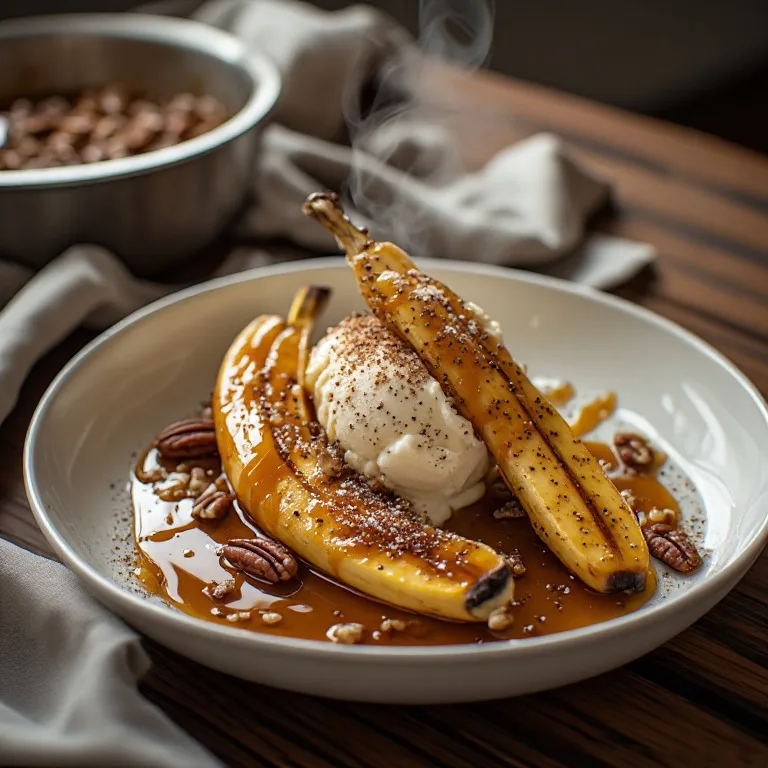
Brennan's Bananas Foster

Brennan's Bananas Foster
Jump to Recipe
Prep 5 min Cook 10 min Serves 4
Quick answer: In a wide stainless-steel or cast-iron skillet over medium heat, melt 4 tablespoons unsalted butter. Add 1 cup packed dark brown sugar and 1/2 teaspoon ground cinnamon. Stir until the sugar dissolves and the sauce bubbles steadily, about 3 minutes. Stir in 1/4 cup banana liqueur. Peel 4 firm-ripe bananas, cut each in half lengthwise then crosswise (16 pieces total), and lay them cut-side down in the sauce. Cook until they just begin to soften and color, about 2 minutes. Turn them gently. Pour 1/4 cup dark rum into the pan — do not stir it, let it pool on the surface. Let the rum warm for 30 seconds until you see steam rising. Tilt the pan toward a gas burner flame, or use a long utility lighter, to ignite. Blue flame runs across the sauce; swirl the pan gently and let it die naturally, 1 to 2 minutes. Immediately place 4 banana pieces over each scoop of vanilla ice cream and spoon the hot sauce generously on top. The sauce needs to hit the ice cream while hot — that melting edge is the point. Serve at once.

Shop the tools

Gear matched to this recipe. These are Amazon affiliate links — we may earn a small commission if you buy, at no extra cost to you.

As an Amazon Associate, Copycat Spices earns from qualifying purchases. Product images are generic illustrations, not the exact item listed.

Brennan's Bananas Foster

Brennan's invented Bananas Foster in 1951 — 75 years on, the tableside flambe is still one of the most theatrical desserts in America. Butter, brown sugar, cinnamon, banana liqueur, and dark rum over ripe bananas, ignited and spooned over cold vanilla ice cream. The restaurant charges $22 per serving. At home: about $4.

Easy Prep: 5 min Cook: 10 min Total: 15 min4 servings ~$2.45/serving
Prep5 min
Cook10 min
Total15 min
Servings
4
At home~$2.45/serving
vs
Restaurant~$11.02/serving
You save ~78%

The Story Behind the Recipe

Brennan's invented Bananas Foster in 1951 for a practical reason: New Orleans was the largest banana port in the United States, and the restaurant had an abundance of cheap, ripe bananas. Owner Owen Brennan asked his chef, Paul Blangé, to build a new dessert around them. The result was named for Richard Foster, a Brennan family friend and local businessman who'd just been appointed chairman of the city's Crime Commission. The dish — butter, brown sugar, cinnamon, banana liqueur, and dark rum, ignited tableside — hasn't changed in the 75 years since. Brennan's now uses roughly 35,000 pounds of bananas a year and has served the dish over 2 million times.

At the restaurant on Royal Street in the French Quarter, the tableside flambe is performed in the dining room by your server and is the most-ordered item on the menu. A single serving runs about $22. At home the four-ingredient sauce costs roughly $4 per serving — the main expense is the ice cream. The technique that matters most is temperature: the ice cream bowls should come out of the freezer the moment the flames die, the sauce should go on while it's still hot, and the dish should be on the table within 90 seconds. That contrast — hot caramelized sauce beginning to melt cold ice cream from below — is the entire point of the recipe.

Nutrition Facts

Per serving (4 servings)
Calories560
Total Fat18g
Total Carbs88g
Dietary Fiber2g
Sugars72g
Protein4g
Sodium85mg

* Estimated values based on standard recipe preparation. Actual values may vary.

Ingredients

Instructions

💡
Pro tip: This recipe tastes even better the next day. The flavors need time to meld together in the fridge.
❄️
Storage: Keeps in an airtight container in the fridge for up to 2 weeks. Freezer-friendly for up to 3 months.
🎃 Free Halloween cookbook — download now The Copycat Halloween Cookbook A ready-made, photo-illustrated PDF of our best halloween copycat recipes — free to download, no building required. Pay what you want to support if you love it.

Free PDF — instant download. We'll also send new seasonal copycat recipes now and then; unsubscribe anytime. Or just download it →

Bananas Foster is the rare dish where the recipe has never changed and probably never should. Brennan’s built the original in 1951 and has made it the same way ever since: butter and brown sugar, cinnamon, banana liqueur over ripe bananas, then rum ignited tableside in a pan that goes straight to the dining room table. There’s nothing to tweak, no variation that improves it, no technique upgrade the 21st century offers. The dish is the flambe.

2026 marks the 75th anniversary. Over 2 million servings. 35,000 pounds of bananas a year. One recipe.

What actually happens when you flambe rum

The blue flame you see when rum ignites is ethanol combustion — the alcohol vaporizes off the surface of the hot sauce and burns. It looks dramatic but extinguishes in under two minutes because there’s only 1/4 cup of rum in the pan. What’s left behind is the rum’s flavor without the harsh raw-alcohol edge. The caramel, the molasses, the faint oak from barrel aging — those stay. What burns off is the astringency.

Home cooks sometimes skip the flambe or fail to get the rum to ignite, then assume the result is basically the same. It isn’t quite. The unflambeed version has a slightly sharp finish that 2 extra minutes of cooking partially addresses but never fully resolves. The flambe is also what reseals the sauce’s surface and creates the slight smoky depth that shows up in every tasting note for the original dish. The theater matters, but so does the chemistry.

The bananas are the ingredient most people get wrong

Brennan’s uses firm-ripe bananas, and this is not a flexible specification. Yellow with light brown speckles, bending slightly under pressure but not soft — that’s the target. An overripe banana (all brown, very soft) disintegrates into the sauce in about 45 seconds and produces a mushy, formless result. The dish stops being Bananas Foster and becomes warm banana pudding, which is fine but not what you’re making.

Underripe bananas (still greenish at the tips or fully yellow with no spots) are too starchy and never develop the right sweetness in the short cook time.

Plan your banana timing deliberately. If your bananas are at the right stage today, make this today. If they’re slightly green, leave them on the counter one more day uncovered — check them in 24 hours.

Why the ice cream needs to be in the freezer during the flambe

The entire experience of Bananas Foster is thermal contrast: hot, barely-set caramel meeting cold, semi-firm ice cream. The sauce begins to melt the ice cream from underneath the moment it touches it, creating a zone of caramel-flavored soft cream at the edge of each scoop. If the ice cream has been sitting at room temperature even for five minutes while you cook the sauce, it’s already partially melted, and that soft-to-liquid transition happens instantly instead of visibly.

Scoop into frozen bowls before you turn on the stove. Pull from the freezer the moment the flames die. Move fast — the sauce cools quickly once off the heat, and it needs to hit the ice cream while it still has enough heat to cause that partial melt.

Scaling up for a party

The recipe scales cleanly to 8 or 12 servings — just double or triple the quantities. Use a larger pan (a 14-inch or a wide sauté pan) so the bananas still fit in a single layer. The flambe step is the same; more sauce means slightly longer burn time. If you’re serving 8 or more guests, have all the ice cream scooped and sitting in the freezer well before you start the sauce, so you can plate all 8 portions in under 2 minutes. Bananas Foster does not wait.

More New Orleans at home

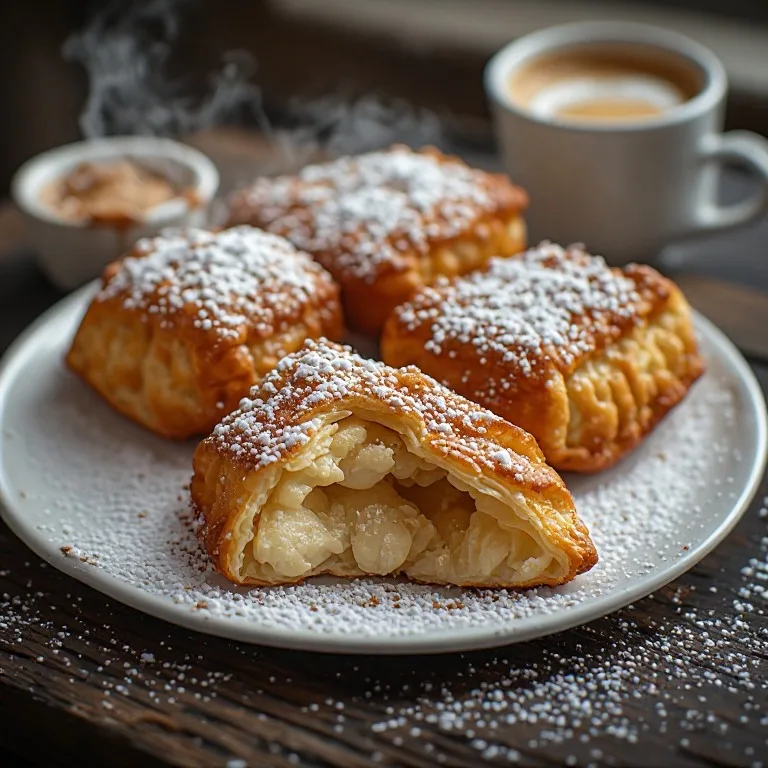
If you’re building a French Quarter dinner, the dessert has natural company. Our Café du Monde beignets recreate the square, powdered-sugar-buried fritters served around the clock at the Decatur Street stand — the other dessert every visitor to New Orleans tracks down. For the savory side, the Ruth’s Chris New Orleans–style BBQ shrimp is the Worcestershire-and-butter skillet dish that has nothing to do with barbecue and everything to do with the city’s love of a rich pan sauce — and, like Bananas Foster, it’s finished in minutes right before serving.
🥗

Make It Healthier

Love Brennan's Bananas Foster but want a lighter version? Try these simple swaps:

  • ✓Reduce brown sugar to 3/4 cup and add 1/4 teaspoon pure vanilla extract to compensate — the sauce thins slightly but still coats the bananas, saving about 75 calories per serving
  • ✓Use 3 tablespoons of butter instead of 4 — the difference in richness is minimal and saves about 25 calories
  • ✓Substitute a premium low-fat frozen yogurt (Stonyfield Organic or Chobani) for ice cream — saves 40 to 50 calories with only slight textural difference; the tangy edge actually pairs well with the rum sauce
  • ✓Serve 3 banana pieces instead of 4 and use a slightly smaller ice cream scoop — the sauce and flambe are the centerpiece anyway; the portions are generous as written

Frequently Asked Questions

What is banana liqueur and can I skip it in the Brennan's Bananas Foster recipe?

Banana liqueur is a sweet, clear liqueur with concentrated banana flavor — the most common brands are Crème de Banane (French-style, rich and sweet) and 99 Bananas (American-style, brighter and more straightforward). At Brennan's it is the first liquid added after the butter-and-sugar base, and it serves two purposes: it adds a layer of banana depth that is separate from the fresh fruit, and it thins the sauce slightly so it stays pourable. You can skip it, but the sauce will be thicker and more purely caramel in character — closer to a bananas foster-flavored butterscotch than the layered thing Brennan's makes. If you omit it, reduce the rum to 3 tablespoons to keep the alcohol level similar, and add 1/4 teaspoon pure banana extract with the rum for some of the flavor back. Banana liqueur is sold at most liquor stores; a small bottle (375ml) costs about $10 and will last for many batches.

Should I use 151-proof rum or 80-proof rum?

The Brennan's recipe calls for dark rum, which at the restaurant is typically a standard 80-proof bottle (Flor de Caña 7, Appleton Estate, or Mount Gay are all appropriate). 80-proof rum does ignite, but the flame is smaller, lower, and blue — it can be hard to start and easy to miss. If you want the dramatic tall orange flame you see in tableside videos, use Bacardi 151 (overproof, 75.5% alcohol) or Gosling's 151. The tradeoff: 151-proof creates more flame but is also harder to control, and you should have a lid within reach in either case. For a first attempt, 80-proof is the safer choice. Whichever you use, the rum needs to be at room temperature, not cold from the refrigerator — cold rum will not ignite reliably. Pour it gently so it pools on the surface of the sauce rather than mixing in immediately.

What if the rum won't light?

Three common causes. First, the rum is cold — 80-proof rum poured directly from the refrigerator rarely ignites; bring it to room temperature before cooking. Second, the sauce is not hot enough — the rum needs to be sitting on a warm surface (around 130°F) to vaporize enough alcohol for ignition; make sure the pan has been over medium heat and the sauce is actively steaming when you pour. Third, you're trying to ignite too soon — pour the rum, count to 30, let it pool and warm, then approach with the lighter. For gas stoves: tilt the pan carefully toward the burner flame at its very edge. For electric/induction stoves: a long utility lighter is the only option. If it still won't light after these adjustments, bring the sauce to a simmer over medium-high heat for 30 seconds to heat the rum faster, then try again. You can also skip the flambe entirely — just reduce the sauce with the rum added for 1 extra minute; the dish loses its theater but still tastes excellent.

What does flambeing actually do to the flavor?

Primarily theater — but not only. The 1-to-2-minute flambe burns off the majority of the harsh raw-alcohol bite while leaving the rum's caramel, molasses, and oak flavors behind. The sauce after flambeing tastes richer and more integrated than the same sauce with rum simply stirred in and cooked off without ignition. The flame also creates a slight Maillard reaction on the surface of the sauce, adding a faint smoky depth. The thermal shock of the cold ice cream against the hot, ignited sauce is also part of what makes the dish work texturally — the sauce begins to set at the edges as it pours over the ice cream, creating a semi-molten layer. You cannot fully replicate this by adding the rum earlier in the cooking process.

What kind of bananas should I use?

Firm-ripe — yellow with light brown speckles, but not soft or mushy anywhere. This is the single most important ingredient decision in the dish. Overripe bananas (all brown) disintegrate in the hot sauce within seconds of hitting the pan and turn the dish into banana porridge. Underripe bananas (mostly green or green-tipped) stay firm and starchy, never developing the right sweetness or texture. The correct banana bends slightly when pressed but does not yield. If your bananas are still slightly green at the tips, leave them out at room temperature for one more day. If they're already browning, use them today.

Can I make Bananas Foster without flambeing?

Yes. After adding the rum, simply continue cooking over medium heat, stirring, for 2 additional minutes. The alcohol cooks off through evaporation rather than combustion. The flavor is slightly less integrated — there's a faint residual alcohol sharpness — and the dish loses its visual drama entirely. But the core of warm caramelized banana over cold ice cream is still excellent. For a fully alcohol-free version, replace the rum with 2 tablespoons of apple cider and 1 teaspoon of pure vanilla extract, and replace the banana liqueur with 2 tablespoons fresh orange juice plus 1/4 teaspoon banana extract. This produces a sauce that is lighter and brighter, though obviously not what Brennan's serves.

What is the history of Bananas Foster — why did Brennan's invent it?

In 1951, New Orleans was the largest banana port in the United States — Central American shipments moved through the city by the millions of pounds each week, and the Brennan family, who had recently taken over their Royal Street restaurant, had an abundance of bananas available cheaply. Owen Brennan challenged his chef, Paul Blangé, to create a new dessert using bananas to be served at the restaurant. The dish was named for Richard Foster, a regular customer and friend of Owen Brennan who had just been appointed chairman of the New Orleans Crime Commission. The original recipe — butter, brown sugar, cinnamon, banana liqueur, rum — has not changed in 75 years. Brennan's has made the dish over 2 million times at the restaurant, using roughly 35,000 pounds of bananas each year.

Love this recipe? Share it!

Free PDF: our 12 most-wanted copycat recipes — instant download.

Made it? Buy us a coffee

Every recipe here is free, with no paywalls. If this one was a hit at your table, a small tip keeps new copycats coming.

$

Brennan's is a trademark of its owner, used here only to describe the dish this recipe recreates. This is an independent copycat written in our own words — Copycat Spices is not affiliated with, endorsed by or sponsored by Brennan's.

Ratings & Reviews

—
No ratings yet

Rate this recipe

Click a star to rate

Leave a Review

0/500

CS

Copycat Spices Editorial

Researched + fact-checked. Every recipe on Copycat Spices is built from published sources — official ingredient lists, brand-published recipes, interviews and food-science references — and fact-checked before it goes live, then written as clear, step-by-step instructions for home cooks of all skill levels.

Learn more about our mission →