


Pin It

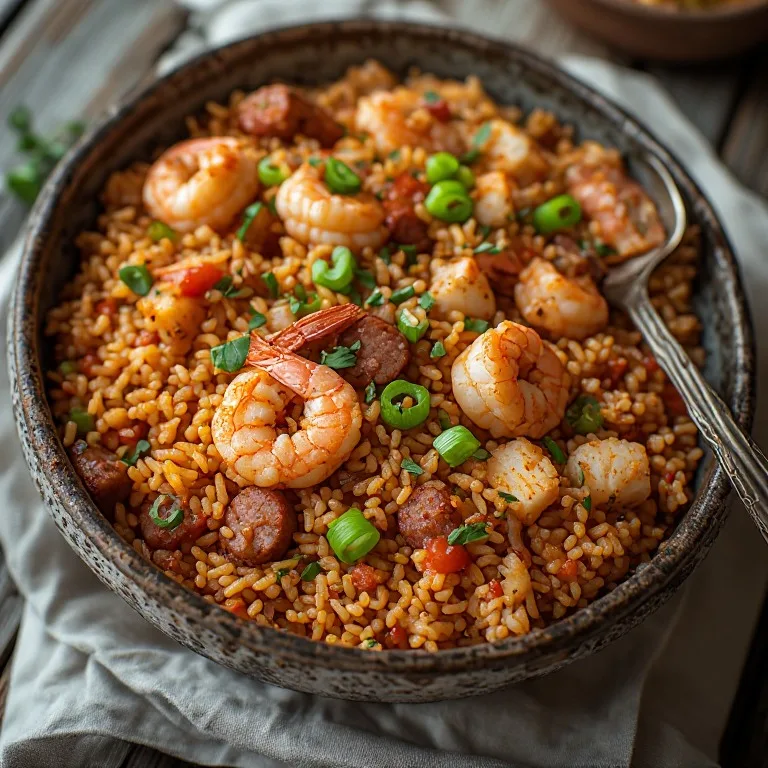
Commander's Palace Seafood Jambalaya

Commander's Palace Seafood Jambalaya
Jump to Recipe
Prep 20 min Cook 50 min Serves 8
Quick answer: To make Commander's Palace seafood jambalaya: make the Creole seasoning blend first (2 tsp salt, 1 tsp each garlic powder, onion powder, and smoked paprika, ½ tsp black pepper and dried thyme, ¼ tsp cayenne). Brown 12 oz sliced andouille in a large Dutch oven over medium-high heat until the fat renders and the edges color, then remove and set aside. Sauté the holy trinity — 1 diced yellow onion, 3 diced celery stalks, 1 diced green bell pepper — in the rendered fat for 6 minutes until soft. Add 4 minced garlic cloves and 2 tbsp tomato paste, cook 2 minutes. Stir in 1 can (14.5 oz) diced tomatoes, 3 cups chicken or shrimp stock, 1½ tsp of the Creole seasoning, and 2 bay leaves. Return the andouille to the pot and bring to a boil. Stir in 1½ cups long-grain white rice, cover tightly, reduce to the lowest heat, and cook 20 minutes without lifting the lid. Lay 1 lb peeled shrimp and 12 oz firm white fish fillets cut into 1½-inch pieces on top of the rice; replace the cover and steam 8 to 10 minutes until the shrimp are pink and the fish flakes. Fold gently to combine, discard bay leaves, and garnish with sliced green onions.

Shop the tools

Gear matched to this recipe. These are Amazon affiliate links — we may earn a small commission if you buy, at no extra cost to you.

As an Amazon Associate, Copycat Spices earns from qualifying purchases. Product images are generic illustrations, not the exact item listed.

Commander's Palace Seafood Jambalaya

The Commander's Palace version of New Orleans seafood jambalaya made at home: andouille, shrimp, and white fish cooked in one pot with the holy trinity, Creole seasoning, and long-grain rice. This is the tomato-based red Creole style — not the Cajun brown kind — built from the restaurant's published recipe with the rice-to-liquid ratio corrected so the pot comes out fluffy, not porridge.

Intermediate Prep: 20 min Cook: 50 min Total: 1h 10m8 servings ~$4.50/serving
Prep20 min
Cook50 min
Total1h 10m
Servings
8
At home~$4.50/serving
vs
Restaurant~$20.25/serving
You save ~78%

The Story Behind the Recipe

Commander's Palace opened in 1893 in a Victorian mansion at 1403 Washington Avenue in New Orleans's Garden District, and it has operated as a fine-dining destination through four owners and two world wars. The Brennan family purchased it in 1969, and Ella Brennan — often called the most influential woman in American restaurant history — shaped it into what it is today: multiple James Beard Awards, a reputation as the school that trained the American South's greatest chefs, and a menu built on Haute Creole cooking that was rooted in Louisiana ingredients and technique before the term "farm to table" existed. Paul Prudhomme became executive chef in 1975, the first American-born chef in that role after decades of European predecessors; he left in the late 1970s to open K-Paul's Louisiana Kitchen. Emeril Lagasse took over in the early 1980s, stayed through 1990, and went on to his television career. Both chefs have said publicly that Commander's Palace is where they became the cooks they are. The jambalaya has been in the restaurant's cookbook since 1984.

Commander's Palace jambalaya is the Creole kind, not the Cajun kind. The difference is tomatoes: Creole cooks in the city added tomatoes to their jambalaya, which turns the broth red and gives the dish its name among New Orleans cooks — "red jambalaya." Cajun jambalaya, from the Louisiana countryside, browns the proteins first in a dry pot until the fond almost burns, then cooks the rice in that dark fond with no tomatoes at all. Commander's jambalaya is neither version at its extreme: it builds a proper tomato base, uses andouille as the sausage component, and adds shrimp and firm white fish at the end so the delicate proteins cook gently in the hot rice rather than overcooking into rubber. The result is closer to a rich one-pot braise than to restaurant rice pilaf — and the Creole seasoning blend, made in the first step and stored in a jar, is the flavoring backbone that the restaurant has used for decades.

Nutrition Facts

Per serving (8 servings)
Calories495
Total Fat18g
Total Carbs42g
Dietary Fiber2g
Sugars5g
Protein37g
Sodium860mg

* Estimated values based on standard recipe preparation. Actual values may vary.

Ingredients

  • Creole Seasoning Blend (makes extra — store in a sealed jar)
  • Jambalaya

Instructions

💡
Pro tip: This recipe tastes even better the next day. The flavors need time to meld together in the fridge.
❄️
Storage: Keeps in an airtight container in the fridge for up to 2 weeks. Freezer-friendly for up to 3 months.
🎃 Free Halloween cookbook — download now The Copycat Halloween Cookbook A ready-made, photo-illustrated PDF of our best halloween copycat recipes — free to download, no building required. Pay what you want to support if you love it.

Free PDF — instant download. We'll also send new seasonal copycat recipes now and then; unsubscribe anytime. Or just download it →

What makes this the Creole version

There are two completely different dishes called jambalaya in Louisiana. Commander’s Palace makes the New Orleans city style: a tomato-based red jambalaya built on the French-influenced Creole tradition, with a tomatoey broth, four distinct proteins, and rice that finishes cooking in a rich, red stock. The other version — the Cajun jambalaya from the rural south — starts by dry-burning pork sausage in a cast-iron pot until the fond nearly scorches, then cooks the rice in that dark, smoky fond with no tomatoes at all. Both are correct. They come from different Louisiana traditions, and they taste entirely different. The red Creole version is what you get at a white-tablecloth New Orleans restaurant; the brown Cajun version is what you get at a church fish fry or a hunting camp. This recipe is the Commander’s Palace version.

The holy trinity is not interchangeable

Every Creole and Cajun recipe begins with the holy trinity: onion, celery, and bell pepper in roughly equal parts. It functions the same way the French mirepoix does — as the aromatic base that flavors everything cooked in it — but the flavor profile is entirely different. Bell pepper adds a grassy, slightly sweet note that onion and celery alone can’t produce. Use green bell pepper, not red or yellow: the red and yellow varieties are sweeter and fruitier, which pulls the jambalaya toward a sweeter flavor profile that the seasoning blend can’t easily balance. Green bell pepper’s slight bitterness is correct here.

The rice-to-liquid ratio (the fix the cookbook needs)

The Commander’s Palace cookbook version of this recipe was flagged by multiple home cooks as producing wet, porridge-like jambalaya — too much rice packed into too little liquid, which produces a starchy slurry rather than individual grains. This recipe corrects it: 1½ cups long-grain rice to 3 cups liquid (the canned tomatoes count as part of the liquid). That’s a 1:2 ratio by volume, which is the standard for long-grain white rice cooked by absorption.

Two more things that matter: use standard long-grain rice, not parboiled (converted) or instant. Parboiled rice is pre-cooked and pre-dried, which means it doesn’t absorb the Creole-seasoned stock the same way raw rice does — the flavor stays on the surface rather than cooking into each grain. Instant rice is worse: it turns mushy immediately and adds nothing to the dish. Uncle Ben’s, Mahatma, or any plain long-grain white rice works perfectly.

Timing the seafood

The only way to ruin this jambalaya in the last step is to overcook the shrimp. Shrimp go from translucent to pink to curled in about 8 minutes over very low heat; at 12 minutes they turn rubbery and shrink noticeably. Fish takes the same amount of time. The solution: lay both on top of the rice without stirring, replace the lid, and cook on the absolute lowest heat setting. You’re not boiling the seafood — you’re gently steaming it in the ambient heat of the pot. If the pot seems to have lost too much heat and the seafood isn’t cooking after 10 minutes, raise the heat to medium-low for the final 2 minutes, then take it off the burner immediately.

Adjusting the heat level
Starting pointChange
Mild (no heat)Use ⅛ tsp cayenne or omit it
Medium (standard recipe)1½ tsp Creole blend as written
SpicyAdd a second ½ tsp cayenne to the seasoning blend
Hot (Gulf-style)Add ¼ tsp cayenne + 1 tsp hot sauce to the stock before adding rice

The andouille sausage itself adds some heat, so taste the base before adding extra cayenne. Crystal Hot Sauce is the New Orleans standard at the table — its vinegary tang cuts through the richness of the stock differently than Tabasco or sriracha.

Make-ahead for a crowd

The andouille-trinity base (everything through the point before adding rice and stock) can be made up to 24 hours ahead and refrigerated. When ready to serve, warm the base over medium heat, stir in the rice and stock, and proceed from step 5. Do not add the rice to the base and refrigerate it — raw rice in a flavorful liquid will absorb that liquid and turn to mush overnight. Make the base early; cook the rice and seafood fresh.
🥗

Make It Healthier

Love Commander's Palace Seafood Jambalaya but want a lighter version? Try these simple swaps:

  • ✓Replace the andouille with turkey andouille — available from Aidells and some specialty markets — to cut saturated fat by roughly 8g per serving with almost no change in flavor, since the smokiness and spice are in the seasoning blend.
  • ✓Use brown long-grain rice instead of white for 3g extra fiber per serving; increase the stock to 3½ cups (the extra liquid is needed for the longer cook) and extend the covered rice step to 35 minutes before adding the seafood.
  • ✓Skip the oysters and reduce the andouille to 8 oz to bring the sodium under 600mg per serving — the shrimp and fish carry enough protein and flavor that the dish holds up.
  • ✓Serve over 2 cups of cauliflower rice per serving instead of long-grain rice to cut carbs to roughly 14g per serving; add the cauliflower rice directly to the pot in the last 5 minutes (it needs only 4 to 5 minutes to heat through).

Frequently Asked Questions

What is the difference between Creole jambalaya and Cajun jambalaya?

Tomatoes. Creole jambalaya — the New Orleans city style, which Commander's Palace makes — includes tomatoes, which turn the broth red and give it a tangy, slightly acidic depth. The dish is sometimes called red jambalaya because of this. Cajun jambalaya, from the Louisiana countryside, starts by browning the proteins in a dry cast-iron pot until the drippings nearly burn and form a dark fond on the bottom; no tomatoes are added, and the rice absorbs that dark fond directly, producing a brown, smokier dish with a drier texture. Neither style is more authentic — they developed independently in different regions. Commander's Palace's Creole version is the one that belongs on a New Orleans white tablecloth.

Why is Commander's Palace jambalaya seafood-forward rather than chicken-and-sausage?

Because Commander's Palace is a New Orleans Haute Creole kitchen, and the Gulf Coast's seafood supply has always been the centerpiece of that tradition. The standard home-cook jambalaya in the rest of America — chicken, andouille, maybe shrimp added at the end — reflects the Cajun countryside tradition, where chickens were raised locally and fresh seafood was less accessible. New Orleans restaurants historically built jambalaya around Gulf shrimp, oysters, and local finfish, using the andouille as the seasoning sausage rather than the primary protein. Commander's Palace keeps this hierarchy: the andouille renders its fat into the base and slices into the pot for texture, but the volume of the dish belongs to the seafood.

What is andouille sausage and can I substitute it?

Andouille is a smoked, heavily spiced Louisiana pork sausage made with coarse-ground pork, garlic, and a heavy hand of black pepper. It has a firm, snappy texture and a smoky depth that no other sausage replicates exactly. In Louisiana it is made by smoking over pecan wood; commercial American andouille (Aidells, Zatarain's, Jacob's World Famous Andouille) is a reasonable substitute. If andouille is not available, smoked kielbasa or smoked Polish sausage are the closest alternatives — choose one with a coarse, chunky grind and visible pork texture, not the finely emulsified hot dog-style sausage. Chorizo is not a substitute: it turns the fat red with paprika and pushes the dish toward Spanish flavors rather than Creole.

Can I skip the oysters?

Yes. The oysters are the most optional component in this recipe. Commander's Palace uses them in their cookbook version, and in New Orleans fresh-shucked Gulf oysters are inexpensive and easy to find, but outside the Gulf Coast they are expensive and variable in quality. If you skip them, increase the shrimp to 1¼ pounds to maintain the volume and richness. If you use them, add the oysters at the same time as the shrimp — they need only 5 to 7 minutes of gentle heat, and overcooked oysters turn leathery. Buy fresh-shucked oysters from a fish counter and drain them well before adding; jarred oysters work but have a softer, less distinct texture.

Which fish works best and what should I avoid?

Any firm white fish that holds its shape when cut into pieces and gently steamed. Good choices: catfish (the authentic Gulf choice), tilapia, snapper, grouper, or mahi-mahi. All cut cleanly, absorb the Creole seasoning well, and flake into substantial pieces rather than dissolving into the rice. Avoid flaky, delicate fish like cod, sole, or flounder — they disintegrate before the shrimp finishes cooking and you end up with fish-flavored fragments rather than distinct pieces. Also avoid salmon: it has a strong flavor that overpowers the Creole base and turns the rice orange. Frozen fish fillets work fine here; thaw completely and pat dry so excess moisture doesn't water down the pot.

My jambalaya rice came out gummy and wet. What went wrong?

Too much liquid relative to the rice, or the lid was lifted during cooking. Commander's Palace's published recipe has been flagged by multiple cooks for producing a porridge-like texture; this recipe corrects the ratio to 1½ cups rice per 3 cups liquid (1:2 ratio). Three things ensure fluffy rice: (1) Use long-grain rice, not medium- or short-grain — the longer starch structure is what creates the separate, distinct grains that authentic jambalaya should have. (2) Don't lift the lid during the 20-minute rice cook. Every time the lid comes off, steam escapes and the rice runs out of moisture before it finishes cooking, compensating by absorbing the liquid at the bottom into a thick paste. (3) The liquid amount accounts for the moisture in the canned tomatoes — do not add extra stock to account for the tomatoes; they are already included in the 3-cup calculation.

Can I make this ahead for a dinner party?

Make the base ahead; add the seafood day-of. The andouille-trinity-tomato base (everything up to and including adding the rice and stock) can be prepared up to 24 hours ahead, cooled, and refrigerated. When ready to serve, bring the base back to a simmer, stir in fresh rice and stock at the same ratio, cover and cook 20 minutes, then add the seafood. Jambalaya with already-cooked rice reheats poorly — the rice continues to absorb liquid in the refrigerator, and by the next morning the dish is more pudding than rice. If you must reheat leftovers, add 2 tablespoons of stock per serving and warm gently covered over low heat rather than blasting it in the microwave.

What makes Commander's Palace Creole seasoning different from store-bought blends?

Proportionality and freshness. Store-bought Creole seasonings (Tony Chachere's, Slap Ya Mama, Zatarain's) are heavy on salt as the first ingredient, which makes it easy to accidentally over-salt a dish. Commander's Palace builds its blend with salt as one component among several — garlic powder, onion powder, paprika, thyme, and cayenne all carry equal weight. The blend in this recipe can be made in 5 minutes and stored indefinitely in a sealed jar. Double or triple the batch: it works as a dry rub on chicken, a seasoning for fried catfish, or a finishing sprinkle for roasted vegetables.

Love this recipe? Share it!

Free PDF: our 12 most-wanted copycat recipes — instant download.

Made it? Buy us a coffee

Every recipe here is free, with no paywalls. If this one was a hit at your table, a small tip keeps new copycats coming.

$

Commander's Palace is a trademark of its owner, used here only to describe the dish this recipe recreates. This is an independent copycat written in our own words — Copycat Spices is not affiliated with, endorsed by or sponsored by Commander's Palace.

Ratings & Reviews

—
No ratings yet

Rate this recipe

Click a star to rate

Leave a Review

0/500

CS

Copycat Spices Editorial

Researched + fact-checked. Every recipe on Copycat Spices is built from published sources — official ingredient lists, brand-published recipes, interviews and food-science references — and fact-checked before it goes live, then written as clear, step-by-step instructions for home cooks of all skill levels.

Learn more about our mission →