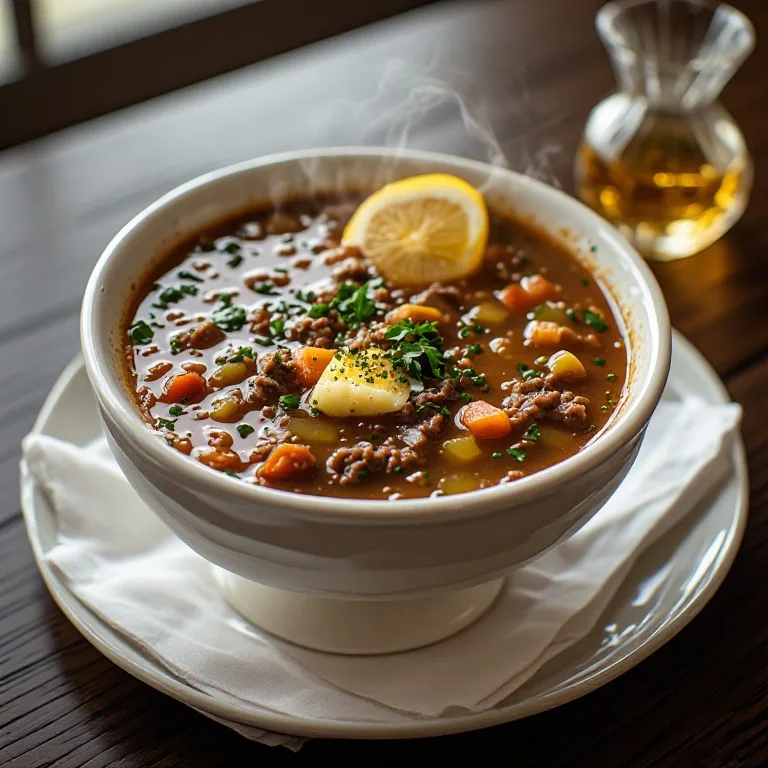



There are very few dishes in American restaurant history where the serving ritual is as famous as the food itself. Commander’s Palace turtle soup is one of them. The bowl arrives dark and fragrant, steaming with the deep richness of a dark-honey roux and browned beef. Then the server sets a small decanter of pale dry sherry beside it. You pour a splash. You stir. And the soup transforms.
That moment — the tableside sherry pour — has been playing out in the Garden District dining room at 1403 Washington Avenue since the early 1970s, when Ella Brennan and a young Paul Prudhomme built the dish together. It is the only item Commander’s Palace has served every single day since it opened in its current form. The bread pudding soufflé gets more headlines; the turtle soup has more tenure.
What makes this soup genuinely different
Commander’s Palace turtle soup is not a simple stew or a thin consommé. It occupies a category specific to New Orleans cuisine: a roux-thickened, deeply seasoned main-course soup that carries the complexity of a braise in a single bowl. Three things set it apart from any other beef-based soup you might make.
The roux is the first: you build it separately, take it to an amber color over 15 minutes of constant stirring, then whisk it into the broth at the end rather than at the beginning. This means the thickening arrives after the stock has already developed flavor, so you get depth first and body second — the opposite of most thickened soups.
The hard-boiled eggs are the second: finely chopped and stirred in off the heat, they dissolve partly into the broth and add a richness that butter or cream cannot replicate. This is a distinctly Creole technique, borrowed from 19th-century New Orleans cookbooks, and it is non-negotiable. A bowl without eggs is a different soup.
The sherry is the third: dry fino or manzanilla sherry poured into the hot bowl at the table. The alcohol flashes off immediately, leaving a nutty, slightly acidic note that cuts through the fat of the roux and changes the finish of the soup entirely. Serve it at the table in a small decanter, exactly as the restaurant does.
Why turtle? And what to use at home
Snapping turtle was a staple of Creole cooking long before the Civil War. The meat is dense, dark, and mildly gamey — described variously as somewhere between dark chicken, beef, and pork, with an underlying sweetness. It was abundant in the Mississippi River basin and became embedded in the cuisine the way catfish and crawfish did.
Today, real snapping turtle is difficult to find outside Louisiana. Specialty game butchers stock it; a few online retailers ship frozen turtle meat nationally. But Commander’s Palace’s own published recipe has long included a mixed-protein base of turtle, veal, and lean beef — acknowledging the substitution reality. Ground beef plus ground veal is the standard home approximation, and the restaurant staff will tell you the recipe still works. Ground beef alone, browned hard enough to develop a good crust, delivers the result with less nuance but full satisfaction. Use 93% lean for either option; higher fat beef makes the roux-thickened broth greasy.
The holy trinity and why it matters
Every Creole recipe of substance starts with the holy trinity: celery, onion, and green bell pepper in equal parts, finely minced. It is the Creole equivalent of French mirepoix (onion, carrot, celery), but the bell pepper replaces the carrot and sweetens the base differently — fruitier and more vegetal than the carrot’s earthiness, with less sugar.
For turtle soup, the trinity gets cooked until completely transparent before the tomato goes in. That step — unhurried, 5 to 7 minutes over medium heat — removes the raw edge from the pepper and celery and builds the base flavor. Do not shortcut it. If the vegetables still have texture when the tomato goes in, they will be crunchy in the finished soup.
The roux: what color, what technique
A medium-blond roux — what some Louisiana cooks call a “peanut butter roux” in color, though lighter than actual peanut butter — is the target. You are not making gumbo, which uses a much darker roux with a deeper chocolate-red color and a more pronounced nutty flavor. That dark color carries a subtle bitterness that works in gumbo but would overwhelm a soup like this.
Cook the roux over medium heat, stir constantly with a wooden spoon or high-heat spatula, and take your time. Rushing with high heat will burn the flour before it colors evenly, and there is no recovering a burnt roux. The color shifts will be slow and then fast: 10 minutes of slow blonding, then a rapid shift from blond to amber in the final 2 to 3 minutes. Watch it closely and pull from heat as soon as you hit the target.
One practical note: the roux stiffens as it cools, which makes whisking it into the hot soup feel awkward. This is fine. Add the cooled roux a few tablespoons at a time, whisking aggressively after each addition until smooth. It will incorporate completely.
The sherry ritual
Dry sherry at the table is not optional or decorative. This is the dish’s most important flavoring element, and it works precisely because it is not cooked.
When you add sherry to a hot soup on the stove, the alcohol cooks off during the simmer and takes some of the aromatic compounds with it. When you pour room-temperature sherry into a hot bowl, the alcohol flashes off in seconds on contact with the broth, but the full aromatic profile — nutty, slightly saline, oxidative — lands in the soup intact. The effect is dramatically different from cooked sherry.
Buy fino or manzanilla: both are bone-dry, pale, and meant to be served cold. They are inexpensive ($12–18 for a 750ml bottle at any wine shop), and the opened bottle keeps refrigerated for 4 to 6 weeks. Cream sherry is too sweet. Medium-dry sherry will make the soup cloying. If you cannot find fino or manzanilla, a dry fino-style South African or Spanish cooking sherry works acceptably, but avoid labeled “cooking sherry,” which is heavily salted.