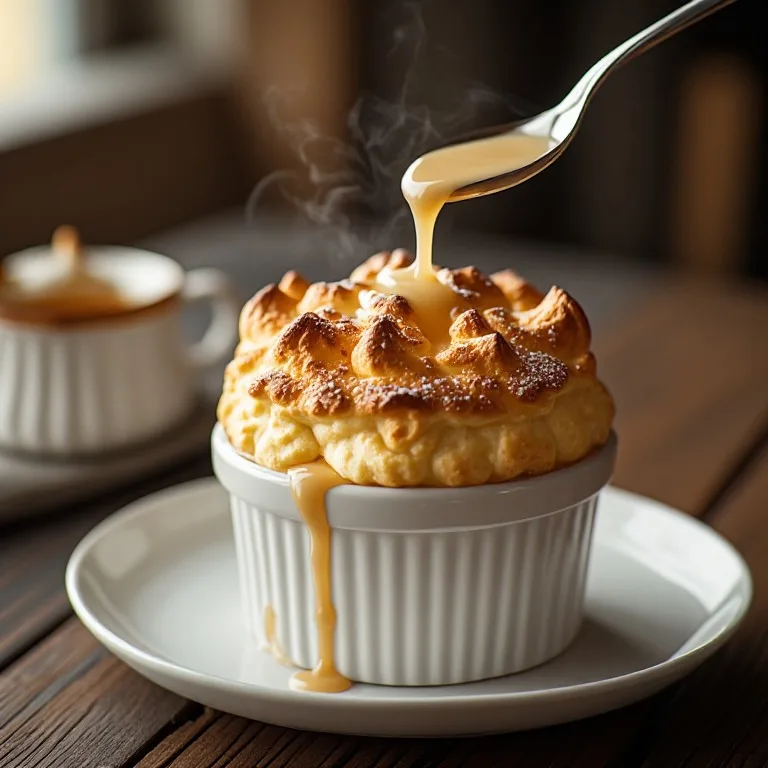



There are restaurants that invented dishes, and then there is Commander’s Palace, which invented the event of ordering dessert. For the last four decades, when a server at the Garden District’s most celebrated dining room leans in and says “The soufflé takes twenty minutes — shall I put one in now?” the entire table pays attention. It is arguably the best-scripted moment in the American restaurant business, and the Bread Pudding Soufflé at the center of it has earned more genuine superlatives — from James Beard judges, from food critics, from Emeril Lagasse himself — than almost any other dessert in the country.
The recipe is also genuinely clever. It solves a real tension: bread pudding is the soul of New Orleans baking, dense and custardy and deeply satisfying, but it finishes heavy. A soufflé is the technical opposite — all air and drama. The Commander’s Palace kitchen figured out that if you fold bread pudding into beaten egg whites and bake the whole thing again, you get something that is neither: a soufflé with density, warmth with levity, a crust of airy meringue encasing a core of Creole custard. The whiskey sauce poured tableside into the broken top is not a flourish. It soaks into the pudding and completes the dish.
Making it at home requires the same logic the restaurant uses: do the slow work first, move fast at the end.
What makes this soufflé different from a standard one
Most soufflés are built entirely on a base of beaten egg whites, with a flavoring agent — chocolate, cheese, pastry cream — folded in. They are notoriously fragile because the only structure is air.
The Commander’s Palace version is structurally different. The bread pudding provides actual body: protein from eggs, fat from cream, and the physical structure of bread. When you fold meringue around it, the pudding holds the air in place more effectively than a standard soufflé base. The result rises dramatically and falls more slowly. You still need to run from the oven to the table — but you have an extra minute.
The other difference is temperature: unlike a standard soufflé base, the bread pudding filling is cold (or room temperature) when it goes in. The meringue insulates it and the oven warms it through while the exterior sets and rises. By the time the top is golden, the inside is warm throughout without having dried out.
The bread matters more than you think
New Orleans French bread is distinct from any other bread sold in American bakeries. The crust is cracker-thin and shatters audibly. The interior is open and soft. It goes stale differently than a baguette — it dries rather than hardens, and when soaked in cream and eggs it becomes a soft, yielding custard rather than a gluey mass.
You probably cannot find authentic NOLA French bread outside of Louisiana (Leidenheimer Baking Company ships it, but it’s expensive for a single recipe). The best substitute is a soft Italian sandwich loaf, a brioche-style bread, or a simple pullman loaf left unwrapped overnight. Avoid baguette, sourdough, or any bread with a thick, chewy crust — they create a dense, gummy base. The goal is a bread that absorbs rather than resists.
The timeline at home
The recipe has two distinct phases and a hard deadline:
Day before (or morning of): Make and bake the bread pudding base. Cool it fully. Refrigerate.
45 minutes before dessert: Make the whiskey sauce. Keep warm.
20 minutes before dessert: Beat the meringue. Fold in bread pudding. Fill the dish. Bake.
Now: Run.
The 20-minute restaurant ritual maps directly to the home version. If you are having dinner guests, announce the soufflé before the main course is cleared. Beat the meringue while you clear plates. By the time you’ve poured coffee, the soufflé is ready.
The whiskey sauce, straight from the Brennan family kitchen
The version here — cream, sugar, cornstarch, bourbon — is lighter and more pourable than the traditional Louisiana whiskey sauce made with powdered sugar and a raw egg whisked into melted butter. The cream-based sauce is easier to calibrate, more stable if you need to hold it warm, and it pours beautifully. If you want the classic egg-butter version: melt 1 stick of butter over low heat, whisk in 1 cup powdered sugar until smooth, remove from heat, let cool for 3 minutes, then whisk in 1 beaten egg very slowly while stirring continuously (the residual heat cooks the egg without scrambling it). Add bourbon off heat. Both are authentic; the cream version is more forgiving.
How much soufflé to make
The recipe above makes enough for six servings in a single 2-quart soufflé dish. Individual 8-ounce ramekins (filled to three-quarters) are actually better for home use: they are less dramatic visually, but they bake more evenly, they are easier to serve without deflation panic, and the ratio of crisp golden top to creamy interior is better per serving.
If you are cooking for two, use one-third of the meringue recipe (3 egg whites) and about 3/4 cup of the bread pudding base for two ramekins. The full bread pudding base keeps in the refrigerator for three days, so you can run it twice over a long weekend.
Why the restaurant guards this recipe
The Brennan family has long described the bread pudding soufflé as the single most sought-after dessert in Commander’s Palace history — the dish people come back for, sometimes on purpose, sometimes as the afterthought that becomes the memory of the whole meal. It’s the reason the twenty-minute ordering ritual exists at all: no other item on the menu is worth timing your entire dinner around.
The restaurant opened in 1893 in a Victorian mansion on Washington Avenue, not in the French Quarter but in the older, quieter Garden District — the neighborhood where old New Orleans money lived. Ella Brennan and her siblings took over in 1969. Under her watch the restaurant became something more than a local institution: Paul Prudhomme joined as executive chef in 1975 and created the Cajun food canon while working out of Commander’s kitchen; Emeril Lagasse followed in 1983 and spent seven years there before opening Emeril’s. The James Beard Foundation has recognized Commander’s Palace seven times.
The Bread Pudding Soufflé was not invented at Commander’s Palace — bread pudding is the foundational Creole dessert, made in New Orleans homes for centuries from stale bread, cream, and eggs, always with whiskey sauce. But the soufflé technique is Commander’s own, and no other restaurant in the world has made the dish as central to its identity. When Emeril opened his own restaurants, he put bread pudding soufflé on the menu, too. So did many of the chefs who trained under him.
The soufflé on your table at home is the same architecture as the one on the white linen in the Garden District: Creole custard, French technique, bourbon finishing, ordered twenty minutes in advance.