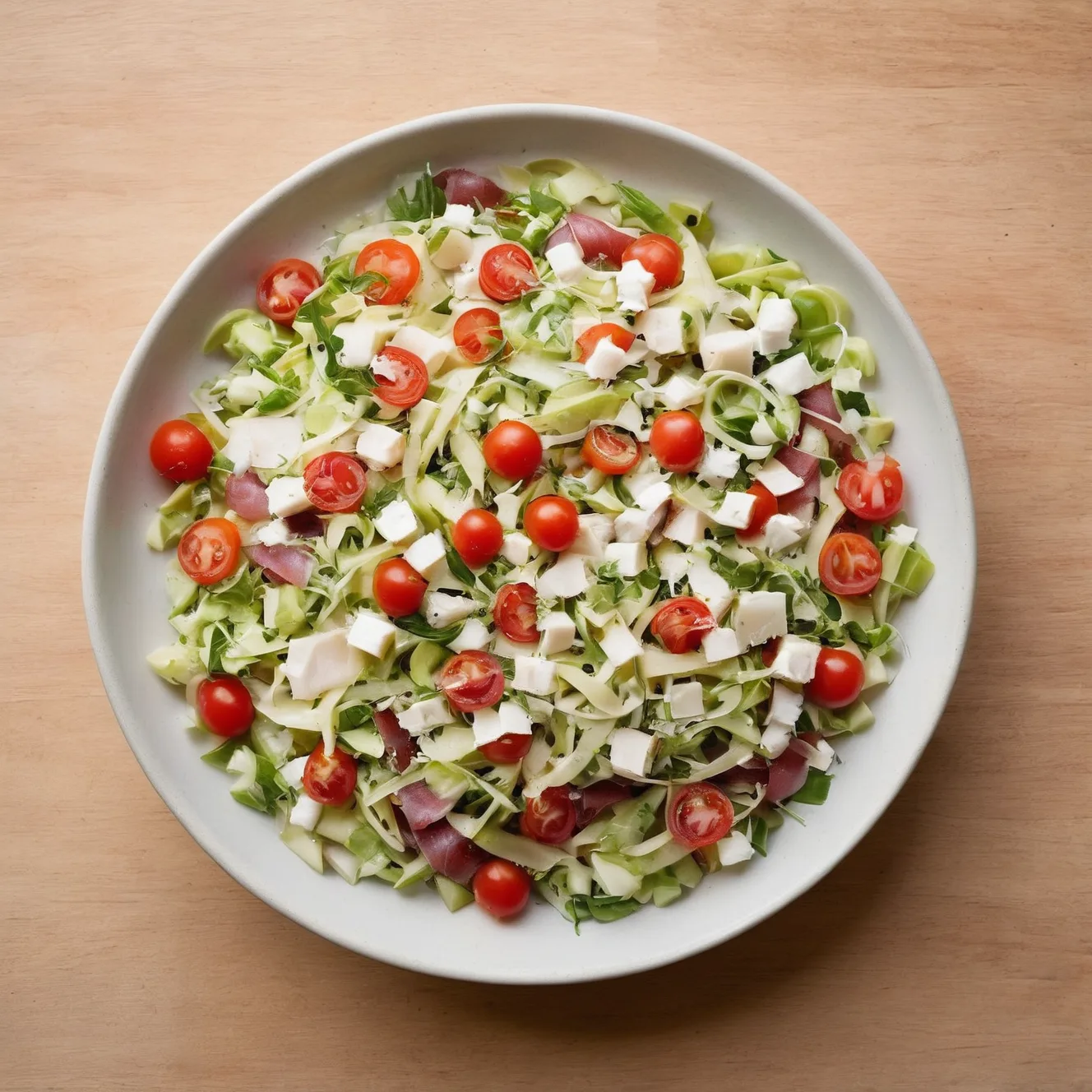
Copycat California Pizza Kitchen Original Chopped Salad
Prep time: 25 min Servings: 4 as a side, 2–3 as a main
California Pizza Kitchen opened in Beverly Hills in 1985 with a simple and somewhat radical premise: familiar food executed with precision and better ingredients than you expected at a casual chain. The same debut menu that introduced the Original BBQ Chicken Pizza also carried the Original Chopped Salad — also called the Italian Chopped Salad on later menus — and it is a product of that same era. It is not complicated, but it requires taking the technique seriously. Most restaurant copies fail because the chop is lazy: the lettuce is shredded roughly, the proteins are dropped on top in large chunks, and the result is a dressed salad with Italian toppings rather than a true chopped salad.
The difference is significant enough that CPK fans can tell immediately.
TL;DR for the experienced cook
Iceberg + romaine chopped to 1/8-inch. Genoa salami julienned to match. Turkey and mozzarella diced to ¼ inch. Garbanzo beans, seeded tomatoes, basil chiffonade. Dijon-herb-Parmesan vinaigrette made an hour ahead. Uniform size is the entire point — every forkful should be identical. Do not skip the garbanzo beans.
The technique: what “chopped” actually means
A chopped salad has one defining rule: every ingredient is cut to approximately the same small size. The target is roughly the scale of a garbanzo bean — about ¼ inch for most components, 1/8 inch for the lettuce strips and the salami. At this scale, each forkful contains all the components simultaneously: some lettuce, a bit of salami, a chunk of turkey, a chickpea, a cube of mozzarella, a thread of basil. There is no luck-of-the-fork variation. Every bite is the salad in miniature.
This is not how most salads work. A typical dinner salad has lettuce as the base, toppings distributed over it, and each forkful is mostly lettuce with occasional encounters with the other ingredients. A chopped salad has no base — it is a mixture, and every component is equal.
The practical implication: do not skip the knife work. Rough, uneven chopping is not a stylistic choice — it changes the flavor balance of the dish because the proportions shift in each bite. Spend the extra five minutes to chop everything uniformly.
For the lettuce specifically, the technique is:
- Halve the head and remove the core.
- Slice the leaves crosswise into 1/8-inch strips.
- Turn and chop across those strips into rough squares.
The result should look more like a loose grain than a salad base. That is correct.
The dressing: Dijon does two jobs
The herb-mustard Parmesan vinaigrette is what separates this from a generic Italian salad. It uses Dijon mustard as the emulsifier — mustard lecithin binds the oil and vinegar into a creamy, stable suspension that clings to the finely chopped ingredients rather than pooling at the bottom. Without the Dijon, the dressing breaks and runs to the bottom of the bowl, leaving the lettuce under-dressed and the bottom of the salad swimming.
The other key is the oil-to-vinegar ratio. Many vinaigrettes run 3:1 oil to acid; this dressing runs closer to 4:1, which sounds richer, but the salami, mozzarella, and turkey already bring plenty of fat and salt. The lighter oil proportion keeps the overall salad from feeling heavy. The red wine vinegar provides the sharpness; the grated Parmesan adds umami and body to the emulsion, not just flavor.
One technique upgrade: make the dressing at least 30–60 minutes before serving. The dried oregano and parsley rehydrate in the olive oil during that time, releasing their flavor compounds properly. Oregano added to a dressing that is used immediately tastes dusty and sharp. Oregano that has had an hour in oil tastes like a herb, which is what you want.
The proteins: salami + turkey, and why both matter
This salad’s flavor identity comes from the combination of Genoa salami and chilled roast turkey breast. They are doing different work.
The salami provides salt, fat, and the sharp, slightly cured pork-and-spice edge that gives the salad its backbone. A chopped salad without the salami is underpowered — it tastes like a well-dressed lettuce salad, not like CPK’s version. The salami must be julienned thin, not cubed. Thin strips incorporate into the uniform chop correctly; chunky cubes create irregular bites.
The turkey provides lean, mild protein that lets the other flavors — the dressing, the mozzarella, the basil — come through without competing with them. CPK specifically calls for “chilled” turkey on their menu, not warm. Cold turkey holds its shape, dices cleanly, and keeps the salad from getting warm and heavy. If you are roasting your own turkey breast, roast it the day before and refrigerate it overnight. Deli counter turkey breast, sliced thick and diced, is the practical shortcut most people use, and it is completely appropriate here.
The garbanzo beans: the missed ingredient
Most home copies of this salad omit the garbanzo beans, either because they were not aware of them or because they seem like an odd choice. They are on the original recipe, confirmed by both the Top Secret Recipes recreation and multiple independent sources, and they matter for two reasons.
First, texture. In a salad where everything else is soft — lettuce, turkey, mozzarella, basil — the chickpeas provide a firm, slightly resistant bite that adds variety across the bowl. They are not crunchy, but they have a substance that everything else lacks.
Second, flavor. Garbanzo beans have a mild nuttiness and a very slight earthiness that fills the mid-register flavor profile of the dressing. They do not taste strongly of anything on their own, but they provide a subtle richness that makes the salad feel more complete than it would with just the proteins.
Rinse the canned chickpeas very well and dry them on a paper towel for a few minutes before adding them. Residual can liquid thins the vinaigrette and dulls the herb flavors.
The mozzarella: fresh vs. low-moisture
Either works, but they behave differently. Fresh mozzarella (the water-packed variety) has more moisture and a softer, milkier texture. It needs to be well-drained before dicing, and it can make the salad wetter than you want if not handled carefully. Pat it dry between paper towels.
Whole-milk low-moisture mozzarella — the firmer block variety — dices more cleanly, holds its shape in the salad, and does not add extra moisture. It has a slightly less rich flavor than fresh, but in a dressing as assertive as this one, the difference is smaller than you expect.
CPK uses shredded mozzarella at the restaurant, but diced works better at home. Shredded cheese tends to clump in a dressed salad, while ¼-inch cubes distribute evenly and stay distinct in each bite.
Dressing the salad: less is more
The most common mistake in a dressed chopped salad is overdressing it. Because all the components are small and the surface area of everything is high, the dressing coats the salad very efficiently. Start with 3–4 tablespoons for a full 4-serving batch. Toss thoroughly, then assess. Every piece should glisten but not be wet. The dressing should not pool at the bottom of the bowl.
If you are not serving the full batch at once, dress only the portion you plan to eat immediately. The undressed components stay fresh in the refrigerator for a day; a dressed chopped salad wilts within 30 minutes.
What to expect vs. the restaurant
The CPK Original Chopped Salad ran approximately $15–18 in 2026, depending on location and whether you order full or lunch size. The full restaurant portion is designed as a complete meal. The home version in this recipe serves 2–3 as a main at approximately 480 calories per serving — primarily from the mozzarella, salami, and olive oil in the dressing.
CPK’s Italian/Original Chopped Salad was off the menu for several years and returned in 2023 as a fan-requested item, per a BusinessWire announcement from August 2023. Its return was notable enough to make trade press, which tells you something about the loyalty this salad generates.
Variations
-
Add pepperoncini. Several copycat versions include sliced pepperoncini rings, which add a bright, pickled pepper heat that plays well with the Dijon dressing. CPK’s current menu version does not include them, but they are a natural addition that does not distort the flavor profile.
-
Add olives. A handful of sliced Kalamata or black olives fits within the Italian flavor framework and adds a briny richness. Like the pepperoncini, not in CPK’s version but a common and successful home addition.
-
Swap turkey for chicken. Grilled or rotisserie chicken breast, chilled and diced, substitutes cleanly. The flavor is slightly less neutral than turkey but equally appropriate in the dressing.
-
Make it vegetarian. Skip the salami and turkey and add double the garbanzo beans plus ½ cup of jarred artichoke hearts (drained and chopped). The dressing has enough body to hold the salad together without meat, and the mozzarella provides richness.
-
The lunch-size portion. At CPK, the lunch size is roughly half the ingredients. At home, halve the salad recipe but use a full half-batch of the dressing, since dressing scales awkwardly at very small quantities.
If you like a chopped-and-tossed salad built on a bold house dressing, the same knife discipline carries straight over to a copycat Olive Garden salad — different flavor profile, same principle that the dressing and the cut matter more than the ingredient list.