


Copycat Cheesecake Factory Chicken Bellagio
Prep time: 20 min Cook time: 30 min Servings: 4
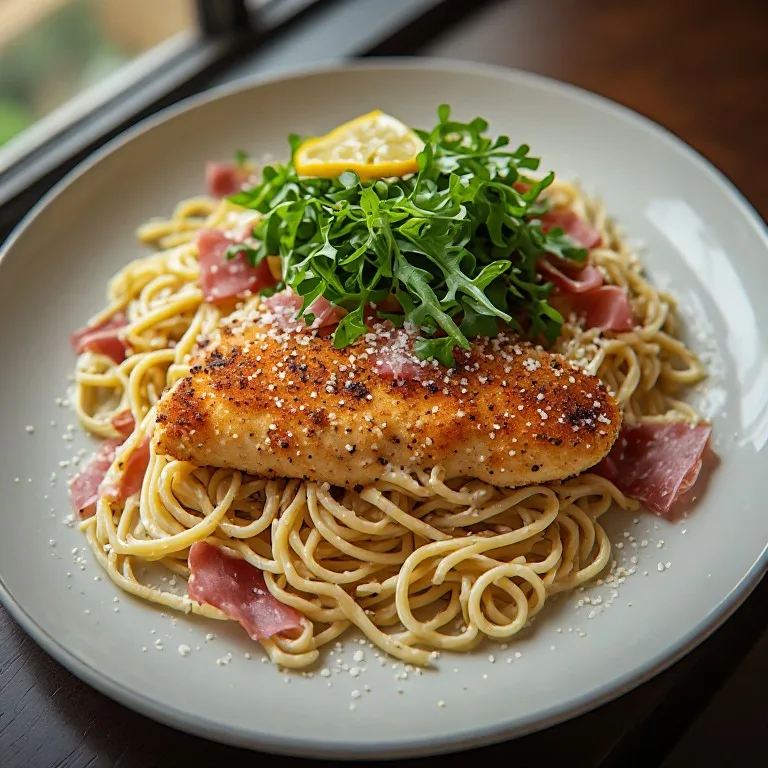
The Cheesecake Factory describes Chicken Bellagio on their menu as “Crispy Coated Chicken Breast over Basil Pasta and Parmesan Cream Sauce Topped with Prosciutto and Arugula Salad.” That description is precise and worth paying attention to, because it reveals something most copycat recipes get wrong: the basil and the cream sauce are separate components — the basil is in the pasta, not stirred into the cream.
There are no pine nuts in this dish. There is no pesto. Those are additions home cooks sometimes graft onto the recipe after seeing the word “basil,” but the official recipe doesn’t use them. The prosciutto is draped fresh over the chicken, forming a crown, not crisped into shards. And the arugula salad — dressed with lemon, olive oil, and Parmesan — is piled in the center of that prosciutto crown, making it the visual centerpiece of the plate and the ingredient that cuts through all the richness below it.
Cost Comparison: Home vs. Restaurant
Chicken Bellagio runs $25–28 per plate depending on location, making it one of the pricier main courses on the Cheesecake Factory menu. At home, the most expensive ingredient is the prosciutto; the rest is standard weeknight-grocery territory.
| Cheesecake Factory | Homemade (4 servings) | |
|---|---|---|
| Per plate | $25–28 | — |
| Full batch (4 plates) | $100–112 | ~$36–44 |
| Per serving | $25–28 | ~$9–11 |
| Savings per plate | — | ~$15–19 |
The Two-Component Pasta Approach
Most copycat recipes simplify the dish to a single “basil cream sauce” — cream, basil, pesto, done. The Cheesecake Factory version is more layered. The pasta is tossed in a basil oil finish: olive oil, butter, garlic, chicken broth, fresh basil, and parmesan. The basil flavor lives in the pasta itself. The parmesan cream sauce is then drizzled over the chicken on top of the plate separately, providing richness and body. When you eat the dish, you get the basil and garlic note from the pasta and the creamy, savory depth from the sauce, rather than both coming from the same merged source.
This distinction affects the result significantly. A single basil cream sauce dilutes the basil flavor into the fat. The two-component approach keeps the herb note clean and bright in the pasta while the cream sauce layers over the chicken. It requires two pots rather than one, but it’s why the restaurant version has the structural contrast it does — light basil pasta underneath, rich cream over the chicken, fresh peppery arugula on top.
The Prosciutto Crown
The prosciutto is arranged in a crown or ring around the top of the chicken, letting the thin slices drape naturally in a slightly ruffled way. This isn’t decorative for its own sake — it creates a visual frame around the arugula salad in the center, and the slight overlap of prosciutto on the sides of the chicken means every bite of chicken can include a piece.
Prosciutto is dry-cured Italian ham that doesn’t require cooking. It’s sliced to translucent thinness and warms from the heat of the chicken beneath it. Crisping it in a pan is a reasonable technique that makes a delicious dish, but that dish is not Chicken Bellagio. If you want something textural in the prosciutto component, choose very thin slices rather than thicker cuts — thin prosciutto has a delicate, silky quality when draped warm that thicker cuts don’t.
The Arugula Salad
The arugula is the element most home cooks underplay. It’s not a garnish — it’s pile mounded in the center of the prosciutto crown and serves a specific function: the peppery bitterness of the arugula cuts through the cream sauce below it, and the lemon in the dressing provides acidity that the rest of the plate doesn’t have. Dressed arugula on a rich pasta dish is the same principle as salad alongside a heavy pasta or greens on a burger — it makes the plate feel balanced instead of one-dimensional.
The dressing is simple: olive oil, lemon juice, Parmesan or Romano, salt, and pepper. Dress it lightly. Overdressed arugula wilts immediately and becomes limp; you want it to hold its shape as a mound in the center of the plate.
Tips & Variations
- Time the angel hair carefully. Angel hair cooks in 2 to 3 minutes and continues cooking from residual heat after draining. Err on the side of slightly underdone — it will soften further when you toss it with the warm basil oil. If it overcooks, it clumps into a mass.
- Keep the cream sauce warm on the lowest heat. Parmesan cream sauce breaks if it gets too hot — the Parmesan seizes and becomes grainy. Once you stir in the cheese, keep it on the absolute lowest burner setting and stir often. If it does break, a splash of cream and vigorous stirring can usually recover it.
- Use freshly grated Parmesan, not pre-shredded. Pre-shredded Parmesan has anti-caking agents that prevent it from melting smoothly into the cream sauce. Freshly grated from a block melts into a smooth, cohesive sauce; the bagged version creates a grainy, separated sauce.
- Let the crust develop. The panko-Parmesan breading needs full contact with a hot oiled pan and enough time to become deep golden brown — not pale golden, not dark brown. The visual cue is uniform color across the surface. Resist the urge to move or flip the chicken before 4 minutes; disturbing the crust too early tears it.
- Rest the chicken on a rack, not a plate. A flat plate traps steam under the chicken and softens the bottom crust. A wire rack lets air circulate, keeping the crust crisp while the chicken stays warm.
Storage & Reheating
The components store separately. Keep the cream sauce in a sealed container in the refrigerator for up to 2 days — reheat gently with a splash of cream, stirring to restore its consistency. The pasta stores for up to 2 days but needs to be re-tossed with a drizzle of olive oil to loosen it after refrigeration. Reheat the chicken in a 350°F oven for 10 minutes to restore the crust; microwaving turns it soggy. Do not store the dressed arugula — make it fresh at serving time.
More Cheesecake Factory Copycat Recipes
- Copycat Cheesecake Factory Crusted Chicken Romano — the other CF crispy-coated chicken: Romano + Parmesan crust (sharper and saltier than Bellagio’s Parmesan coating), served over spaghetti in a creamy tomato sauce with no prosciutto or arugula crown
- Copycat Cheesecake Factory Chicken Madeira — the restaurant’s other signature chicken entrée: pan-seared chicken with mushrooms, asparagus, and melted mozzarella in a glossy Madeira wine sauce
- Copycat Cheesecake Factory Chicken Piccata — a lighter Cheesecake Factory chicken option with lemon-caper butter sauce over pasta
- Cheesecake Factory Louisiana Chicken Pasta — crispy parmesan-crusted chicken over bow-tie pasta in a spicy Cajun cream sauce, the most-copied Cheesecake Factory recipe online
- Copycat Cheesecake Factory Brown Bread — the complimentary dark bread served at every table; a strong pairing with this dish