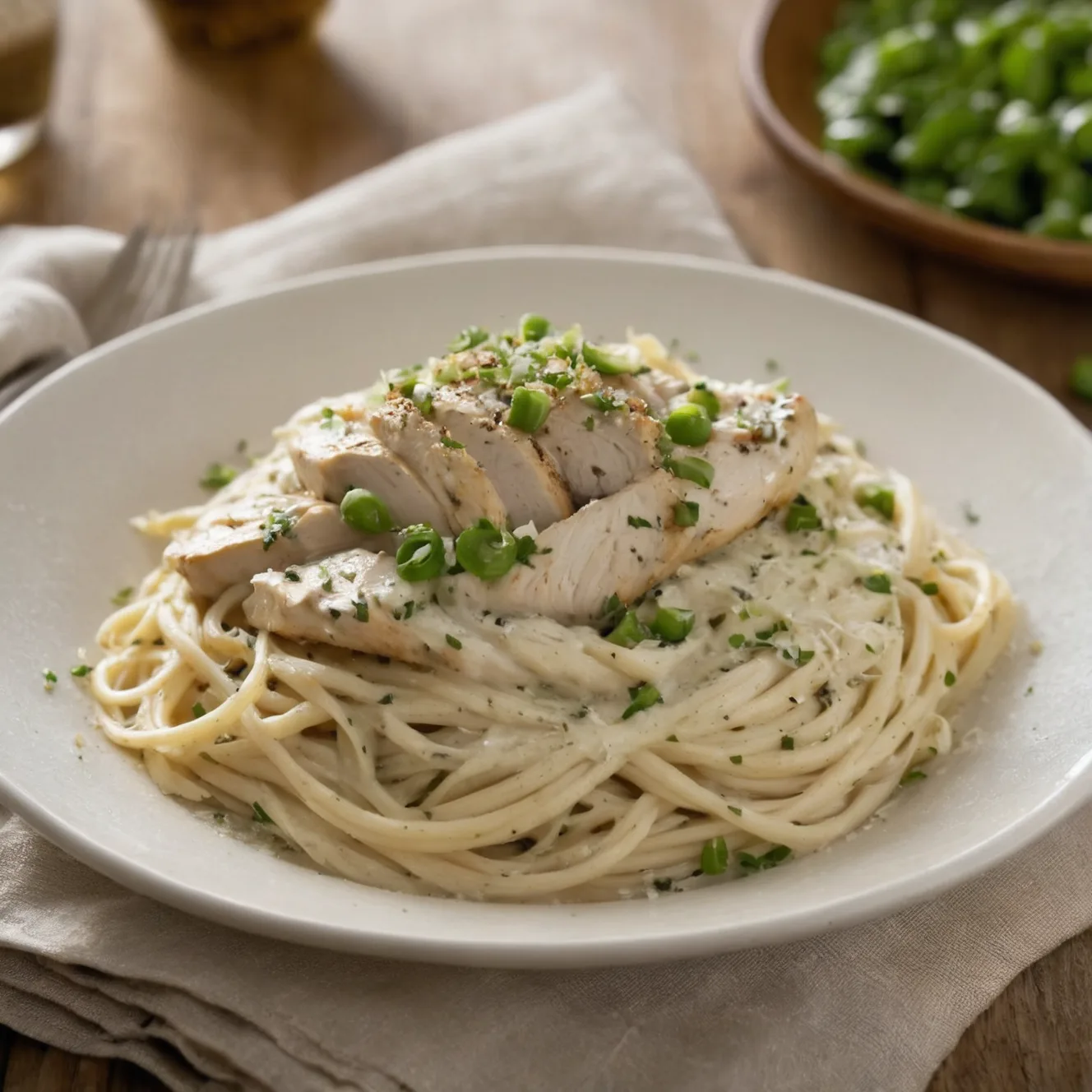
Copycat Cheesecake Factory Pasta Carbonara with Chicken
Prep time: 15 min Cook time: 25 min Servings: 4
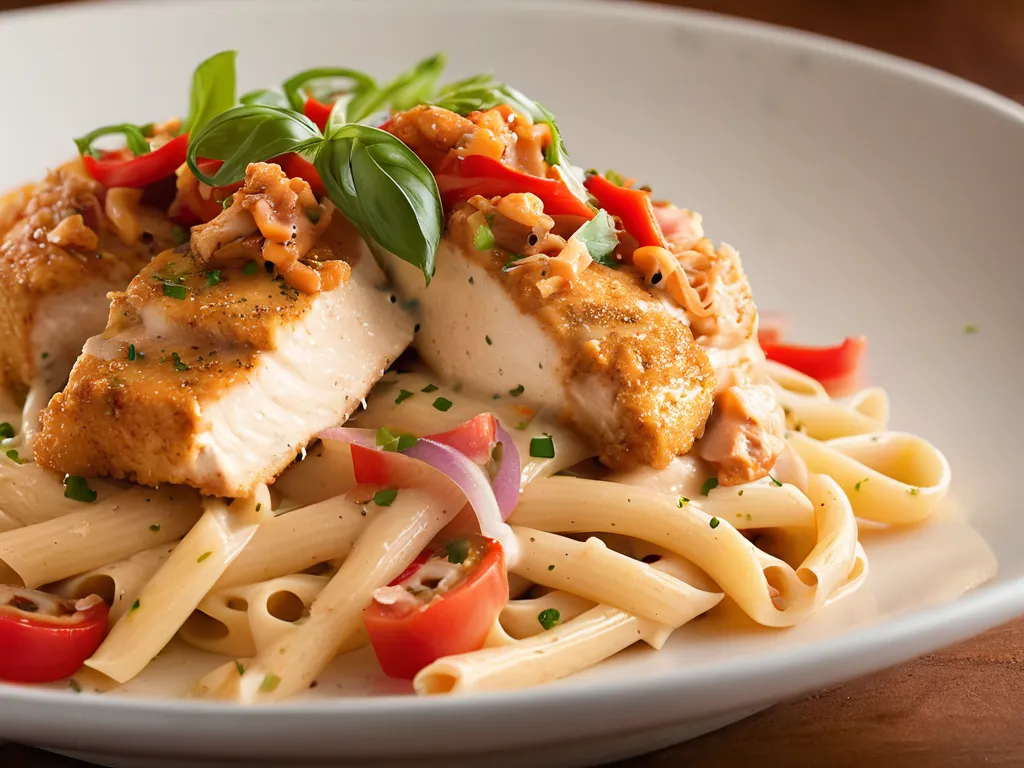
Here is what the Cheesecake Factory’s Pasta Carbonara with Chicken actually is: spaghetti with grilled chicken breast, crispy American-style bacon, green peas, and a garlic-Parmesan cream sauce. The official menu description is exactly that. There are no egg yolks. There is no guanciale. There is no traditional carbonara technique.
That is the most important thing to know before making this recipe. Traditional Roman carbonara — the dish served at osterie throughout Lazio — uses raw egg yolks emulsified with rendered guanciale fat and starchy pasta water. No cream. No dairy. No vegetables. The eggs and fat emulsify into a silky, clinging coating. It is a technically demanding sauce that breaks if the pasta is even slightly too hot when the eggs go in.
CF’s version is not that. It is a garlic-Parmesan cream sauce — butter, garlic, heavy cream, Parmesan — with American bacon and peas added. It borrows the name and the flavor profile (salty pork, black pepper, aged cheese, pasta) while taking a completely different technical approach. Understanding this distinction matters for the copycat: if you search “carbonara recipe” and follow a traditional Italian method, you will scramble egg yolks in cream and end up with something that is neither CF’s version nor traditional carbonara.
The restaurant charges roughly $24–$28 for the dinner portion, which clocks in at approximately 2,340 calories — one of the highest-calorie items on the CF menu. At home this recipe makes four reasonable servings at about 790 calories each and costs roughly $40 total.
Cost Comparison: Home vs. Restaurant
| Cheesecake Factory | Homemade (4 servings) | |
|---|---|---|
| Per plate | ~$24–$28 | — |
| Full batch (4 plates) | ~$96–$112 | ~$40 |
| Per serving | ~$24–$28 | ~$10 |
| Calories (dinner) | ~2,340 | ~790 |
The cost savings are significant partly because restaurant portions at CF are extremely large. The home version is sized for a satisfying dinner, not a 2,340-calorie experience.
What Makes This Version Accurate
No eggs in the sauce — at all. The single most important accuracy point. Every copycat recipe that adds egg yolks “for authenticity” is adding them to the wrong dish. CF’s menu specifically describes a “Rich Garlic-Parmesan Cream Sauce” — not a carbonara sauce. Egg yolks added to hot cream scramble rather than emulsify, producing small solid curds in the sauce. The authentic CF approach is to simply add freshly grated Parmesan to hot cream off-heat and stir until melted. That’s it.
Bacon, not pancetta. The official CF description says “Crispy Bacon” — American-style smoked bacon. Pancetta (Italian cured pork belly) is unsmoked, saltier, and has a distinctly different flavor from American bacon. Substituting it produces a dish that tastes more Italian and less like the restaurant’s version. Render the bacon until genuinely crispy — the strips should be hard-set and brittle, not just cooked through — so they hold up against the cream sauce without turning soggy.
Green peas are required. They are in the menu description alongside the bacon, chicken, and cream sauce. Practically, they do real work: the sweetness offsets the smokiness of the bacon, and their slight starchiness helps the cream sauce cling more evenly to the spaghetti. Add frozen peas to the pasta water 3 minutes before draining — they are cooked exactly right by the time the pasta is ready.
Block Parmesan only. Pre-grated Parmesan contains cellulose anti-caking agents that do not melt into cream — they remain as tiny gritty particles and can cause the sauce to look grainy and separated. A wedge of Parmigiano-Reggiano grated on a microplane melts into cream in seconds. This is the difference between a glossy, cohesive sauce and one that looks broken. Three ounces of Parmesan costs roughly the same whether it comes in a wedge or a container; buy the wedge.
Building the Sauce
The sauce comes together quickly in four steps, and understanding each one helps you adjust it:
-
Bacon fond as the base. After the bacon renders and is removed, the skillet has a thin layer of rendered fat and dark fond — the browned proteins from the pork. Cooking the chicken in that same fat infuses it with smokiness, and the combined fond from both proteins becomes the flavor backbone of the cream sauce. Do not wipe the pan.
-
Garlic dissolved in butter. Grated garlic added to melted butter cooks in about 60 seconds to a fragrant, dissolved state with no chunks. Minced garlic in the same situation leaves small pieces that can have a raw, sharp edge. The garlic flavor should be background and integrated, not identifiable as individual bites.
-
Cream reduced slightly before Parmesan. Simmering the cream for 2 to 3 minutes thickens it slightly and removes some of the raw dairy edge. The Parmesan goes in off-heat (or at the lowest setting) — adding cheese to aggressively boiling cream can cause it to break.
-
Pasta water for consistency. Starchy pasta water is the adjustment tool. The sauce will tighten as the pasta is added; pasta water loosens it without thinning the flavor. Have a full cup reserved, even if you use only a few tablespoons.
Tips & Variations
- Don’t undercook the bacon. The most common mistake is pulling the bacon when it looks done in the pan — it softens further as it sits, especially in the cream sauce. It needs to be genuinely crispy, which means cooking longer than feels necessary.
- Rest the chicken before slicing. Five minutes of resting after cooking redistributes the juices. A chicken breast sliced immediately loses more moisture; sliced after resting, the slices stay juicier and hold up better in the pasta.
- Adjust garlic to taste. Five cloves is moderately garlicky; if you want the garlic forward (some versions are more assertive), use 6 to 7 and increase the cooking time by 30 seconds.
- Add a little pasta water first. When the pasta goes into the sauce, it absorbs cream quickly. Add 3 to 4 tablespoons of pasta water before tossing to give yourself some latitude — it is much easier to add more cream than to fix an over-thickened sauce.
- Finish with more black pepper. Traditional carbonara is heavily black-pepper-forward; CF’s version is subtler. Taste when plated and add more coarsely ground pepper if it feels flat. Black pepper blooms in the heat and has a different character than pepper added during cooking.
Make-Ahead Notes
The bacon can be cooked 1 to 2 days ahead and stored in the refrigerator; re-crisp briefly in a dry skillet before serving. The cream sauce can be made a day ahead and refrigerated; reheat gently over low heat with a splash of chicken broth or pasta water, stirring frequently, as cream sauce can break if reheated aggressively. The chicken is best cooked fresh — reheated chicken strips in cream sauce dry out.
Storage & Reheating
Leftovers keep in an airtight container in the refrigerator for up to 2 days. The pasta will tighten significantly as the cream sets around it. Reheat in a skillet over low heat with 2 to 3 tablespoons of chicken broth, stirring gently. Do not microwave at high power — the cream can separate. The pasta will not fully return to its original sauciness, but it eats well the next day as a slightly drier pasta dish.
More Cheesecake Factory Copycat Recipes
- Cheesecake Factory Louisiana Chicken Pasta — the spicy Cajun cream-sauce version; shares the cream-pasta format but is an entirely different flavor profile with real heat
- Cheesecake Factory Four Cheese Pasta — a cheese-forward pasta with a different four-cheese blend; no bacon or chicken in the base
- Cheesecake Factory Avocado Egg Rolls — one of CF’s most popular appetizers
- Olive Garden Chicken Alfredo — the closest Parmesan cream-sauce analog at a competing chain; cream-based, no bacon, no peas
- Viral TikTok Ramen Carbonara — what actual egg-based carbonara technique looks like; the contrast between that recipe and this one makes clear exactly what CF changed