


Pin It

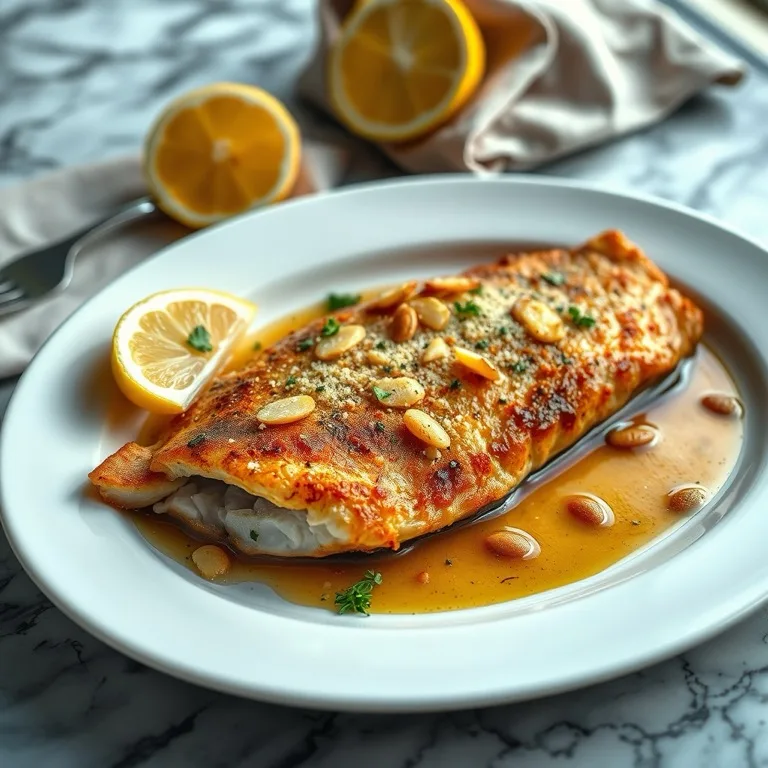
Galatoire's Trout Meunière Amandine (The Famous New Orleans One, Made at Home)

Galatoire's Trout Meunière Amandine (The Famous New Orleans One, Made at Home)
Jump to Recipe
Prep 15 min Cook 25 min Serves 4
Quick answer: Toast 1/2 cup blanched slivered almonds in 1 tablespoon of unsalted butter in a small skillet over medium heat, stirring constantly, until golden and fragrant — about 3 minutes. Set aside warm. Whisk together 1 cup all-purpose flour, 1 teaspoon kosher salt, 1/2 teaspoon white pepper, and 1/4 teaspoon cayenne in a shallow dish. Pat 4 Gulf speckled trout fillets (6 to 7 oz each, skin removed) completely dry with paper towels — wet fish won't brown, it will steam. Dredge each fillet in the seasoned flour on both sides, pressing gently, then shake off every trace of excess. Heat 1/4 cup clarified butter and 2 tablespoons canola oil in a heavy stainless steel or cast iron skillet over medium-high until shimmering. Fry the fillets in batches of two, 3 to 4 minutes per side, until deep golden brown on both sides. Transfer to a wire rack in a 200°F oven to keep warm. Pour out the frying fat but don't wipe the pan. Return the pan to medium heat and add 1/2 cup (1 stick / 113g) fresh unsalted whole butter. Cook 3 to 4 minutes, swirling occasionally, until the butter turns a deep mahogany-brown and smells intensely nutty — further than beurre noisette, nearly to beurre noir, but pulled before it turns acrid. Remove from heat. Add 2 tablespoons fresh lemon juice and 1 tablespoon Worcestershire sauce — stand back, it will spit. Stir quickly to incorporate, scraping up the brown bits. Plate the fish, spoon the sauce over generously, top with the warm toasted almonds and 2 tablespoons of minced flat-leaf parsley. Lemon wedges and more Worcestershire to pass at the table.

Shop the tools

Gear matched to this recipe. These are Amazon affiliate links — we may earn a small commission if you buy, at no extra cost to you.

As an Amazon Associate, Copycat Spices earns from qualifying purchases. Product images are generic illustrations, not the exact item listed.

Galatoire's Trout Meunière Amandine (The Famous New Orleans One, Made at Home)

Galatoire's most iconic dish since 1905: Gulf speckled trout dredged in seasoned flour, fried in clarified butter until paper-crisp, finished with a mahogany-dark brown butter sauce that gets its NOLA depth from Worcestershire. Most copycat recipes skip that step and wonder why the sauce tastes flat.

Medium Prep: 15 min Cook: 25 min Total: 40 min4 servings ~$4.50/serving
Prep15 min
Cook25 min
Total40 min
Servings
4
At home~$4.50/serving
vs
Restaurant~$20.25/serving
You save ~78%

The Story Behind the Recipe

Jean Galatoire opened his restaurant in 1905 at 209 Bourbon Street, a narrow building in the French Quarter that has barely changed since. He came from Pardies, a village in the Béarn region of southwestern France, and cooked what he knew — French country classics adapted to Gulf Coast ingredients, particularly the speckled trout and Gulf shrimp that arrived fresh at the French Market each morning. The restaurant has stayed in the family across four and five generations of Galatoires. The main dining room still takes no reservations. The famous Friday lunch, a rolling four-to-five-hour institution of white-jacketed waiters and Sazeracs and trout amandine, begins filling at 11:30 and sometimes doesn't empty until late afternoon. It has operated this way for most of a century.

The Trout Meunière Amandine is the dish that defines the kitchen. The dish is French in structure — meunière means "miller's wife," referring to the flour dredge and butter sauce — but Galatoire's version diverges from the French original in one important way: Worcestershire sauce goes into the brown butter at the finish. This is a New Orleans addition, not a French one, and it gives the sauce a faint savory depth that the classic French version doesn't have. One order at the restaurant runs about $49 in 2026. Made at home with fresh trout and a bottle of Worcestershire, it costs roughly $7 to $9 per person — and the technique, once learned, takes about 25 minutes.

Nutrition Facts

Per serving (4 servings)
Calories618
Total Fat46
Total Carbs14
Dietary Fiber1
Sugars2
Protein37
Sodium710

* Estimated values based on standard recipe preparation. Actual values may vary.

Ingredients

  • For the fish
  • For frying
  • For the meunière sauce
  • For the almonds
  • To finish

Instructions

💡
Pro tip: This recipe tastes even better the next day. The flavors need time to meld together in the fridge.
❄️
Storage: Keeps in an airtight container in the fridge for up to 2 weeks. Freezer-friendly for up to 3 months.
🎃 Free Halloween cookbook — download now The Copycat Halloween Cookbook A ready-made, photo-illustrated PDF of our best halloween copycat recipes — free to download, no building required. Pay what you want to support if you love it.

Free PDF — instant download. We'll also send new seasonal copycat recipes now and then; unsubscribe anytime. Or just download it →

There are restaurants that define a city’s table, and Galatoire’s is the one that has defined New Orleans’s for 120 years. The white-jacketed waiters who have worked there for decades — some of them for four or five decades — know the regulars by name, know what they want before they order, and know that most of what they want is the Trout Meunière Amandine. It is the restaurant’s oldest, most ordered, and least changed dish.

Making it at home requires understanding one thing the recipe does differently from every French meunière you’ve made before.

What French meunière does vs. what Galatoire’s does

Classic French meunière is one of the simplest fish preparations in the canon: flour-dredged fish, fried in whole butter, finished with beurre noisette (brown butter), lemon juice, and parsley. Clean, light, classic.

Galatoire’s version has one addition: Worcestershire sauce goes into the brown butter at the finish. This is not a French technique — it is a New Orleans one, and it is what makes the sauce taste like it came from a kitchen on Bourbon Street rather than from Paris. Worcestershire (built from tamarind, anchovies, molasses, and vinegar) adds a savory, slightly sweet depth that the clean French version doesn’t have. It is small — one tablespoon into a full stick of butter — but it is decisive. The sauce without it tastes good. With it, it tastes like Galatoire’s.

The other difference is the degree of browning. Standard beurre noisette is golden-amber. Galatoire’s meunière sauce goes darker: deep mahogany, almost to beurre noir, where the milk solids are very close to their smoke point. The darker stage produces more of the Maillard compounds — more nutty, complex, slightly bitter depth — that can stand up to the Worcestershire and lemon without being overwhelmed. The smell, when you’re there, shifts from milky-cooked butter to something hazelnut and almost chocolatey. That is your cue.

The only difficult part is the fish

Gulf speckled trout is genuinely delicate. It is thinner than most white fish Americans cook regularly and it falls apart easily. Two things prevent this:

First, the fillets need to be completely dry before dredging. Wet fish steams in the pan instead of frying, and wet flour coating dissolves rather than crisping. Pat thoroughly with paper towels.

Second, the flour-only dredge — no egg, no breadcrumbs — produces a very thin crust. That thin crust holds the fish together only if you handle it carefully. Use a wide, thin spatula for flipping. Slide under the full length of the fillet, not just the middle. The fish will be fragile, especially at the thinner tail end. This is fine; it is the nature of the fish. A slightly jagged fillet with a perfect crust and perfect brown butter sauce tastes exactly like it should.

If you cannot find Gulf speckled trout, thin rainbow trout fillets are the closest substitute in flavor. Thin sole or flounder fillets work and cook slightly faster. Mild catfish is firmer and takes the sauce very well. Avoid thick fish — halibut, salmon, swordfish — they need more cooking time than the sauce can wait for.

How to clarify butter (or skip it)

Clarified butter has the milk solids removed, which means it can fry at a higher temperature without burning — important for getting the fish deeply golden. Galatoire’s kitchen uses clarified butter for the frying stage. At home, the simplest substitute is a combination of whole butter and canola oil: the oil raises the smoke point enough to fry the fish without burning.

To clarify butter properly: melt 2 sticks of unsalted butter over medium-low heat without stirring. The milk solids will sink and the foam will rise. After 10 minutes, skim the foam, let it settle, and carefully pour the clear yellow liquid into a jar, leaving the white sediment behind. It keeps refrigerated for a month and is worth having on hand if you cook fish regularly.

The almonds

They are toasted in butter separately and scattered over at the very end. This is not a garnish decision — it is a texture decision. Almonds added to the butter sauce or cooked with the fish become soft. Almonds toasted on their own and added at the last moment stay crisp, add a contrasting texture to the soft fish and glossy sauce, and bring a gentle sweetness that completes the plate. Do not add them until you are about to serve.

What to serve with it

Galatoire’s serves Trout Meunière Amandine with Brabant Potatoes — a Louisiana classic of fried potato cubes in garlic butter — or with Pommes Soufflées (the airy, double-fried puffed potato slices that have been on the menu since the beginning). At home, small roasted or boiled potatoes work well, as does simple steamed rice to absorb the sauce. A green salad dressed with lemon and olive oil, nothing more, balances the richness. A cold, dry white wine — a Muscadet, a Chablis, a dry Vermentino — cuts the butter without fighting the Worcestershire.

Avoid rich sides: no cream-sauced vegetables, no cheesy gratins. The sauce is doing enough.

About Galatoire’s

Galatoire’s opened in 1905 at 209 Bourbon Street in the French Quarter. Jean Galatoire came from Pardies, in the Béarn region of southwestern France, and built a French-Creole kitchen around the Gulf Coast ingredients he found in New Orleans — the speckled trout, the Gulf shrimp, the oysters that arrived fresh at the French Market each morning. The restaurant has stayed in the family through four and five generations. It has never moved.

The main dining room takes no reservations. It operates first-come, first-served. On Fridays, the line forms before 11:30 a.m. The meal that follows — Sazeracs, Shrimp Rémoulade, Oysters en Brochette, the Trout Meunière, the Soufflé Potatoes, coffee and something sweet — can last four or five hours. It has operated this way for most of a century.

The recipe above produces the dish as accurately as a home kitchen can reproduce it: the thin flour crust, the dark brown butter, the Worcestershire, the warm almonds, the parsley. The only thing missing is the white jacket and the Friday afternoon on Bourbon Street.


Frequently Asked Questions

What makes New Orleans meunière sauce different from classic French meunière?

The defining difference is Worcestershire sauce. Classic French meunière is beurre noisette, lemon, and parsley. Galatoire’s adds Worcestershire at the finish — a NOLA addition that gives the sauce a faint savory depth and complexity the pure French version doesn’t have. The other difference is the degree of browning: Galatoire’s cooks the butter significantly darker, to deep mahogany rather than golden-amber, which produces more nutty, toasted depth that stands up to the Worcestershire and lemon.

What is Gulf speckled trout, and what can I substitute?

Gulf speckled trout (spotted seatrout) is a delicate, mild-flavored saltwater fish from the Gulf Coast. Outside the Gulf states it’s hard to find. The closest substitutes are thin rainbow trout fillets, flounder or sole, or mild catfish. Avoid thick fish like halibut or salmon — they take much longer to cook than the sauce can wait.

Why does the butter need to get so dark?

The deeper brown stage (past beurre noisette, toward beurre noir) produces more Maillard compounds — more nutty, complex, slightly bitter depth — that can stand up to the Worcestershire and lemon. The target is deep mahogany and an intensely nutty smell. It is not burned: burned butter smells acrid and has visible black flecks. Very dark brown butter smells like toasted hazelnuts and chocolate. Watch the color and smell, not the clock.

Why is the dredge flour only — no egg wash?

The flour-only dredge produces the thin, paper-crisp crust that defines this dish. An egg wash makes a thicker, sturdier crust that works well for heartier fish but overwhelms the delicate trout. The keys to making flour-only work: completely dry fish (pat aggressively), and shake off every bit of loose excess flour before frying. Because there’s only one dry coating and no batter, the dish is easy to make gluten-free — swap the all-purpose flour for fine white rice flour or a 1:1 gluten-free baking blend. Rice flour actually crisps a touch harder than wheat flour, so it’s a good match here.

What is the Galatoire’s Friday lunch?

The Friday lunch at Galatoire’s is one of the most famous recurring events in New Orleans — a rolling three-to-five-hour institution since the early 20th century. The main dining room takes no reservations, so Friday lunch begins with a line forming before 11:30 a.m. on Bourbon Street. Once seated, the meal moves slowly through cocktails, appetizers, an entrée, sides, and dessert, with white-jacketed waiters (some working there for decades) managing the pace. It is not a quick meal.

What does the trout amandine cost at Galatoire’s?

As of 2026, the Trout Meunière Amandine is approximately $49 as an entrée. Galatoire’s operates à la carte (unusual for a restaurant of its caliber). A full meal — cocktail, appetizer, entrée, side, dessert — typically runs $90 to $130 per person. With wine and tip, dinner for two is usually $280 to $360. The restaurant is at 209 Bourbon Street in the French Quarter; reservations are accepted only for private upstairs dining rooms, not the main dining room downstairs.
Frequently Asked Questions

What makes New Orleans meunière sauce different from classic French meunière?

The defining difference is Worcestershire sauce. Classic French meunière is simply beurre noisette — brown butter — with lemon juice and flat-leaf parsley. Clean and simple. New Orleans meunière, as practiced at Galatoire's and the other old-guard French-Creole restaurants, adds Worcestershire sauce at the finish. Worcestershire is built from tamarind, anchovies, molasses, and vinegar, and when it hits brown butter, it adds a faint savory depth and a slight sweetness that makes the sauce richer and more complex than the pure French version. It is a small addition but a decisive one — it's what people notice when they say the sauce tastes 'rounder' or 'more complete' than other brown butter fish dishes. The other difference is the degree of browning: Galatoire's cooks the butter significantly darker than most French meunière recipes call for. The target is deep mahogany, almost to beurre noir, rather than the golden-amber of standard beurre noisette. This darker stage produces more Maillard compounds — more nutty, caramel-bitter depth — that can stand up to the Worcestershire and lemon without being overwhelmed.

What is Gulf speckled trout, and what can I substitute?

Gulf speckled trout (Cynoscion nebulosus), also called spotted seatrout or spotted weakfish, is a delicate, mild-flavored saltwater fish native to the Gulf of Mexico and the Atlantic coast. It has thin, slightly translucent flesh that cooks quickly and is distinctly fragile — it will fall apart if handled roughly or overcooked. Galatoire's sources Gulf trout from local New Orleans suppliers. Outside of the Gulf states and the Southeast, speckled trout is genuinely hard to find — your fishmonger may not carry it. The best substitutes, in order of accuracy: rainbow trout fillets (widely available, similar delicacy and mild flavor), thin flounder or sole fillets (flatter, need slightly less frying time per side), mild catfish fillets (firmer texture but takes the sauce very well), or thin tilapia fillets. Wild-caught Pacific rockfish also works. What to avoid: thicker fish like halibut, salmon, or swordfish — they take much longer to cook, the flour crust will overbrown before the interior is done, and the rich sauce overwhelms their flavor. This dish works best with thin (3/4 inch or less), mild, delicate white fish.

Why does the butter need to get so dark — isn't that burning it?

It is not burning, though it looks alarming. There are three stages of browned butter. Beurre noisette (hazelnut butter) is golden-amber with a mild nutty smell — most people have made this. Beurre noisette foncé (dark hazelnut) is copper-brown, deeper and richer. Beurre noir (black butter) is genuinely dark brown and stops just short of actually burning — at this stage, the milk solids are very close to their smoke point. Galatoire's meunière sauce targets the middle ground between beurre noisette foncé and beurre noir: deep mahogany in color, intensely nutty in smell, with slightly more bitterness than golden-stage beurre noisette. The darker stage produces more of the Maillard reaction compounds that make the sauce smell toasted and complex. When you add the lemon juice and Worcestershire immediately after pulling from heat, the acid hits the very-dark butter and creates an emulsion — the steam, the sizzle, the foam — that is as much theatrical as functional. The technique is the same at Galatoire's as at home: watch the color, not the clock. When the foam subsides after the initial butter-melt and the color shifts from golden to amber to deep brown, and the smell is nutty-rich rather than milky-cooked, you are there. Pull it. The residual heat of the pan will take it another degree even off the burner.

How is 'trout amandine' different from 'trout almondine'?

'Amandine' is the correct French term for a dish garnished with almonds (from amande, French for almond). 'Almondine' is the anglicized, American English version of the same word. They refer to exactly the same preparation. Both spellings appear on menus throughout the country. Galatoire's uses 'amandine.' Most American cookbook authors use 'almondine.' Neither is wrong — they are regional spellings of the same concept. The almonds in the dish are not cooked with the fish or added to the butter sauce. They are toasted separately in a small amount of butter, then scattered over the plated fish just before serving. This keeps them crisp and warm rather than soggy from the sauce.

What is the Galatoire's Friday lunch, and why is it famous?

Friday lunch at Galatoire's is one of the most famous recurring social events in New Orleans — a tradition that stretches back to the early 20th century and has barely changed since. The main dining room at Galatoire's does not take reservations, which means Friday lunch operates on first-come, first-served seating. New Orleans families, lawyers, businesspeople, and regulars line up outside on Bourbon Street before 11:30 a.m. to secure a table. Once seated, a Galatoire's Friday lunch is not a quick meal. It typically runs three to five hours, with Sazerac cocktails, Soufflé Potatoes, Oysters en Brochette, and Trout Meunière Amandine giving way to coffee and Creole desserts. White-jacketed waiters, some of whom have worked there for decades, manage tables with an unhurried formality. The restaurant has been in the same location since 1905. It has survived Prohibition (some accounts suggest it survived it better than others), two world wars, and multiple hurricanes, and the Friday lunch has continued through most of them.

Why is the dredge flour only — no egg wash?

The flour-only dredge is what produces the characteristic thin, paper-crisp crust that Galatoire's trout is known for. An egg wash coating before the flour (or a flour-egg-breadcrumb sequence) creates a thicker, sturdier crust — the egg binds the coating and creates a barrier between the fish and the fat. For a thick fish or a very delicate fillet, this structure can be useful. But for thin speckled trout, the thick crust is counterproductive: it insulates the fish unevenly and creates a heavier coating than the dish is built for. The flour-only dredge adheres in a thin, even layer. When it hits hot clarified butter, it crisps immediately and turns a uniform golden-brown within 3 to 4 minutes. The crust is so thin it almost disappears on the plate — you notice it as crispness and color rather than as texture. The key to making it work is completely dry fish (pat thoroughly with paper towels before dredging), and shaking off every bit of excess flour before it goes into the pan. Excess flour burns in the fat and makes the sauce bitter.

What does the trout amandine cost at Galatoire's, and what does dinner cost overall?

As of 2026, the Trout Meunière Amandine at Galatoire's is approximately $49 as an entrée. Galatoire's is not a prix-fixe restaurant — it operates à la carte, which is unusual for a restaurant of its caliber in 2026. A full meal — a cocktail or two, an appetizer of Shrimp Rémoulade or Oysters en Brochette, the trout as an entrée, Soufflé Potatoes on the side, and a dessert — typically runs $90 to $130 per person before tax and tip. With wine (the restaurant has a strong and fairly priced French list) and a proper tip, dinner for two is usually $280 to $360. Lunch is typically less formal and somewhat less expensive. The restaurant is at 209 Bourbon Street, French Quarter, New Orleans. Reservations are accepted for the upstairs private dining rooms but not for the main dining room downstairs, which operates first-come, first-served — walk-ins only.

Love this recipe? Share it!

Free PDF: our 12 most-wanted copycat recipes — instant download.

Made it? Buy us a coffee

Every recipe here is free, with no paywalls. If this one was a hit at your table, a small tip keeps new copycats coming.

$

Galatoire's is a trademark of its owner, used here only to describe the dish this recipe recreates. This is an independent copycat written in our own words — Copycat Spices is not affiliated with, endorsed by or sponsored by Galatoire's.

Ratings & Reviews

—
No ratings yet

Rate this recipe

Click a star to rate

Leave a Review

0/500

CS

Copycat Spices Editorial

Researched + fact-checked. Every recipe on Copycat Spices is built from published sources — official ingredient lists, brand-published recipes, interviews and food-science references — and fact-checked before it goes live, then written as clear, step-by-step instructions for home cooks of all skill levels.

Learn more about our mission →