

Copycat Cosme Corn Husk Meringue with Corn Mousse (Enrique Olvera’s Signature Dessert, Made at Home)
Prep time: 30 min + 2 hr air-dry Cook time: 1 hr 10 min Servings: 4
The short version: Char 1½ oz dried tamale husks at 450°F, grind them to a powder, and fold that powder into a French meringue (3 egg whites + 180g sugar). Pipe 3-inch mounds, air-dry 2 hours, then bake at 195°F for about 1 hour 10 minutes. Fill with a mousse made from corn kernels simmered in milk and cream, strained, then lightened with mascarpone and whipped cream. Cosme charges about $20 a plate; this makes four for under $8. The two non-negotiables are the 2-hour air-dry and filling the shells only at the last second.
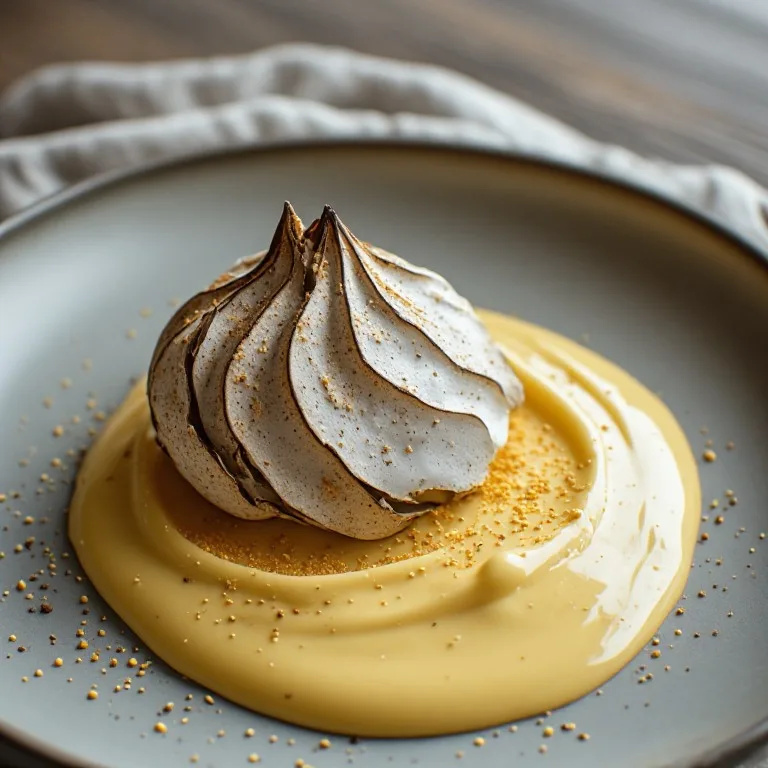
Cosme opened in the Flatiron district of Manhattan in October 2014, and its corn husk meringue has been on the menu ever since — one of the few dishes Enrique Olvera has never seen fit to remove. The concept came from a memory of a Mexico City pastry shop he visited as a child, translated by chef de cuisine Daniela Soto-Innes into something that had no precedent in any pastry kitchen: a French meringue colored and flavored with the charred ash of corn husks, shaped to look like a tamale husk folded over itself, and cracked tableside to reveal a mousse made from the sweet milk extracted from fresh corn kernels.
Olvera published the recipe in his cookbook Mexico from the Inside Out (Phaidon, 2015) — unusually transparent for a dish that had been on the menu less than a year. The technique is now one of the most-referenced modern Mexican dessert methods in professional pastry circles. Soto-Innes, who executed it at Cosme’s opening and refined it through hundreds of covers, won the World’s Best Female Chef award from the World’s 50 Best Restaurants in 2019.
The dessert at Cosme runs about $20. Four servings at home cost under $8 in ingredients. The published recipe is the one used here, adjusted for home equipment.
What the Corn Husk Powder Is Actually Doing
Standard French meringue is egg whites and sugar — a dessert that is entirely sweet, with no counterpoint. The corn husk powder introduces two things: color (the carbon from charring turns the meringue a warm beige-gray) and flavor (the Maillard compounds from the charred husks carry a subtle smokiness, like toasted popcorn with an earthy edge). In a dessert built on sweetness — sugar in the meringue, corn cream sweetened with more sugar, mascarpone — that faint savory, smoky note is what prevents the whole thing from becoming cloying. It also makes the meringue taste specifically of corn, rather than just sweet.
The reserved tablespoon dusted over the finished plate amplifies this. At Cosme, the finishing powder is what ties the meringue to the mousse visually and aromatically — the same charred husk note that runs through the shell appears again as a garnish.
The Corn Mousse: Why the Two-Step Build Matters
The mousse is built in two stages rather than one. The first stage — the cream of corn base — cooks the kernels in a mixture of milk and cream until soft, then blends and strains them, extracting a smooth, intensely flavored liquid from the milky starch inside each kernel. This is the critical step: blending raw corn into cream produces a starchy, slightly gummy result; cooking and straining it first produces a liquid that is smooth, clean, and much more intensely flavored. The cooking evaporates some water and concentrates the sugars.
The second stage folds a measured portion of that base into mascarpone (which adds richness and structure), then folds in whipped cream (which adds volume and lightness). The result is mousse — light enough to spoon but substantial enough to pool without immediately spreading. It holds its shape for about 30 minutes after plating, which is why it must be made day-of and assembled just before serving.
The Three Things That Determine Whether This Works
1. The 2-hour air-dry — not optional
Piped meringues that go directly into the oven develop an irregular skin: the heat sets the outside too quickly and the expanding interior cracks unpredictably. Two hours at room temperature allows a thin, uniform skin to form across the entire surface, so the low-heat bake can set the interior slowly and evenly without cracking. This step cannot be shortened by using a fan, a dehydrator, or a slightly warmer room. It requires 2 hours.
2. The 195°F bake — as low as your oven goes
Classic French meringues bake at 200°F to 225°F for stability and brightness. The Cosme recipe bakes lower — 195°F — because the goal is not a classic crisp meringue but something between chewy and crisp: set at the surface, with a slightly marshmallow-like interior. At 225°F, the meringues will become too dry and brittle. At 300°F (a common home baker’s shortcut), they will color and crack. If your oven’s minimum is 200°F, prop the door open about an inch with a wooden spoon to let some heat escape.
3. Fill at the last possible moment
The corn mousse is wet — it contains whipped cream and liquid corn base. Once it touches the base of a meringue shell, it begins dissolving the sugar in the shell from the inside. At 20 minutes, the base softens slightly but the structure holds. At 45 minutes, the base has dissolved enough that the meringue cannot support its own weight. Plate and fill immediately before bringing to the table.
The Cosme Dessert vs. Making It at Home
| Cosme | Homemade | |
|---|---|---|
| Price | ~$20 per dessert | ~$2 per serving |
| Meringue | Made daily in batches of 80+ | Batch of 4; can make day ahead |
| Corn mousse | Portioned to order | Made day-of; use within 4 hours |
| Filling method | Piped tableside by pastry team | Spooned or piped at home |
| Corn husk powder | Ground from house-dried husks | Dried tamale husks from Mexican grocery |
The restaurant’s volume means their pastry team builds rhythms — the shells are made in the morning, the mousse in the afternoon, the garnish applied tableside. The home version compresses this but preserves every element.