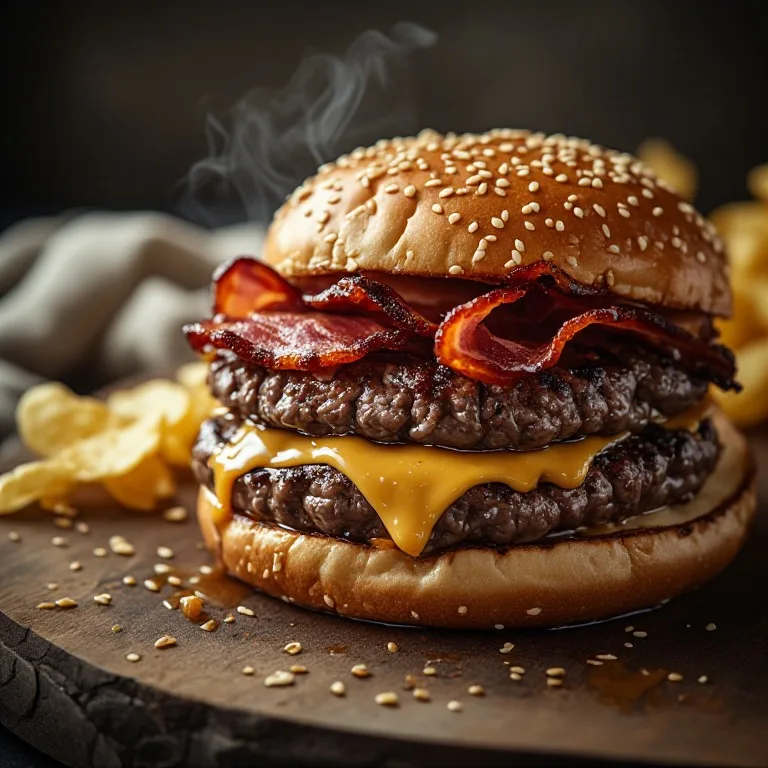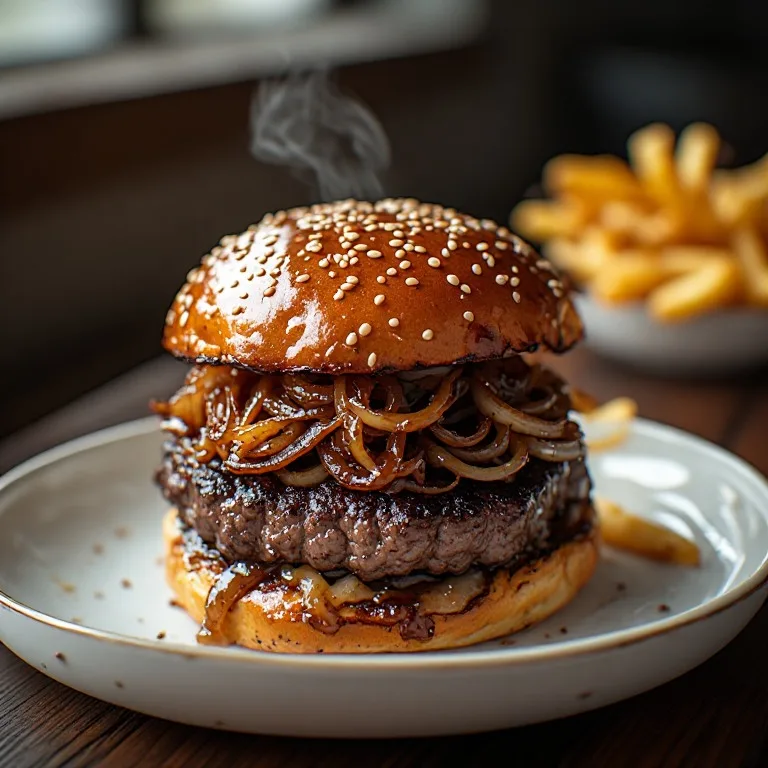



Copycat DB Bistro Burger (Daniel Boulud’s Sirloin Stuffed with Short Rib and Foie Gras)
Prep time: 45 min active (plus overnight braise cooling) Cook time: 4 hr braise + 10 min for the burger Yield: 4 stuffed burgers
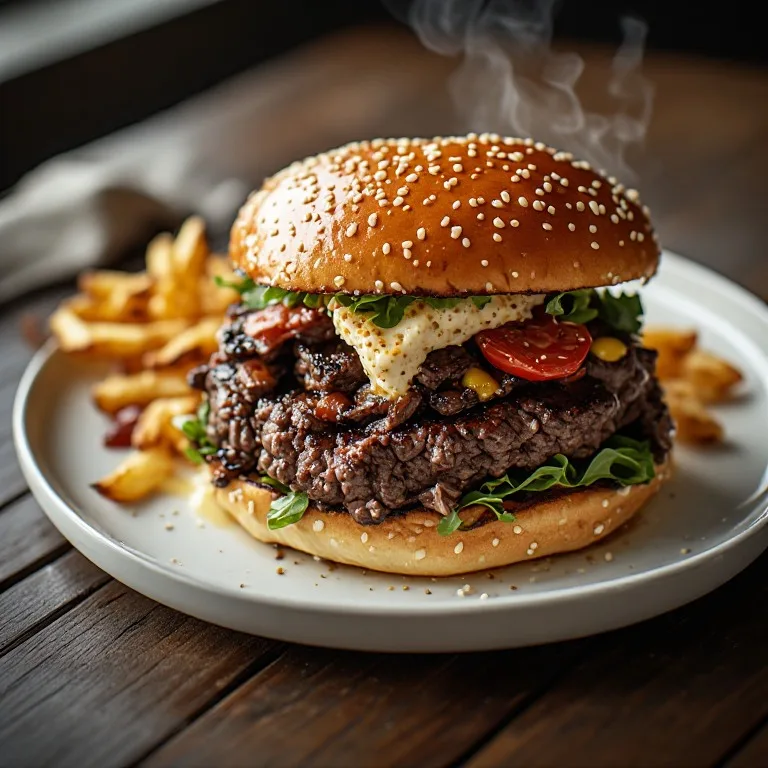
TL;DR: The DB Burger is a ground sirloin patty stuffed with a frozen disc of red wine-braised short rib meat wrapped around a core of foie gras torchon — then seared in a cast-iron pan and served on a Parmesan-crusted brioche bun with tomato confit, frisée, and whole-grain mustard. The process takes two days (braise and freeze the filling on day one, assemble and cook on day two) but each stage is straightforward. The key technique is freezing the filling solid before assembly — it is the only way to wrap sirloin cleanly around a soft center without the whole thing falling apart. This is an advanced recipe, not because any single step is complicated, but because the three-day original has been compressed into a two-day home version that still requires planning.
When Daniel Boulud put a $27 burger on the menu at db Bistro Moderne in 2001, half of New York’s food press thought it was a stunt. The other half waited two hours to try it.
The burger — ground sirloin stuffed with red wine-braised short rib and foie gras torchon, served on a Parmesan brioche bun with tomato confit and frisée — became the most influential restaurant dish of the decade. Not because it was delicious (it was), but because it permanently changed what American diners thought a burger could be. By 2004, Boulud had added fresh-shaved black truffle and raised the price to $59; a seasonal white truffle version hit $99. Every luxury burger that followed — from restaurant tasting menus to steakhouses to hotel dining rooms — was working in the shadow of this one.
Db Bistro Moderne at 55 West 44th Street in Midtown closed permanently during the COVID-19 shutdowns of 2020. The DB Burger still exists at DB Bistro & Oyster Bar in Singapore. In New York, you can only make it yourself.
The Three-Part Architecture
The DB Burger is not a single recipe but three recipes built into one:
The sirloin shell acts as a casing — lower fat than a standard 80/20 grind, so it holds together without shrinking excessively around the filling. Fresh-ground sirloin from a good butcher has the cleanest beef flavor, which matters because the exterior layer is competing with an extremely rich center and needs to taste like actual beef, not just fat.
The short rib and foie gras core is the center — braised short rib meat folded with its own reduced cooking liquid, wrapped around a disc of foie gras torchon, frozen into a cylinder, then sliced into patty-sized discs. The braised meat is rich, deeply flavored, and already cooked; the foie gras adds fattiness and a specific silky texture at the center that is unmistakable when you cut the burger open. The frozen disc construction is what makes the burger technically possible: there is no other way to embed a soft filling inside a raw patty cleanly.
The tomato confit is not an optional garnish. Raw tomato slices make a brioche bun soggy in 90 seconds; a raw tomato slice on a rich burger tastes like a cold, watery interruption. Tomato confit — roasted for 2.5 to 3 hours at 275°F until collapsed and jammy — has a concentrated sweetness and acidity that cuts through the richness of the filling. It sits firmly on the burger without releasing liquid. It is worth the three hours in the oven.
The Braise: Where the Flavor Lives
The short rib braise is the soul of this recipe. Four components matter:
The sear. Short ribs must be completely dry before they go into a hot pan, and the pan must be ripping hot before the meat touches it. A proper sear develops a deep mahogany crust that releases hundreds of flavor compounds (the Maillard reaction) — the same compounds that will eventually go into the braising liquid and come back to the shredded meat when you reduce and fold the liquid in. Skipping or rushing the sear produces a braise that tastes like boiled beef.
The red wine. Use a bottle you would actually drink — not expensive, but not acrid. Côtes du Rhône, Burgundy, or any full-bodied red without residual sweetness. The wine reduces during the braise and concentrates significantly; bad wine concentrates into bad braise. Two cups is correct — more than this and the liquid never reduces to the syrupy intensity you need.
The reduction. After the short ribs are done, straining and reducing the braising liquid to about 1/2 cup (from the original 4+ cups of liquid in the pot) is what transforms a competent braise into an extraordinary filling. The reduced liquid is intensely flavored, gelatinous from the collagen in the short rib bones, and almost like a demi-glace. Folding it back into the shredded meat glazes every strand of beef with that concentrated flavor. Do not skip this step and do not underreduce.
The fill-to-meat ratio. After reducing the braising liquid, fold only enough back into the shredded meat to make the mixture moist but holdable. If the filling is too wet, it will not hold its shape in the plastic wrap and will leak into the sirloin during cooking. Test by pressing a small ball of the mixture in your hand — it should hold together for 30 seconds without the liquid running out.
The Filling Cylinder: Technique Matters Here
Rolling the short rib mixture around the foie gras and freezing it is the most technique-sensitive step:
Lay the shredded short rib in a 2-inch-wide strip on plastic wrap. The foie gras goes in the center of the strip. When you roll the plastic, the short rib should fully encircle the foie gras with no gaps. The goal is a cylinder where the foie gras is completely enclosed by braised meat on all sides — not just on top and bottom.
After rolling, the cylinder should be uniform in diameter (about 2 inches) so that when you slice it into discs, each disc has the same cross-section: braised beef on the outside, a circle of foie gras in the center. Uneven cylinders produce uneven discs where the foie gras is off-center in some burgers.
Freeze the cylinder completely. When you slice it the next day, do so with a sharp chef’s knife in one clean motion — sawing produces uneven discs that may crack. The disc should look like a cross-section of a miniature roulade: braised beef ring around a foie gras center.
Assembling the Patty Without Tears
Ground sirloin at refrigerator temperature (35 to 40°F) is slightly firm and easy to work with. Take it out of the refrigerator, portion immediately, and flatten the first patty in under 60 seconds. Place the frozen disc in the center and bring the edges up quickly — the sirloin will start to warm in your hands almost immediately, and warm ground beef tears more easily when you are pressing it around a frozen object.
If the sirloin tears, press it back together firmly. Small gaps in the outer patty will cause the filling to leak during searing — not catastrophically, but enough to lose some of the foie gras and reduce the richness at the center. If you notice a gap during assembly, pinch the sirloin firmly across the gap and rotate the patty to check the entire perimeter.
After assembly, refrigerate the patties for 20 minutes before searing. This firms them back up and helps them hold their shape during the first minutes of cooking when the sirloin is warming toward searing temperature.
The Sear: Why This Burger Needs More Time Than You Think
A standard 6-oz flat burger at 3/4 inch thick takes 2 to 3 minutes per side at high heat for medium-rare. A DB Burger, assembled as described here, is roughly 1.5 inches thick with a frozen center. It needs 4 to 5 minutes per side.
This is not a problem — it is a feature. The slower cook gives the sirloin shell more time to develop a serious crust. The crust on the exterior of this burger should be deeply browned and almost crispy at the edges, the way a well-seared short rib exterior is. That contrast between the caramelized sirloin exterior and the yielding, braised-beef-and-foie-gras interior is part of what makes the burger what it is.
The only mistake to avoid: do not press the burger during cooking. Pressing squeezes the filling against the sirloin shell and can force gaps open at the seams. Set the burger in the pan and leave it completely alone until it releases on its own, which is the sign that the bottom crust has formed properly.
| Component | What it contributes | Common mistake |
|---|---|---|
| Sirloin shell | Clean beef flavor, structural casing | Using 80/20 — too much fat, casing shrinks and tears |
| Short rib filling | Rich, deep braised-beef flavor | Undereducing the braising liquid |
| Foie gras center | Silky richness, a liquid center when hot | Slicing too thin — disc disappears into the filling |
| Parmesan bun | Savory, slightly crispy contrast to the soft burger | Broiling too long — cheese burns rather than melts |
| Tomato confit | Sweet-acid cut through the richness | Raw tomato instead — makes the bun soggy immediately |
| Frisée | Bitter crunch, textural contrast | Skipping it — the burger needs something light and crisp |
| Whole-grain mustard | Tangy, textured sharpness | Yellow mustard — too sharp and one-note for this application |
Variations
The truffle version. Boulud added black truffle to the burger when he raised the price to $59. At home: add 1 to 2 tablespoons of finely minced preserved black truffle (or black truffle paste) to the shredded short rib mixture before rolling the cylinder. Fresh black truffle, shaved directly into the filling, is the restaurant version but expensive and seasonal. Preserved truffle works year-round. The truffle aroma diffuses into the braised beef during freezing and cooking — the result is subtle but distinct.
Without foie gras. The chicken liver mousse substitute described in the FAQ is the most reliable alternative. Another option: a disc of bone marrow butter. Take 2 oz of roasted bone marrow (scooped from the bone after roasting at 450°F for 15 minutes), whip with 1 oz of softened unsalted butter, season with salt and thyme, roll in plastic wrap, and freeze. Bone marrow is more neutral in flavor than foie gras but provides a similar fattiness and melting quality.
More accessible protein. Ground chuck (80/20) as the outer patty is more forgiving during assembly than sirloin because the fat content makes the beef slightly more pliable. The flavor is beefier but less clean. If this is your first time making a stuffed burger, chuck gives you more margin for error.
Tips for Success
- Make the braising liquid reduction the day before even if you are not braising that day — if you braise on day one and plan to assemble on day two, the reduction step can be done immediately after straining, before you go to bed. The reduced liquid and the shredded meat refrigerate separately and are combined when you form the cylinder.
- Weigh your sirloin portions to 6 oz each — a portion too small will not fully enclose the filling disc; a portion too large will make the sirloin shell excessively thick and require longer cooking, which dries the outer layer.
- Toast the Parmesan buns at the last possible moment. Broiled Parmesan softens quickly in steam — if you toast the buns and then let the burgers rest for 3 minutes before assembly, the buns will be slightly soggy by the time the burger lands on them. Time the bun broil so they finish at the same time the burgers come out of the pan.
- The frisée placement matters. The frisée goes under the burger on the bottom bun, not on top. This prevents the greens from wilting under the hot patty and also lifts the patty slightly, making the cross-section more photogenic when you cut the burger in half — the ring of braised beef visible through the sirloin shell, the foie gras center — is one of the most striking images in modern restaurant food.
Storage and Make-Ahead
The braised short rib filling cylinders (frozen and wrapped in plastic) keep for up to 2 weeks in the freezer. This is the main make-ahead leverage point: do the braise on a Sunday, freeze the cylinders, and you can make these burgers on any weeknight with only 30 minutes of active work.
Assembled raw patties (stuffed but uncooked) can be refrigerated for up to 8 hours or frozen for up to 1 week. If freezing assembled patties, cook from frozen — add 2 minutes per side to the cooking time.
Tomato confit refrigerates in its oil for up to 1 week.
The cooked burger does not reheat well — the sirloin shell dries and the filling separates from the interior. This is not a meal-prep recipe; make and serve immediately.
More NYC Restaurant Burgers and Fine-Dining Copycats
- Copycat Gramercy Tavern Burger — Danny Meyer’s flagship casual restaurant burger, with the specific dry-aged beef blend and house-made condiments that make it one of New York’s most consistently excellent
- Copycat Minetta Tavern Black Label Burger — the Pat LaFrieda dry-aged blend from Keith McNally’s West Village institution, cooked in a cast-iron pan the way the kitchen does it
- Copycat Peter Luger Porterhouse and Steak Sauce — the full reverse-sear porterhouse method, plus the two ingredients (anchovy paste, tamarind) that most copycat steak sauce recipes miss
- Copycat Carbone Spicy Rigatoni — the most-copied pasta in New York, made for about $8 a plate with the tube of tomato paste cooked until brick-red
- Copycat Rao’s Famous Meatballs — the specific three-meat blend and the no-breadcrumb technique behind the lightest, most tender meatballs from the hardest table in New York