

Copycat Din Tai Fung Cucumber Salad (The Famous One, Made at Home)
Prep time: 15 min (plus 30 min salt drain) Cook time: 0 min Servings: 2 to 3
Din Tai Fung started as a cooking oil store in Taipei in 1958. Yang Bing-Yi and his wife Pen-Mei Lai named it after their oil supplier and ran a retail shop on Xinyi Road. By 1972, cooking oil margins had collapsed and the business was failing. They cleared the shelves, installed four tables, and started selling handmade xiao long bao — soup dumplings — and noodles. That pivot turned a failing storefront into what the New York Times, in 1993, named one of the 10 best restaurants in the world.
The chain now operates across 13 countries. Its Hong Kong branch has earned a Michelin star five times. The first US location opened in Arcadia, California in March 2000. Yang Bing-Yi died in March 2023, at age 96, after more than 50 years of watching the business he saved with four tables become one of the most recognized restaurant names on earth.
The cucumber salad is not the restaurant’s signature dish — that is the xiao long bao, whose wrappers are weighed to exactly 5 grams and whose filling is precisely 16 grams, each piece folded into exactly 18 pleats. But the cucumber salad exemplifies the same principle: something simple, executed with enough care that the result is noticeably better than it has any right to be.
At home it takes 45 minutes, most of it idle salt-draining time, and costs under $2 for two servings.
Why the Salt Drain Matters
Most cucumber salad recipes treat salting as optional — a step you can abbreviate or skip if you are in a hurry. This recipe is not that forgiving.
Persian cucumbers are approximately 96 percent water by weight. That water is held in the cells, and when you cut the cucumber, you expose more surface area for it to escape. Without salting, the cut rounds start releasing liquid immediately after plating — the dressing dilutes, the cucumber softens, and within 10 minutes you have a wet salad that bears no resemblance to what Din Tai Fung serves.
Salting the cucumber rounds and letting them rest for 30 minutes draws that water out through osmosis before it reaches the dressing. The high external salt concentration creates a concentration gradient across the cucumber’s cell walls, and water moves outward to equalize it. You will see the liquid pool in the colander beneath the cucumbers — that is water that would otherwise have ended up in your dressing.
After rinsing and thorough drying, what remains is a more concentrated, more flavorful, crunchier cucumber that holds its texture for 30 minutes or more after plating. The salt-drain step produces a structurally different ingredient, not just a slightly saltier one.
Do not reduce the drain time. Thirty minutes is the minimum for meaningful moisture removal. Extended beyond 45 minutes, the cucumbers start to collapse; there is no advantage in a longer soak.
Persian Cucumbers: Why This Specific Variety
Din Tai Fung uses cucumbers — at US locations, consistently Persian cucumbers, the small, dark-green variety sold individually or in bags of six to eight. This is not interchangeable.
Persian cucumbers have three advantages over the alternatives. Their skin is thin and tender enough to eat without peeling, which keeps the rounds intact and allows the tower to stack cleanly. Their seed cavity is small and dry, meaning less internal water and better crunch after the salt drain. And they are denser and firmer than English cucumbers — they hold a clean edge when sliced and stack without sliding or crumbling.
English cucumbers (the long seedless ones shrink-wrapped in plastic) are the next-best option if Persian cucumbers are unavailable. Remove the seeds with a spoon before slicing if they are large and watery. American slicing cucumbers (the large, dark green variety common in grocery produce sections) have thick, bitter skin that should be peeled and a very large seed cavity — workable, but a meaningful step down in texture.
Whatever cucumber you use, look for firm ones without soft spots. A cucumber that feels even slightly soft in the center is already releasing water — it will be impossible to drain enough to get a good result.
The Dressing Breakdown
Din Tai Fung’s dressing is built on four flavor vectors: salt and umami from the soy sauce, brightness from the rice vinegar, sweetness from the sugar to balance the vinegar’s sharpness, and heat and depth from the chili oil and garlic. The sesame oil is an aromatic finish, not a structural ingredient — add it last and do not overwork it.
Light soy sauce. Use standard light soy sauce (regular soy sauce, not the “lite” or reduced-sodium version — “light” refers to color, not sodium). Dark soy sauce is aged longer, colored with molasses, and has a bittersweet, complex flavor that overwhelms the cucumber. Pearl River Bridge or Kikkoman light soy sauce both work.
Rice vinegar. Use unseasoned rice vinegar. Seasoned rice vinegar has sugar and salt added for sushi applications — it will throw off the balance of the dressing. Unseasoned rice vinegar provides clean, mild acidity that brightens without sharpness.
Chili oil. The distinction between clear chili oil and chili crisp matters here. Clear chili oil (S&B La-Yu is the most widely available, any bottle without visible solid components) produces the cleanest, most precise DTF result — heat and red color, no additional flavor compounds. Lao Gan Ma Chili Crisp (the most common product in the US, black-cap jar) adds fermented black beans, fried garlic pieces, and mushroom — a richer, more complex result that is excellent but slightly further from the source. Both are correct choices depending on what you have.
Garlic. Grate it on a Microplane. Grated garlic forms a paste that dissolves completely into the dressing; minced garlic leaves small pieces that concentrate in spots and can be harsh. The grated garlic is uniform and mild relative to its quantity. The raw garlic slices on top are a different element — a deliberate punch on the first bite of the tower.
The Tower Presentation
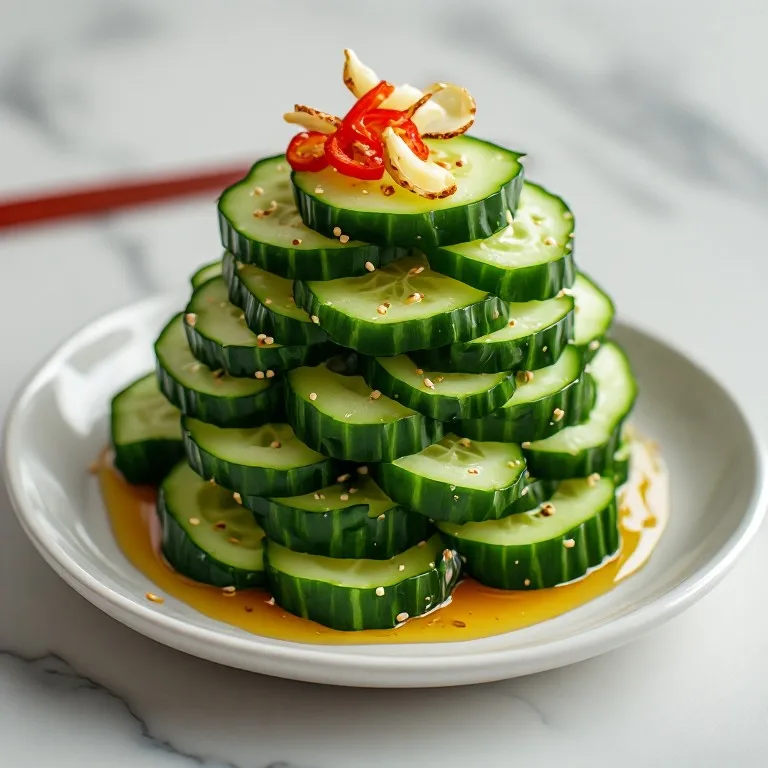
The stacked cylinder is the visual signature of DTF’s cucumber salad. It is easier to execute than it appears and requires no special equipment.
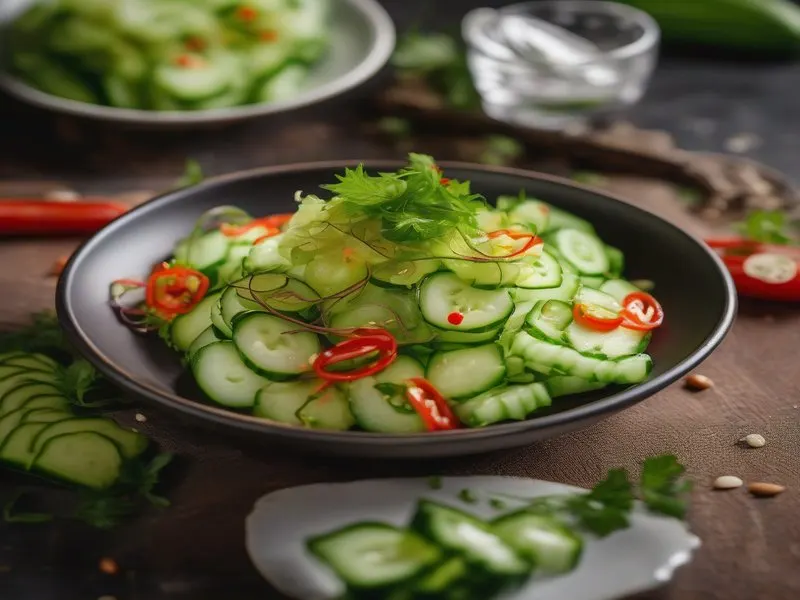
Work on a small, round plate — 6 to 7 inches is ideal. After the 10-minute marinade, lift the cucumber rounds with tongs or a fork rather than pouring — you want as little extra dressing pooled on the plate as possible. Start with a ring of rounds around the plate’s outer edge, each one overlapping the previous by about a quarter. The rounds will be slick, so press each one down gently before placing the next. Work inward with a second ring inside the first, repeating the overlap. Pile any remaining rounds in the center.
Spoon any remaining dressing from the marinade bowl over the assembled tower. Lay 2 or 3 paper-thin garlic slices across the top — shave them on a mandoline set to its thinnest setting, or use a very sharp knife held at a low angle. Finish with 2 or 3 thin rounds of Fresno pepper or red jalapeño for color.
Serve promptly. The tower will hold for about 10 to 15 minutes before the cucumbers continue releasing liquid and the structure softens. This is a last-minute plating, not an advance-preparation one.
Cost Comparison: Din Tai Fung vs. Home
| Din Tai Fung (US) | Homemade (2-3 servings) | |
|---|---|---|
| Price | $8–$12 | Under $2 |
| Wait | Often 30-90 min queue | 45 min including drain |
| Cucumber variety | Persian | Persian |
| Dressing | House recipe | Matched |
| Presentation | Precise cylinder | Achievable at home |
The queue at popular DTF locations — the Seattle University Village, the NYC Hudson Yards, and the LA Century City locations regularly run 45 to 90 minute waits — is longer than the recipe itself. Making it at home is not a consolation prize; it is the faster path to the same bowl.