Eleven Madison Park Honey-Glazed Duck
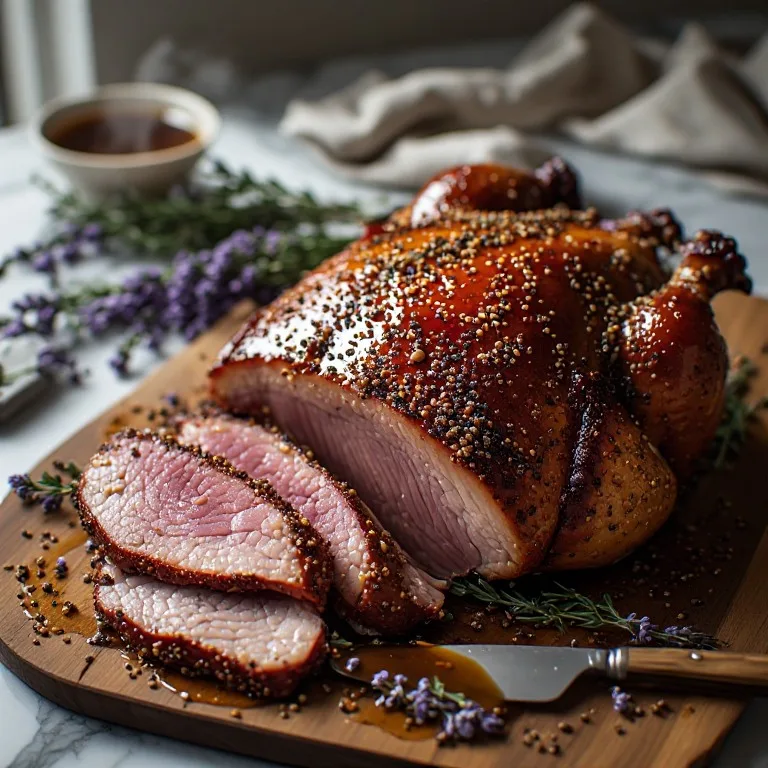
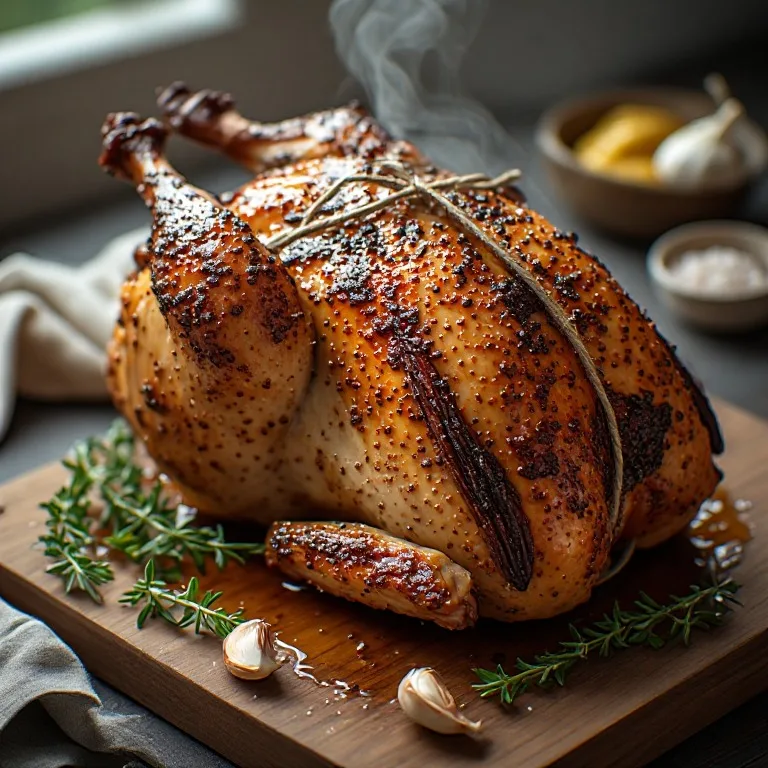
Quick answer: The day before: pat the duck completely dry, season generously inside and out with kosher salt (about 1½ tsp per pound), set on a rack over a sheet pan, and refrigerate uncovered for 24 hours — this is the home cook's substitute for EMP's 8-to-14-day dry aging, and it drives moisture out of the skin so it crisps instead of steaming. When ready to cook, make the spice rub: toast 1 tbsp Szechuan peppercorns, 1 tbsp coriander seeds, and 1 tsp cumin seeds in a dry skillet over medium heat for 90 seconds until fragrant, then grind coarsely with a mortar or spice grinder; stir in 1 tsp dried lavender buds and ½ tsp black pepper. Take the duck out of the fridge 45 minutes before it goes in the oven. Prick the skin all over (especially the thighs and breast) with a fork or skewer 20 to 30 times — this lets the subcutaneous fat render as it cooks instead of sitting under a soft skin. Rub the entire exterior with 1 tbsp neutral oil, then press the spice rub firmly over every surface. Roast on a rack in a roasting pan at 425°F for 20 minutes to blast the skin, then reduce to 375°F and continue roasting for another 40 to 45 minutes. Make the glaze: whisk ¼ cup lavender honey (or good floral honey) with 2 tsp warm water to loosen it. In the last 15 minutes of cooking, brush the duck generously with the honey glaze and return to the oven for 8 minutes; brush a second time and roast 7 more minutes until the skin is deep caramel-mahogany and the internal temperature in the thickest part of the thigh reads 160°F. Rest uncovered on the rack for 15 to 20 minutes. Carve at the table — the dramatic moment is part of the point.
Shop the tools
Gear matched to this recipe. These are Amazon affiliate links — we may earn a small commission if you buy, at no extra cost to you.
 Illustrative imageInstant-Read Digital ThermometerNail fry-oil and doneness temps every timeCheck price on Amazon →
 Illustrative imageKrups Electric Spice & Coffee GrinderFresh-ground spice blends — the Copycat Spices wayCheck price on Amazon →
 Illustrative imageLodge 10.25" Cast Iron SkilletThe restaurant-grade sear most copycats depend onCheck price on Amazon →
 Illustrative imageNordic Ware Half Sheet PanCommercial-quality aluminum, bakes dead evenCheck price on Amazon →
As an Amazon Associate, Copycat Spices earns from qualifying purchases. Product images are generic illustrations, not the exact item listed.
Eleven Madison Park Honey-Glazed Duck
Eleven Madison Park's lavender honey-glazed duck — the signature dish of the world's #1 restaurant, retired when EMP went plant-based in 2021 — made at home: whole Pekin duck, a Szechuan-coriander-lavender spice rub, and a double lavender-honey glaze that drives the skin to deep mahogany.
Medium
Prep: 30 min active (plus 24 hr uncovered in fridge)
Cook: 1 hr 15 min
Total: 25h 45m4 servings
~$4.50/serving
At home~$4.50/serving
vs
Restaurant~$20.25/serving
You save ~78%
The Story Behind the Recipe
Eleven Madison Park sits at 11 Madison Avenue in a landmarked art deco tower overlooking Madison Square Park. By 2017, Daniel Humm and Will Guidara had turned it into the number-one restaurant in the world on the World's 50 Best list — the first New York restaurant to hold that position. Three Michelin stars. A multi-course tasting menu that ran well over $300 a head. The kitchen and dining room operated as a single coordinated performance for every service.
The centerpiece of that performance, for nearly a decade, was the duck. Whole Muscovy ducks — air-dried for up to two weeks, rubbed with a warm Szechuan and lavender spice blend, glazed repeatedly with lavender honey until the skin turned deep amber — were wheeled to each table on a cart and carved by the server in full view of the guests. It was theater and craftsmanship at once. When EMP went fully plant-based in June 2021, the duck came off the menu permanently. The restaurant has experimented with reintroducing some animal proteins since 2024 as an optional track, but the original honey-glazed duck has not returned. This recipe recreates it at home, using a Pekin (Long Island) duck — widely available — in place of Muscovy, with a 24-hour salt-air cure standing in for the restaurant's extended dry aging. The spice blend and the glaze are the soul of the dish; the technique brings it home.
Nutrition Facts
Per serving (4 servings)Calories520
Total Fat34g
Total Carbs12g
Dietary Fiber0g
Sugars10g
Protein42g
Sodium590mg
* Estimated values based on standard recipe preparation. Actual values may vary.
Ingredients
- For the duck
- For the warm spice rub
- For the honey glaze
- Optional for serving
Instructions
Pro tip: This recipe tastes even better the next day. The flavors need time to meld together in the fridge.
Storage: Keeps in an airtight container in the fridge for up to 2 weeks. Freezer-friendly for up to 3 months.
Free PDF — instant download. We'll also send new seasonal copycat recipes now and then; unsubscribe anytime. Or just download it →
🎉 Your Thanksgiving Cookbook is ready!
It's free — but if it's worth something to you, you can pay what you want. It keeps the recipes coming.
$
✓ Downloading your free Thanksgiving Cookbook — check your downloads folder. Happy cooking!
Make It Healthier
Love Eleven Madison Park Honey-Glazed Duck but want a lighter version? Try these simple swaps:
- ✓Remove and discard the skin after resting before serving — roasted duck skin is delicious but accounts for roughly 150 of the calories per serving; the lean meat underneath is naturally lower in fat than most beef cuts.
- ✓Serve with roasted root vegetables (parsnips, carrots, turnips) rather than a starchy side — they soak up the pan drippings beautifully and keep the plate vegetable-forward.
- ✓Reduce the honey glaze to 3 tbsp instead of ¼ cup per bird — you lose a small amount of the caramelized depth on the skin but cut the added sugar from the glaze by about a quarter.
- ✓Duck fat rendered during roasting can be strained and saved in the refrigerator for up to a month to use in sautés and roasted potatoes — it is a byproduct, not waste, and extends the value of the bird.
Frequently Asked Questions
What is the difference between Muscovy duck and Pekin duck, and does it matter for this recipe?
It matters for the final flavor profile but not for the technique. Muscovy duck — the breed EMP used at the restaurant — is a large, lean, game-flavored bird with a muscular breast and minimal subcutaneous fat compared to Pekin. The breast meat has a slightly livery, iron-forward richness that can handle bold spices and aggressive glazing without tasting muddied. Pekin duck (also called Long Island duck), which is what you will find at most American supermarkets and butchers, has more fat under the skin and a milder, more approachable flavor. The fat difference is the main practical issue: Pekin requires more thorough fat-rendering during the cook (hence the pricking step), while Muscovy's leaner skin can handle higher heat more directly. For the home cook, Pekin is the correct call — it is widely available fresh, it responds beautifully to the spice rub and honey glaze, and it produces more rendered fat in the pan (useful for those roasted vegetables). If you can source Muscovy from a specialty butcher or farmers market, the flavor reward is worth the premium, but do not let its absence stop you from making the recipe.
What is lavender honey and where do I find it?
Lavender honey is produced when bees forage primarily on lavender blooms, giving the honey a distinctly floral, slightly herbal character that goes directly to the lavender note in EMP's glaze. It is sold at specialty food stores, Whole Foods, and farmers markets, particularly during summer and fall. Brands like Savannah Bee Company and Rigoni di Asiago produce widely distributed versions. If you cannot find it, the simplest substitute is ¼ cup of good clover or wildflower honey with ½ teaspoon of dried culinary lavender buds ground to a powder and stirred in — let it sit for 20 minutes before using to let the lavender infuse. The key is that the honey should be a good one: a floral, aromatic varietal (acacia, orange blossom, or Manuka all work) produces a noticeably better glaze than a neutral commercial honey. The honey forms the entire flavor foundation of the skin.
What is the point of the 24-hour air-dry step, and can I skip it?
The 24-hour uncovered fridge rest is not optional if you want crisp skin. Raw duck skin contains a significant amount of moisture — both surface moisture from handling and water bound within the skin itself. If that moisture is present when the duck hits a hot oven, it steams rather than fries, producing skin that puffs and steams rather than crisping and rendering. The uncovered rest in the fridge lets the cold, circulating air draw moisture from the skin surface continuously for 24 hours, dehydrating it to a state where it crisps within minutes of hitting heat. EMP's restaurant version went further — the birds were hung and aged for up to 14 days in a temperature-controlled environment with very precise airflow. That is not possible at home, but the 24-hour method achieves roughly 60 percent of the skin-texture benefit. If you genuinely cannot spare the time, a minimum of 4 hours uncovered in the fridge will help. At zero rest time, you are fighting physics and will get disappointing skin no matter how hot your oven is.
How should I carve a whole duck, and what is the EMP tableside carving ceremony?
At Eleven Madison Park, the duck arrived at the table on a rolling cart, still whole and rested, and was carved by a server using a long slicing knife with practiced, unhurried movements in full view of the guests. The breast was removed in two halves by cutting along the keel bone, then sliced against the grain into thick, slightly fanned pieces. The legs were separated at the joint, the thigh bone removed and discarded, and the leg meat presented alongside the breast. The carcass was often taken back to the kitchen to be pressed for a jus served on the side. For the home cook: rest the duck on a cutting board for at least 15 minutes — the juices need time to redistribute. Remove the legs first by cutting through the joint where they meet the body; the joint will give way cleanly once you find the socket. Then run a knife along each side of the keel bone to free the two breast halves. Slice the breast on the bias at a shallow angle for broad, even pieces. The leg and thigh can be served whole (it photographs beautifully) or the thigh bone removed and the meat cut into pieces.
Why did Eleven Madison Park go plant-based, and what happened to the duck?
In June 2021, Daniel Humm reopened EMP after its COVID closure as a fully plant-based restaurant — no meat, no fish, no animal products of any kind except honey. The decision was significant: Humm had built his reputation partly on the duck, on a famous prosciutto-wrapped chicken, on elaborate fish preparations. He said at the time that the pandemic had given him the space to think about what kind of restaurant he wanted to run, and that he wanted to demonstrate that fine dining could be exceptional without relying on animal proteins. The New York Times characterized it as 'a deeply personal and potentially career-redefining act.' Early reviews of the plant-based tasting menu were mixed — some critics found the food extraordinary, others found it a constrained showcase. Since late 2024, EMP has experimented with a hybrid approach, offering plant-based as the default with an optional supplemental meat and fish track for guests who request it. The original honey-glazed duck with its full tableside ceremony has not returned.
What should I serve alongside this duck for a Christmas dinner?
The pan drippings from roasting a duck are gold — deeply savory, richly flavored rendered duck fat with caramelized honey and spice residue. Roasted root vegetables (halved parsnips, whole shallots, thick carrot batons) placed in the roasting pan around the duck for the last 40 minutes of cooking will absorb those drippings and become the natural side dish. For starch, a celery root purée (roasted, then blended with butter or olive oil and cream until silky) echoes the fine-dining register of the dish without competing with the duck's spices. A bitter green salad with a sharp vinaigrette — frisée, endive, or arugula — cuts the richness of the meat. For the table: a simple red-wine jus made from the roasting juices (deglaze the pan with ½ cup red wine over medium heat, scraping up the fond, then strain and reduce by half) adds a sauce without requiring a separate effort. This combination — root vegetables, celery root purée, bitter greens, simple jus — is close to how EMP composed the plate.
Can I make this recipe with duck breasts instead of a whole duck?
Yes, and the method is actually more forgiving on duck breasts. Use 4 skin-on, bone-in duck breast halves (Moulard or Pekin, about 10 oz each). Score the skin in a crosshatch pattern with a sharp knife, cutting through the fat but not into the meat. Season the skin side with the spice rub and let rest uncovered in the fridge for 4 hours (a whole-duck overnight cure is too long for breasts). To cook: place the breasts skin-side down in a cold oven-safe skillet and turn the heat to medium. Cook undisturbed for 12 to 15 minutes as the fat renders and the skin crisps; the skin will turn golden and release cleanly from the pan. Flip and cook the flesh side for 2 minutes. Brush the skin generously with the honey glaze and transfer the pan to a 400°F oven for 5 to 7 minutes until the glaze is set and the internal temperature of the thickest part of the breast reads 130 to 135°F for medium-rare (rosy and tender) or 145°F for medium. Rest 5 minutes before slicing. The flavors are the same; the presentation is more weeknight-friendly.
The recipe calls for Szechuan peppercorns — what are they and can I substitute?
Szechuan peppercorns are not black pepper. They are the dried husks of a berrylike fruit from the prickly ash tree native to China, and their most distinctive quality is a tingling, slightly numbing sensation on the lips and tongue caused by a compound called hydroxy-alpha-sanshool. They also have a floral, citrusy quality entirely unlike black pepper. In EMP's spice rub, they contribute the tingle and the floral lift that bridges the warm earthiness of coriander and cumin toward the lavender in the glaze. Find them at Asian grocery stores, Whole Foods spice aisles, or online; they are inexpensive and keep for months in a sealed jar. If you truly cannot find them, substitute a 50/50 blend of black peppercorns and a small amount (½ tsp) of lemon zest, added off-heat after toasting — it approximates the citrus-floral quality without the numbing, which cannot be replicated. The result will still be a delicious spice rub; it will just taste different in a way EMP regulars would notice.
Love this recipe? Share it!
Made it? Buy us a coffee
Every recipe here is free, with no paywalls. If this one was a hit at your table, a small tip keeps new copycats coming.
$
💛 Support checkout is coming soon — the cookbook stays free either way.
Eleven Madison Park is a trademark of its owner, used here only to describe the dish this recipe recreates. This is an independent copycat written in our own words — Copycat Spices is not affiliated with, endorsed by or sponsored by Eleven Madison Park.
Ratings & Reviews
Rate this recipe
Click a star to rate