



Copycat Father’s Office Burger (LA’s Famous No-Ketchup Burger, Made at Home)
Prep time: 20 min Cook time: 60 min (mostly unattended compote) Servings: 4
Sang Yoon opened Father’s Office in 2000 at 1018 Montana Avenue in Santa Monica, taking over a shuttered neighborhood bar that had operated under that name for decades. He kept the name, installed 36 draft taps with a beer list that was genuinely unusual for Los Angeles at the time — Belgian ales, German lagers, regional American craft — and put the burger on the menu with a rule: no substitutions, no ketchup, no modifications of any kind.
The Los Angeles food world spent the next several years writing about the rule. Esquire called it one of the best burgers in the world. Chefs across the country replicated the no-substitutions format for their own composed dishes. Yoon opened a second location in Culver City in 2011. The burger still carries the rule, and the rule still generates coverage.
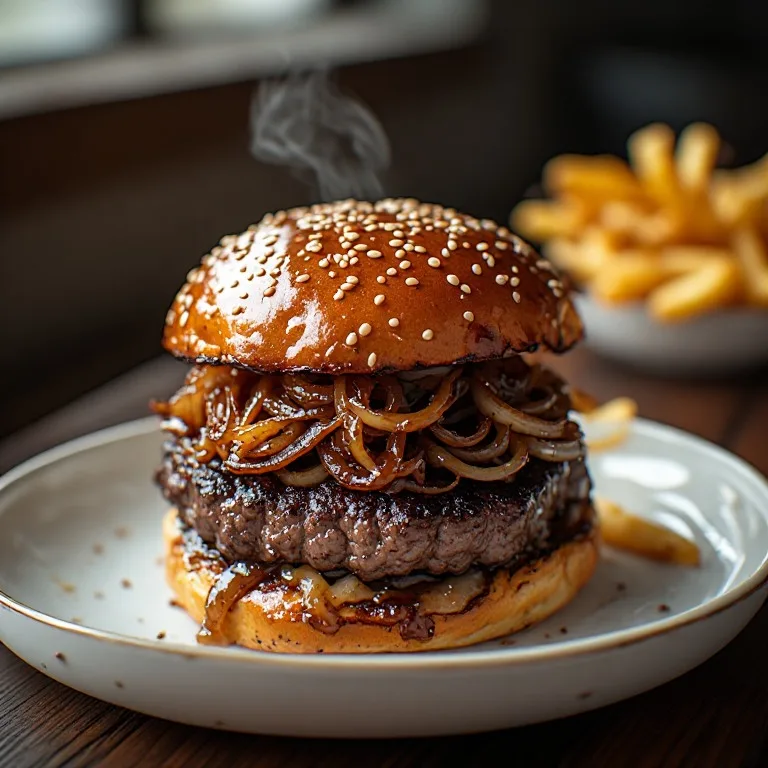
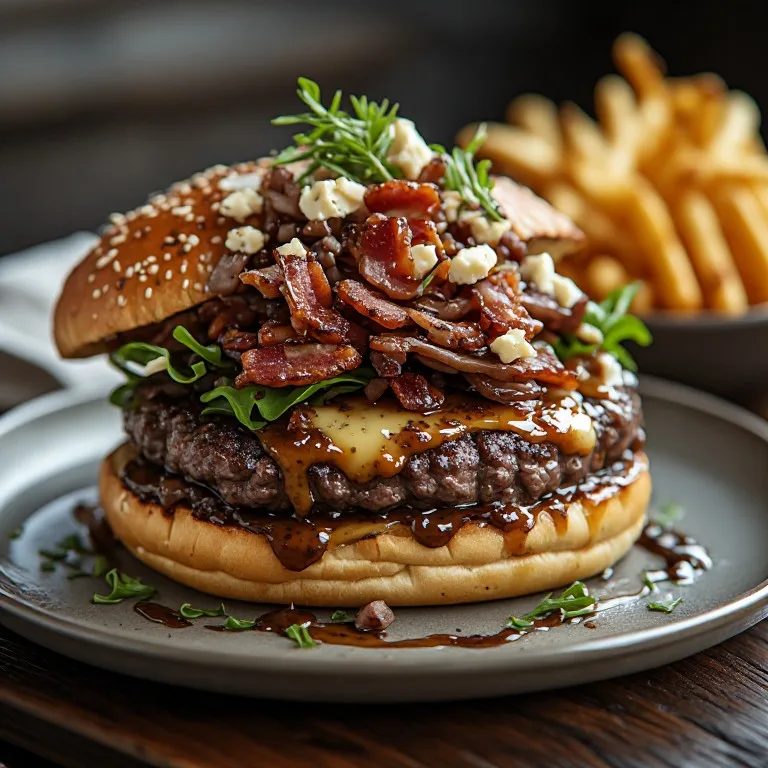
What the coverage sometimes underplays is why the rule is defensible: the burger genuinely does not need ketchup. The caramelized onion and bacon compote — 45 minutes of slow-cooking with a balsamic finish — provides the sweetness and savory depth that ketchup delivers on lesser burgers. The blue cheese provides the salty punch. The arugula provides the peppery lift. The burger is a composed system, and ketchup would break the balance rather than add to it.
The Caramelized Onion and Bacon Compote
This is the element that takes the longest and that the burger most depends on. Three large yellow onions — slowly cooked for 45 to 55 minutes in a combination of butter and rendered bacon fat — reduce to a dark golden, intensely sweet, almost-sticky heap. The balsamic vinegar deglazes the pan in the final 2 minutes, taking the residual fond off the bottom and concentrating into the onions themselves.
The bacon gets chopped and folded back in at the end. The finished compote tastes like French onion soup filling — sweet, savory, smoky, rich — and it does the work of several condiments at once. It is why the burger does not need ketchup, mustard, or aioli.
Two practical notes. First, use a wide pan — a 12-inch cast iron or stainless skillet. The onions start as a large pile and need room to release their moisture and shrink evenly; a smaller pan will steam them into a pale, soggy mass instead of caramelizing them properly. Second, do not rush the heat. Medium-low and patient wins. If the onions are browning faster than they are softening, the heat is too high — add a tablespoon of water and stir.
The Cheese Combination
Every successful burger has a theory about fat and salt. Father’s Office answers the question with two cheeses at opposite ends of the flavor spectrum.
Gruyère melts smoothly — it is one of the best-melting cheeses — and its flavor is nutty and mild, almost buttery. It functions as a creamy layer that pools into the seared crust of the patty and softens the transition between the beef and the sweet compote above it. The blue cheese — Point Reyes Original Blue in the recipe Yoon has shared, though Maytag Blue is the long-assumed and equally good substitute — stays in crumbles rather than fully melting; its flavor is pungent, aggressively salty, and funky in the blue-cheese tradition. It is the spike in the flavor profile — without it, the burger would be only rich and sweet. Together, they build the flavor architecture: richness from the rib-eye and Gruyère, edge from the blue and arugula, sweetness from the compote.
The proportion that works is roughly equal parts by weight — 1 oz Gruyère and 1 oz blue cheese per burger. Less blue and the burger tilts entirely sweet. More blue and it becomes aggressively funky.
The Baguette, Not a Round Bun
Father’s Office serves the burger on a section of soft brioche baguette — about 6 inches, split lengthwise and toasted cut-side down in butter. This is not an affectation. The baguette section holds the compote and patty stack better than a round bun: the firm walls support the weight of a generous heap of caramelized onions and bacon without collapsing, and the lengthwise split gives you a structural container rather than a lid-and-bottom sandwich.
At home, use a soft brioche baguette — not a hard French baguette, which would be too crusty and tooth-fatiguing for this application. Most good bakery departments sell them. Cut into 6-inch sections, split each lengthwise, and toast cut-side down in a buttered skillet until golden. The butter-toasted interior is part of the flavor.
The Beef
Yoon uses a dry-aged NY strip and rib-eye blend — ground beef made from two premium steak cuts rather than chuck. Strip contributes a dense, clean beefiness; rib-eye contributes fat and a rich, buttery quality. Dry-aging concentrates both flavors by removing moisture.
For home cooks, the best option is a butcher shop that sells fresh-ground blends. Ask for a coarse grind of NY strip and rib-eye, roughly equal parts. If dry-aged is available, take it — the flavor difference is meaningful. If not, fresh-ground is still well ahead of pre-packaged grocery-store beef.
The patties are oval — shaped to match the baguette — and cooked to medium (140 to 145°F). Father’s Office does not offer the choice of doneness for the same reason it does not offer modifications: the burger is a specific composed dish, and medium is the intended temperature.
Why This Burger Matters
Father’s Office is credited by food writers and restaurant critics as one of the foundational moments of the American gastropub movement. Before it opened, Los Angeles did not have the concept of a serious bar kitchen attached to a serious beer list. The restaurant demonstrated that bar food could be composed and precise rather than utilitarian, that craft beer deserved the same attention as wine, and that a kitchen could hold to a composed vision of a dish rather than accommodating every customer’s modification requests.
The imitators are everywhere now — Gruyère-and-blue-cheese burgers on brioche baguettes at gastropubs from Chicago to Brooklyn to Austin. Most of them trace back to this building on Montana Avenue.
The Father’s Office burger at the restaurant costs around $18 to $20. At home, with good sourced beef and Maytag blue from a cheese counter, you land at roughly $9 to $12 per burger. Make the compote on Sunday and you have four weeknight burgers that take 15 minutes each to assemble.