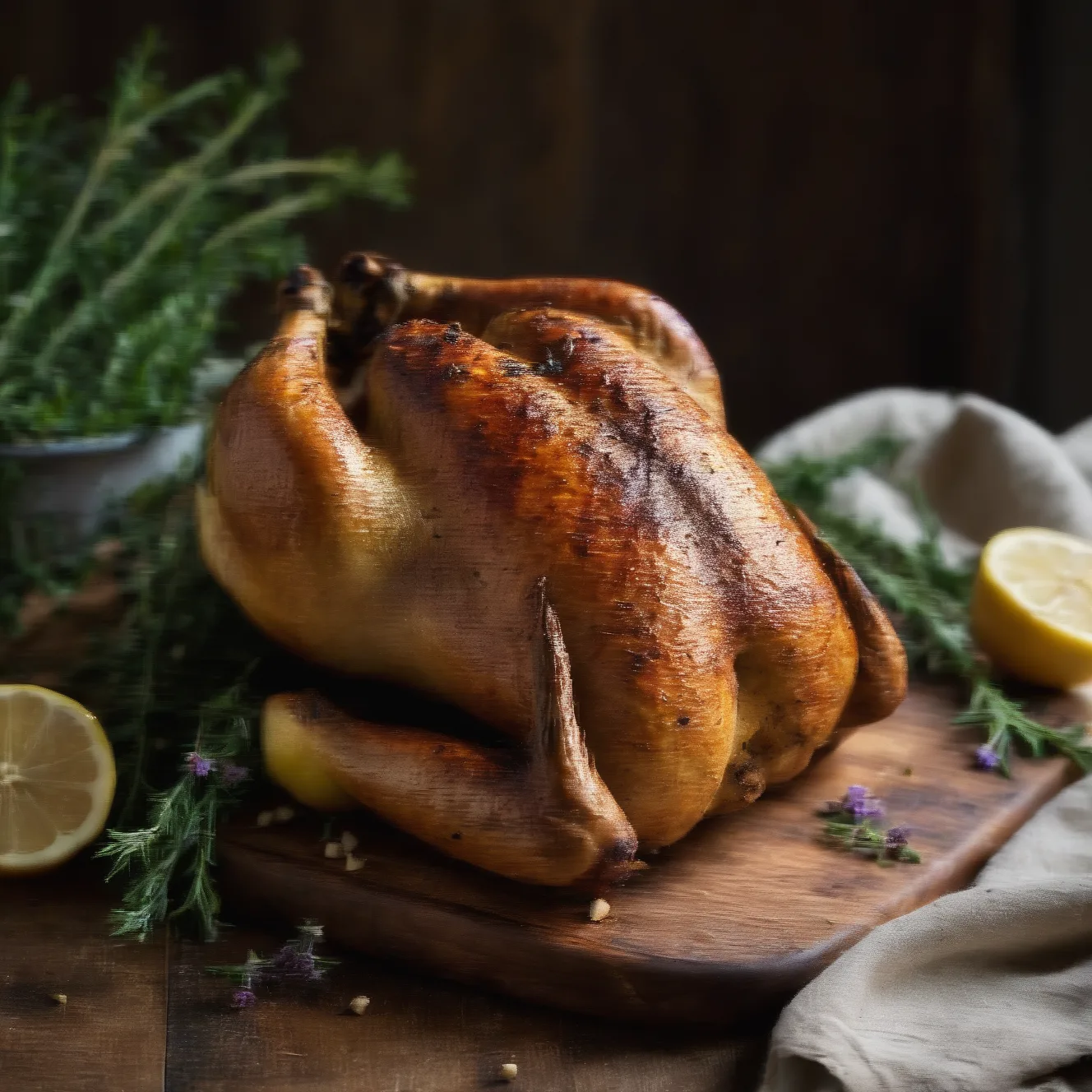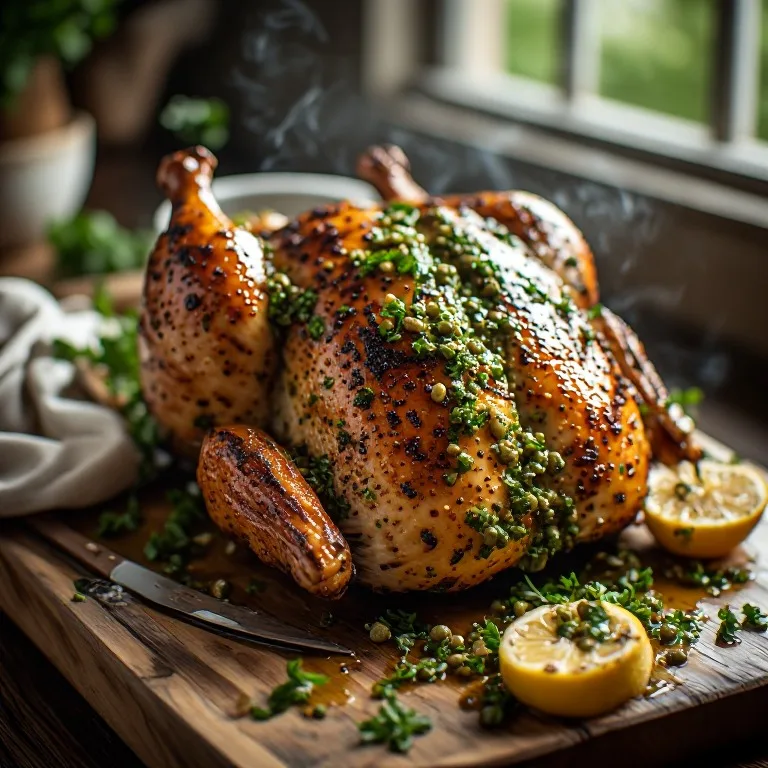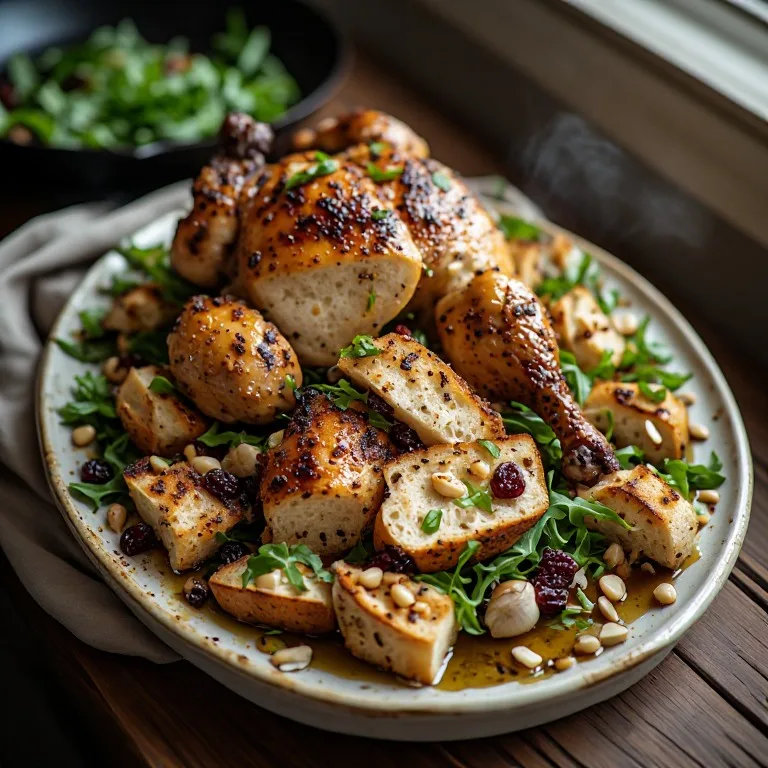



Copycat Zuni Café Roast Chicken with Warm Bread Salad (The Judy Rodgers Technique, Made at Home)
Prep time: 20 min active + 1–3 days dry brine Cook time: 55 min Servings: 4 Difficulty: Medium
TL;DR: Salt a small fryer chicken under the skin — herbs, sliced garlic, and kosher salt — and refrigerate it uncovered for 1 to 3 days. Roast at 475°F in a preheated cast-iron skillet using a three-stage flip sequence (20 min breast-up, 15 min breast-down, 20 min breast-up) until the skin is lacquered and the thigh reads 160°F. While it rests, toast torn peasant bread under the broiler, dress it with a Champagne vinegar vinaigrette and currants and pine nuts, then pour the hot pan drippings directly over the bread — the drippings are the dressing. Toss with peppery greens and serve under the carved chicken. The advance salt is not optional. Everything else is.
In the entire catalog of iconic American restaurant dishes, Zuni Café’s roast chicken may be the single most influential. Judy Rodgers installed a brick oven when she became chef and partner at Zuni in 1987, and within a few years the dish she built around it — a small fryer seasoned days in advance, roasted fast in cast iron, served over a warm bread salad saturated with rendered chicken fat — became one of the most written-about and most copied recipes in American food culture.
At the restaurant on Market Street in San Francisco, the chicken is roasted to order in the brick oven and takes about an hour — you order it when you sit down, and it arrives as one small bird plated over the warm bread salad, meant for two. The roast chicken alone costs more than a week’s worth of groceries for the same dish at home.
What Rodgers discovered, and documented in the 2002 Zuni Café Cookbook, was a technique so specific and so counterintuitive that most home cooks still skip the critical step: the advance salt.
The 1-to-3-Day Advance Salt Is the Entire Discovery
This is not seasoning. This is not brining. This is a physical process Rodgers identified through years of cooking the dish: when you salt raw chicken under the skin — not on the surface, under it — and leave it uncovered in the refrigerator for long enough, something changes in the muscle tissue.
The salt draws moisture out in the first several hours. If you roast the chicken now, you have dried the surface at the cost of the interior. But leave the chicken another 24 to 48 hours and the muscle reabsorbs that salty moisture back into the fibers. The thigh meat, which normally requires aggressive seasoning to reach the interior, ends up seasoned from inside. Not just the surface. Not the subcutaneous fat layer. The meat itself.
The second effect of the long refrigerator rest is skin drying. Uncovered chicken in a refrigerator for 24 to 72 hours loses surface moisture steadily. The skin becomes papery and tight. That dry skin goes into a 475°F oven and crisps — not steams. Wet skin from a freshly unwrapped chicken steams in the initial minutes of roasting and ends up flabby regardless of the oven temperature.
| Same-day salt | Day-before salt | 1-to-3-day advance salt | |
|---|---|---|---|
| Interior seasoning | Surface only | Light penetration | Full muscle penetration |
| Skin condition | Wet | Partly dried | Papery, fully dried |
| Skin texture after roasting | Soft to flabby | Better, some crisp | Deeply crisped |
| Recommended | No | Acceptable | Yes — this is the technique |
Small Bird, Cast Iron, 475°F
The pairing of a 2¾ to 3½-pound fryer with 475°F heat is deliberate. A larger bird at this temperature burns on the outside before the thigh cooks through. A small bird at 350°F produces even cooking but without the intense skin crisping. The combination — small, high, fast — is what produces the Zuni result: a deeply bronzed exterior that looks nearly lacquered, with moist, well-seasoned meat inside.
The cast-iron skillet is part of the technique for two reasons. First, cast iron preheated to 475°F gives the chicken immediate bottom heat the moment it goes in — the underside begins to crisp from the first contact rather than sitting on a cool rack. Second, the 10-inch size keeps the chicken close to its own rendered fat as it drips into the pan, effectively basting the bottom from below throughout the cook. The drippings pool in the pan rather than burning off on a large sheet pan.
No rack. No trussing. No basting. The chicken goes directly into the hot dry pan.
The Flip Sequence
Rodgers’ three-position roasting is not fussy — it is functional. Breast-side up first to start drying the skin; breast-side down for the middle stretch so the breast meat cooks from below and the pooled drippings baste it; breast-side up again for the final 20 minutes to crisp the breast skin before serving.
The combined effect is evenly cooked meat with no dry patches and no raw spots near the backbone, which is the failure mode of most single-position high-heat roasting.
The Bread Salad Is the Dish
Saying the roast chicken is the dish at Zuni is technically true and also incomplete. The bread salad that accompanies it — warm, chewy, charred in spots, dressed in rendered chicken fat — is why people remember this meal.
The technique is not complicated, but it requires understanding what each component is doing:
The bread is torn, not sliced, so the pieces are irregular — some surfaces are flat and will char quickly under the broiler; some are ragged and hold dressing in their pockets. The contrast between the very crisp outside and the still-soft inside of each piece is why the salad has texture that a crouton-dressed salad doesn’t.
The currants are plumped in a separate vinegar-and-water soak before they go in, which doubles their flavor: they absorb red wine vinegar as they rehydrate, becoming small pockets of tart sweetness that pop against the richness of the chicken fat and the earthiness of the pine nuts.
The pan drippings are the primary dressing. The Champagne vinegar vinaigrette pre-dresses the bread, but what makes the salad taste like Zuni is what comes next: tilting the cast-iron skillet and pouring every drop of rendered fat and concentrated roasting juices directly over the dressed salad. A single 3-pound fryer at 475°F for 55 minutes produces a substantial quantity of golden, intensely flavored drippings. None of it goes down the drain.
The greens — arugula, frisée, or red mustard — go in last, after the hot drippings, so they barely wilt. Their bitterness cuts the richness of the fat and keeps the salad from feeling heavy.
What You’re Making at Home vs. What Costs $80 at Zuni
Zuni Café at 1658 Market Street in San Francisco is still open in 2026. The roast chicken — still on the menu, listed as “Zuni Roast Chicken for Two with Bread Salad” — is served at dinner Tuesday through Sunday. Because it’s roasted to order and takes about an hour, you order it when you sit down. The dish runs around $72 for the chicken-for-two over the bread salad (it was $49 in earlier years); a full dinner for two with wine and sides lands closer to $150 to $200.
At home, a 3-pound fryer costs $8 to $12 depending on whether you buy conventional or free-range (free-range birds at this size are worth it for the flavor concentration). The bread salad ingredients add another $6 to $10. The technique costs a day or two of advance planning.
The gap in result is narrower here than it is with most restaurant copycats. Zuni’s roast chicken is not expensive because of rare ingredients or elaborately trained technique — it is expensive because it is Zuni Café, and Zuni Café is Zuni Café. The recipe has been published, adapted, and reproduced thousands of times in the 24 years since the Zuni Café Cookbook came out. The technique is documented in detail. The home version is genuinely the same dish.
For other famous restaurant mains worth recreating at home: the Nobu black cod miso is the same category of iconic restaurant dish with a published technique (the miso-sake marinade is well-documented), and the Carbone spicy rigatoni occupies the same aspirational-downtown-table territory. For a different interpretation of roast chicken at home, the Boston Market rotisserie chicken uses a contrasting approach — lower heat, longer cook, no bread salad — and covers the comparison in detail.